
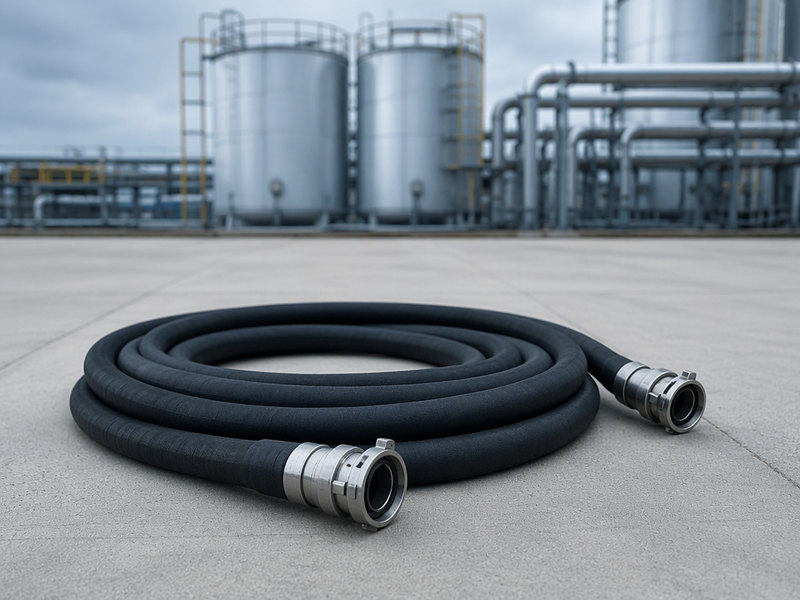
Choosing a chemical plant hose means matching one assembly to the exact duty at each transfer point: tank farm, railcar and tanker unloading, reactor charging, drum and tote transfer, and sump or waste lines. Match four things in this order: the transfer point, the liner, the structure, and the electrical grade. Then control the static, the inspection discipline, and the containment around that choice.
This page is written for plant maintenance and process engineers who already know the chemistry and need the operating rules instead. It covers which transfer points need bonding and grounding, how often to inspect, when to retire a hose, and how to stage containment before the first drum moves. The rules below follow EN 12115:2021, the European standard for rubber and thermoplastic chemical hose and hose assemblies, together with OSHA practice for bonding and grounding.
About a 16-minute read at 250 words per minute; covers in-plant transfer points, bonding and grounding, inspection intervals, and spill readiness.
What a Chemical Plant Hose Has to Survive In-Plant
Few pieces of plant equipment work as hard as a chemical plant hose. It is dragged across grating, drenched in washdown water, charged with aggressive media, and expected to fail safely if it fails at all. The real service conditions are harsher than a catalog figure suggests, because the hose meets heat, abrasion, chemical attack, and static charge at the same time.
Duty changes from point to point. A manifold hose may sit idle for days and then run at full flow during a single unloading. A reactor charging line may see short, frequent pulses of hot solvent.
A sump line may run almost continuously on dilute mixed waste. Selection starts with the transfer point, because the same bore can see idle days, hot pulses, and continuous waste duty.
Map every duty before choosing a construction. Five transfer points cover most in-plant work: tank farm manifold, railcar and tanker unloading, reactor charging, drum and tote transfer, and sump and waste lines. Table 1 sets out what each one demands and the question to ask first:
Table 1. In-plant transfer points, typical media, and the primary demand each one places on a hose (planning guidance).
| Transfer Point | Typical Media | Primary Demand | First Question to Ask |
|---|---|---|---|
| Tank farm manifold | Acids, caustics, solvents | Broad chemical coverage, long idle periods | Which fluids share the line? |
| Railcar and tanker unloading | Bulk solvents, acids | Static control, high flow, weather exposure | Is the vessel conductive and grounded? |
| Reactor charging | Solvents, oxidizers, reagents | Temperature and chemical fit, short pulses | What is the worst temperature? |
| Drum and tote transfer | Concentrates, additives | Flexibility, small bore, frequent handling | How often is the hose moved? |
| Sump and waste lines | Dilute mixed waste | Abrasion, continuous service, low pressure | Is the duty suction or discharge? |
Treat Table 1 as a first pass. The transfer point, liner, static, inspection, and containment sections that follow decide the final specification.
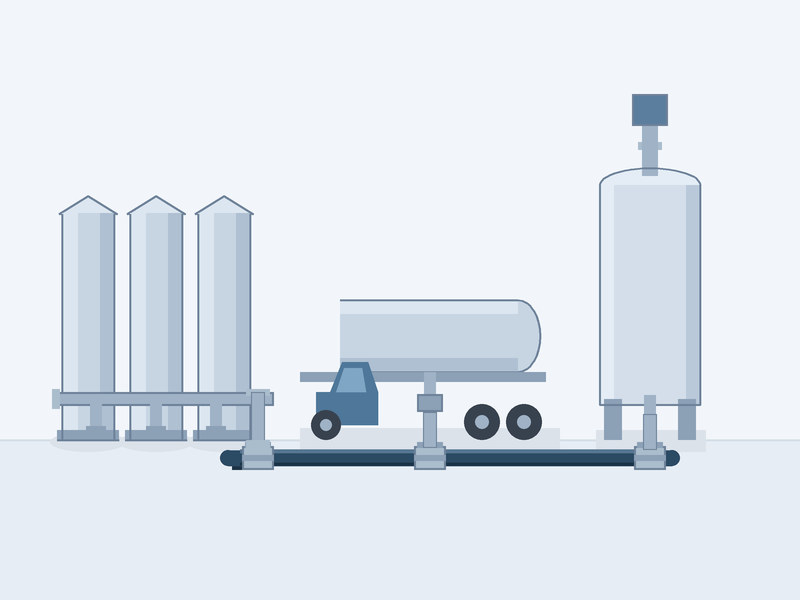
Figure 1. One hose run serving three of the in-plant transfer points: a tank farm manifold, a tanker connection, and a reactor charging port.
Which In-Plant Transfer Points Need Their Own Hose?
The transfer point sets the structure before the material does. A line that must pull liquid from a tank, a sump, or a low drum needs a suction-rated construction, because a hose without internal support collapses under vacuum. A line that only pushes fluid away from a pump is a delivery type and needs no helix. EN 12115:2021 names these two forms directly: Type D for delivery, and Type SD for suction and delivery.
A transfer point needs its own hose when its fluid family, its duty, or its static grade differs from the point next to it. A shared hose has to carry the narrowest compatible liner of the two, and it is retired on the condition of the worst fluid it ever saw. That is why plants commonly keep a dedicated assembly at the points that switch between chemical families.
Every rubber or thermoplastic chemical transfer hose in a plant belongs to one of those families, and the choice follows the pump and the vessel, not the fluid alone. Bore sizes for these duties cluster in a narrow band: 3/4 in, 1 in, 1-1/4 in, 1-1/2 in, 2 in, 3 in, and 4 in. Drum and tote work sits at the small end, while tank farm and unloading lines sit at the large end.
To fix a size against flow instead of habit, work through the hose size selection guide.
For a closer look at when the reinforcement must resist collapse rather than pressure, the comparison of suction versus delivery hose construction explains the internal helix in more detail.
Pressure rarely drives the choice inside a plant. Common grades are 150 PSI (about 10 bar), 16 bar, and 17 bar, and EN 12115:2021 constructions are rated 10 bar across a −20 °C to +65 °C band. Burst pressure runs about three to four times the working figure, which is planning data rather than a service target. Where a plant line does see high pressure, check the pump setting before the hose grade: the pressure at the hose is the number that matters.
Matching Liner Material to the In-Plant Duty
Material selection follows chemistry first and temperature second. A liner that swells, hardens, or cracks in the medium will fail no matter what pressure it is rated to carry. Table 2 lists the liner families used in plant service, their continuous temperature windows, and the boundary that decides where each one stops.
Table 2. Liner material, continuous temperature window, and in-plant boundary (planning values).
| Liner | Temperature Window | In-Plant Boundary |
|---|---|---|
| PTFE | −70 °C to +260 °C | Broadest chemical inertness. First choice for mixed or unknown media and for the widest temperature window; molten alkali metals and elemental fluorine fall outside any standard liner. |
| UHMWPE (UPE) | −40 °C to +120 °C | Wide industrial coverage at moderate cost; for strong oxidizing acids and for hot aromatics, specify PTFE instead. |
| XLPE | −40 °C to +100 °C | First choice for acids, caustics, and hypochlorite; for aromatic solvent duty, specify PTFE. |
| EPDM | −40 °C to +120 °C | First choice for acids, bases, ketones, alcohols, and steam; where petroleum oil can reach the liner, specify an oil-resistant rubber (NBR). |
| Oil-resistant rubber (NBR) | −30 °C to +100 °C | First choice for petroleum oils and fuels; for ketones, esters, and strong acids, specify XLPE or PTFE. |
| FKM | −20 °C to +200 °C | First choice for hydrocarbons and hot acids; for hot bases, ketones, and amines, specify PTFE or EPDM. |
Read Table 2 as a boundary map: each row shows the duty its liner is specified for, and the next liner takes over where that row ends. UHMWPE covers a very wide share of industrial chemicals, and manufacturer data sheets commonly state that a UHMWPE liner handles about 98% of them, but the remaining fraction includes strong oxidizing acids and some hot aromatics.
XLPE suits oxidizing media such as hypochlorite, while aromatic solvents call for PTFE. EPDM tolerates steam and many acids, while a trace of petroleum oil calls for an oil-resistant rubber.
In-plant duty attacks the cover as well as the liner, and the cover is commonly a different compound from the liner, with its own and often narrower chemical range. Wipe off a drip, a spill, or a washdown splash before the hose goes back to the rack, and specify a cover compound for the fluids that actually reach it.
For the wider picture of how a liner is chosen from the chemistry alone, see the fluid compatibility chart for NBR, EPDM, and FKM and the general flexible hose materials guide.
Structure follows the liner material. A suction duty, or a combined suction-and-delivery duty, needs a steel helix inside the wall to resist collapse. The XLPE suction and discharge construction is one example, and the 17 bar XLPE suction and discharge spec sheet sets out its layers in full. A plain delivery hose omits the helix and stays lighter and more flexible.
Do You Need Bonding and Grounding at Every Transfer?
Static charge builds whenever a low-conductivity fluid moves through a hose, so a plant that moves solvents cannot treat grounding as optional.
Two separate actions protect a transfer. Grounding ties the equipment to earth, and bonding ties two conductive parts to each other at the same potential. The order matters: connect the ground first, then bond the hose to the vessel, and break the connections in reverse when the transfer ends.
A non-conductive container (a plastic drum or carboy) needs more than ordinary grounding, because the charge has no path to follow. The common practice is a grounded metal dip tube or a grounded rod that reaches into the liquid. Slow the transfer and avoid splashing, since a free-falling stream generates far more charge than a submerged inlet. Where a small container holds a flammable liquid and its volume is four liters or less, bonding may be omitted, but the decision should follow a written procedure rather than habit.
Chemical hose safety at this step rests more on procedure than on the hose itself. Choose a conductive or antistatic grade, confirm its electrical resistance against the EN 12115:2021 grading, and re-check the clamps and the grounding path at every setup. A conductive hose sitting on an ungrounded vessel still has nowhere to send its charge.
Make each connection on bare metal. Paint, scale, and rust insulate the clamp face, so a lead that looks connected can still be the weakest point in the path.
The bonding and grounding sequence has five steps, in this order, and each one exists for a reason:
Table 3. Bonding and grounding sequence for a flammable-liquid transfer, with the reason for each step.
| Order | Action | Reason |
|---|---|---|
| First | Ground the receiving vessel | Gives charge a path to earth before flow starts |
| Second | Bond the hose to the vessel | Keeps both parts at the same potential |
| Third | Start the flow slowly | Limits charge generation at the inlet |
| Fourth | Keep the inlet submerged | Avoids splashing and flammable mist |
| Fifth | Stop the flow, break the bond, then the ground | Removes the last spark path in a safe order |
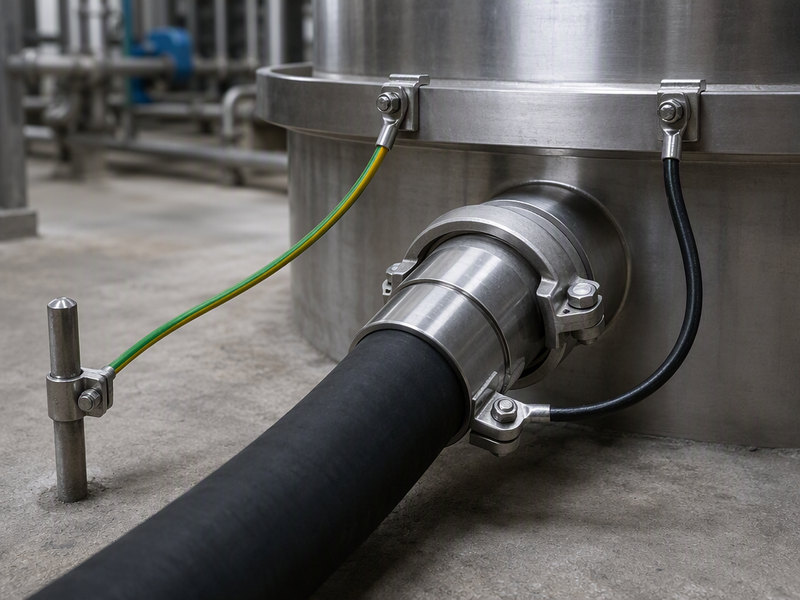
Figure 2. Two clamped leads, one from the vessel to earth and one from the hose to the vessel.
Under OSHA requirements for bonding and grounding, the goal is simply to keep every conductive part at the same potential throughout the transfer. A written procedure that names who connects what, and in which order, removes the guesswork that causes incidents.
Inspection Intervals and Retirement Criteria for Chemical Plant Hose
A plant hose is a perishable item, and a documented chemical hose inspection routine is what keeps a tired hose away from a live transfer. Inspect before every use, at a fixed interval set by the fluid and the duty, and after any event that stresses the hose, such as a pressure surge, a drop, or contact with a spill.
The pre-use check is a visual pass. Look at the cover for cuts, blisters, and soft spots, check the fittings for weeping fluid or movement, and confirm the hose carries a legible marking with its pressure and its batch date. A formal inspection adds a bend test, and a resistance check on conductive grades. If you run the pre-use pass, you need no more than a light and a legible marking.
Retirement is a decision rule, not a judgment call. Remove the hose from service when the cover shows exposed reinforcement, when a fitting leaks or swivels freely, when a bend stays kinked after the pressure is released, or when the marked date passes the interval your procedure sets. Replace the whole assembly. A patched wall cannot be re-tested to its original figure, so a repair leaves the hose outside its rated specification.
Track every chemical plant hose against the same five checks before a transfer:
Table 4. Recurring inspection checks, the usual interval, and the retirement trigger for a plant hose (planning values; confirm against the site procedure).
| Check | Usual Interval | Retirement Trigger |
|---|---|---|
| Cover condition | Before each use | Cut, blister, or exposed reinforcement |
| Fitting and clamp | Before each use | Weeping, free swivel, or loose clamp |
| Bend and kink | Monthly | Kink that does not relax |
| Electrical resistance | Monthly on conductive grades | Reading outside the graded band |
| Marking and batch date | Monthly | Illegible marking or expired interval |

Figure 3. Hands running along a hose cover, checking the fitting and clamp, with a kinked section beside it.
Treat the clamp as a safety part: match it to the fitting and to the specified torque, because that joint is what the whole assembly depends on. The hose clamp selection guide covers the materials and torque values behind that choice.
Where Should Spill Containment Sit at Each Station?
Size the containment to the largest volume that could escape from the connection, and have it in place before the first transfer. A drum or tote station sits inside a spill pallet or a bunded tray. Table 5 sets out the containment and readiness items for each station.
Spill readiness is a checklist that hangs at the station. Keep absorbent, a neutralizer matched to the fluid, a compatible salvage drum, and the right personal protective equipment within reach. Store the bonding and grounding leads with the kit so they cannot be borrowed and lost.
Bond a sample container before it is opened, the same way a drum is bonded before a transfer starts. A written chemical hose safety rule should name who checks the kit and how often.
Table 5. Containment and spill-readiness items for common in-plant transfer stations.
| Station | Containment Item | Readiness Item |
|---|---|---|
| Drum and tote | Spill pallet or bunded tray | Neutralizer matched to the fluid |
| Railcar and tanker | Drip pan under the connection | Closable drain and absorbent |
| Fixed transfer line | Secondary trough along the run | Inspection tag and spare gasket |
| Reactor charging | Local curbing and catch basin | Salvage drum and PPE |
Specifying a Chemical Plant Hose Assembly for the Quote
When a chemical plant hose requirement goes out for quotation, it should describe the duty rather than a brand. A clear request lets the supplier match the liner, the structure, the fittings, and the marking to the job in one step. If you are sourcing rather than operating, add the batch traceability and any documentation you need to the same seven answers.
Send these seven details with the request:
- The fluid or fluid family, and its concentration.
- The normal and the worst wall temperature.
- The transfer point, and whether the duty is suction or delivery.
- The bore size, the length, and any bend radius.
- The working pressure, and any pump surge.
- Whether the grade must be conductive or antistatic.
- The fittings, the end connections, and whether a crimped assembly is needed.
Each of those seven answers drives one decision. Fluid and temperature set the liner. Suction or delivery sets the structure. Bore and length set the flow and the layout.
The electrical grade sets the static path. The fittings set the seal. A supplier who receives all seven can quote one matched assembly instead of a family of options.
Order the chemical transfer hose for the worst duty it will meet, and keep a margin below the rated pressure at that temperature. HENGHUA crimps the assembly in one plant, so the specification on the label is the specification you receive.
Chemical Plant Hose FAQs
What is the difference between bonding and grounding in a plant transfer?
Grounding gives charge a path to earth; bonding removes the potential difference between two conductive parts. A vessel and a tanker can both be grounded and still sit at different potentials, which is the gap a bond closes. Connect the ground first, then the bond, and break them in reverse order when the transfer ends.
How often should a chemical hose inspection be carried out?
Set the interval from two things: how aggressive the fluid is and what a failure at that station would reach. A hose on a flammable transfer beside a walkway is inspected more often than one on dilute waste. Use a pre-use visual pass on every hose, a formal documented inspection at the fixed interval your procedure sets, and an out-of-cycle check after any surge, drop, or spill.
When should a chemical plant hose be retired?
Retire it at the first of four triggers: exposed reinforcement or a cut cover, a fitting that weeps or swivels, a kink that stays after the pressure is released, or the interval the marked batch date sets. Then tag the assembly out of service, move it to a quarantine area, and record the date. A hose that drifts back to the rack after a failed check is the failure mode an inspection routine exists to prevent.
Can one hose serve both suction and discharge?
Yes, with a combined suction-and-delivery type. The difference is the steel helix inside the wall: a Type SD hose handles vacuum and pressure, while a plain Type D delivery hose collapses under vacuum. Choose the combined type for any point where the duty can change, such as a manifold that fills from a tanker and drains to a sump.
Where does the highest pressure in a plant line actually sit?
The highest pressure in a plant line usually sits at the pump discharge rather than at the tank outlet, so size the hose to that point. Check the pump curve, the relief setting, and any surge from a closing valve, then size the hose to the highest of those.
Why does a non-conductive container need a different grounding method?
Charge cannot drain through a non-conductive wall, so the path has to start inside the liquid itself. That is why the transfer needs a grounded conductor reaching into the product, and why a plastic drum cannot be made safe by clamping a lead to its rim. Keep the inlet submerged as well: a free-falling stream builds more charge than a submerged one.
Which liner covers the widest range of plant chemicals?
PTFE covers the widest range: it is the most chemically inert liner and spans the widest temperature window, from −70 °C to +260 °C. For mixed or unknown media, that makes PTFE the default choice. UHMWPE covers a large share of industrial chemicals at a lower cost, and XLPE suits oxidizing media, so a narrower liner works when the fluid list is short and known.
Is a chemical transfer hose rated 17 bar heavier than a 10 bar hose?
At the same bore, the extra weight comes from the reinforcement and, on a suction-and-delivery type, from the steel helix. A higher pressure grade carries more textile reinforcement in the wall, and the helix adds a wire that a plain delivery hose does not have. That is why the 17 bar grade is reserved for the points that actually need it.
Do I need secondary containment for every hose transfer?
Set the volume from the largest release the connection could pass before anyone can respond. A drum or tote station uses a spill pallet or bunded tray, a railcar or tanker point uses a drip pan with a closable drain, and a fixed line uses a secondary trough along its run. Check the containment on the same walkdown as the hose, and keep it in place before the first transfer.
What should I send for a chemical plant hose quote?
Two of the seven change the answer most: the worst wall temperature, and whether the grade must be conductive or antistatic. Both drive the liner or the wall construction, and neither can be read off the fluid name alone. The other answers — fluid and concentration, the normal temperature, the transfer point and its duty, bore and length, working pressure, and fittings — usually follow from the duty description.
Final Verdict: Choose the Chemical Plant Hose for the Worst Duty
Selection comes down to four decisions made in order. Get those right and the rest of the specification follows. Then protect the choice with a written inspection routine, a containment plan, and a bonding and grounding procedure that workers actually follow.
The four decisions map to four inputs, and each one has a characteristic failure behind it:
Table 6. The four in-plant decisions in order, the input each one needs, and the mistake it prevents.
| Decision | Input | Mistake It Prevents |
|---|---|---|
| Transfer point | Duty at that station; suction or delivery | A delivery hose collapsing under vacuum |
| Liner | Fluid family, concentration, worst temperature | Swell, hardening, or cracking in service |
| Structure | Vacuum, bend radius, how often the hose is moved | A kink that stays kinked after the pressure is released |
| Electrical grade | Flammable atmosphere and transfer rate | A charge with no path to earth |
Work through this short checklist before the next transfer:
- Match each hose to its fluid and its temperature.
- Confirm the structure is suction-rated wherever a pump pulls liquid.
- Apply the right electrical grade, and prove the ground path at setup.
- Set a chemical hose inspection interval with clear retirement triggers.
- Stage containment and spill equipment before the first transfer.
- Record the batch date, and keep the cover marking legible.
A chemical hose safety plan that no one reads protects no one, so keep the rules short and visible at the station. For the wider selection picture, start with the chemical hose complete guide and the explainer on what a chemical hose is. When the duty is unusual, send the conditions to a supplier and let the material follow the chemistry. A chemical plant hose chosen for the worst duty it will meet, and inspected on a fixed schedule, is the one that stays safe.
About HENGHUA: Supplying the Chemical Hose Line
HENGHUA manufactures chemical hoses and complete hose assemblies for distributors, retailers, and OEM brands. The chemical hose line includes UHMWPE (UPE), XLPE, and PTFE liners as well as rubber (EPDM and oil-resistant synthetic rubber) constructions, with high-tensile textile reinforcement and, for suction duty, a steel helix. We supply factory-crimped assemblies, custom lengths, fittings, cover printing, private label, and OEM/ODM work.
Because we control compounding, extrusion, reinforcement, and crimping in one plant, commercial terms stay simple: factory-direct pricing, short lead times on bulk orders, and a warranty. If you are sourcing hoses for a plant or a distribution program, send us the duty and we will quote a matched assembly, with a planning figure for the volume you need. Get a quote and free samples
Written by the HENGHUA engineering team, from our own assembly and crimping records. HENGHUA manufactures chemical hoses and hose assemblies with UHMWPE (UPE), XLPE, and PTFE liners and rubber constructions, in bores from 3/4 in to 4 in, with custom lengths, fittings, and OEM/ODM branding.






 English
  Spanish
  Portuguese
  French
  German
  Arabic
  Russian
  Indonesian
  Japanese
  Korean