
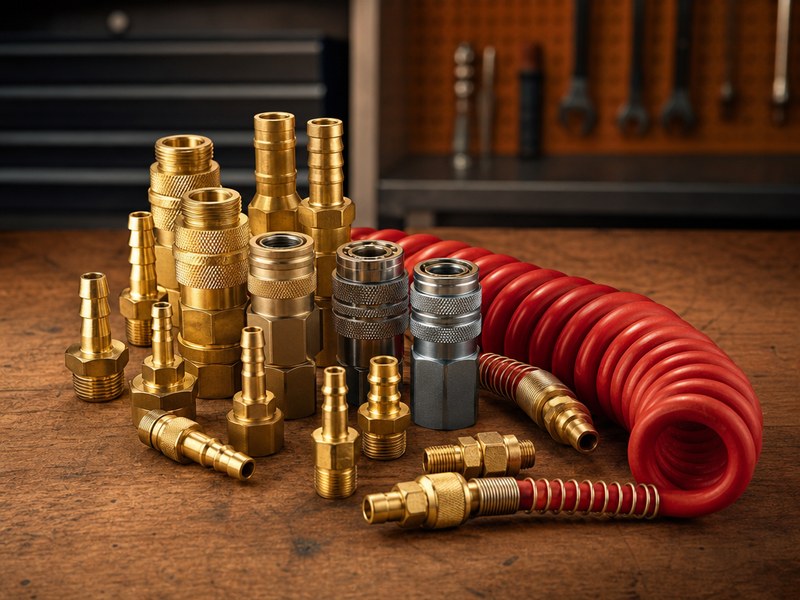
There are four broad types of air hose fittings on any compressed-air system: the hose-end fitting that grips the hose, the port-end fitting that threads into a tool or manifold, the coupling that joins two hoses, and the adapter that changes size or thread.
This guide maps the full family taxonomy, from barbs and ferrules to threaded ports, push-to-connect, quick connect plugs and sockets, adapters, reducers, bushings, swivels, and bulkhead and elbow fittings. It reduces every fitting to three numbers: hose inside diameter, port thread size, and coupler style. From those numbers it builds sizing rules around tool demand and run length, then closes with a selection worksheet and the symptoms of a wrong choice.
All flow figures are our bench measurements at 100 PSI inlet; tool demand figures are manufacturer ratings at 90 PSI. About 12 min read.
How the Types of Air Hose Fittings Split Into Two Ends
A pneumatic connection has two interfaces, and every fitting serves one of them. The hose interface grips the hose. The port interface threads, clicks, or seals into the tool, compressor, manifold, or regulator. When two hoses meet, a third interface appears in the middle, and that joint needs a coupling.
The split is why fittings are best described by function rather than shape. A 3/8 in hose barb and a 3/8 in male pipe adapter look nothing alike, yet both serve the same 3/8 in line. Reading a part as “which interface does this serve” prevents the most common ordering error: buying a fitting that suits the hose but not the port.
The hose end disappears inside the assembly once it is built, while the port end stays exposed and measurable on the tool or compressor, so diagnosis usually starts there.
The Main Types of Air Hose Fittings, Family by Family
The table below is the map for the rest of this article. Each family is defined by what it is, where it sits, and how it fails.
Table 1. The main types of air hose fittings, where each family sits on a system, and how it fails in service.
| Family | What it is | Where it belongs | How it usually fails |
|---|---|---|---|
| Шланговый патрубок | A tapered, ridged shank pushed into the hose bore | Hose end on workshop assemblies | Clamp left loose; barb cuts the tube wall; hose pulls off |
| Crimped ferrule | A collar swaged over the hose cover behind the insert | Hose end on factory-made assemblies | Under-crimp leaks; over-crimp cuts the reinforcement |
| Threaded port, taper | A pipe thread that seals on the thread flanks as it tightens | Port end on compressors, tools, and regulators | Over-tightening splits a brass port; tape debris blocks the seal |
| Threaded port, parallel | A straight thread that seals on a washer or O-ring | Port end on European and metric equipment | Wrong seal type fitted, so the joint seeps when tight |
| Push-to-connect | A collet and O-ring that grip plain tubing | Port end on small pneumatic controls | Tube cut off-square or scored, so the collet cannot grip |
| Quick connect plug | The male half that clicks into a matching socket | Hose end and tool end where tools change often | Worn nose groove, so the plug releases under pressure |
| Quick connect socket | The female half with a locking sleeve and internal valve | Hose end and compressor outlet | O-ring dries and leaks; dirt stops the sleeve returning |
| Adapter | A fitting that changes thread standard, gender, or size | Any joint where two interfaces differ | Cross-threading when forced onto the wrong standard |
| Reducer and bushing | A fitting that steps one port size up or down | Port end when the tool port is smaller than the line | Used as a structural step, so the wall cracks at the hex |
| Swivel | A fitting with a rotating joint between two threaded ends | Between hose and tool on high-cycle work | Seal wear at the rotating face after long service |
| Bulkhead | A fitting that passes through a panel and locks both sides | Through a wall, cabinet, or hose reel frame | Panel nut loosened by vibration, then the line leaks |
| Elbow | A 90 or 45 degree fitting that turns the connection | At the tool inlet where a straight part would kink the hose | Strain at the bend, which eventually cracks the body |
A barb is the simplest hose-end option, provided the clamp is sized to the hose cover and tightened to the maker’s torque. A crimped ferrule costs more per assembly but removes the operator variable, which is why factory assemblies use it. Most field returns on barbed hose come down to a clamp that was never re-tightened after the hose relaxed.
Port-end fittings divide by how they seal. A taper pipe thread seals on the thread flanks, so the metal deforms slightly as it tightens. A parallel thread seals on a washer, bonded seal, or O-ring ahead of the thread, so extra tightening does more harm than good. Naming the standard tells you which you have: ASME B1.20.1 for NPT, and ISO 228-1 for parallel pipe threads.
Couplings handle the middle joint. Push-to-connect fittings are the default on small control lines, where a collet grips plain tubing and an internal O-ring seals. Quick connect plugs and sockets serve high-cycle work, where a tool is changed several times an hour. Both depend on a clean square cut or a full insertion.
Adapters, reducers, bushings, swivels, bulkhead fittings, and elbows are transition parts. Real systems rarely match: a tool with a 1/4 in port, a hose with a 3/8 in bore, and a compressor outlet in a third standard. Distributors group these air hose fittings and connectors into the families above. One rule keeps them out of trouble. Use a transition part to change dimension or thread. Correct a flow problem by changing the hose bore.
The Three Numbers That Set Air Hose Fitting Sizes
Every fitting is defined by three independent numbers. Write all three down before you search for a replacement.
Table 2. The three numbers that define air hose fitting sizes, and what to record for each one.
| Number | What it fixes | How it is written | What to record |
|---|---|---|---|
| Hose inside diameter | Flow capacity of the whole line | 1/4 in, 3/8 in, 1/2 in, or metric 6, 8, 10, 12 mm | The bore marked on the hose, never the outside diameter |
| Port thread size | Mechanical fit at the tool or regulator | Nominal pipe size, such as 1/4-18 NPT or 1/4 in BSPP | Thread standard and nominal size, not the wrench size |
| Coupler style | Which plugs and sockets will mate | Style letters such as M, A, and E | The style letter on both halves of the pair |
The first number is the one people misread: a nominal 1/4 in pipe thread does not measure 1/4 in across the threads, because the figure refers to the pipe bore. Measure, then confirm against a thread chart rather than trusting the label.
The three numbers also fail independently. Bore sets flow, port thread size sets the mechanical fit, and coupler style sets whether two parts join at all. A part can match on one scale and miss on the other two, which is why a bag of mixed fittings so often contains almost the right item. For reading the bore and port on an assembled tool, see the walkthrough on how to measure air hose size.
An unmarked port needs measurement, not a guess. Count the threads per inch and check the flank angle, then compare the result with a standard chart. That procedure is set out in the batch companion on identifying air hose fittings by threads and sizes, a planned URL that should be published before this link goes live.
Quick Connect Couplers and How Air Hose Fitting Styles Interchange
Style letters describe families of plug and socket profiles that latch together. The letters come from catalogue practice, not from a published standard; the named standard for pneumatic quick-action couplings is ISO 6150. What the letters decide is interchange.
Table 3. Common air hose fitting styles, the market each serves, and measured flow at 1/4 in and 100 PSI.
| Style | Typical market | Flow at 1/4 in, 100 PSI | Where it belongs |
|---|---|---|---|
| M style | North American industrial and automotive workshops | About 40 SCFM | The general shop standard for hand tools |
| A style | North American automotive service chains | About 35 SCFM | Tool lines already standardized on A |
| E style | European industrial equipment | About 35 SCFM | Machines imported with European couplers fitted |
At 1/4 in and 100 PSI, our flow bench puts an M style coupler slightly ahead of A and E, about 40 SCFM against 35 SCFM at the same nominal size, which matches what workshops report in practice. The gap is too small to drive a purchasing decision, and consistency inside one building matters more, because one odd family on one hose creates a fitting that will not connect.
Mixing families has two outcomes. The plug may not latch at all, which is obvious and safe. More often it latches on the nose profile but sits too deep or too shallow, so the joint holds at low pressure and separates under load. That second failure is the dangerous one, because it looks like a worn O-ring rather than a wrong part.
If your question is which of these air hose fitting styles will mate with what you already own, the site’s air hose fittings and couplers guide covers the compatibility matrix in full, with installation and leak diagnosis. For an unmarked plug, the procedure on quick connect coupler profiles is the companion reference, a planned URL for this site.
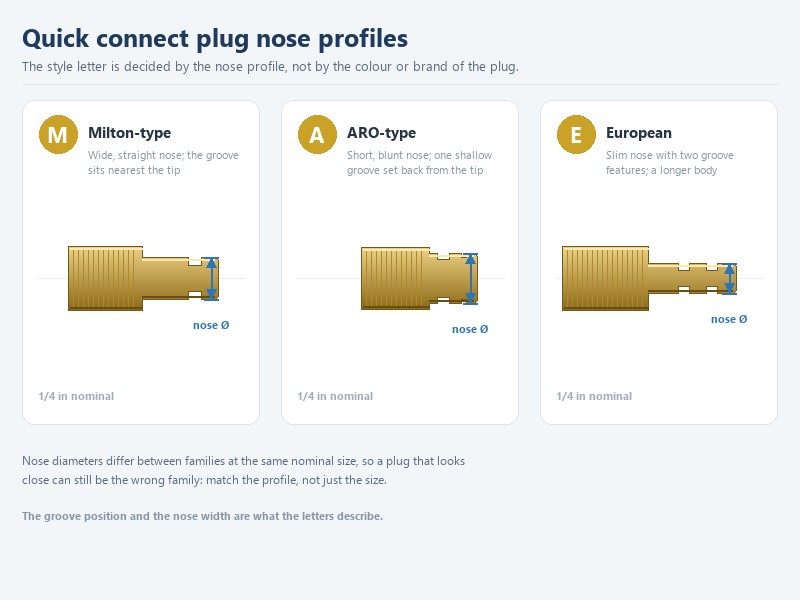
Figure 2. Three coupler families compared by nose profile. The letter is decided by the profile, not by the color or brand of the plug.
Sizing Rules: Matching Air Hose Fitting Types to Tool Demand
Sizing starts on the tool side, not on the hose rack. Every air tool carries a rated demand at 90 PSI, and that figure is the load the line has to carry.
Table 4. Common air tools, their rated demand at 90 PSI at the tool inlet, and the hose and air hose fitting types that meet it.
| Tool | Rated demand at 90 PSI | Minimum hose bore | Why |
|---|---|---|---|
| Brad nailer | 0.3 to 0.5 SCFM | 1/4 in | Intermittent load; a light whip hose is enough |
| Framing nailer | 2.0 to 2.5 SCFM | 1/4 in to 3/8 in | Short bursts; 3/8 in keeps recovery time short |
| Air ratchet | 2 to 4 SCFM | 1/4 in to 3/8 in | Continuous use raises the average demand |
| Impact wrench, 1/2 in | 4 to 8 SCFM | 3/8 in | High peak demand; a 1/4 in line will starve it |
| Impact wrench, 3/4 in | 8 to 10 SCFM | 1/2 in | Peak demand approaches the capacity of a 3/8 in line |
| Die grinder | 4 to 8 SCFM | 3/8 in | Continuous high flow with no recovery pause |
Tool demand and hose capacity meet. At 100 PSI inlet, a 1/4 in line moves about 40 SCFM, a 3/8 in line about 80 SCFM, and a 1/2 in line about 140 SCFM. Against those numbers a 0.5 SCFM brad nailer is easy and a 4 to 8 SCFM impact wrench is not.
Every fitting in the chain takes a share of that capacity. An adapter, a swivel, a coupling, and the hose length itself each add restriction, and the losses accumulate along the line.
That leads to the rule worth remembering. Size the hose and its air hose fitting types for the tool with the highest demand that will ever run on the line, not for the tool you reach for most often. A line built for the daily drill will fail the moment somebody plugs in the impact wrench.
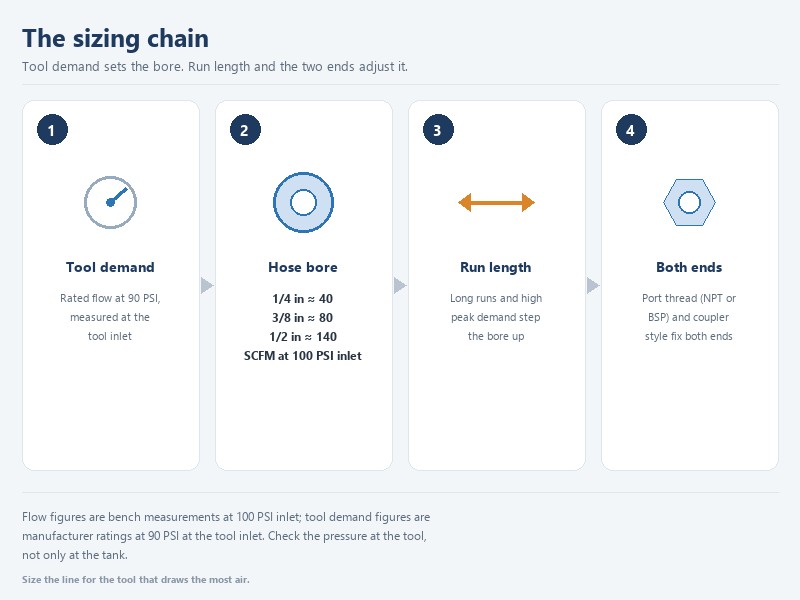
Figure 3. The sizing chain. Tool demand sets the bore, run length adjusts it upward, and the port thread and coupler style fix the two ends.
If the tool list is long, the worked examples in what size air hose do I need run the same arithmetic against real tool combinations.
Run Length, Dash Sizes and Metric Equivalents
Length is the variable that quietly changes the answer. Air loses pressure as it travels, and the loss grows with distance, so a hose that measures well on a one-foot bench test behaves differently across a fifty-foot shop floor. Doubling the run roughly doubles the friction loss at the same bore and flow.
Dash sizes come from the hydraulic world and remain in use on pneumatic fittings because they are compact. The dash number is the bore in sixteenths of an inch.
Table 5. Dash sizes, inch bores, and metric equivalents for the hoses most shops keep on the rack.
| Dash size | Bore in inches | Nominal metric | Typical use |
|---|---|---|---|
| -4 | 1/4 in | 6.4 mm | Light tools and short whip hoses |
| -6 | 3/8 in | 9.5 mm | General workshop use and most hand tools |
| -8 | 1/2 in | 12.7 mm | High-demand tools and long runs |
| -12 | 3/4 in | 19.0 mm | High-flow shop mains and manifold drops |
Metric push-to-connect fittings are sized by the tube outside diameter. A 10 mm fitting takes 10 mm tubing, and a 3/8 in coupler takes 3/8 in hose. Use each fitting on its own sizing scale. The two sizes sit close together, so a mismatch damages the collet and the tube.
For run length, a workable rule is to step up one bore size once the run passes roughly fifty feet, or to move the regulator closer to the work. Adding a second drop and a short whip hose is usually cheaper than one long line at a larger bore. The full table is in the air hose size chart guide.
The Types of Air Hose Fittings Selection Order: A Worksheet
The sequence below turns the three numbers into an order you can place.
Table 6. A selection order for choosing air hose connection types without guesswork.
| Step | Question to answer | What you write down |
|---|---|---|
| 1 | What is the hose bore? | Inside diameter in inches or millimeters |
| 2 | What thread is on the tool port? | Standard and nominal size, such as 1/4-18 NPT |
| 3 | What coupling family is already in use? | The style letter of the plugs and sockets on the line |
| 4 | Which tool has the highest demand? | Rated flow at 90 PSI from the tool label or manual |
| 5 | How long is the run, and how many fittings sit in it? | Length in feet and a count of adapters and couplings |
| 6 | Which family does each end need? | Hose-end part and port-end part, chosen separately |
| 7 | Does the part suit the pressure and temperature of the job? | Working pressure, burst rating, and temperature range for the body material |
Steps one to three define fit, and steps four and five define performance. Answer the performance steps before you order, because a line that skips them assembles perfectly and still disappoints at the tool.
One more check belongs at the end. The plug and the socket must come from the same style family, and both must be rated for line pressure. A high-flow socket paired with a standard plug of a different family will either refuse to latch or release early. Our air hose and fitting range is listed in the industrial air hose collection if you want to compare part families side by side.
Apply two rating checks before you order. A brass standard-duty fitting is rated 150 to 300 PSI working pressure, and a heavy steel body extends that to 500 PSI, with burst pressure running three to four times the working figure. Rubber air hose is rated -40 to +70 °C under ISO 2398:2024, and PVC or PU hose -10 to +60 °C under ISO 5774:2023, at a reference condition of 23 °C.
Mismatch Symptoms: Signs You Chose the Wrong Air Hose Connection Types
A wrong choice rarely announces itself as a size problem. It shows up as a symptom somewhere else on the system, and the symptom usually points back to one of the three numbers.
Table 7. Mismatch symptoms on a compressed-air line and the number that usually explains them.
| Symptom | Most likely cause | What to change |
|---|---|---|
| Tool feels weak and the body runs hot | Bore too small, or too many adapters in the chain | Step up one hose bore and remove one adapter |
| Coupler will not latch | Plug and socket from different style families | Match both halves to one style family |
| Joint seeps after the tape is replaced twice | Taper thread mated to a parallel thread | Fit the correct standard, or a purpose-made adapter |
| Hose pulls off a barb under pressure | Clamp sized wrong or never re-tightened | Resize and re-torque the clamp, or buy a crimped assembly |
| Hose whips on disconnect | Stored air in a long line, or a plug that releases early | Add a safety coupling, shorten the line, and hold cleaning pressure at or below 30 PSI under OSHA 29 CFR 1910.242(b) |
| Push-to-connect seeps only at pressure | Tube cut off-square, or wrong tube outside diameter | Recut the tube square and match the metric size |
| Tool recovers slowly between cycles | Run too long for the bore, or regulator set too far back | Move the regulator closer, or step up one bore size |
Read Table 7 from the symptom backwards. A hot tool with low torque is a flow complaint, so the answer sits in the bore or in the number of air hose fittings and connectors between the regulator and the tool. A joint that leaks however carefully it is sealed is a thread-standard complaint, so the answer sits in the port number.
The fixes are not interchangeable. Adding sealant to a mismatched thread pair hides the leak for a week and then it returns, while removing an adapter costs nothing and gives back flow immediately. Sorting a symptom into fit, flow, or sealing is the fastest route to the right repair, and it is the same sorting these air hose connection types call for.
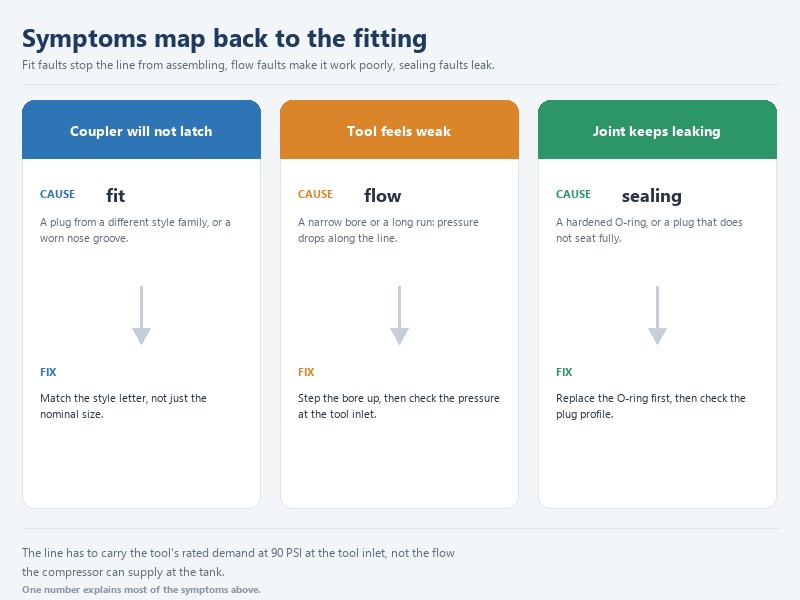
Figure 4. Symptoms map to one number. Fit faults stop the line from assembling, flow faults make it work poorly, and sealing faults leak.
Types of Air Hose Fittings FAQs
I am rebuilding a shop line with unmatched air hose connectors: how many kinds of air hose fittings are there?
Grouped by job, there are four: hose-end fittings, port-end fittings, couplings, and adapters. Grouped by family, the list runs to about a dozen, from barbs and crimped ferrules to adapters, reducers, bushings, swivels, bulkhead fittings, and elbows. Most workshops stock only a few of these air hose fittings and connectors.
What is the difference between a hose barb and a crimped ferrule?
A barb is a reusable fitting with a ridged shank that slides into the hose bore and is held by an external clamp. A crimped ferrule is a collar swaged permanently over the hose, so the assembly cannot be taken apart in the field. Barbs suit workshops that build hoses as needed; ferrules suit repeatable factory assemblies.
How do I work out which air hose fitting sizes to order?
Read three things off the system: the hose bore, the port thread standard and nominal size, and the coupler style letter. Write all three down before searching, because a fitting that matches one can still be wrong on the other two. If a port is unmarked, measure the thread and confirm it against a chart rather than assuming it matches the rest of the shop.
I am adding a plug to a line I inherited: are all 1/4 in quick connect plugs the same?
The 1/4 in figure describes the hose or port connection, not the coupler family. Two 1/4 in plugs from different style families have different nose profiles, so they will not latch correctly into the same socket. A plug may appear to seat and then release under pressure. Match the style letter, not just the nominal size, when adding a plug to an existing line.
Can I run a 1/2 in impact wrench on a 1/4 in hose?
A 3/8 in hose is the practical minimum for a 1/2 in impact wrench. The 4 to 8 SCFM figure is the wrench’s rated demand at its own inlet at 90 PSI, so the pressure the line delivers there matters more than the flow the compressor can supply. A 1/4 in line moves about 40 SCFM at the compressor, yet pressure falls along the bore and through every fitting, so the wrench sees well under its rated pressure and feels weak. Use 1/2 in for long runs.
What does a dash size mean on a fitting?
A dash size is the bore measured in sixteenths of an inch, so a -6 fitting has a 6/16 in bore, which is 3/8 in. The convention comes from hydraulic hose and carries across to pneumatic fittings because it is short enough to mark on a small part. It describes the bore only.
How much pressure do I lose over a long hose run?
Loss rises with length, and for the same bore and flow it roughly doubles when the run doubles. Each adapter and coupling narrows the path further. A fifty-foot 3/8 in line with six fittings can lose enough pressure to make a tool feel tired, while the same tool on a short whip hose feels normal.
Why does my coupler leak only while the tool is running?
Air flowing past a worn or incorrectly seated seal opens the leak; with no flow, pressure alone may not push it through. The common causes are a hardened O-ring, a plug that does not seat fully in the socket, or a plug from a different style family that sits slightly too deep. Replace the O-ring first, then check the plug profile.
Which couplers work with metric push-to-connect tubing?
Metric push-to-connect fittings are sized by the tube outside diameter, such as 6, 8, 10, or 12 mm, not by pipe thread. They connect metric tubing to a port and are not interchangeable with 1/4 in or 3/8 in couplers. If a metric tube must meet a quick connect line, use an adapter rated for the pressure and sized for both ends.
What are the symptoms of an undersized air hose?
The classic signs are a tool that loses torque under load, a motor body that runs hot, slow recovery between cycles, and performance that improves as soon as a shorter or larger hose is fitted. Because each adapter and coupling adds restriction, the symptom often appears on a line that looks correct by bore alone. Count the fittings as well as the hose.
Final Verdict: Choosing the Right Types of Air Hose Fittings
The subject reduces to a short sequence. Record the hose bore, the port thread standard and size, and the coupler style. Then size the line for the highest-demand tool that will ever run on it, adjust upward for long runs and fitting count, and confirm the pressure and temperature rating of every part before ordering. Done in that order, the choice is arithmetic rather than guesswork, and the difference between correct and almost correct is usually one part number.
Before you place an order, confirm the following:
- Bore measured and written down, in inches or millimeters
- Port thread standard and nominal size confirmed by measurement, not by memory
- Coupler style letter matched on both the plug and the socket
- Line sized for the highest-demand tool, with adapter count included
- Run length checked, with a step up in bore size beyond roughly fifty feet
- Working pressure and temperature range verified for every fitting in the chain
HENGHUA manufactures air hose fittings, quick connect couplers, air hoses, and hose assemblies for distributors, retailers, and OEM brands worldwide. Fittings are machined from brass, zinc-plated steel, or stainless steel, thread-checked against NPT and BSP gauges, and pressure-tested to rated working pressure before shipment. The range covers 1/4, 3/8, and 1/2 in plugs and sockets in M, A, and E style interchange profiles, hose barbs, NPT-to-BSP adapters, reducers, complete kits, and spare O-rings, with rubber, PVC, and PU air hose to match.
Because the process runs from raw material to final pressure test under one roof, we hold consistent quality at factory-direct pricing, with short lead times on bulk orders. Private labeling, custom packaging, and OEM or ODM branding are available. If you are sourcing fittings for a retail, distribution, or OEM program, contact our team for a quote and samples, and we will help you match the right bore, thread standard, and coupler style to your market.
About the author. Written by the HENGHUA engineering and test team, who design, machine, and pressure-test air hose fittings, quick connect couplers, and hose assemblies for industrial, automotive, and OEM customers. The figures in this guide come from the company’s own flow bench and crimp test data, checked against published tool ratings and the standards named in the text. Questions about a specific application can be sent to the team through the contact page.






 English
  Spanish
  Portuguese
  French
  German
  Arabic
  Russian
  Indonesian
  Japanese
  Korean