
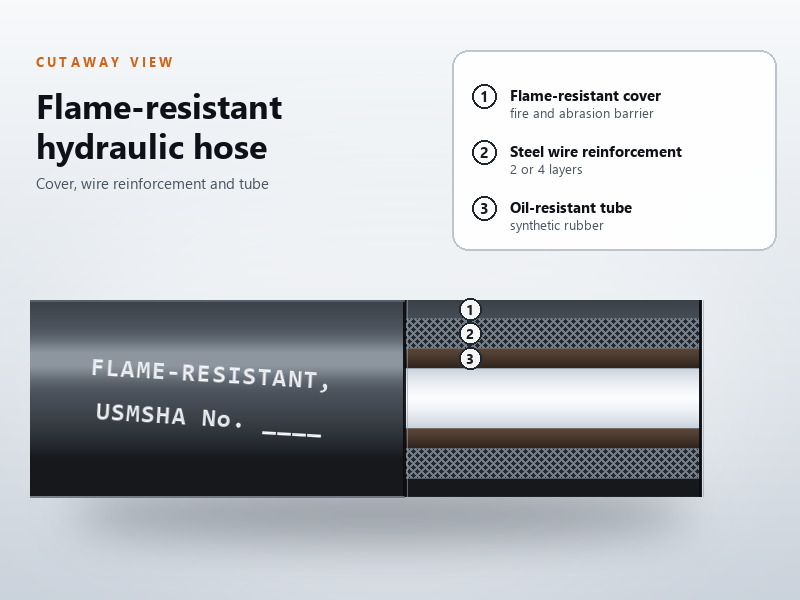
An MSHA hydraulic hose is a hydraulic oil hose whose cover is accepted as flame resistant under 30 CFR Part 18.65 by the U.S. Mine Safety and Health Administration. The accepted cover must be marked “Flame-Resistant, USMSHA No. ____” at intervals not exceeding 3 feet. Acceptance covers the flame resistance of the cover and nothing else, so pressure, impulse life and conductivity each stay a separate specification duty with its own standard. In short, buy a hose that carries a current acceptance number, size it from your relief valve setting rather than your pump, and record the acceptance number on the order.
1. What Is an MSHA Hydraulic Hose?
An MSHA hydraulic hose is specified for hydraulic circuits on equipment working in gassy underground mines and tunnels. The tube, the reinforcement and the pressure rating stay as they are on the standard hose of the same construction; the cover compound and the paperwork are what change.
The reason the acceptance exists is methane and coal dust. In a gassy mine, an ignition source on a machine can start an explosion, and a burning hydraulic hose draped across a machine is a fuel path that leads fire into places miners cannot reach. Making the cover self-extinguishing removes one fuel source from a machine that is otherwise designed, under Part 18, to be permissible.
Why Does MSHA Acceptance Exist at All?
Part 18 governs electric motor-driven mine equipment and accessories intended for gassy mines or tunnels. It issues three different things, and hoses only receive one of them:
Figure 1. Acceptance applies to the cover: flame-resistant compound on the outside, oil-resistant tube and steel reinforcement unchanged inside.
The three MSHA instruments under 30 CFR Part 18, and which products they apply to.
| Instrument | Applies to | What it states |
|---|---|---|
| Approval | A completely assembled electrical machine or accessory | That the machine has met Part 18 and may carry an approval plate as permissible for gassy mines or tunnels |
| Certification | An electrical component | That the component complies with Part 18 and is suitable for incorporation into equipment submitted for approval |
| Acceptance | A hose or hose conduit | That the hose has met Part 18 and will be listed by MSHA as acceptable flame-resistant auxiliary equipment |
What Does “MSHA Certified” Actually Mean for a Hose?
Strictly, a hose is not certified and it is not approved. Part 18 defines “acceptance” as written notification that a hose has met the applicable requirements and will be listed as acceptable flame-resistant auxiliary equipment, and defines “acceptance marking” as the identifying mark showing the hose has been accepted for listing as flame resistant. The word the regulation uses for hoses is accepted.
That distinction is not pedantry, because the same word “MSHA certified” is used for something else entirely in the same industry:
- MSHA certification usually refers to miner training records and qualifications under Part 46 and Part 48, and to medical examiner certification for respirator use.
- MSHA approval refers to permissible machines and to approved fire-resistant hydraulic fluids under Part 35.
- MSHA acceptance is the correct term for a flame-resistant hose, hose conduit, belt or similar product.
When a supplier’s catalogue says “MSHA certified hydraulic hose”, the document to ask for is the acceptance, not a training certificate. An MSHA approved hydraulic hose is identified by the cover marking, never by the sales description. Our hydraulic hose guide explains how the same hose family is specified for surface equipment where no flame-resistant cover is required.
2. What Are the MSHA Hydraulic Hose Requirements Under 30 CFR 18.65?
Section 18.65 is titled “Flame test of hose” and it is short, specific and measurable. It sets the specimen size, the apparatus, the mounting angle, the flame application time, the pass criteria and the marking. Everything else you read about MSHA hydraulic hose requirements is either a different regulation or a supplier’s own claim.
How Is the Flame Test Run?
The test is a small-scale laboratory test on strips cut from the hose, run in a 21-inch cubical gallery:
- Prepare four specimens. Each is 6 inches long by 1/2 inch wide by the wall thickness of the hose, so the cover, reinforcement and tube are tested as one composite.
- Mount the specimen. The free end is centred 1 inch above the burner top, the longitudinal axis horizontal, the transverse axis inclined 45 degrees to the horizontal, with a 5-inch square of 20-mesh iron wire gauze clamped below.
- Set the flame. A Bunsen-type burner with an 11 mm burner tube is adjusted to give a blue flame 3 inches high on natural gas, with the observation door closed.
- Apply flame for 1 minute in still air. The flame is then removed and a fan is switched on to give an air current of 300 feet per minute.
- Measure flame duration, then afterglow. After the specimen stops flaming it stays in the air current for at least 3 minutes so any afterglow can be timed.
The pass criteria are averages across the four specimens, not a single best result.
Test requirements and acceptance marking in 30 CFR 18.65.
| Element | Requirement |
|---|---|
| Specimens | 4 specimens, each 6 in long x 1/2 in wide x hose wall thickness |
| Flame application | 1 minute in still air, blue flame 3 in high, natural gas |
| Air current after flame removal | 300 ft per minute |
| Afterglow observation | At least 3 minutes in the air current |
| Duration of flame | Average must not exceed 1 minute after the applied flame is removed |
| Afterglow | Average must not exceed 3 minutes |
| Marking text | “Flame-Resistant, USMSHA No. ____” |
| Marking intervals | Not exceeding 3 feet along the hose |
| Letter height | At least 1/4 inch |
| Marking method | Impressed letters, raised letters on a depressed background, or printed letters |
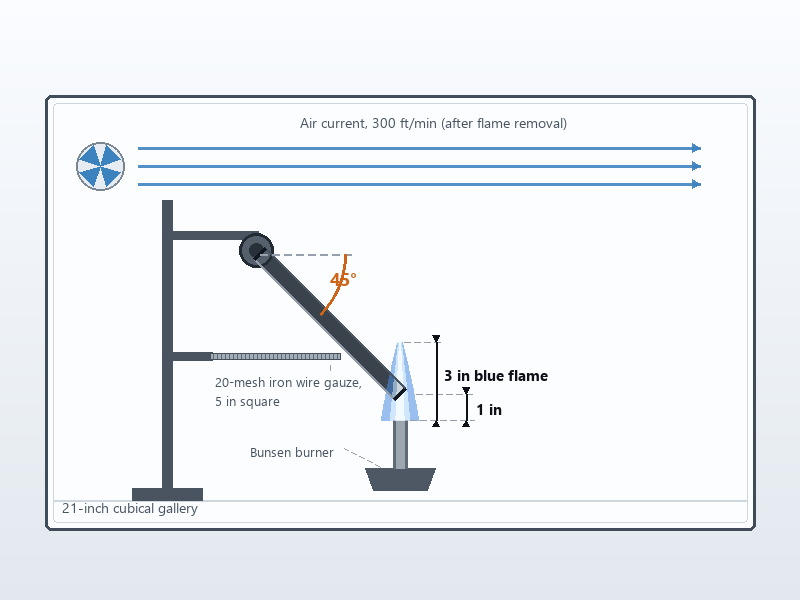
Figure 2. The 18.65 setup: specimen clamped at 45 degrees, 1 inch above the burner, wire gauze below, flame then airflow at 300 ft per minute.
Why Is the “Cease Burning” Definition the One That Matters?
Part 18 defines flame resistant, as applied to cable, hose and insulating materials, as material that will burn when held in a flame but will cease burning when the flame is removed. That is a modest standard and it is worth reading literally.
Two consequences follow for a buyer:
- A cover that resists ignition but keeps burning once lit does not pass, however good its other properties are.
- Passing says nothing about how a hose behaves in a fully developed fire. It says the cover will not sustain combustion on its own.
How Do You Read the Marking on a Delivered Hose?
Roll the hose out and read the cover before you cut anything:
- Find the words. The cover must carry “Flame-Resistant, USMSHA No. ____” at intervals not exceeding 3 feet.
- Read the number. Letters and numbers must be at least 1/4 inch high and must be impressed, raised on a depressed background, or printed.
- Check the acceptance is current. MSHA publishes acceptance lists that also record companies that have gone out of business or transferred their listings, so a number alone is not proof of current supply.
- Cross-check the layline. The pressure, temperature and standard markings are separate from the acceptance marking and must agree with the datasheet.
What Do MSHA Acceptance Numbers Look Like?
Acceptance numbers have changed format over the decades, and both old and new forms appear on hoses still in service:
- Legacy series. Older listings in MSHA’s published hose and hose conduit lists carry numbers such as 2G-11, 2G-14/4, 2G-55/3 and 2G-IC-11C/25, issued from the 1950s onward. The number format alone tells you nothing about whether the product is still made.
- Current series. Newer listings use a longer form tied to Part 18, such as 18-HCA050001, 18-HCA080001, 18-HCA110001 and 18-HCA190001.
- Component-style numbers. Some listings carry an IC segment, which appears in the older list entries and in field reports of hoses marked with an IC-prefixed number.
- Where they come from. MSHA’s Approval and Certification Center in Triadelphia, West Virginia issues and maintains these listings through its materials and explosion testing branch.
The practical point is that the number is the traceable link between the hose in your hand and a test record. Treat it the way you treat a pressure test certificate.
3. What Does MSHA Acceptance Not Cover?
What MSHA acceptance does not cover is the part most buyers get wrong, and it causes the most expensive mistakes, because a supplier’s four-row table labelled “MSHA requirements” for a fire resistant hydraulic hose very often contains two rows that come from other standards.
Scope: MSHA acceptance under 18.65 covers one property of one component, the flame resistance of the hose, proved by the 18.65 flame test and stated in the cover marking. Every item listed below sits outside that scope and is governed elsewhere:
- Working and burst pressure. These come from the construction standard, such as SAE J517 (the SAE International hydraulic hose standard) for the 100R series, or EN 853 and EN 856 (the European Norm hose standards) for the SN, SP and SH classes.
- Impulse life. Cyclic pressure endurance is defined by the impulse test in the construction standard, not by Part 18.
- Electrical conductivity or surface resistance. Where a mine specification calls for an antistatic hydraulic hose, that value is a manufacturer’s data-sheet figure and a site requirement, and it should be confirmed against the mine’s own specification.
- Fluid compatibility. Which fluids a tube compound can carry is a manufacturer and fluid-supplier question, and Part 35 approval for a fire-resistant hydraulic fluid is a separate instrument again.
- Fittings, crimps and assemblies. Acceptance attaches to the hose and hose conduit, not to a finished assembly, a crimp diameter or a swage machine.
- Service life. No acceptance implies a replacement interval.
Which document or standard actually governs each specification on a mining hydraulic hose, and what to request from the supplier.
| Specification | Governing source | Where the value is proved | What to ask the supplier for |
|---|---|---|---|
| Flame resistance of cover | 30 CFR 18.65 | MSHA acceptance and cover marking | Acceptance number, the construction it covers, and the marking text |
| Working and burst pressure | SAE J517, EN 853, EN 856 | Layline and proof or burst test record | Written confirmation that layline, datasheet and proof test record agree |
| Impulse endurance | Construction standard impulse test | Type test report | Type test report naming the standard it was run to |
| Conductivity or antistatic cover | Mine or OEM specification | Manufacturer data sheet and incoming inspection | The data-sheet figure and the incoming inspection method |
| Fluid approval | 30 CFR Part 35 for fire-resistant fluids | Fluid certificate of approval | Fluid certificate of approval for the fluid in service |
| Tube compatibility | Compound data and fluid supplier guidance | Immersion test data | Immersion test data for the fluid in service |
Part 35 also matters because MSHA approves fire-resistant hydraulic fluids in their own right, under its own test set: autogenous-ignition temperature, temperature-pressure spray ignition, and the effect of evaporation on flammability. If your machine runs an approved fire-resistant fluid, that fluid choice constrains the tube compound you can use, which is the subject of the next two sections.
4. How Is a Mining Hydraulic Hose Built?
A fire resistant hydraulic hose built for mining is the same three-layer sandwich as any other hydraulic hose, with two deliberate changes: a cover compound that will not sustain combustion, and heavier or spiralled reinforcement so the hose survives impulse cycles underground. Our oil-resistant hose guide covers how the tube and cover compounds are chosen against the fluid the hose will carry.
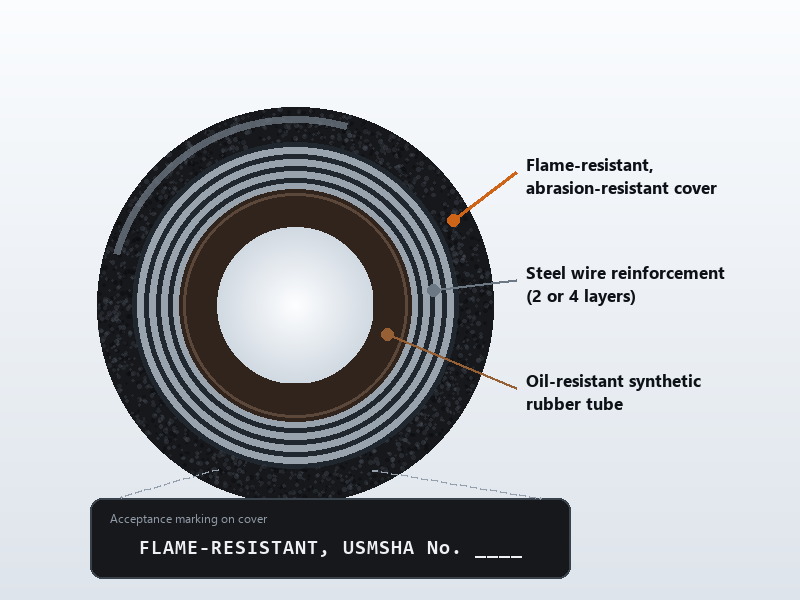
Figure 3. Three layers, two of them specified for mining duty: the tube handles the fluid, the reinforcement handles the pressure, the cover handles fire and abrasion.
Function of each layer, and what changes for underground mining service.
| Layer | Material | Job it does | What mining duty changes |
|---|---|---|---|
| Tube | Oil-resistant synthetic rubber, typically nitrile based | Carries the fluid, protects the wire from corrosion from the inside | Compound must suit the fluid actually used, including water-based fire-resistant fluids |
| Reinforcement | High-tensile steel wire, braided or spiralled in 2, 4 or more layers | Carries working pressure, absorbs impulse cycles | Spiral construction is preferred where pressure spikes and abrasion dominate |
| Cover | Flame-resistant synthetic rubber, abrasion and weather resistant | Protects the wire, resists rock and coal dust contact, limits fire spread | Cover compound is the accepted flame-resistant one, and it carries the acceptance marking |
Which Constructions Carry MSHA Acceptance?
Acceptance is granted to a specific hose or hose conduit, so the answer is not “all spiral hoses”. In practice, flame-resistant covers are accepted across the common hydraulic families, and the buyer’s job is to obtain the acceptance for the exact construction ordered:
- Wire braid classes. SAE 100R1 and SAE 100R2, and their European equivalents EN 853 1SN and 2SN, cover the medium-pressure circuits on roof bolters, conveyors and drilling rigs. Our SAE 100R1 hose and SAE 100R2 hose pages list the size range and pressure steps.
- Wire spiral classes. SAE 100R12, SAE 100R13, SAE 100R15 and EN 856 4SP and 4SH cover shearer, shield support and other high-impulse circuits.
- Thermoplastic classes. SAE 100R7 and SAE 100R8 use thermoplastic rather than rubber construction, which is lighter and more flexible, and can be supplied with an accepted flame-resistant cover for restricted spaces.
- Hose conduit and sleeves. Protective conduit and sleeves are accepted separately under the same section, which is why a sleeve can carry its own acceptance number.
What Fluids Can an MSHA Hydraulic Hose Carry?
Flame resistance and fluid compatibility are independent, and a hose can be accepted and still be the wrong hose for your fluid. The constraints come from the tube compound and the cover chemistry.
Typical compatibility of a nitrile-tube hydraulic hose with fluids used in mining service.
| Fluid | Compatibility | Practical limit |
|---|---|---|
| Mineral hydraulic oil (HM, HV) | Excellent | Up to the hose’s rated maximum temperature |
| Water-glycol (HFC) | Good | Apply the hose maker’s water-based de-rating; the mineral-oil pressure figure does not carry over |
| Water-oil emulsion (HFA, HFB) | Good | Plan on permeation checks and a shorter cover life than mineral oil service |
| Synthetic ester (HEES) | Check the compound | Confirm with the hose and fluid supplier before ordering |
| Phosphate ester (HFD-R) | Not recommended | Requires a hose built for HFD fluids |
| Diesel and light fuel oil | Short term only | Not a continuous-service fluid |
Two limits deserve stating plainly, because they are where field failures start. First, for phosphate-ester and HFD-type fluids, specify a hose built with an HFD-compatible tube: a Part 35 fluid approval changes the fluid, not the tube compound. Second, castor-oil-based and some ester-based fluids attack the wrong compound for the wrong reason, and the answer is a different tube, not a thicker wall. Our fluid compatibility guide sets out the NBR, EPDM and FKM options side by side.
5. What Working Pressure and Bore Do You Need Underground?
If you are ordering for a longwall and the same circuit keeps eating hoses, size the replacement from that circuit’s relief valve setting and the flow it must pass rather than from the machine’s headline pressure. Underground machines have three specific habits that break hose sized on averages: pressure spikes at valve shifts, sustained full-pressure work, and bore sizes above one inch on return and drain lines where a low-pressure family is often wrongly assumed to be adequate.
The table below uses published values from our own catalogue, so you can compare constructions on one scale.
Typical published working pressure by construction and size. Confirm the layline of the product you install: values are catalogue figures for standard products.
| Dash size | Bore | SAE 100R2 two-wire braid | SAE 100R12 four-spiral | EN 856 4SH four-spiral |
|---|---|---|---|---|
| -6 | 3/8 in | 28.0 MPa (4,060 psi) | 28.0 MPa (4,060 psi) | – |
| -8 | 1/2 in | 24.5 MPa (3,550 psi) | 28.0 MPa (4,060 psi) | – |
| -12 | 3/4 in | 15.7 MPa (2,280 psi) | 28.0 MPa (4,060 psi) | 42.0 MPa (6,090 psi) |
| -16 | 1 in | 14.0 MPa (2,030 psi) | 28.0 MPa (4,060 psi) | 38.0 MPa (5,510 psi) |
| -20 | 1-1/4 in | 11.3 MPa (1,640 psi) | 21.0 MPa (3,045 psi) | 32.5 MPa (4,710 psi) |
| -24 | 1-1/2 in | 8.7 MPa (1,260 psi) | 17.5 MPa (2,540 psi) | 29.0 MPa (4,205 psi) |
| -32 | 2 in | 7.8 MPa (1,130 psi) | 17.5 MPa (2,540 psi) | 25.0 MPa (3,625 psi) |
Compare the same bore across the columns and the reason construction choice matters underground becomes obvious. At 3/4 inch, a four-spiral 4SH carries 42.0 MPa against 15.7 MPa for two-wire braid, a factor of 2.7. At 2 inch the 4SH gap is wider still: 25.0 MPa against 7.8 MPa, a factor of 3.2. Longwall and shearer circuits that appear to need only “medium pressure” at the pump often need spiral construction simply because the bore is large. Our two-wire braid vs four-wire spiral comparison sets the two constructions side by side on the same dash sizes.
A 4:1 safety factor is built into these families, so minimum burst is four times working pressure, and proof pressure is typically twice working pressure. That is a design margin, not an operating allowance. Select the hose on its working pressure, and use burst pressure to confirm the margin. Our hydraulic hose standards guide maps SAE J517, EN 853 and EN 856 onto the same dash sizes so you can compare a braid hose with a spiral hose on one scale. The SAE 100R12 four-spiral hose page lists the pressure steps to compare against the two-wire braid figures before you commit a dash size.
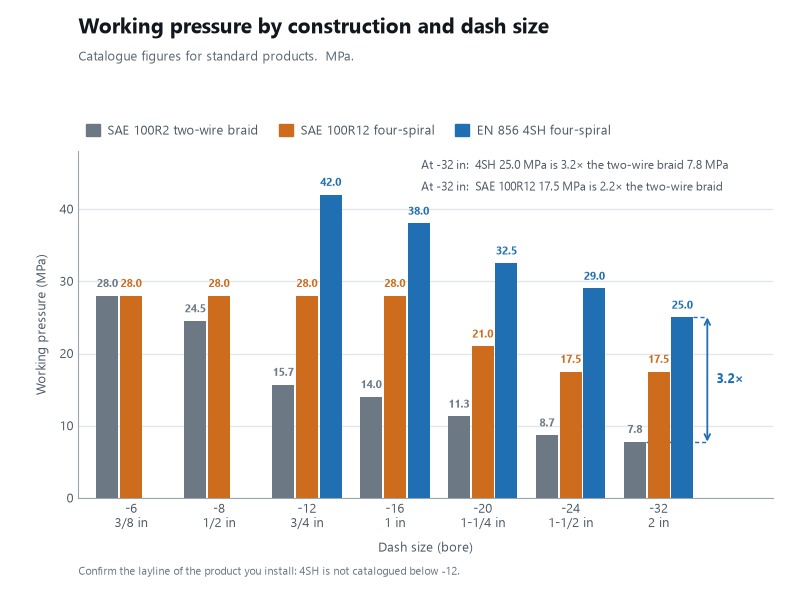
Figure 4. The braid-to-spiral pressure gap widens with bore: at -32 the difference is above three times for four-spiral 4SH.
Why Does Impulse Life Matter More Than Burst Pressure in Mining?
Impulse life predicts field life in mining because underground machines cycle constantly. Hose does not fail from steady pressure; it fails from the fatigue that accumulates each time pressure rises and falls, which is why the construction standard’s impulse test, not its burst test, is the test that predicts service life:
- What the impulse test does. The hose is cycled between low and high pressure at an elevated fluid temperature for a defined number of cycles, and must show no leakage and no failure of the reinforcement.
- What we measure. Our four-spiral R12 construction completes more than 500,000 impulse cycles to SAE J343 at 133 percent of working pressure and 93 degrees C for sizes through 25 mm, and more than 400,000 cycles for the 31.5 mm to 51 mm sizes.
- What it means at the face. A roof support or shearer circuit that spikes several times a minute accumulates cycles faster than a surface machine, so the spiral hose’s longer impulse life converts directly into fewer unplanned changes.
- What to record. Track replacement by operating hours per circuit rather than by calendar, and the impulse data tells you where to set the interval. Our guide to impulse life testing covers how the test is set up.
6. Which MSHA Approved Hydraulic Hose Fits Which Mining Machine?
If you are replacing hose on a roadheader in a coal mine and the cover keeps wearing through, machine type should decide the construction rather than pressure alone, because the dominant failure mode differs: abrasion on a roadheader, impulse fatigue on a shearer, and crush damage on a shuttle car. Catalogues and site paperwork usually call an accepted hose approved; the regulated term for it is acceptance, and this section treats the two as the same product.
Typical construction and bore by mining machine circuit. Bore ranges are common practice, not limits.
| Machine or circuit | Typical construction | Typical bore | Dominant failure mode |
|---|---|---|---|
| Shearer ranging arm | EN 856 4SH or SAE 100R13 | DN25 to DN32 | Impulse fatigue from continuous cutting load |
| Shield and roof support | SAE 100R12 or EN 856 4SH | DN12 to DN25 | Impulse fatigue and fitting leakage from frequent cycling |
| Roadheader and continuous miner | SAE 100R12 | DN19 to DN25 | Abrasion and impact from rock and coal contact |
| Load-haul-dump and shuttle car | SAE 100R2 or EN 853 2SN | DN12 to DN19 | Crush and kink damage in confined tramming routes |
| Roof bolter and drill rig | SAE 100R2 or SAE 100R1 | DN10 to DN16 | Flexing fatigue at the feed and boom joints |
| Conveyor and crusher hydraulics | SAE 100R12 or SAE 100R2 | DN16 to DN25 | Heat and continuous low-amplitude cycling |
| Pump and reservoir suction or return | SAE 100R4 suction and return | DN19 to DN51 | Collapse under vacuum and external abrasion |
The same logic carries over to surface operations, and our hose selection for mining page sets out how the range breaks down across open-pit, highwall and longwall duty. For the high-impulse circuits the table points to spiral construction, and the SAE 100R13 spiral hose page lists the sizes and pressure steps.
The suction and return line in the last row deserves a warning. It is the one place in a mining circuit where a pressure hose is the wrong answer, because a pressure hose collapses under vacuum and starves the pump. Our separate hydraulic suction hose guide covers the R4 family, its vacuum rating and its own MSHA-accepted flame-resistant version.
7. How Do You Route and Protect Hydraulic Hose Underground?
If the hose on your roof support keeps failing at the same bend, the routing is usually the cause. Roughly half the hose failures we examine in mining service are installation problems rather than product problems, and most of those are abrasion, heat or a bend that was tighter than the hose allows:
- Respect the minimum bend radius. Catalogue figures are generous compared with what fits in a machine frame: a 3/4 inch two-wire braid hose has a minimum bend radius of 240 mm, and a 2 inch EN 856 4SH four-spiral hose needs 700 mm. Keep the installed bend at or above that minimum; change the hose or change the route instead.
- Allow for length change under pressure. Hose shortens or lengthens as pressure is applied, so leave slack rather than installing it taut. Our bend radius calculation guide gives the working method.
- Clamp at intervals and keep the clamps off the bend. Support the hose at regular intervals and keep clamping out of the bend zone, using clamps rated for the hose diameter and the torque the maker specifies.
- Separate hose from hot surfaces. Exhaust and turbo areas harden a cover from the outside, and a hardened cover cracks rather than flexes.
- Route away from tramming paths. Where that is impossible, add mechanical protection rather than accepting the contact.
- Avoid twist on installation. Mark the centreline before fitting and confirm the mark is still true after tightening, because a twisted hose pulls its own fittings loose.
When Do You Need an MSHA Hose Sleeve?
A sleeve is worthwhile when the hose is exposed to a hazard it cannot be routed away from, and it is the cheapest way to keep a certified hose compliant while making it survive longer:
- Abrasion from rock, coal and machine parts. The sleeve takes the wear that would otherwise open the cover and expose the steel wire to corrosion.
- Pinhole leaks and burst containment. A properly specified sleeve system contains a pinhole leak and holds burst fluid and energy, which matters most where a miner works within reach of the hose. Our GUARDSPINE containment sleeving system is rated to contain bursts up to 10,000 psi and pinhole leaks up to 5,000 psi at 250 degrees F for up to five minutes, and discharges fluids at the hose ends through channel clamps so a failure becomes visible instead of invisible.
- Flame exposure and molten splash. Fire sleeves add a barrier where a hose passes close to a heat source or a weld zone.
- Accepted conduit where the specification calls for it. Hose conduit is accepted by MSHA separately under 18.65, so where the site specification requires accepted conduit, the conduit carries its own acceptance number.
Match the protection to the hazard rather than to habit; our guide to hose protection sleeve selection sets out the sleeve types against abrasion, heat and impact.
8. What Goes Wrong with Mining Hydraulic Hose, and How Do You Inspect It?
Underground service produces a predictable set of failure modes, and each one leaves an inspection signature you can see before the hose fails.
Common failure modes on hydraulic hose in mining service, what causes them, and what to look for.
| Failure mode | Usual cause | What you look for |
|---|---|---|
| Cover abrasion through to the wire | Contact with rock, coal or machine structure | Bare or rusty wire visible along a wear flat |
| Cover cracking and hardening | External heat, ozone and age | Fine cracks that open when the hose is flexed by hand at ambient temperature and zero pressure |
| Fitting pull-off or leakage | Twist in installation, pressure spikes, wrong crimp | Fluid weeping at the crimp, movement between hose and shell under load |
| Reinforcement fatigue and burst | Impulse cycles accumulated beyond the construction’s capability | Localised swelling or a soft section you can feel with the circuit depressurised |
| Kink or flattening at a tight bend | Bend radius below the catalogue minimum | A visible crease, and reduced flow with rising oil temperature |
| Tube degradation from the fluid | Wrong tube compound for the fluid, or the wrong fluid for the hose | Swelling, softening or blistering of the inner tube found on removal |
| Suction collapse and cavitation | A pressure hose used on a suction line, or a blocked strainer | Flat spots on the suction hose, pump noise and aeration of the oil |
Key details in the inspection routine:
- Inspect at zero pressure and near operating temperature. A cover judged cold at zero pressure will over-report cracking, because a cold rubber cover is stiff. Flex the hose by hand once, at the temperature it runs at, and judge it then.
- Check the whole hose, not the visible half. The failure is usually where the hose is hardest to see, at the clamp, the bend or the fitting.
- Record the acceptance number in the inspection log. It makes each hose traceable to a construction and a test record, which matters when the same machinery is spread across several sites.
- Replace on evidence, not on the calendar. Cover cracking, exposed wire, weeping crimps and soft sections are evidence. Age alone is not, though a hose in continuous service deserves a review at the interval set by its own history.
- Replace a failed hose. A hose that has failed at pressure is replaced, and a damaged cover over exposed wire is replaced rather than wrapped and returned to service.
The full procedure, with the failure signs in order of severity, is in our hydraulic hose inspection checklist, and the troubleshooting logic for a circuit that keeps eating hoses is in our hose failure causes guide.
9. What Does an MSHA Hydraulic Hose Cost, and How Do You Buy It?
The accepted cover is a modest part of the price of a fire resistant hydraulic hose. What actually moves the number is construction, bore, end fittings and volume, in that order:
- Construction. A four-spiral 4SH or R12 hose costs materially more per metre than a two-wire braid hose of the same bore, and at large bore the difference is substantial because the wire content rises with diameter.
- Bore. Price rises steeply above one inch, both in hose and in the fittings needed to terminate it.
- End fittings and assembly. Crimped assemblies cost more than hose by the reel, but they remove field assembly error, and 100 percent proof testing before shipment is worth more on an underground machine than the saving on loose hose.
- Cover specification. A flame-resistant accepted cover adds cost, and it is the one line item you should never trade away on a gassy mine site.
- Volume, lead time and stock. Stock sizes and standard reels ship fastest; custom lengths, coloured covers, conductive or antistatic compounds, private labelling and custom packaging add lead time.
- What to state on the enquiry. Bore and dash size, working pressure your relief valve is set to, fluid type, expected fluid temperature, environment, end fitting type, required length, quantity, and whether the site requires a flame-resistant cover with a current acceptance number.
How Do You Verify an Acceptance Number Before You Buy?
Ask for the information in writing, then check it, because MSHA’s own published lists show how many listed products have changed hands over the years:
- Ask for the acceptance number and the exact hose construction to which it attaches. A number attached to a different cover compound is not your number.
- Ask for the marking text and interval. The delivered hose should read “Flame-Resistant, USMSHA No. ____” with the correct number at intervals not exceeding 3 feet.
- Check the number against MSHA’s published accepted-product lists. The lists are public, are updated periodically, and include notes where a listing has been transferred to another company or the original holder has gone out of business.
- Confirm the pressure data separately. The layline, the datasheet and the proof test record should agree; the acceptance says nothing about pressure.
- Get the sleeve and conduit acceptance too, if you are buying protection. Conduit is accepted separately, so its number is a separate line on the quotation.
10. Frequently Asked Questions
Is MSHA hydraulic hose the same as MSHA approved hydraulic hose?
In everyday use the two phrases mean the same product, but the regulation is more precise. 30 CFR Part 18 uses “approval” for completely assembled machines and accessories, “certification” for components, and “acceptance” for hose and hose conduit listed as flame resistant. When you buy, the document that matters is the acceptance, and it is identified by the marking “Flame-Resistant, USMSHA No. ____” on the cover.
I need a replacement for a 1 inch return line on a roof support before the next shift: what do I order?
Order against the acceptance number first when the shift window is tight, since the number is what makes the replacement like-for-like. Take the bore and pressure from the relief valve setting on that return circuit rather than from the pump figure, since a return circuit can be set above what a return line is assumed to see, and state the fluid and working temperature when you order. On a roof support, a return line that doubles as the pump suction line is the one place a braid hose will not do; specify the R4 suction and return family there. Record the number against the hose position for the next swap.
I am building a roadheader for a gassy mine and must submit hose documentation: what do I hand over?
For a submission, form matters as much as content. An OEM reviewer works from documents: hand over a written acceptance confirmation tying the number to the construction in the bill of materials, the flame test record issued by the holder of the listing, and a drawing showing where the cover marking sits on the delivered hose.
I stock hydraulic hose for mine customers: how many MSHA-accepted constructions should I hold?
Group your stock by the machines your customers run rather than by a target number of stock lines, because acceptance is granted per construction and does not carry across a family. The machine table in this guide gives the grouping, so the practical minimum is one accepted construction for each duty group. Hold both a braid and a spiral construction in the bores you sell most, because at the same bore the two are not interchangeable and the pressure table above is what sets that choice. Track replacement by operating hours per circuit rather than by calendar, so stock turns on evidence.
This is my first MSHA hose order: how do I check the supplier’s acceptance claim before I pay?
Three failures will tell you the claim does not hold: a number that does not match the construction you ordered, a cover marking that disagrees with the paperwork in wording or interval, and pressure data that does not reconcile between the layline, the datasheet and the proof test record. Ask for written confirmation of all three before you pay. If any one of the three cannot be produced in writing, treat the claim as unverified.
What are the MSHA hydraulic hose requirements a supplier should be able to prove?
A supplier should be able to show four things: the acceptance number and the exact construction it covers; the flame test result behind it, which under 18.65 requires an average flame duration of no more than 1 minute after the flame is removed and an average afterglow of no more than 3 minutes across four specimens; the marking text and its interval on the delivered cover; and the separate pressure, temperature and impulse data from the construction standard. Any table that lists only the first three and calls them all MSHA requirements is mixing standards.
Does an MSHA acceptance number expire?
MSHA publishes its accepted-product lists with notes that record transfers of ownership and companies that have gone out of business, so an old number can be genuine and still unusable in practice. Treat the number as evidence of a test, not as evidence that the hose you were quoted today is the hose that was tested, and ask for the number that applies to the cover compound in your order.
Can I use an antistatic hydraulic hose and a flame-resistant hose as one item?
They are different properties and they are proved differently. Flame resistance is what MSHA acceptance under 18.65 establishes. Conductivity or surface resistance is a data-sheet value that some mine specifications require, and it belongs in the specification as a separate line. If your site calls for an antistatic hydraulic hose, state the required value and the test method on the enquiry rather than assuming an accepted cover supplies it.
How do I inspect a mining hydraulic hose?
Inspect at zero pressure, near operating temperature, with the hose flexed once by hand, and check the whole length including clamps, bends and fittings. Look for exposed wire, cover cracks that open on flexing, weeping crimps, soft or swollen sections, and flat spots on suction lines. Record the acceptance number and the position of each hose you inspect.
Which fluid should I use with an MSHA flame-resistant hose?
The fluid and the hose are separate decisions. Mineral hydraulic oils are the standard duty and give the full temperature range. Water-glycol and water-oil emulsions are workable with pressure and temperature de-rating. Phosphate-ester and HFD-type fluids are not suitable for a standard nitrile-tube hose and need a hose built for them. If the machine runs an MSHA-approved fire-resistant fluid under Part 35, confirm the tube compound with both suppliers before you order.
Why does my 2 inch return hose keep failing?
Large-bore return and drain lines are where hose sized from the machine’s headline pressure goes wrong, because flow, not pressure, sets the bore. A 2 inch two-wire braid hose is rated 7.8 MPa, and a 2 inch four-spiral 4SH hose is rated 25.0 MPa. If the circuit spikes, the braid hose is being cycled near its limit on every valve shift. Check the relief setting on the circuit itself, not on the main system, and consider spiral construction before replacing the hose a fourth time.
Does an MSHA acceptance replace a pressure rating?
No. Acceptance covers flame resistance only. Working pressure, proof pressure, burst pressure and impulse life come from the construction standard such as SAE J517, EN 853 or EN 856, and they are proved by proof and burst testing and by type-tested impulse data. A hose can be accepted and still be the wrong pressure class for your circuit.
Where is MSHA acceptance issued?
Through MSHA’s Approval and Certification Center in Triadelphia, West Virginia, acting through its materials and explosion testing branch. Applications for hose and hose conduit acceptance are made under 30 CFR 18.65, and the resulting listings are published as accepted-product lists that buyers can check.
What does the marking on the hose cover have to say?
The cover must carry “Flame-Resistant, USMSHA No. ____”, with letters and numbers at least 1/4 inch high, applied as impressed letters, raised letters on a depressed background, or printed letters, at intervals not exceeding 3 feet along the hose. If the lettering is absent or the interval is longer, the acceptance cannot be verified from the product.
Do I need an MSHA hose sleeve as well as an accepted hose?
Not for flame resistance, because the acceptance attaches to the hose. You need a sleeve when the hose faces a hazard you cannot route it away from: rock and coal abrasion, a tramming path, a pinhole leak risk next to a person, or local heat. A containment sleeve system is worth its cost where a miner works within reach of a high-pressure line.
Can a thermoplastic hose be accepted as flame resistant?
Yes. SAE 100R7 and 100R8 thermoplastic constructions can be supplied with covers accepted as flame resistant, and they are useful where weight and tight bend radius matter more than heavy abrasion resistance. The acceptance is granted per construction and cover, so confirm the number for the exact thermoplastic hose you are ordering.
11. Final Verdict: Specifying an MSHA Hydraulic Hose in Five Steps
The fast version, for procurement teams under pressure to get a machine back to work:
- Confirm the site requirement. Establish whether the circuit is on a gassy mine machine or tunnel machine that requires a fire resistant hydraulic hose with an accepted cover, or whether an ordinary hose is acceptable.
- Size from the circuit, not the pump. Take the relief valve setting on the circuit itself, add the flow-driven bore check, and choose braid or spiral from the resulting pressure and the impulse duty.
- Match the tube to the fluid. Mineral oil, water-based fluid or an approved fire-resistant fluid each constrain the compound differently, and no cover acceptance changes that.
- Buy the acceptance number, not the adjective. Ask for the number, the construction it covers, and the marking text, and check the number against MSHA’s published lists.
- Protect and inspect what you install. Route to the catalogue bend radius, clamp off the bends, add an MSHA hose sleeve where the hazard cannot be routed away, and inspect at zero pressure near operating temperature.
An MSHA hydraulic hose is not a premium version of a hydraulic hose. It is a hose whose cover has been tested to a specific, published flame test and marked accordingly, and the value of the acceptance depends entirely on the buyer checking that the number, the construction and the fluid all match the machine it is going onto. Get those three right and the flame-resistant cover costs you very little; get them wrong and the acceptance is a label on a hose that fails anyway.
HENGHUA supplies flame-resistant hydraulic hose and hose assemblies for underground and surface mining from our manufacturing base in Tianjin, China. Our hydraulic hose range covers the braid classes SAE 100R1 and SAE 100R2 with their EN 853 1SN and 2SN equivalents, the spiral classes SAE 100R12 and EN 856 4SP and 4SH, and the SAE 100R4 suction and return family, in flame-resistant cover constructions supplied against the acceptance number applicable to the construction you order. Every production length is proof tested before shipment, and the four-spiral constructions complete more than 500,000 impulse cycles to SAE J343 at 133 percent of working pressure and 93 degrees C for sizes through 25 mm. Alongside the hose we supply GUARDSPINE containment sleeving, crimped and reusable fittings, adapters and flanges, and complete factory-made assemblies, so that the hose, the protection and the ends come from one source with one test record. We work with mine operators, OEM machine builders, maintenance workshops and distributors, and we can supply custom lengths, conductive or antistatic cover options, colour-coded covers, private labelling and OEM and ODM programs. If you are specifying for a shearer, roof support, roadheader, load-haul-dump or conveyor circuit, send our engineering team your dash sizes, fluid type, temperature and certification requirements and we will confirm the right construction, state the acceptance position for that construction in writing, and come back with pricing, samples and lead time.
About the author: HENGHUA Engineering Team — hose application engineering and mining service support, Tianjin, China. The team specifies flame-resistant hydraulic hose, assemblies and hose protection for underground coal and metal and non-metal mining equipment, and supports OEM and aftermarket hose programs worldwide.






 English
  Spanish
  Portuguese
  French
  German
  Arabic
  Russian
  Indonesian
  Japanese
  Korean