
Can fuel hose be used for oil? Yes in low-pressure, moderate-temperature oil lines, and no in pressure lines, hot oil circuits and any suction duty. The deciding factor is the hose’s own rating rather than its name. SAE J30, the standard most automotive fuel hose is built to, is titled Fuel and Oil Hoses, and it covers hose for gasoline, oil, diesel fuel, lubrication oil and crankcase vapour. The standard also requires the tube to pass a defined oil-resistance test, so oil service is legitimate inside the printed rating — commonly 50 psi working pressure and 125 °C for the 30R7 grade — and no tube compound survives outside it.
This guide answers the question in the order the decision actually happens. It covers what the fuel hose standard says about oil service, the four limits that decide whether a fuel hose survives oil, a verdict table by application, the failure modes that appear when the match is wrong, and the oil hose options that replace fuel hose where it cannot be used.
It is written for people who have a hose in one hand and a system in front of them: equipment mechanics, fleet maintenance planners, plant engineers, and buyers who need to know whether a specification is acceptable before an order goes out. The same limits apply to a lawnmower owner replacing a fuel line, a farm operator working on a diesel tank, and a boat owner checking a fill or vent hose, because the standard lists mobile, stationary and marine applications in the same sentence.
Can Fuel Hose Be Used for Oil? The Direct Answer
A fuel hose can be used with oil when three conditions are met at the same time. The hose’s own standard or listing must cover oil service, the oil temperature at the hose must stay inside the hose’s temperature rating, and the system pressure including spikes must stay under the hose’s rated working pressure. When any one of those conditions fails, fuel hose is the wrong part, and the fault usually appears as a swollen tube, a weeping joint or a burst.
The table below gives the verdict for the applications that generate most of the questions, with the specific limit that decides each case.
Can fuel hose be used for oil: verdict by application and the limit that decides each case.
| Application | Fuel hose acceptable? | Governing limit |
|---|---|---|
| Gasoline or diesel fuel feed line, small engine or vehicle | Yes — this is the design use | Listed fuel service under SAE J30 |
| Lubricating oil feed or return, warm oil, low pressure | Usually yes, when the hose is listed for oil | Tube oil resistance tested in IRM 903 oil |
| External engine oil cooler line, circulating hot oil | Only where the cooler circuit stays inside the hose rating | Circuit pressure plus oil temperature at the cooler decide, not the tube chemistry |
| PCV or crankcase ventilation line, warm oil vapour | Usually yes, when the hose is listed for oil and vapour service | Vapour and oil mist duty at low pressure; no system pressure present |
| Engine oil pressure line, hot oil typically at 40–80 psi | Нет | 35–50 psi rating and a 100–125 °C ceiling in the common low-pressure designations |
| Turbocharger oil feed or drain line | Нет | Oil temperature above the 125 °C limit of the higher-temperature low-pressure hose |
| Hydraulic return line, typically 150–300 psi | Нет | Pressure rating several times below the circuit pressure |
| Hydraulic pressure line, typically 1,000 psi or more | Нет | Requires wire-reinforced hydraulic hose construction |
| Bulk oil transfer, pump discharge typically at 150–300 psi | Нет | Requires a hose rated for oil transfer duty |
| Waste oil suction with a vacuum pump | Нет | Collapse resistance under vacuum |
| Engine oil drain, gravity flow, ambient to warm oil | Yes in most cases, if oil service is listed | No system pressure and no sustained heat |
| Transmission or ATF cooler line | Нет | Circuit pressure plus an additive package the tube was not tested against |
| Oil burner or heating oil supply line | Only the hose listed for that service | Installation codes for oil-burning equipment |
The verdict pattern is simple: a fuel hose is a low-pressure, moderate-temperature part, and oil service is acceptable only while the application stays inside those two boundaries.
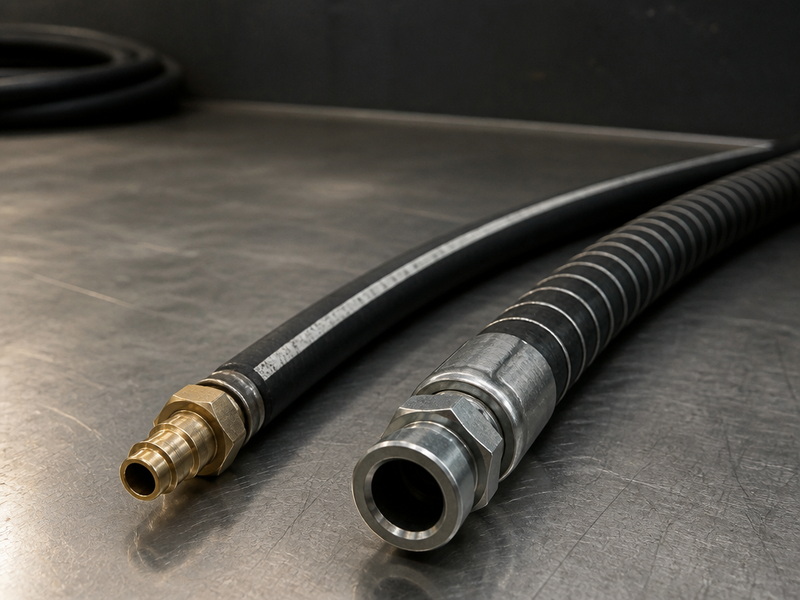
Figure 1. Two parts that look similar and are rated differently: a low-pressure fuel hose with a printed standard marking, and an oil hose with helix wire reinforcement.
What SAE J30 Says About Oil Service
SAE J30 is why the answer to can fuel hose be used for oil is not a flat no. The standard covers fuel, oil and emission hose for use with gasoline, oil, diesel fuel, lubrication oil and the vapour present in the fuel system or the crankcase of internal combustion engines. Its constructions are specified with a fuel- and oil-resistant tube and with a cover that resists oil, ozone and heat.
Oil resistance is a tested property in that standard rather than a marketing phrase. The standard requires fuel resistance and oil resistance testing per ASTM D471, with the oil test run in ASTM IRM 903 oil, and the change in tensile strength, elongation and volume after immersion must stay inside the limits set in the standard’s property table.
The technical basis for the honest answer is the test itself. A hose built to SAE J30 is a fuel and oil hose in the language of the standard, so oil contact is expected, and the real question is whether fuel hose for oil service tolerates the pressure, temperature and duty of your specific oil circuit.
Which Fuel Hose Designations Are Listed for Oil or Lubrication Service
SAE J30 separates its constructions by designation, and the rated pressure and temperature differ enough that the designation matters more than the brand. The table lists the designations the standard’s own application selection guide names, with the rated values stated in the standard.
SAE J30 fuel hose designations with the rated working pressure, temperature or collapse requirement stated in the standard.
| Designation | Typical service | Pressure or burst limit | Temperature or collapse requirement |
|---|---|---|---|
| SAE 30R5 | Wire-inserted fuel and oil filler and vent hose for mobile, stationary and marine use, uncoupled and clamped in service | No working pressure maximum stated for the designation; a burst minimum and a vacuum change limit apply instead | Resistance to collapse is a specified requirement; the helical wire holds the bore in curved routing and under negative pressure |
| SAE 30R6 | Low-pressure coupled or uncoupled fuel and oil hose | 0.34 MPa (50 psi) up to 3/8 in; 0.24 MPa (35 psi) above 3/8 in; 0.11 MPa (16 psi) above 1 in | Up to 100 °C |
| SAE 30R7 | Low-pressure fuel and oil hose, the common automotive grade | 0.34 MPa (50 psi) up to 3/8 in; 0.24 MPa (35 psi) above 3/8 in | Up to 125 °C |
| SAE 30R8 | Low-pressure fuel hose for higher heat duty | 0.34 MPa (50 psi) up to 3/8 in; 0.24 MPa (35 psi) above 3/8 in | 135 °C continuous, 150 °C intermittent |
| SAE 30R9 | Fuel injection, medium pressure | 0.69 MPa (100 psi) up to 1/2 in | −34 to 135 °C, 150 °C intermittent |
| SAE 30R10 | In-tank, low pressure, uncoupled | 0.69 MPa (100 psi) up to 1/2 in | −34 to 100 °C, 125 °C intermittent |
| SAE 30R11 | Low-permeation fill, vent and vapour hose | Low pressure, 14.5 kPa service | −40 to 100 °C (T1) or 125 °C (T2) |
| SAE 30R12 | Low-permeation fuel feed and return | 1.0 MPa (145 psi) | −40 to 100, 125, 135 or 150 °C by T1 to T4 category |
| SAE 30R14 | Low-pressure hose for small engines | 0.34 MPa (50 psi) up to 3/8 in; 0.11 MPa (16 psi) above 1 in | 100 °C (T1) or 125 °C (T2) |
Three figures in the SAE J30 designation table above decide most real-world cases. The 50 psi ceiling on the common low-pressure designations rules out any oil line that carries system pressure, and the 100 °C and 125 °C ceilings rule out hot engine oil and turbo oil. The permeation requirement of 100 g/m²/day or less, tested by the recirculation method with CM15 fuel at 60 °C on the low-permeation designations, shows how tightly the standard defines fuel behaviour — and no equivalent permeation limit is defined for an oil line built from fuel hose.
The single most useful pair of numbers before any substitution is the designation’s own rating. A hose marked SAE 30R7 — written SAE J30R7 on some laylines — is rated to 125 °C and to 50 psi in 3/8 in bore, and those two figures answer most questions about warm oil service without further research.
Why Higher Ethanol or Oxygenate Content Changes the Calculation
Fuel hose performance is tied to the fluid it is tested against, and the standard states this explicitly. Exposure to gasoline or diesel fuel containing more than 5% by volume of oxygenates such as ethanol, methanol or MTBE may result in significantly higher permeation rates than the rates listed for the low-pressure designations.
Oil circuits raise the same class of issue in a different way. Oil carries detergents, anti-wear additives and oxidation products. The IRM 903 oil immersion test qualifies the tube for oil contact; it does not set a service life. Where oil runs continuously at the top of the temperature band, treat the tested compound as qualified for the fluid and unqualified for the duty until the application is reviewed.
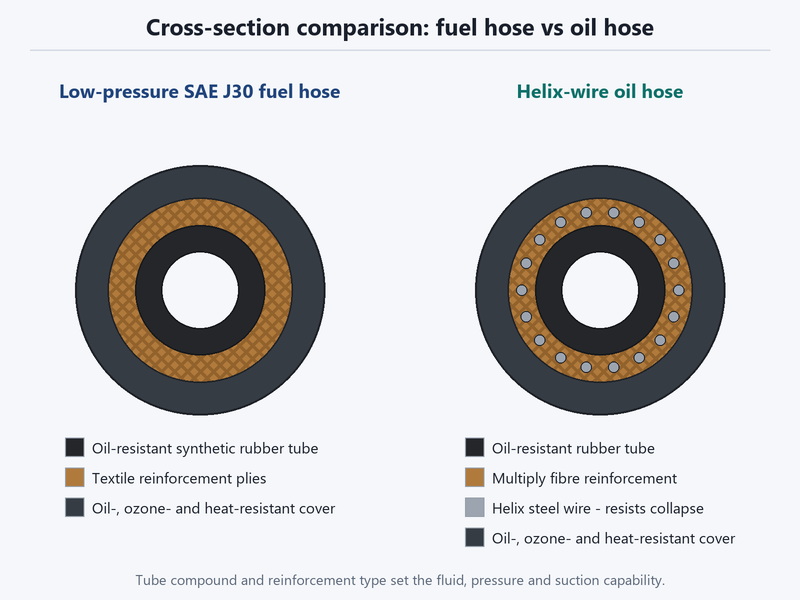
Figure 2. Construction comparison: a textile-reinforced low-pressure fuel hose and a helix-wire oil hose. The tube compound and reinforcement type, not the outside diameter, set the fluid and pressure capability.
Scope: what these limits cover. The limits below apply to low-pressure automotive fuel hose and to oil duties that stay inside its printed rating. Silicone hose is a different family with its own temperature class and its own fluid list, and it is not one of the designations covered here, so it is specified from its own manufacturer’s data rather than from this guide.
Shelf life is not service life. Storage life is counted from the date of manufacture rather than from the date of fitting, and the standard’s own figures differ by shelf-life class: MIL-HDBK-695 gives 6 years for military hose, and the Rubber Manufacturers Association figure for industrial hose is 7 years. A hose that has already been in service is judged by inspection rather than by age, and one that has run above its temperature rating is treated as degraded regardless of when it was made.
The Four Limits That Decide Whether Fuel Hose Handles Oil
Four limits decide the outcome. Pressure, temperature and tube compound cover the fluid side of the problem, and suction duty together with the assembly method covers the mechanical side. Almost every case where fuel hose fails in oil service sits inside one of the four.
Limit 1 — Pressure: What Is a Fuel Hose Pressure Rating?
A fuel hose pressure rating is the maximum working pressure printed on the hose or listed in its data sheet, and for low-pressure automotive fuel hose it is measured in tens of psi rather than hundreds. The common low-pressure designations are rated at 0.34 MPa (50 psi) up to 3/8 in bore, 0.24 MPa (35 psi) above 3/8 in, and as low as 0.11 MPa (16 psi) above 1 in bore in the R6 designation.
Compare that with the circuits people commonly want to run oil through. Engine oil pressure at operating temperature typically sits inside 40 to 80 psi, and cold-start pressure runs higher. Hydraulic return lines commonly run at 150 to 300 psi, and hydraulic pressure lines run from several hundred to several thousand psi.
Bulk oil transfer hoses are generally rated at 150 to 300 psi for pump discharge, which is another pressure band well above a low-pressure fuel hose rating. The fuel hose pressure rating is therefore the first figure to check, and it is printed on the cover of any hose built to a current standard.
The checks that settle the pressure question are short:
- Read the working pressure marking on the hose, not the burst pressure
- Check the system relief valve setting, which is the true ceiling the circuit can reach
- Account for pressure spikes from valve closure and cold-start viscosity
- Confirm the hose is not being reused where circuit pressure has been raised since it was fitted
Limit 2 — Temperature: Where Hot Oil Goes Past the Rating
Fuel hose temperature ratings are quoted for fuel service, and oil circuits often run hotter than the fuel the hose was rated against. The low-pressure designations reach 100 °C for R6, 125 °C for R7 and 135 °C continuous with 150 °C intermittent for R8, while the medium-pressure R9 fuel injection hose is rated −34 to 135 °C with 150 °C intermittent use.
Hot engine oil spends much of its life in the upper part of that band and can exceed it. Sump oil in a working engine commonly sits near 100 °C, and cylinder-head and turbocharger feed oil runs hotter. A hose routed close to an exhaust manifold or turbo housing sees radiant heat on top of fluid temperature.
Which number should the comparison use? A fuel hose is rated for fluid temperature rather than for radiant load, so the deciding value is the hottest surface along the routing, not the reading on the gauge. A hose marked SAE 30R7 is rated to 125 °C, and that figure leaves no margin for radiant load from a nearby exhaust run even when the oil temperature reads acceptable.
The temperature checks worth making before installation are these:
- Measure oil temperature at the hottest operating condition, not at idle
- Add radiant heat from exhaust, manifold and turbo surfaces along the routing
- Compare the worst case against the continuous rating, not the intermittent figure
- Treat a hose that has already run hot as degraded, since heat aging is cumulative
Limit 3 — Tube Compound: Swelling, Extraction and Additive Attack
Tube compound decides chemical compatibility, and the practical failure is swelling rather than a dramatic melt. Nitrile rubber, the NBR compound used in most automotive fuel hose and hydraulic hose tubes, has good resistance to petroleum fluids, and NR/SBR compounds are used in fuel oil and diesel transfer hose. Chloroprene, written CR or neoprene on a data sheet, is a third compound that appears in oil hose tubes and covers, and it is declared with its own fluid and temperature list. What differs between compounds is how much the tube swells and how much strength it loses after immersion.
Two mechanisms drive oil-related tube failure. The first is swelling, where the tube absorbs oil and grows, which reduces the bore, softens the elastomer and loads the reinforcement. The second is extraction, where oil pulls plasticisers out of the compound and leaves the tube hard, cracked and prone to flaking into the circuit.
The SAE J30 oil-resistance test is designed to catch exactly this. Immersion in IRM 903 oil is followed by measurement of the change in tensile strength, elongation and volume, and the limits are set so a hose passing the test still has usable strength after oil contact. A hose with no oil-resistance statement has not been checked against that question at all.
The practical indicators of tube distress are these:
- A cover that has blistered or swollen, which usually follows tube swelling
- A tube surface that is soft, sticky or spongy at the cut end
- Flaking or crumbling material inside the bore or at the fitting
- A hose that has become noticeably stiffer or harder along its length
- Oil that darkens unusually fast, suggesting additive or plasticiser transfer
Limit 4 — Vacuum and Assembly: The Part People Skip
Suction duty and assembly method fail a fuel hose even when pressure and temperature look acceptable. A fuel hose drawing oil through a vacuum pump collapses unless it has internal support. Within SAE J30, the wire-inserted construction is SAE 30R5, listed for fuel and oil filler and vent duty on mobile, stationary and marine equipment and specified for applications where resistance to collapse is desirable; the low-pressure designations 30R6, 30R7 and 30R8 carry textile reinforcement only. Treat 30R5 as the wire-inserted exception, and treat 30R6, 30R7 and 30R8 as unsuitable for sustained suction.
SAE J30 does include a vacuum collapse test for most constructions, run on a 915 mm straight length at −67.5 kPa for 15 to 30 seconds, with the requirement that no diameter decrease by more than 20%. The in-tank designation SAE 30R10 is the construction the standard names as exempt from vacuum testing, which is why an in-tank fuel hose is a poor candidate for any suction line. Where a hose is used for suction without support, the visible result is a flattened section, restricted flow, and a pump that cavitates.
Assembly adds its own failure mode. Fuel hose is commonly supplied uncoupled and secured with clamps on barbed fittings, which is adequate for fuel at 50 psi and marginal for oil at higher pressure and temperature. Oil softens the tube, the clamp holds a tube that is now softer, and weeping starts at the joint.
The clamp side can fail on its own as well. A worm-gear clamp loses preload under vibration and heat cycling, so a joint that was tight when fitted can loosen without the hose changing at all. Check clamp torque at the first service interval. Crimped assemblies with matched hose and coupling systems are the reliable option wherever an oil circuit carries sustained pressure.
Can Fuel Hose Be Used for Oil in These Four Applications?
The verdict table covers the pattern, and these four cases deserve the reasoning written out. They are the questions people search for by name when they are considering fuel hose for oil service, and each one is decided by a different limit.
Can Fuel Hose Be Used for Hydraulic Oil?
Not in a hydraulic pressure or return line, and the reason is the pressure ratio rather than the fluid. Hydraulic oil is mineral oil, which the tube of a fuel hose can generally tolerate chemically, but the pressure does not transfer. A hydraulic return line in the SAE 100R and EN 853 classes typically runs at 150 to 300 psi, and a pressure line runs above that. Both sit far above the 35 to 50 psi rating of typical low-pressure fuel hose. Hydraulic hose reinforcement is wire braid or spiral rather than textile, which is what carries that pressure.
Hydraulic systems also produce pressure spikes, and the textile reinforcement in a fuel hose does not carry them. The correct part is a wire-reinforced hydraulic hose in the right pressure class, with a tube compound matched to the oil and to the circuit temperature.
Can You Use Fuel Hose for Engine Oil in an Emergency?
A short-term repair on a low-pressure oil return or a drain line can work when the hose is marked for oil service and the oil is cool, but an engine oil pressure line is not a safe emergency repair. Oil pressure lines typically run at 40 to 80 psi in normal automotive service with higher cold-start peaks, which is above the 50 psi rating of the common low-pressure designation, and leaking oil onto hot exhaust surfaces creates a fire risk that ends the roadside-repair argument.
Where a field repair is unavoidable, keep it to lines that return oil at low pressure, secure it properly, and inspect it after the first heat cycle. Replace it with a correctly rated oil hose as soon as one is available, and treat the repair as a way to move the machine to a workshop rather than as a specification change.
Will a Fuel Hose Work for Diesel or Heating Oil?
Yes for diesel fuel service, because diesel and fuel oil (the distillate also sold as heating oil or gas oil) are part of the design use of fuel hose for diesel lines and of dedicated fuel oil transfer hose, and no for heating oil lines where installation codes apply. A diesel fuel line is a fuel line, so a hose supplied as fuel hose for diesel service is operating in its intended application.
Heating oil and burner supply lines are governed by installation rules for oil-burning equipment, and the accepted hardware for that service is the specified oil line rather than a general-purpose fuel hose. Diesel transfer also brings a temperature question: fuel oil and diesel transfer hose is commonly rated to around 80 °C, which suits pump discharge into a tank. Above that figure the line belongs to a hot-oil circuit and to the oil hose families in the next section.
Can Fuel Hose Be Used for Transmission Fluid?
No, and this is one of the clearer cases. Automatic transmission fluid and power steering fluid are mineral oils carrying additive packages that include friction modifiers and seal conditioners, and cooler lines and power steering circuits commonly run at pressures above a low-pressure fuel hose rating.
The fluid also attacks the tube in a way that fuel service does not test. A transmission fluid line needs a hose specified for that fluid at that pressure and temperature, which in practice means a hydraulic or dedicated oil hose from the same family as the original assembly.
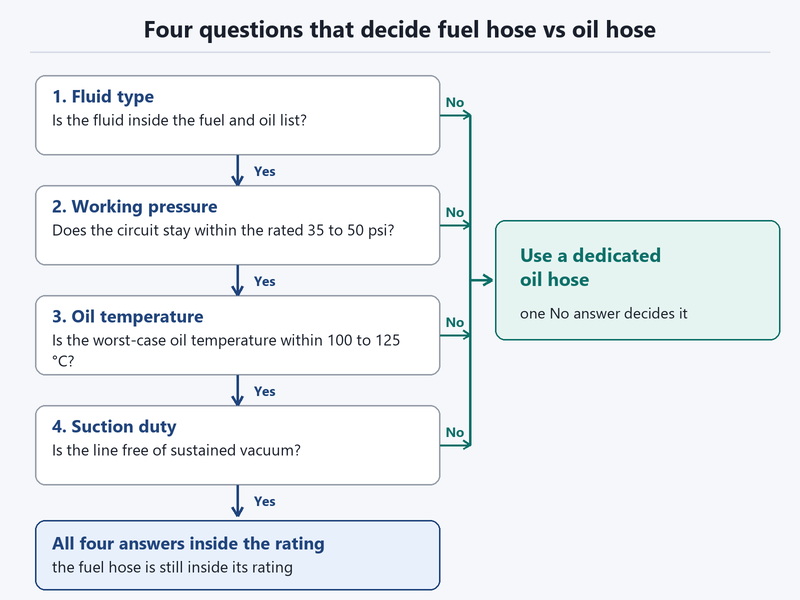
Figure 3. The four-question check that replaces guesswork: fluid type, working pressure, worst-case oil temperature, and whether the line is under suction.
If the line you are replacing carries oil at system pressure, our hydraulic oil hose selection guide walks through the pressure class and temperature class you need before you buy.
Fuel Hose vs Oil Hose: Which Differences Decide a Substitution?
The fuel hose vs oil hose comparison is usually framed as a materials question, and that is where it goes wrong. Both families commonly use an oil-resistant synthetic rubber tube and an oil-, ozone- and heat-resistant cover, so a comparison based on materials alone does not separate them.
The differences that matter are rated pressure, rated temperature, reinforcement type, suction capability and the standard the hose is declared against. The table puts the two families side by side for general industrial work.
Fuel hose against a dedicated oil hose: the differences that decide whether a substitution is safe.
| Property | Low-pressure fuel hose | Dedicated oil hose |
|---|---|---|
| Primary media | Gasoline, diesel, lubrication oil, crankcase vapour | Hydraulic oil, lubricating oil, diesel, fuel oil, crude oil |
| Typical maximum working pressure | 0.34 MPa (50 psi) up to 3/8 in; 0.24 MPa (35 psi) above 3/8 in | 1.0 to 2.1 MPa (150 to 300 psi) for transfer duty; far higher for hydraulic constructions |
| Typical temperature range | 100 °C to 125 °C for the common low-pressure designations | −40 °C to +125 °C for standard oil hose, higher with a high-temperature compound |
| Reinforcement | Textile fibre, yarn, cord or fabric | Textile plies with helix steel wire for suction; wire braid or spiral for hydraulic pressure; stainless-steel overbraid for turbo feed lines |
| Suction capability | Not rated for sustained vacuum duty in the textile-reinforced designations; SAE 30R5 is the wire-inserted exception | Helix wire keeps the bore open under negative pressure |
| Typical end connection | Uncoupled, secured with clamps on barbed fittings | Crimped or flanged assemblies with matched couplings |
| Driving standard | SAE J30 | EN 1765 and ISO 1823 for oil suction and discharge; SAE 100R and EN 853 for hydraulic oil |
Substitute in one direction only: specify fuel hose for fuel service and oil hose for oil service, and re-qualify whenever the fluid changes. Oil and hydraulic hose tubes are selected for mineral oil resistance, and a compound that suits mineral oil can swell or soften when it meets gasoline or a high-aromatics fuel. That is why a hydraulic hose is a poor substitute for a fuel line in the other direction, and why the fuel hose vs oil hose question has to be answered in both directions.
What Happens When Fuel Hose Is Used With the Wrong Oil?
Mismatched service produces a small set of recognisable failures rather than random ones, and each one points to a specific limit being exceeded. Reading the pattern tells you whether the cause was pressure, heat, chemistry or assembly.
The failure modes worth knowing are these:
- A swollen, softened tube that reduces the bore and loads the reinforcement, following long oil contact beyond the compound’s resistance
- A blistered cover, which indicates fluid has reached and attacked the reinforcement through the tube
- A hardened, cracked tube with flaking material, caused by plasticiser and additive extraction
- Oil weeping at a clamped joint, caused by a softened tube releasing clamp load
- A collapsed or flattened section on a suction line, from the absence of helix wire support
- A burst with no external damage, from pressure above the rated working pressure or from heat-aged reinforcement
Where does a leak show up first? Cover condition, joint condition and bore condition are the three places to check, and the inspection takes under a minute per hose.
The inspection points that matter on an oil line are these:
- The cover along its full length, looking for blisters, swelling, hardening or cracking
- The joints at both ends, looking for weeping, clamp slip or a tube that has shrunk behind the fitting
- The bore at the cut end, looking for softness, swelling or flaking material
- The routing, looking for contact with exhaust, manifold or turbo surfaces and for any flattened section
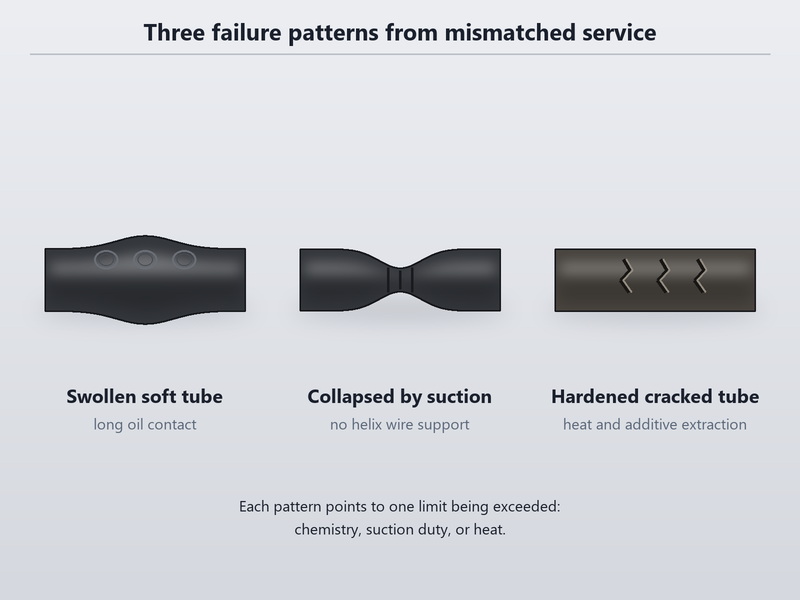
Figure 4. Three failure patterns from mismatched service: a swollen tube, a collapsed suction line, and a hardened tube after heat exposure.
How Do You Verify a Fuel Hose Is Rated for Oil?
Verification takes five steps and about two minutes, and it prevents the substitution error that produces most of the failures above. The starting point is the marking on the cover, because an unmarked hose cannot be checked against anything.
The sequence that answers the question reliably is this:
- Read the marking on the hose cover and identify the designation, for example SAE 30R7
- Look up that designation’s rated working pressure and temperature in the standard or the supplier data sheet
- Measure the worst-case oil temperature and the circuit’s relief pressure, including spikes
- Confirm the tube is declared oil resistant and that the assembly method suits the pressure
- Check whether the line is under suction, which rules out unsupported constructions
The question of fuel hose for oil duty is settled by the marking rather than by appearance. Where the hose marking is illegible, or the supplier cannot state the designation, treat the hose as unspecified. An oil resistant hose is a hose whose resistance is stated and tested rather than assumed from appearance, and the cost of a correctly specified part is a fraction of the cost of the leak it prevents.
When Do You Need a Dedicated Oil Hose Instead?
Three hose families cover the oil duties that fuel hose cannot, and the choice between them follows the pressure and temperature of the circuit. Recognising which family your application belongs to is the fastest way to specify correctly.
The three families and where each one applies are these:
- Oil hose for pump discharge and loading service, typically rated 150 to 300 psi with fibre reinforcement and helix wire, and rated to around 80 °C for diesel and fuel oil
- Oil suction and discharge hose for bulk petroleum movement, specified under EN 1765 and ISO 1823 in four types by service
- Hydraulic hose with wire braid or spiral reinforcement for pressure and return lines, specified under the SAE 100R series and EN 853
A standard oil hose covers hydraulic oil, lubricating oil, diesel, fuel oil and crude oil with an NBR inner tube and an operating range of −40 °C to +125 °C, and high-temperature variants reach higher. Where the fluid is a phosphate ester or the temperature sits above the nitrile range, an oil resistant hose with an FKM tube is the alternative.
For fuel oil and diesel transfer specifically, a medium-pressure hose with an NR/SBR tube, helix steel wire and a weather-resistant cover handles pump discharge and suction at the transfer pressures this duty requires. That is the case our fuel oil rubber hose is built for within the wider oil hose range.
Frequently Asked Questions
Can fuel hose be used for oil?
Yes when the hose is listed for oil service and the application stays inside its pressure and temperature rating, and no when either limit is exceeded. A fuel hose for oil lines that carry no system pressure is a common and acceptable use. A hose built to SAE J30 covers both fuel and oil service and its tube is tested for oil resistance, but the same hose in an engine oil pressure line, which typically runs at 40 to 80 psi, or against oil hotter than 125 °C, is outside the rating printed on it.
Can fuel hose be used for oil in a small engine such as a lawnmower or a generator?
Usually yes, because small-engine fuel systems run at low pressure and the hose is operating in its intended duty. The limits still apply: keep the oil below the hose’s continuous temperature rating, keep system pressure under the rated working pressure, and use a hose that is marked with a designation rather than an unmarked line of unknown origin.
Can fuel hose be used for oil transfer on the suction side of a bulk delivery pump?
Only at low pressure and at low temperature, which rarely matches transfer duty. Bulk oil transfer pumps typically discharge at 150 to 300 psi, above the rating of low-pressure fuel hose, and transfer lines also see suction on the inlet side that an unsupported fuel hose cannot resist. Use a hose rated for oil transfer with helix wire reinforcement instead.
Can fuel hose be used for hydraulic oil in a return line that runs at low pressure?
Not in a hydraulic return line, because a hydraulic return is not a low-pressure circuit: return pressure in this class of system typically sits at 150 to 300 psi, which is above the rating of low-pressure fuel hose. A hydraulic pressure line runs far higher again. The common low-pressure fuel hose designations are rated at 35 to 50 psi with textile reinforcement, so hydraulic oil lines need wire-reinforced hydraulic hose in the correct pressure class.
Is fuel hose the same as oil hose when the application is a warm lubrication line?
They overlap in tube chemistry and differ in rating. Both usually use an oil-resistant synthetic rubber tube and an oil-, ozone- and heat-resistant cover, but oil hose is rated for higher pressures, often includes helix wire for suction duty, and is declared against oil transfer or hydraulic standards rather than against SAE J30.
What happens if you use fuel hose for engine oil on a pressurised circuit?
The hose is used above its rated pressure and temperature, so the likely outcomes are a softened swollen tube, oil weeping at the clamped joint, and eventually a leak or a burst. Hot oil also ages the tube faster than fuel service does. A leak onto a hot exhaust or manifold adds a fire risk to the mechanical failure.
Can I use fuel hose for diesel fuel in a transfer line that also runs under suction?
Yes, diesel is part of the design use of automotive fuel hose and of dedicated fuel oil transfer hose. Check the temperature of the diesel at the point of use, because fuel oil and diesel transfer hose is commonly rated to around 80 °C, and check the pressure, because transfer hose is typically rated in the 150 to 300 psi range rather than the 50 psi of a low-pressure fuel line.
Can fuel hose be used for transmission fluid in a cooler line on a road vehicle?
No. Transmission fluid is a mineral oil with friction modifiers and seal conditioners, and cooler lines and power steering circuits run at pressures above a low-pressure fuel hose rating. Use a hose specified for that fluid at that pressure and temperature.
How do I know if a fuel hose is oil resistant when the cover marking has worn off?
Read the designation marking on the cover and check it against the standard or the supplier data sheet. A hose built to SAE J30 is tested for oil resistance in IRM 903 oil per ASTM D471, with limits on the change in tensile strength, elongation and volume after immersion. If the designation cannot be identified, treat the hose as unspecified.
What working pressure is a low-pressure fuel hose actually rated for at my bore size?
The rated figures depend on both designation and bore, and the designation table above carries them in full. For the R6 designation the rating falls from 0.34 MPa (50 psi) at 3/8 in bore to 0.24 MPa (35 psi) above 3/8 in and 0.11 MPa (16 psi) above 1 in. Medium-pressure fuel injection hose is rated at 0.69 MPa (100 psi) up to 1/2 in, and low-permeation feed and return hose at 1.0 MPa (145 psi).
Can a fuel hose handle hot engine oil at full operating temperature and under pressure?
Only up to the hose’s own temperature rating, which is 100 °C for the R6 designation, 125 °C for R7, and 135 °C continuous for R8. Hot engine oil and turbocharger oil reach and exceed those figures, and radiant heat from exhaust components raises the temperature at the hose surface further. A hose that has run above its rating is degraded even if it still looks intact.
What hose should I use for oil when the circuit carries both pressure and suction?
Match the hose to the duty: a hose rated for oil transfer duty, typically 150 to 300 psi, for pump discharge, oil suction and discharge hose under EN 1765 and ISO 1823 for bulk petroleum movement, and wire-reinforced hydraulic hose for hydraulic oil pressure and return lines. Above the nitrile temperature range, specify a high-temperature or FKM tube.
Getting the Right Hose for Oil Service
On the question that opened this guide — can fuel hose be used for oil — the answer is a specification check rather than a rule of thumb. Fuel hose and oil hose share tube chemistry because SAE J30 covers both fuel and oil service, which is why the substitution is acceptable in low-pressure, moderate-temperature oil lines where the hose is listed for oil. It fails in pressure lines, hot oil circuits, suction duty and transfer service, where the rating rather than the material is the limiting factor.
HENGHUA manufactures oil hose, fuel oil transfer hose and hydraulic hose for construction, mining, agricultural, marine and industrial equipment, supplying equipment builders, distributors and fleet operators worldwide. The oil hose range covers NBR tube constructions from 3/16 inch to 4 inch bore with an operating range of −40 °C to +125 °C and high-temperature variants for hotter circuits, and the fuel oil transfer hose line uses an NR/SBR tube with helix steel wire for pump discharge and suction at 150 to 300 psi.
Every assembly is built with matched hose and coupling systems and pressure tested before shipment, with production records traceable to the batch. Because extrusion, reinforcement, covering and testing are handled in house, we can review a failed hose from your field returns and identify whether the correct fix belongs in the tube compound, the pressure class, the routing or the system itself. Standards cited in this guide are referenced to their current published editions.
I need one hose that works for both diesel and hydraulic oil on the same machine — what should I specify?
Treat them as two circuits rather than one part. Diesel and hydraulic oil differ in pressure, temperature and contamination sensitivity, so the diesel side needs a hose rated for fuel oil transfer at the transfer pressure, and the hydraulic side needs a hydraulic hose in the correct pressure class. One compromise hose for both duties usually means the pressure duty is under-specified, which is where failures concentrate.
If you are replacing fuel hose on an oil circuit, or specifying a hose for oil transfer, send us the fluid, the maximum working pressure including spikes, the worst-case oil temperature, the bore size and whether the line is under suction. Our engineering team will confirm whether the hose you have is rated for the duty or recommend the correct construction — contact our engineering team or review the oil hose selection guide for the wider range.
For related reading, the oil resistant hose guide covers compound selection across petroleum media, the fuel transfer hose guide covers transfer duty in detail, and the oil hose working pressure and burst pressure guide explains how the pressure rating and the burst margin relate for oil service.
Ratings, temperature limits and standard references in this guide are reviewed on a quarterly cycle; the designation table and the oil-resistance test references were last checked against the current published edition of SAE J30 on 19 September 2026.
About the author: Written by the HENGHUA Engineering Team — hose application engineers and assembly specialists supporting hose selection, coupling and pressure testing for industrial, marine and mobile equipment customers. The oil and fuel hose limits in this guide reflect our production and field service experience with SAE J30, SAE 100R and EN 853 constructions.
Sources and Standards
The technical figures in this guide come from the standards listed below, cited by designation rather than by link. Where a value depends on hose size or construction category, this guide states it the same way the standard does.
The standards referenced are these:
- SAE J30, Fuel and Oil Hoses — application selection guide, Section 3. Designation descriptions with the rated working pressure and temperature of each construction, Sections 4.3 to 4.10. Permeation limits and the CM15 test fuel condition, Sections 4.7 and 4.8. Qualification and inspection test lists, Section 5, including the SAE 30R10 vacuum test exemption in Section 5.1.3.3. Vacuum collapse test conditions, Section 6.4. Fuel resistance, oil resistance and ozone resistance test procedures, Sections 6.9 to 6.11. Shelf life ordering numbers, Section 8
- ASTM D471, Standard Test Method for Rubber Property — Effect of Liquids — the immersion method used for the fuel resistance and oil resistance evaluations
- ASTM D573, ASTM D380 and ASTM D1149 — heat aging, rubber hose test methods and ozone cracking tests referenced by the fuel hose standard
- SAE J1737 — recirculation test used to determine hydrocarbon losses from fuel tubes, hoses and fittings
- EN 1765, Rubber hose assemblies for oil suction and discharge services — service categories for bulk petroleum hose assemblies
- ISO 1823, Rubber hose and hose assemblies for oil suction and discharge — the four types of assembly used for petroleum conveyance
- SAE 100R series and EN 853 — hydraulic hose constructions used where oil service carries system pressure
- MIL-HDBK-695, Rubber Products: Recommended Shelf Life — storage life guidance referenced by the fuel hose standard






 English
  Spanish
  Portuguese
  French
  German
  Arabic
  Russian
  Indonesian
  Japanese
  Korean