
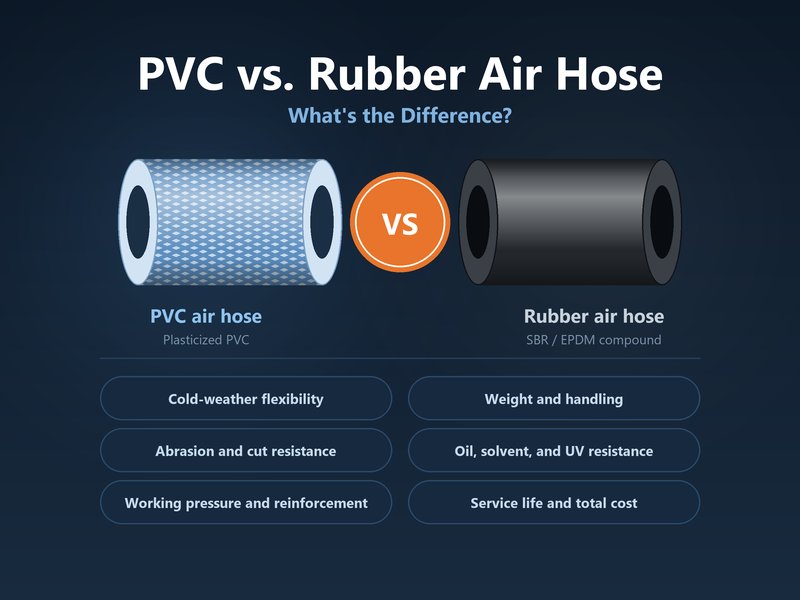
You are asking what separates a PVC air hose from a rubber air hose, and whether the price gap is worth paying. PVC vs rubber air hose differences come down to how each tube compound holds its flexibility. PVC is the lighter, cheaper option; rubber is the one that keeps working when conditions turn cold, oily, or abrasive.
This guide covers what each tube compound is made of, the six differences that change performance in real use, and a specification table you can compare line by line. It closes with a five-year cost calculation for your PVC vs rubber air hose decision, and the cases where the material choice genuinely does not matter. In this article, PVC and rubber mean the tube compound of a compressed-air hose, not PVC pipe or garden hose.
About a 16-minute read at 250 words per minute; rated ranges follow ISO 5774:2023 and ISO 2398:2024.
PVC vs. Rubber Air Hose: The Short Answer
- Choose PVC when you want low cost, low weight, and easy cleaning, and your work happens indoors at normal temperatures with light tools.
- Choose rubber when the hose will be dragged, driven over, left in the cold, or used daily — abrasion resistance and cold flexibility are what you are paying for.
- Choose neither when you need the light weight of PVC with cold-weather flexibility and oil resistance — that combination is what hybrid polymer air hoses exist for.
What Is a PVC Air Hose Made Of?
A PVC air hose has a flexible tube of polyvinyl chloride (PVC), usually with a textile braid reinforcement of polyester or nylon yarn bonded into the wall for strength. PVC is a rigid polymer by nature, so manufacturers add plasticizers — typically 25% to 40% of the compound by weight — to make the tube soft enough to coil.
That plasticizer is the material’s defining weakness. It migrates out of the wall over time, and the hose loses flexibility gradually rather than failing all at once. Plasticizer loss also accelerates with heat, oil, and solvents, which is why a PVC hose that feels supple in year one can feel like a garden stake in year four.
PVC air hose is normally produced to ISO 5774:2023, the international specification for textile-reinforced thermoplastic hose for compressed air.
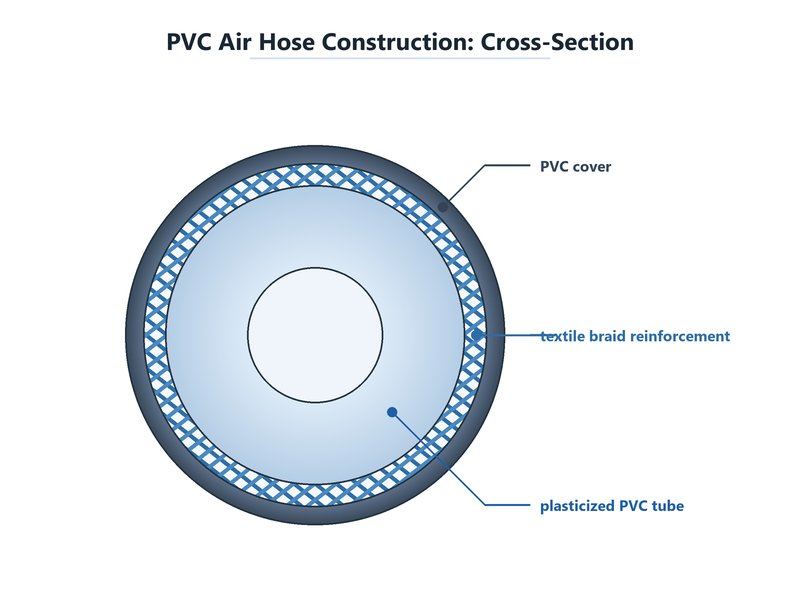
Figure 1. PVC air hose construction: plasticized tube, textile braid reinforcement, thin PVC cover. The plasticizer level sets the initial flexibility; the cover thickness sets abrasion life.
What Is a Rubber Air Hose Made Of?
A rubber air hose uses a compounded rubber tube, commonly a blend of SBR (styrene-butadiene rubber) and EPDM (ethylene propylene diene monomer) for general shop use, and EPDM alone for cold or ozone-exposed duty. The tube is wrapped with textile braid reinforcement or a wire spiral, under a rubber cover. Rubber is cured rather than plasticized, so its elasticity comes from cross-linked polymer chains, not from an additive that can leach away.
That structural difference is the reason a rubber air hose keeps its suppleness far longer than a PVC hose of the same wall thickness. It also explains the weight: rubber compounds for hose sit around 1.1 to 1.2 g/cm³, while plasticized PVC sits around 1.3 to 1.45 g/cm³. A rubber hose also uses more material: a thicker cover and a heavier reinforcement, so the finished hose outweighs a PVC one of equal bore.
Rubber air hose for compressed air is specified under ISO 2398:2024, and rubber hose test methods fall under ASTM D380.
PVC vs. Rubber Air Hose: The 6 Differences That Change Performance
1. Cold-weather flexibility
Plasticized PVC begins to stiffen near 32 °F (0 °C) and becomes difficult to uncoil below about 25 °F (-4 °C); those are practical handling limits, not the rated range. A general-purpose SBR blend is specified for normal shop temperature, while an EPDM rubber air hose is rated to -40 °F (-40 °C) under ISO 2398.
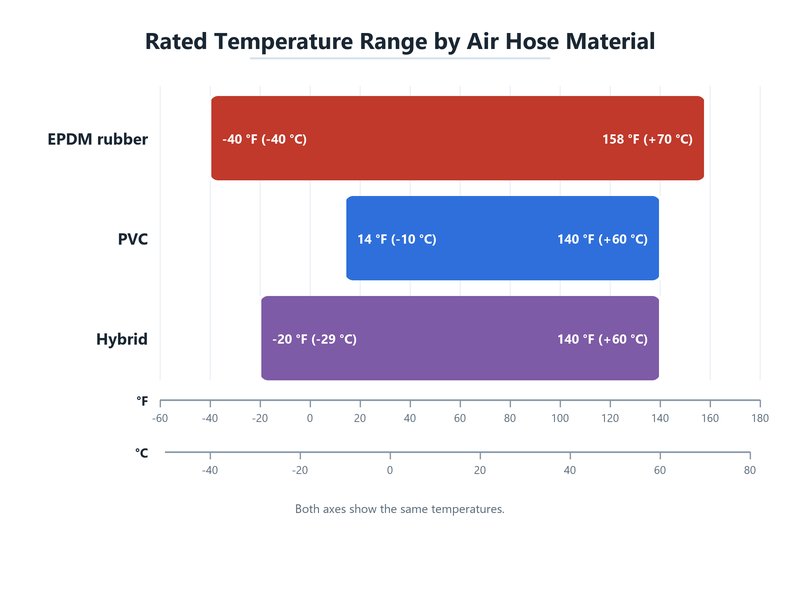
Figure 2. Rated temperature range by air hose material: EPDM rubber holds to -40 °F (-40 °C), PVC is rated from 14 °F (-10 °C), and hybrid sits between the two.
Why it matters: a stiff hose kinks instead of bending, and a kink in an air line is a flow restriction you cannot see from the outside. In a cold garage the practical result is a tool that loses power at the end of a run, not a dramatic failure.
If your workshop drops below freezing, compare cold-weather ratings directly before you compare price — our cold-weather air hose selection guide lists rated materials by temperature.
2. Weight and handling
A 50-foot, 3/8-inch PVC hose typically weighs 4 to 5 lb. The same length in rubber runs 7 to 9 lb; at 4.5 lb against 8 lb, the rubber hose is about 78% heavier. Overhead work, reels, and mobile carts all punish that extra weight.
The lighter hose is not always the easier one to handle. PVC’s lighter weight comes with more coil memory, so it keeps the shape it was stored in. Rubber releases its coil faster and lies flatter, which is why production shops that move hoses all day still choose it.
3. Abrasion and cut resistance
Rubber compounds generally outperform plasticized PVC on abrasion testing, and the gap widens on concrete, gravel, and metal edges. In our own abrasion rig, on 3/8-inch hose at a fixed load, stroke, and cycle rate, the rubber cover reached roughly three times the cycles of a standard PVC cover before the reinforcement became visible.
The mechanism is simple: rubber deforms and recovers under a scraping load, while PVC tends to cut and then propagate the cut. Once a cut reaches the braid, the pressure rating of that section is gone.
4. Oil, solvent, and UV resistance
Standard PVC has poor resistance to oils, greases, and many solvents; the plasticizer is extracted and the tube hardens. Rubber resists oil and solvent contact better, and EPDM is the specified compound for water, steam, and ozone duty. For petroleum-based oil, specify an oil-resistant rubber compound.
UV exposure affects both, but differently. UV accelerates plasticizer loss in PVC and causes surface crazing in unprotected rubber. A black compound with carbon black filler resists UV far better than a bright, lightly filled one, so color is not purely cosmetic.
5. Working pressure and reinforcement
A 3/8-inch PVC air hose is typically rated 200 to 300 PSI working pressure. A rubber hose with textile braid reinforcement of the same bore is commonly rated 300 to 500 PSI. Burst pressure is normally three to four times the working rating for both.
Reinforcement design, not base polymer, sets most of the limit. A two-spiral or braided high-tensile yarn layer raises the rating considerably, which is why two hoses that look identical on the shelf can carry very different printed ratings. Our working pressure vs burst pressure explainer shows how to read those numbers safely.
6. Service life and total cost
Price is the easiest difference to see and the least useful one. A PVC hose usually costs about 54% less than a comparable rubber hose, but in continuous shop use it is commonly replaced two to three times sooner.
Run the arithmetic over five years. A ~$30 PVC hose lasting 1.5 years costs about $20 a year; a ~$65 rubber hose lasting four years costs about $16, and you spend two fewer afternoons chasing leaks. That is the whole PVC vs rubber air hose cost argument in one line. Extend the same arithmetic across a fleet and air hose service life becomes the largest line in the budget, because the labor of replacement is charged every time. Coil memory, by contrast, is the one difference you notice on the first cold morning.
PVC vs. Rubber Air Hose: Specification Comparison
Table 1. Typical specification ranges for a 3/8-inch air hose with textile braid reinforcement, by tube material. Values are typical manufacturer ranges; the printed rating on the specific product is the governing figure.
| 속성 | PVC air hose | Rubber air hose |
|---|---|---|
| Base polymer | Plasticized PVC | SBR / EPDM compound |
| Flexibility comes from | Plasticizer additive | Cross-linked polymer |
| Rated temperature range | 14 °F to 140 °F (-10 °C to +60 °C, ISO 5774) | -40 °F to 158 °F (-40 °C to +70 °C, ISO 2398 EPDM) |
| Weight, 50 ft at 3/8 in | 4–5 lb | 7–9 lb |
| Working pressure, textile braid reinforcement | 200–300 PSI | 300–500 PSI |
| Abrasion resistance | Moderate | High |
| Oil and solvent resistance | Poor to fair | 좋아요 |
| UV and ozone resistance | Fair, degrades faster | Good; EPDM excellent |
| Coil memory | High — holds storage shape | Low — lies flat |
| Service life, daily shop use | 1–2 years | 3–5 years |
| Relative cost | Lower | 117% higher |
When the Difference Between PVC and Rubber Air Hose Actually Matters
The two materials behave similarly for light, occasional, indoor work. The difference becomes decisive in four situations:
- Sub-freezing conditions. Below 25 °F (-4 °C), the handling limit, the PVC hose stops behaving like a hose. This is the single clearest dividing line.
- Constant dragging and traffic. Hoses pulled across concrete, over door thresholds, or run over by carts fail by abrasion first.
- Oil and grease exposure. Auto shops, machine shops, and fabrication benches break down plasticized PVC noticeably faster.
- Long or repeated duty. If the hose is in use every working day, the cheaper purchase is usually the more expensive one.
Applicability: for a home garage, a light nailer, or a blow gun used monthly, a PVC air hose covers the whole duty cycle in a heated space.
Three variables decide the air hose material for a given job: hours of use per week, ambient temperature, and whether the hose contacts oil.
Table 2. Recommended tube material by duty cycle for a 3/8-inch air hose.
| Duty cycle | Hours per week | Environment | Recommended tube material |
|---|---|---|---|
| Light, occasional | Under 10 | Heated indoor | PVC |
| Regular shop | 10 to 30 | Indoor, oil mist | Hybrid or rubber |
| Daily, continuous | Over 30 | Dragged outdoors | Rubber |
| Sub-freezing | Any | Below the PVC rated range | Rubber (EPDM) |
Light, occasional use (under 10 hours a week)
This is the largest group of buyers, and the one where PVC usually wins on total cost. A hose used for under 10 hours a week in a heated indoor space is unlikely to reach the abrasion or flexing cycles that separate PVC from rubber, so purchase price and weight decide it.
Daily or continuous use (30+ hours a week, hoses dragged over concrete)
Once a hose is dragged across concrete, over door thresholds, and around sharp corners every working day, the cover becomes the limiting part. Abrasion, not pressure, ends the working life of a hose used this way. For this duty cycle, a rubber cover over textile braid reinforcement is the specification that survives.
Oil, solvent, and sub-freezing duty
Oil mist, solvent splash, and sub-freezing storage attack the plasticizer in a PVC tube from two directions at once. Rubber holds its properties in the same conditions, and an EPDM compound suits hose that also sees ozone or repeated freezing. In a garage that drops below freezing, cold weather air hose selection starts with the printed temperature rating, not the brand.
The table below states the applicability boundaries directly, so the material decision can be checked against the duty:
Table 3. Where each tube material is specified, and the specified substitute where a boundary applies.
| 재료 | Specified for | Not specified for | Specified substitute |
|---|---|---|---|
| PVC | Light indoor duty, dry air, occasional use | Oil and solvent contact, sub-freezing storage | Hybrid or rubber |
| Hybrid | Light-to-medium duty with cold exposure | Constant dragging over concrete | Rubber |
| Rubber (SBR) | General shop duty, dragging, abrasion | Ozone-heavy duty | EPDM rubber |
| Rubber (EPDM) | Sub-freezing, ozone, water and steam duty | Petroleum-based oil contact | Oil-resistant rubber compound |
Where a duty falls between two rows, see which material is right for your workshop for the case-by-case path.
What About Hybrid Air Hoses?
A hybrid air hose blends PVC with a rubber or polyurethane compound to sit between PVC and rubber. The usual result: the weight and price of PVC with much better cold flexibility and better oil resistance than plain PVC. It is the fastest-growing segment in air hose because it removes the main objection to each of the older two materials.
Applicability: a hybrid air hose suits light, occasional, cold-exposed work. Constant dragging over concrete and sharp edges is rubber-only duty, and the lowest-cost hybrids share the plasticizer-migration weakness of plain PVC. The full three-way breakdown is in our PVC vs rubber vs hybrid air hose comparison.
How to Identify PVC and Rubber Air Hose Before You Buy
The five field checks
Most confusion about the PVC vs rubber air hose question happens on a shelf, where the two products look similar and the label is short. Five checks settle it in under a minute:
- Read the temperature range first. It is the single most reliable indicator. A hose rated from about 14 °F upward is PVC. A hose rated from -20 °F or -40 °F is hybrid or rubber.
- Squeeze a 6-inch section and release it. Rubber springs straight back. PVC holds a slight set and feels firmer under the thumb.
- Look at the surface. Plasticized PVC has a glossier, more uniform sheen. Rubber covers are duller and often show a faint matte grain.
- Fold it sharply, then unfold it. A PVC air hose leaves a visible crease line for some seconds. A rubber air hose recovers almost immediately.
- Smell it. New PVC air hose has a distinct plasticizer odor that fades within weeks but is obvious on first opening. Rubber has a mild, dry smell.
None of these checks is conclusive alone. Together they will separate the two materials on a retail shelf with reasonable confidence, and they cost nothing.
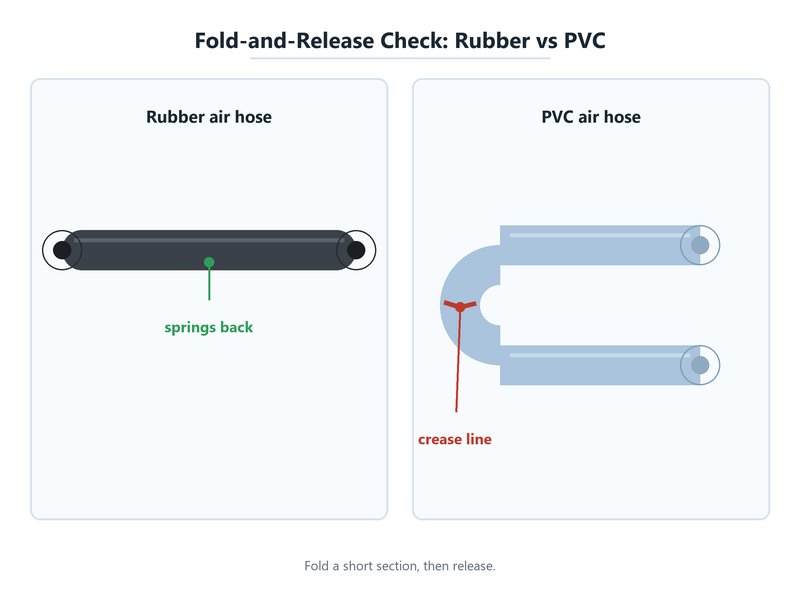
Figure 3. The fold-and-release check: a folded rubber air hose springs back within seconds, while a folded PVC air hose holds a visible crease line.
What the printing on the cover tells you
Every reputable air hose prints its operating limits on the cover. Look for four items in this order: working pressure, reinforcement type, inside diameter, and temperature range. Check the printed temperature range before anything else: a hose that prints a pressure rating alone is typically PVC sold on price.
If the printing shows textile braid reinforcement plus a -20 °F rating, you are almost certainly looking at a hybrid — a different product from either PVC or rubber. If it shows textile braid reinforcement and a 300 PSI or higher rating with a -40 °F range, you are looking at rubber.
PVC vs. Rubber Air Hose: Five-Year Cost Calculation
The purchase price is the smallest number in this comparison. What decides most PVC vs rubber air hose purchases is how many times you buy the same hose.
Take a 50-foot, 3/8-inch hose used in daily workshop conditions. Using typical figures:
Table 4. Indicative five-year cost for a 50-foot 3/8-inch air hose in daily workshop use. Prices are illustrative planning figures, not quotations from HENGHUA. Five-year totals are annualized from service life (price ÷ life × 5), not whole-hose purchase counts.
| Item | PVC air hose | Rubber air hose |
|---|---|---|
| Purchase price per hose | ~$30 | ~$65 |
| Service life in daily use | 1.5 years | 4 years |
| Cost per year of coverage | ~$20 | ~$16.25 |
| Five-year cost of coverage | ~$100 | ~$81 |
| Hoses consumed over 5 years | ~3.3 | ~1.3 |
| Downtime risk | Higher — typically fails mid-task | Lower |
Three conclusions follow from that table, and they matter more than the price difference on the invoice.
- In daily use, rubber is cheaper. At the Table 4 planning figures of ~$65 against ~$30, rubber costs 117% more per hose, and that gap is recovered inside two years once the labor of one fewer replacement is counted.
- In occasional use, PVC is cheaper. A hose used twice a month will not wear out in five years on either material, so the lower price wins outright.
- Labor dominates at the margin. A 20-minute hose change costs more in technician time than the ~$35 purchase gap between the two hoses. If the hose is on a production machine, the arithmetic is not close.
That is why the honest answer to the PVC vs rubber air hose question is not a material preference. It is a question about the duty cycle, and nothing else decides it.
When you replace a hose, measure the old one first: how to measure an air hose for a replacement covers inside diameter, fittings, and length in the order that matters.
Reading the comparison table
Three numbers decide most purchases: working pressure, temperature range, and weight per 50 feet. Table 1 lists all three for a 3/8-inch hose, and the temperature range is usually the one that decides, because cold weather air hose behavior is the part buyers get wrong. Coil memory and air hose service life matter mainly where the hose is stored coiled or replaced on a maintenance contract. The air hose material question is settled by the duty cycle, not by the table.
Common Buying Mistakes With Both Materials
Six errors appear repeatedly in purchase feedback from workshops and distributors:
- Buying on the pressure rating alone. A 3/8-inch air hose rated 300 PSI is not automatically better than one rated 200 PSI if your system runs at 90 PSI.
- Assuming a thicker hose is a stronger hose. Wall thickness affects abrasion life and kink resistance, not pressure rating. Reinforcement sets pressure.
- Ignoring coil memory when buying a long PVC hose. Store a 50-foot PVC hose on a reel; laid loose on a cold floor, it keeps the storage curl and the hose becomes a trip hazard.
- Mixing materials across a coupled system. Two hoses of different materials coupled together are rated at the lower of the two figures, not the higher.
- Storing either material in direct sun. UV degrades both, faster on bright colors and faster on PVC.
- Buying a plasticizer-heavy hose for an oily environment. The oil extracts the plasticizer and the hose hardens within a season.
Work through these six items in order, then confirm the material against the rating printed on the hose you are buying.
PVC vs. Rubber Air Hose FAQs
Is a PVC air hose as strong as a rubber air hose?
No, not at the same bore and reinforcement. A textile braid reinforced PVC air hose is typically rated 200–300 PSI working pressure, against 300–500 PSI for a rubber hose of the same bore. Burst pressure follows the same gap, at a three-to-four-times working-pressure safety factor for both.
Can I use a PVC air hose in winter?
PVC carries a rated range of -10 °C to +60 °C (14 °F to 140 °F) under ISO 5774:2023. Below 32 °F the tube stiffens, and coiling a stiff hose can crease the wall permanently. For work in an unheated space, specify a rubber or hybrid hose rated for your actual temperature.
Why does my PVC air hose get hard and crack?
Plasticizer migration. The plasticizer that made the tube soft migrates to the surface and is lost to heat, oil, and time. The hose is not repairable once the tube has hardened — the flexibility is gone from the compound, not from the surface.
Is rubber air hose worth the extra cost?
For daily use, dragging across floors, cold weather, or oil exposure, yes: the extra purchase cost is recovered inside two years once one fewer replacement is counted. For occasional indoor use with light tools, the duty cycle sits inside what PVC handles.
Which is better for an air compressor, PVC or rubber?
It depends on the compressor’s environment, not its brand or size. Match the hose rating to your compressor’s output pressure and to the temperature where the hose is stored, then choose the material by how the hose will be handled.
I use my air hose fewer than 10 hours a week in an unheated garage — PVC or rubber?
Under 10 hours a week, purchase price alone settles it, provided the garage stays inside the PVC rated temperature range. An unheated garage spends months below freezing, which is what changes the answer. Where the hose is worked below its rated range, specify an EPDM rubber hose rated to -40 °F (-40 °C) instead.
I spray paint in an oily shop and the hose lies in oil mist — does PVC or rubber last longer?
Rubber lasts longer in oil mist. The plasticizer that keeps a PVC tube soft is extractable, and airborne oil plus solvent vapor extracts it steadily from the tube surface inward; the tube then hardens and cracks at the flex points. An SBR rubber cover resists that extraction better than a plasticized PVC cover does. Route the hose above floor level where oil pools.
Does switching from PVC to rubber raise the air pressure at my tool?
Almost no change. Static pressure at the tool is set by the compressor and the regulator, and the loss along the hose is set by inside diameter, length, and flow, not by the tube material. A rubber hose of the same bore and length delivers roughly the same pressure as a PVC hose. What you gain by switching is cold flexibility, abrasion life, and oil resistance.
Can a stiffened PVC air hose be repaired, or must it be replaced?
A stiffened PVC air hose is a replacement item, not a repair item. Once the plasticizer has migrated out of the tube compound, the wall itself has lost its flexibility, and no clamp or coupling restores it. The air hose service life you get from PVC therefore depends on storage as much as on hours of use: a hose left coiled in a hot bay hardens years before one stored on a reel indoors.
My hose is stored coiled on a cold concrete floor — which material uncoils cleanly?
Rubber uncoils cleanly from a cold concrete floor; PVC does not. A plasticized PVC hose that has sat in the cold keeps its coiled set, so it has to be forced open before every job. A rubber hose stored in the same place uncoils and lies flat. If the hose must be stored coiled in an unheated space, rubber is the practical specification.
About HENGHUA
Because the duty cycle decides the material, three details are enough to start: the working temperature range, working pressure, and the tools the hose feeds. Length, inside diameter, and fitting thread then fix the exact part.
HENGHUA manufactures PVC, rubber, polyurethane, and hybrid air hoses and reinforced hose assemblies for workshops, distributors, and OEM brands worldwide. Rubber air hoses are compounded in-house — including EPDM grades rated to -40 °F for cold-weather and ozone-exposed duty — with high-tensile textile or spiral reinforcement and an abrasion-resistant cover, rated 200–500 PSI and supplied with factory-crimped brass fittings as standard. We build the full size range (1/4, 3/8, and 1/2 inch) plus custom lengths, colors, and OEM/ODM branding.
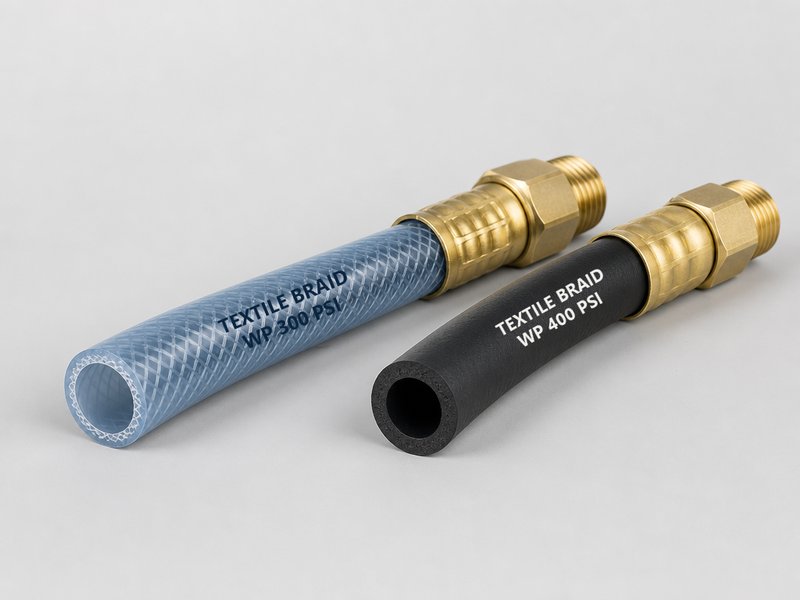
Figure 4. HENGHUA PVC and rubber air hoses with factory-crimped brass fittings. Both are pressure-tested before shipping; the printed rating on the cover states reinforcement type and working pressure.
Because we control compound mixing, reinforcement, and final pressure testing in one plant, we can quote the material that suits your market instead of whatever is in stock. If you are sourcing air hoses for retail, distribution, or industrial use, review our air hose materials and constructions range, then send your temperature range, working pressure, and tools. Contact our engineering team for a quote and samples.
Written by the HENGHUA Engineering Team — the engineers who compound, build, and pressure-test the hoses we manufacture — with input from workshop users across the US and Europe. HENGHUA manufactures PVC, rubber, hybrid, and polyurethane air hose assemblies from 1/4 inch to 1/2 inch, rated 200–500 PSI, with custom lengths, fittings, and OEM branding available.






 English
  Spanish
  Portuguese
  French
  German
  Arabic
  Russian
  Indonesian
  Japanese
  Korean