

A vendor steam hose chart is read from the phase change outward, not from the brand inward. A Parker steam hose catalog page is a useful sample to learn on, because each row fixes bore, pressure, temperature and design factor while the grid behind those rows shows where hot water becomes steam. Start from the working pressure, take the temperature that steam reaches there, and check the hose against that temperature rather than against the pressure.
This guide reads that structure one column at a time. It covers the parameters a chart lists, the ISO 6134 limits behind a published rating, the pressure and temperature pairs worth remembering, and the line between a hose marked for steam service and one that is merely wire braided. Pressure and temperature values quoted here come from the Steam section of the Parker Industrial Hose Catalog 4800 or from the IAPWS-IF97 (the industrial formulation for water and steam properties) saturation table.
About a 14-minute read at 250 words per minute; a column-by-column method for reading any vendor steam chart.
Where Hot Water Turns Into Steam
Water and steam are two phases of the same fluid, and the boundary between them is set by pressure rather than preference. Parker’s Steam section states the rule plainly: water changes to hot water and phases of steam when subjected to heat and pressure. The greater the pressure, the higher the temperature required to achieve and maintain a steam phase. That sentence is the entire reason a vendor chart exists at all.
A published Parker steam hose row is that sentence translated into hardware. The service side gives pressure, which locks in a saturation temperature, and steam quality, meaning saturated or superheated. The hose side gives a tube compound, a reinforcement, a cover treatment and an end connection that must survive both. When the two sides of one row agree, the part number is usable; when they disagree, no downstream test rescues the selection.
The two steam conditions are not symmetrical, and the temperature column of a chart encodes that difference. Saturated steam cannot be given a temperature without also taking a pressure, because the two rise together along a single curve. Superheated steam has been pushed past its saturation temperature at the same pressure, so the two readings separate and each has to be checked on its own.

Figure 1. The phase-change grid behind a vendor chart: liquid water below the curve, saturated vapor on it, and superheated steam above it.
What a Parker Steam Hose Catalog Lists on Every Row
A catalog row is a contract between a service and a construction. The left columns describe the hose: bore, outside diameter, bend radius, unit weight and the reinforcement pattern. The right columns describe the service the construction is qualified for: maximum working pressure, the temperature window, the higher value allowed for superheated steam, and the design factor that separates working pressure from burst. Read the service side first, because a row that fails it fails no matter how clean the geometry looks.
A steam hose rating is only as durable as the standard printed behind it, so two columns carry most of the risk. The temperature window is normally printed twice, once for the saturated condition and once for superheated service, and the lower of the two values governs a saturated line. The design factor states how far the burst figure sits above the working figure, which is why it belongs in the same row as pressure rather than in a footnote.
Table 1. How to read the columns of a vendor steam hose chart, using a published Parker steam hose catalog row as the sample.
| Column in the row | What the value states | What to check before ordering |
|---|---|---|
| Bore and outside diameter | Flow area and the space the assembly needs. | Match the plant line size and confirm the coupling fits the bore. |
| 굽힘 반경 | The tightest bend the hose tolerates without kinking. | Lay out the routing before the line is ordered, not after. |
| Reinforcement and cover | The construction behind the rating: braid layers and cover treatment. | Verify that the construction matches the stated service. |
| Maximum working pressure | The highest gauge pressure the hose body is rated for. | Compare it with the saturation temperature at that pressure, not with pressure alone. |
| Temperature window | Lower and upper limits, printed separately for each steam condition. | Confirm which condition the plant actually runs. |
| Design factor | The ratio between burst and working pressure used in the design. | Read the value that applies to the exact size you are buying. |

Figure 2. The parameter columns of a vendor rating row, split into hose geometry on one side and qualified service on the other.
Reading the Phase-Change Grid in a Steam Hose Chart
Once the operating pressure is chosen, the saturation temperature follows automatically. A column headed temperature window is therefore not a range you can dial at will; at its upper end it marks a boundary that the curve enforces. A hose whose limit sits slightly above the saturation temperature of the working pressure has margin. A hose asked to run at a pressure whose saturation temperature sits above its own limit has none.
Table 2. Saturation pressure and temperature pairs that anchor the temperature column of a vendor chart.
| Gauge pressure (bar g) | Absolute pressure (bar a) | Saturation temperature (°C) | Saturation temperature (°F) |
|---|---|---|---|
| 0 | 1.01 | 100.0 | 211.9 |
| 1 | 2.01 | 120.4 | 248.7 |
| 2 | 3.01 | 133.7 | 272.6 |
| 4 | 5.01 | 151.9 | 305.5 |
| 6 | 7.01 | 165.0 | 329.0 |
| 8 | 9.01 | 175.4 | 347.8 |
| 10 | 11.01 | 184.1 | 363.4 |
| 12 | 13.01 | 191.7 | 377.0 |
| 14 | 15.01 | 198.3 | 389.0 |
| 16 | 17.01 | 204.4 | 399.8 |
| 18 | 19.01 | 209.8 | 409.7 |
| 20 | 21.01 | 214.9 | 418.8 |
The rows that matter most to hose selection sit near the ISO 6134 boundaries. Read the curve at 6 bar g and it returns 165.0 °C, close to the practical ceiling written into the low-pressure type of that standard. Read it at 18 bar g and it returns 209.8 °C, just under the ceiling of the high-pressure type.
A plant asking for 20 bar g is therefore asking for 214.9 °C, above that second boundary. The 20 bar steam hose working pressure breakdown (planned URL — publish before linking) explains what has to change when a request crosses it. The same Parker steam hose catalog rows settle an argument that recurs on most projects, because the two readings cannot be picked independently.
How a Parker Steam Hose Catalog Value Is Anchored to ISO 6134
A published rating means little until it names the standard it was verified against. ISO 6134:2024 covers rubber hoses and hose assemblies for steam service, including their metal hose couplings, and it defines two service types. Type 1 is a low-pressure steam hose with a maximum working pressure of 0.6 MPa (6 bar) and a corresponding temperature of 164 °C, reinforced with textile. Type 2 is the high-pressure type, at 1.8 MPa (18 bar) and 210 °C, reinforced with steel wire. Burst and verification testing follow ISO 1402.
Table 3. The two ISO 6134 steam hose types, their maximum working pressure and the matching saturation temperature.
| ISO 6134 type | Service | Maximum working pressure | Corresponding temperature | 보강 |
|---|---|---|---|---|
| 제1형 | Low-pressure steam | 0.6 MPa (6 bar) | 164 °C | Textile |
| 제2형 | High-pressure steam | 1.8 MPa (18 bar) | 210 °C | Steel wire |
The steam series listed in the Parker Industrial Hose Catalog 4800 are published as ISO 6134 Type 2, with a maximum working pressure of 261 psi (18 bar) and multi-layer steel wire braid reinforcement. Those three facts belong together: the type sets the ceiling, the number states the pressure, and the construction explains how the hose reaches it. A Parker steam hose row that quotes a pressure without naming its type has given you half the story.
The temperature entries on those rows are equally specific. The published range runs from -40 °F to +406 °F for saturated steam, which is -40 °C to +208 °C, and extends to +450 °F, or +232 °C, for superheated steam. The upper end of each window follows from the saturation curve: the saturated window stops lower because that steam is pinned to its curve, while the superheated window reaches further because the steam has been pushed past it.
On a saturated line the temperature entry is the binding one: 208 °C corresponds to about 17.31 bar g, below the 18 bar pressure ceiling printed on the same row. Reading the pressure alone would put a hose above the temperature it was published for.
Table 4. Public parameters shared by the steam series printed in the Parker Industrial Hose Catalog 4800 Steam section.
| 매개변수 | Published value |
|---|---|
| Standard listed | ISO 6134 Type 2 |
| Maximum working pressure | 261 psi (18 bar) |
| Saturation range | -40 °F to +406 °F (-40 °C to +208 °C) |
| Superheated steam limit | +450 °F (+232 °C) |
| 보강 | Multi-layer steel wire braid |
| 표지 | Black or red EPDM, perforated wrapped finish |
| Design factor | 20:1, with the large sizes of series 7263 and 7264 published at 10:1 |
Table 4 gathers those shared values in one place, which is the format most evaluation teams want. The Steam section also names its series, so the row numbers can be traced. Series 7285 Dragon Breath II is annotated with a chlorobutyl tube, while the other steam series are cataloged with EPDM tubes. Series 7288 Dragon Breath appears as the oil-resistant option.
Why Wire Braid Alone Does Not Make a Steam Hose
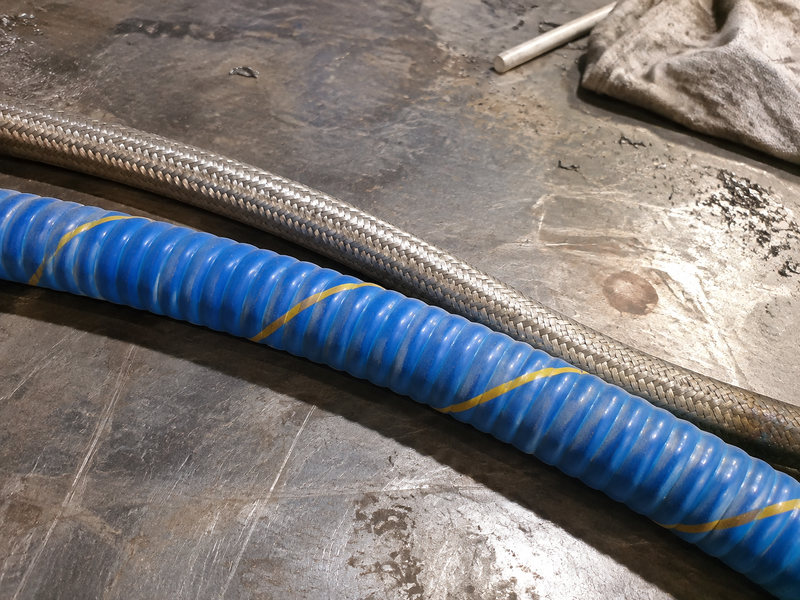
A steel wire braid is a pressure argument, not a service argument. Construction can look identical between a steam hose and a hose built for another hot duty, and the two can share a pressure class while carrying completely different service markings. The only reliable separator is the line on the catalog page that states the intended service.
The clearest published Parker steam hose example sits in the same catalog. Series 7200 is described as a steam-cleaning condensate hose with a nitrile tube, a single wire braid and a working pressure of 350 psi, and its page states in plain terms that it is not for steam service. Nitrile tube and one braid suit the condensate and cleaning duty the series was designed around; they are simply not the combination that steam service calls for. Reading the marking is faster than arguing about braid.
Table 5. Two published rows side by side: a steam series and a wire braided hose marked not for steam service.
| Row detail | Steam series in the catalog | Series 7200 |
|---|---|---|
| Tube compound | EPDM, with chlorobutyl on one series | Nitrile |
| 보강 | Multi-layer steel wire braid | Single wire braid |
| Published working pressure | 261 psi (18 bar) | 350 psi |
| Service marking on the page | ISO 6134 Type 2 steam service | Not for steam service |

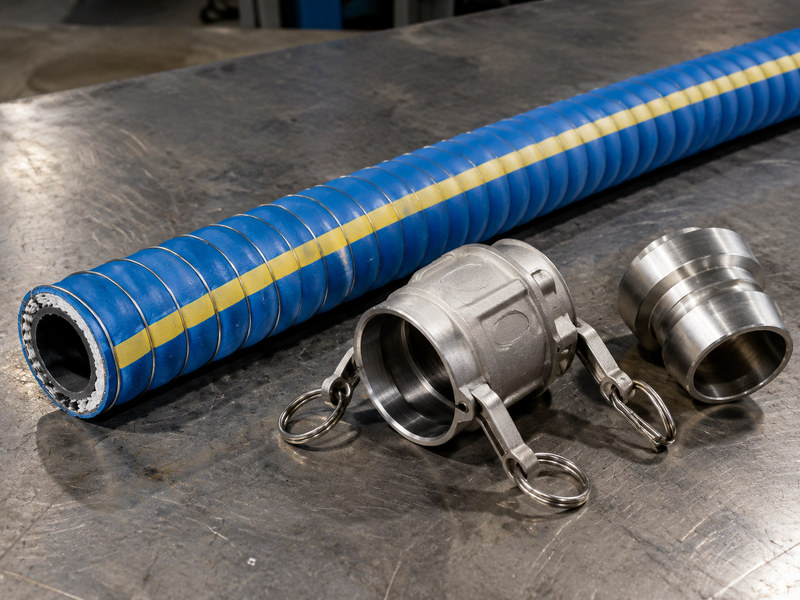
Figure 3. A perforated wrapped cover beside a cutaway of the multi-layer steel wire braid it protects: the construction a steam hose is built from, qualified by the service marking rather than by the braid.
Matching Bore, Bend Radius and Design Factor on a Vendor Row
Service columns decide whether a hose may be used; geometry columns decide whether it can be installed. A generous pressure class does not rescue a hose that cannot take the bend the routing demands, and a tight bend radius on paper does not help if the braid is stressed by a mismatched end connection. Read the two halves of the row against the same sketch of the line.
Design factor is the column that confuses buyers most, because the number changes with size rather than with pressure. Read it per size, not per series, and treat it as a design entry rather than a promise about burst. The published values for the steam series show why that habit matters, and every Parker steam hose row repeats the pattern.
Table 6. Published design factor entries for the steam series and how each one is read on a vendor chart.
| Size or series group | Published design factor | How to read it |
|---|---|---|
| Steam series, general entry | 20:1 | Use as the default ratio between burst and working pressure. |
| Series 7263 and 7264, sizes 1/2, 3/4 and 1 in | 20:1 | Same ratio as the general entry for these three sizes. |
| Series 7263 and 7264, large sizes | 10:1 | Read the row for the exact size, not the series headline. |
Using the Saturated Steam Table Behind a Parker Steam Hose Catalog Entry
A catalog gives you a pressure and a temperature window. To know whether your process fits between them, convert the process pressure into a saturation temperature first, then compare that temperature with the window. The full saturation table (planned URL — publish before linking) holds the complete grid, and the EPDM steam hose guide for steam service explains how the tube compound is chosen for that duty.
The reverse readings are just as useful, because plants often know their temperature and not their pressure. A limit of 164 °C corresponds to about 5.82 bar g, 210 °C to about 18.06 bar g, and 232 °C to about 27.99 bar g. Reading a steam hose rating from either direction gives the same verdict, which is the point of anchoring a chart to a published curve.
The EPDM steam hose product page rated at 170 °C shows how those readings are packaged for ordering, and the pattern is the same everywhere: pressure, saturation temperature, then the hose limit.
Field Checks Before You Trust a Steam Hose Rating
A rated row is the start of a check, not the end of one. Parker’s steam catalog points readers to ARPM IP-11-1, the guide for use, testing and inspection of steam hose, and restates two requirements that catch most field errors. Use only hoses that are marked for steam service, and drain condensate from the hose after each use. Both are written as instructions rather than suggestions, because condensate left in a line is a service hazard on restart.
End connections are the second half of the same argument. Steam hose assemblies should not be closed with band clamps or ordinary clamps pressed over the butt, since that drops the assembly below the rating of the hose body. Purpose-made couplings are the intended solution, and bolted safety clamps are common practice on steam service. The hose coupling selection guide covers the fitting families, while the clamp selection guide deals with clamping hardware in detail.
Related test standards are worth noting on any checklist without quoting clauses: ISO 4023 for steam hose test methods, ISO 7326 for ozone aging, ISO 8031 for electrical properties, ISO 8033 for adhesion and ISO 10619-1 for bending. Alongside ISO 1402 for hydrostatic testing, they tell you which properties a vendor was expected to verify before publishing a rating.
Turning a Chart into a Spec Sheet
The habit that makes a chart useful is the same in every plant: read the service columns, convert the pressure into a saturation temperature, and confirm the construction and the end connection against the duty. A Parker steam hose catalog row is a good training ground for that habit, because the drawings and the numbers sit on the same page and can be checked against each other. Do the same with any vendor and the chart stops being marketing and becomes a spec sheet.
About HENGHUA
HENGHUA is a professional hose and coupling manufacturer supplying distributors, retailers and OEM brands worldwide. The steam hose line centers on an EPDM tube, with textile or steel wire reinforcement, and a cover that is pin-pricked for steam service. Published steam hose products include the EPDM Steam Hose at 170 °C and the EPDM High Temperature Steam Hose at 230 °C. End fittings are available as clamp-type safety couplings, flanges and threaded ends, and the factory supplies assemblies, custom lengths, sheath printing, private label and OEM/ODM.
Parker Steam Hose FAQs
Which columns matter most on a catalog page?
The service columns decide more than the geometry columns. Maximum working pressure, the temperature window for each steam condition and the standard the hose was verified against tell you whether the hose may be used at all. Bore, outside diameter, bend radius and reinforcement tell you whether it can be installed on the line. Read the service columns first, then confirm that the geometry suits the routing.
Why does one hose list two temperature ranges?
That pattern reflects the two steam conditions rather than two products. Saturated steam is locked to its curve, so its temperature cannot be chosen without the matching pressure, which is why the saturated window closes at a lower value. Superheated steam has been pushed past that curve at the same pressure, so it can run hotter. The lower figure governs a saturated line and the higher figure applies only to superheated service.
How does a rating connect to ISO 6134?
ISO 6134 defines the two service types a steam hose can be built to. Type 1 covers low-pressure steam at a maximum working pressure of 0.6 MPa (6 bar), corresponding to 164 °C, with textile reinforcement. Type 2 covers high-pressure steam at 1.8 MPa (18 bar), corresponding to 210 °C, with steel wire reinforcement. A rating that names its type can be traced back to those limits.
Can a wire braided hose be used for steam?
Not on the strength of the braid alone. A published example makes the point: series 7200 has a single wire braid and a working pressure of 350 psi, and its catalog page states plainly that it is not for steam service. The separator is the service marking on the page, not the construction. Check the type and the stated duty before assuming that a braided hose qualifies.
What does the design factor tell me?
It is the ratio the designer used between burst and working pressure for a given size. A published steam series shows a general entry of 20:1, with the large sizes of series 7263 and 7264 listed at 10:1, while the 1/2, 3/4 and 1 in sizes stay at 20:1. Read the value for the exact size, and treat it as a design entry rather than a promise.
How do I convert my process pressure into a temperature?
Look the gauge pressure up on a saturation table. At 6 bar g the saturation temperature is 165.0 °C, at 18 bar g it is 209.8 °C, and at 20 bar g it is 214.9 °C. Compare that temperature with the window printed on the hose row. If the table temperature sits above the hose limit, the selection fails before installation. A plant engineer re-rating a line, a distributor stocking a range and a contractor writing a requisition all perform the same conversion.
What does not for steam service mean?
It means the manufacturer does not publish that hose for steam duty, whatever its pressure class may suggest. Ask for the marking in writing before the hose goes on a steam line. Ignoring that marking puts a hose into a service it was never qualified for. Treat the marking as a hard boundary rather than a recommendation.
Do end connections change the assembly rating?
Yes. A catalog value describes the hose body, and the finished assembly can carry a lower rating once couplings are fitted. Steam practice avoids band clamps and ordinary clamps pressed over the butt, because that lowers the assembly below the hose rating. Purpose-made couplings are the intended solution, and bolted safety clamps are common on steam service. Rating and end connection should always be checked together.
How often should a steam hose be inspected?
Inspection belongs to the service rather than to a fixed calendar. Condensate should be drained after every use, which removes one of the most common causes of internal damage. Hoses marked for steam duty only should be used, and any assembly showing cover damage, braid exposure or a loose coupling should be withdrawn. Treat the published rating as valid only while the hose stays in the condition the rating assumes.
Is a higher pressure rating always better?
No. A higher pressure class often arrives with a stiffer construction and a larger bend radius, which can make a line harder to route. Match the class to the actual saturation temperature of the process instead of buying margin you cannot install. The useful question is whether the hose limit sits above the saturation temperature of the working pressure, with the end connection rated for the same duty.
 English
 Spanish
 Portuguese
 French
 German
 Arabic
 Russian
 Indonesian
 Japanese
 Korean