
Chemical hose fittings are the parts that join a chemical transfer hose to a pump, tank, manifold or second hose. Three decisions govern the choice: the fitting type, the body material and the gasket. This article compares the common types and materials, and explains how to match chemical hose fittings to a specific medium, concentration and temperature.
It covers the cam and groove family and its eight body styles, flanged and threaded ends, PTFE-lined and lined-end construction, the base metals and polymer bodies used in chemical service, and the gasket and elastomer question. A selection procedure and a worked example show how concentration and temperature drive the final choice. Galvanic risk between dissimilar metals is treated as its own problem, because it is a fitting problem rather than a hose problem.
All temperature and pressure figures are the ratings named in the cited standards; verify them against the specific assembly datasheet. About 14 min read.
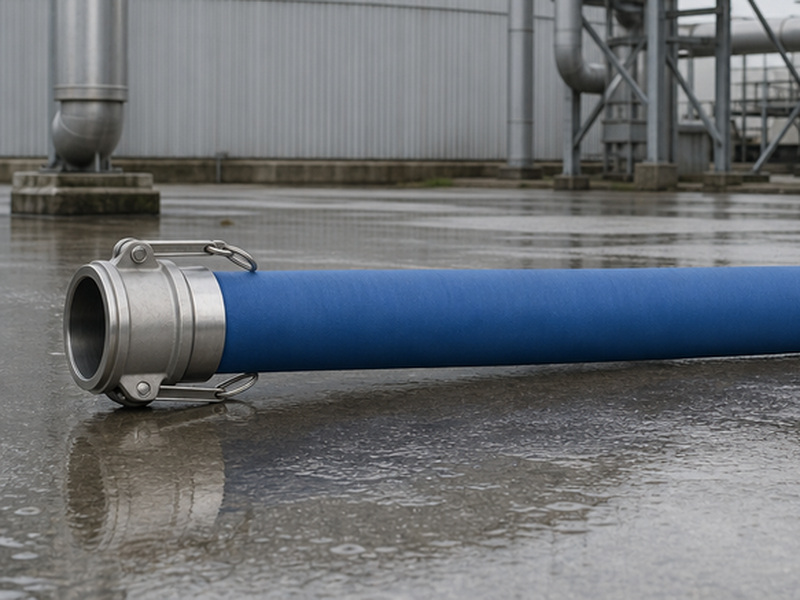
Figure 1. A cam and groove (camlock) coupling fitted to a blue chemical hose.
What Chemical Hose Fittings Must Do
A fitting has one job that outranks all others. It must contain the medium without leaking, and it must do so while resisting attack from the inside. Poorly chosen chemical hose fittings will leak even when the hose itself is correct. The fitting is not an accessory to the hose, therefore; it is part of the wetted system and is judged by the same standard. The European assembly standard EN 12115:2021, which covers rubber and thermoplastics hoses for liquid or gaseous chemicals, specifies metal fittings for the assemblies it governs.
A fitting in chemical service has to satisfy several demands at once:
- Contain the medium at the rated pressure without weeping at the seal.
- Resist the chemical at the highest concentration and temperature the line will see.
- Carry mechanical load from hose weight, pump vibration and operator pull.
- Provide the electrical path where static charge must dissipate.
- Match the mating half exactly, so the joint does not rely on force to seal.
Each end style answers a different question. Cam and groove answers speed. Flanged answers fixed, high-integrity joints. Threaded answers small or rarely broken connections. Lined ends answer aggressive media, and a quick-disconnect suits oil-transfer duty. Table 1 covers these five families and where each is used:
Table 1. Chemical hose fittings by end style: what each family does and where it is used.
| End style | Reference | Typical materials | Where it fits | Main caution |
|---|---|---|---|---|
| Cam and groove (camlock) | A-A-59326, supersedes MIL-C-27487 | Aluminum, brass, carbon steel, 304/316 stainless, PP | Fast, tool-free connect and disconnect for drums, totes, pumps and manifolds | The gasket is the sealing element, so verify it first |
| Flanged | ASME B16.5, ASME B16.24, EN 1092-1 | Carbon steel, 304/316 stainless, cast copper alloy | Fixed pipework, manifolds, pump nozzles and vessels | Bolt pattern and face must match on both sides |
| Threaded | ASME B1.20.1 (NPT) | Carbon steel, 304/316 stainless, brass, PP, PVDF | Small lines, gauges and adapters that are rarely broken | The thread sealant is part of the wetted path |
| Lined / PTFE-lined | Supplied to the assembly standard | PTFE liner inside a metal shell | Aggressive media that would attack bare metal | The liner must stay continuous across the sealing face |
| Quick-disconnect | ASTM F1122 | Stainless steel and other alloys | Oil-transfer service named by regulation | Not every quick-disconnect suits every medium |
The Cam and Groove Family of Chemical Hose Fittings
The cam and groove coupling, usually called camlock, is the workhorse of chemical transfer. Its commercial specification is A-A-59326, which supersedes MIL-C-27487, and the same couplings are also referenced as DIN 2828. Sizes run from about 1/2 in to 6 in, and 1 in, 1.5 in, 2 in and 3 in are the most common in plant use. Aluminum and stainless steel camlock fittings look almost identical from the outside, so read the material from the marking rather than guessing from appearance.
The eight body styles are the part most people get wrong, because the letters describe geometry rather than material. Two of the eight are dust caps and dust plugs, which protect an open end rather than carry product. The eight styles pair as follows:
Table 2. The eight cam and groove body styles and how each one pairs.
| Style | What it is | Common pairing |
|---|---|---|
| A | Male adapter with a groove, threaded tail | Mates with a D coupler |
| B | Female coupler, threaded tail | Mates with an A adapter |
| C | Female coupler with a hose tail | Mates with an E adapter |
| D | Female coupler with a female thread | Mates with an A adapter |
| E | Male adapter with a groove, hose tail | Mates with a C or B coupler |
| F | Male adapter with a groove, male thread | Mates with a C or B coupler |
| DC | Dust cap for a male adapter | Protects an A or E adapter |
| DP | Dust plug for a female coupler | Protects a B, C or D coupler |
Camlock fitting sizes are quoted by the hose bore they serve, but the physical dimensions follow the standard rather than a nominal pipe size. Measure the coupler across the cam arms before you assume a size. A mismatched pair will either refuse to close or will seal on too little gasket compression, and both outcomes lead to a leak under pressure.
Two further points decide whether camlock fittings will hold. First, the gasket is the only sealing element, so its material matters as much as the body. Second, the cam arms and the groove wear with use, so a worn coupler leaks no matter how good the gasket is.

Figure 2. The style letter describes the geometry of the two mating halves, not the material of the body.
Flanged and Threaded Ends as Fitting Options
Where a joint must stay put and carry full line pressure, a flange is the usual answer. The United States Coast Guard hose rules name flanges to ANSI B16.5 for steel and ANSI B16.24 for cast copper alloy among the permitted end connections. In Europe the matching standard is EN 1092-1, which uses PN designations such as PN10 and PN16. Typical classes in industry are Class 150 and Class 300, and the class sets both the bolt circle and the flange thickness.
A Class 150 flange and a Class 300 flange will not bolt together even when the bore matches. Always confirm the class, the facing and the bolt pattern on both halves before a hose assembly is built.
Threaded ends are the simplest option and the one most often misapplied. NPT threads follow ASME B1.20.1 and seal on the thread itself, with a sealant or tape. That sealant becomes part of the wetted path, so it must be compatible with the medium too. A thread that is tightened to hide a mismatch will still weep.
Flanged and threaded ends divide the work differently:
- Flanged: fixed manifolds, pump suction and discharge, vessel nozzles and any joint broken under supervision.
- Threaded: instruments, small drain and sample lines, and adapters that are never opened in normal service.
A chemical hose coupling at a pump nozzle is often a flange, while the free end of the same assembly may carry a camlock coupling or a threaded end. Matching each end to its own duty is normal practice.

Figure 3. A flange joint seals on the gasket, so the gasket material and the flange face both matter.
PTFE-Lined Ends and Lined Construction
Some media attack almost every base metal. For those, the answer is to keep the metal out of contact with the product. A PTFE-lined hose carries a fluoropolymer liner, and PTFE lined hose fittings continue that liner across the sealing face, so the medium only ever touches fluoropolymer. This is the standard route for aggressive acids, solvents and high-purity streams.
Liner continuity is the whole point. If the liner stops short of the sealing face, the edge of the metal is exposed and corrosion begins exactly where the seal is meant to be. A liner that is cut, folded or cracked where it is flared over the face will pass a visual check and still fail in service.
PTFE lined hose fittings are usually paired with a braided stainless cover for pressure. The braid carries the load and the liner carries the chemistry. The end is then tested as an assembly, not as a loose component. When you receive a lined end, confirm three things:
- The liner runs unbroken to the outer edge of the sealing face.
- The liner is not cut, folded or cracked where it is flared.
- The assembly has been pressure-tested with the end fitted, not before.
PTFE-lined construction also changes how the assembly is handled. A liner can be damaged by a sharp blow or by over-tightening, so the end is treated as one unit and never re-flared in the field.
Base Metals and Polymer Bodies
Material selection starts with the medium and the temperature. The metals used most often for chemical service are carbon steel, 304 stainless steel, 316 stainless steel, aluminum and brass. The polymer bodies used most often are polypropylene (PP) and polyvinylidene fluoride (PVDF). Each has a different balance of corrosion resistance, strength, weight and cost.
Carbon steel is strong and inexpensive but corrodes readily, so it suits dry or non-corrosive duty. Stainless steel is the common choice for wet chemical service, with 316 chosen over 304 where chlorides and stronger acids are expected. Aluminum is light and easy to handle but is attacked by many chemicals and by strong alkalis. Brass machines well and is common on water and mild service. PP is the lower-cost polymer, while PVDF holds higher temperature and a wider chemical range.
Table 3. Fitting body materials for chemical service: general behavior, not a compatibility verdict.
| Material | General chemical behavior | Strength and weight | Temperature note |
|---|---|---|---|
| Carbon steel | Corrodes in wet or acidic service | Strong and heavy | Suits ambient, non-corrosive duty |
| 304 stainless steel | Good general resistance, limited with chlorides | Strong, moderate weight | Common process range |
| 316 stainless steel | Better acid and chloride resistance than 304 | Strong, moderate weight | Common process range |
| Aluminum | Attacked by many chemicals and strong alkalis | Light and easy to handle | Limited chemical range |
| Brass | Good on water and mild service, attacked by ammonia | Moderate strength | Mild service only |
| PP | Broad resistance to acids and bases | Lighter than metal, lower pressure | Lower temperature ceiling |
| PVDF | Wide chemical range, good solvent resistance | Good for a polymer, higher cost | Higher temperature than PP |
A polymer body removes galvanic corrosion risk entirely, because there is no second metal to pair with. It also limits pressure and temperature, so it is chosen where chemistry matters more than pressure. Polymer camlock fittings are common on drum and tote transfers for that reason. Where the medium attacks both polymers and standard stainless grades, PTFE lined hose fittings close the gap.
In practice a chemical hose coupling is chosen as a system. The body, the gasket and the mating half are selected together, because a correct body with the wrong gasket still leaks. Material choice and gasket choice are separate checks, and both must pass.
Gaskets and Elastomers: Gasket Material Compatibility
The gasket is the smallest part of the joint and the most common point of failure. Gasket material compatibility is decided by the medium, the concentration and the temperature, exactly as the body material is. A camlock seals on a gasket held inside the coupler; a flange seals on a gasket between the faces. In both cases the gasket sees the full chemical and the full temperature, with no metal shielding it.
The elastomer families below are the common starting points. Use the table to narrow the family, then confirm the exact grade against the supplier’s chart.
Table 4. Gasket and elastomer families: broad application and the caution that applies.
| Gasket | Broad application | Caution |
|---|---|---|
| Nitrile (NBR) | Oils, fuels and many hydrocarbons | Limited resistance to strong acids and ketones |
| EPDM | Water, steam, many acids and bases | Poor with oils and hydrocarbon solvents |
| FKM (fluorocarbon) | Many solvents, acids and hydrocarbons at higher temperature | Not universal, and costlier |
| PTFE envelope | Broad chemical resistance across a rigid core | Cold flow under load if not supported |
| Silicone | Wide temperature band, some chemicals | Limited with oils and solvents |
No short list can replace the manufacturer’s chemical resistance chart. A gasket material compatibility check is a separate step from the body check, and it uses the same three inputs. Ask for the chart that covers the exact medium, the maximum concentration and the maximum temperature, and keep the answer with the assembly record. A rating letter from one supplier does not transfer to another supplier’s grade.
Galvanic Risk When Dissimilar Metals Meet
When two different metals sit in the same conductive liquid, they form a galvanic couple. One metal becomes the anode and loses material, while the other becomes the cathode and is protected. The result is corrosion on the fitting, even when each metal is perfectly acceptable on its own. This is why a fitting can fail at a joint that shows no fault in either component.
Three conditions must all be present for a couple to form. There must be two dissimilar metals, an electrically conductive path between them, and a conductive medium. Remove any one condition and the couple stops. A dry joint, an insulated break or a non-conductive medium all prevent it.
Aluminum and stainless steel are a classic risky pair. Brass and aluminum are another. Where the medium is conductive and the pair is unavoidable, the safer practice is to keep the wetted metals in the same family, or to insert an insulating break so the couple cannot complete a circuit through the liquid.
Reduce galvanic risk with these steps:
- Use the same metal family for both halves of the coupling wherever possible.
- Where that is not possible, insulate the joint and keep the pair out of the conductive liquid.
- Prefer a polymer body or a lined end where the medium is both conductive and aggressive.
- Record the pairing on the assembly drawing, so a replacement half is not fitted in a different metal.
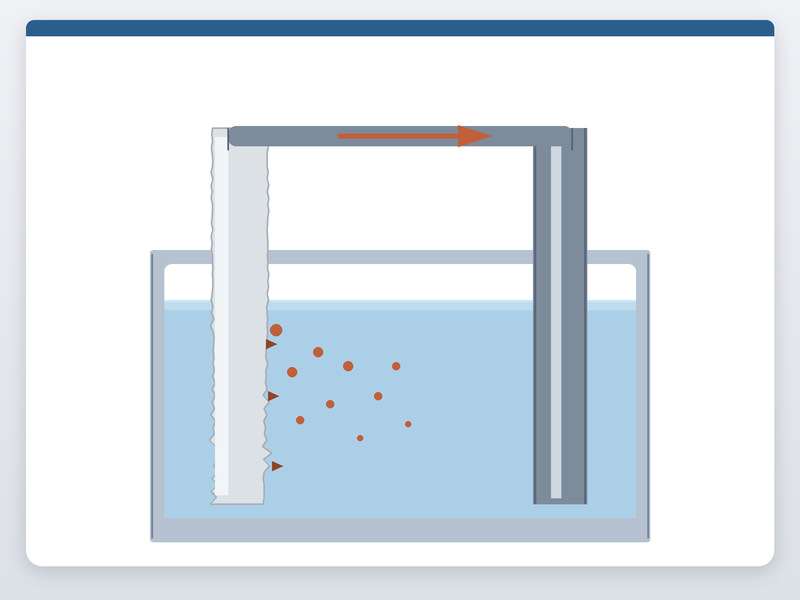
Figure 4. When dissimilar metals sit in a conductive medium, one becomes the anode and loses material.
How to Select Chemical Hose Fittings Against the Medium
Selection is a procedure, not a guess. The order matters: fix the temperature and the concentration first, because both change the answer for the metal and for the gasket. Let the manufacturer’s charts decide the rest. For assemblies governed by EN 12115:2021, the working pressure is limited to 10 bar and the service range runs from −20 °C to +65 °C.
Table 5. The compatibility check as a procedure: inputs, source and decision at each step.
| Step | Input you need | Where the answer comes from |
|---|---|---|
| 1. Identify the medium | Exact chemical name, not a trade name | Supplier documentation and safety data sheet |
| 2. Fix the concentration | Worst-case percentage in the line | Process data |
| 3. Fix the temperature | Maximum and minimum, including cleaning cycles | Process data |
| 4. Check the fitting metal | Material family and grade | Manufacturer’s chemical resistance chart |
| 5. Check the gasket | Elastomer family and grade | Manufacturer’s chemical resistance chart |
| 6. Check the pairing | Both metals and medium conductivity | Engineering judgment |
| 7. Confirm the rating | Pressure and temperature of the duty | Assembly datasheet and standard |
A worked example shows the shape of the reasoning. Suppose a plant transfers a corrosive liquid that has a stated concentration and a maximum operating temperature. First, take those two values from the process data rather than from memory. Second, look up the fitting body material and the gasket family separately in the manufacturer’s chemical resistance chart. Third, check the two halves of the coupling for a galvanic pair. Fourth, confirm that the assembly pressure and temperature rating still covers the duty. Only then release the specification.
This structure matters because rating letters are specific to a supplier and a grade. A value that is correct for one manufacturer’s product is not a verdict for another’s. The chart decides, and the fitting is selected against the same inputs as the hose itself. Where a hose line is chosen for chemical resistance, see the method used on our fluid and inner-tube selection guide and apply it to the fitting as well.
How the end is physically attached to the hose, by crimping, swaging or banding, or fitted with a flange or camlock termination, is a different question. It is covered in our companion article on chemical hose assemblies and end connections; this page stays with what the fitting is made of.
Chemical Hose Fittings FAQs
What are chemical hose fittings made of?
Bodies are made from carbon steel, 304 or 316 stainless steel, aluminum, brass, polypropylene or PVDF. The choice depends on the medium, the concentration and the temperature. Stainless steel is the common default for wet chemical service, while polymer bodies suit aggressive media at lower pressure. The gasket is a separate material, usually nitrile, EPDM, FKM or a PTFE envelope, and it is selected on its own.
What are the eight camlock body styles?
The eight styles are A, B, C, D, E, F, DC and DP. Styles A to F are the working adapters and couplers that carry product, and they pair in fixed combinations, such as A with D. DC is a dust cap and DP is a dust plug, used to protect an open end. The letter describes the geometry of the body, not its material.
How are camlock fitting sizes measured?
Camlock fitting sizes are quoted by the hose bore the coupling serves, not by a nominal pipe size. Sizes run from about 1/2 in to 6 in. To confirm a size in the field, measure the coupler across the cam arms and compare it with the standard rather than trusting a visual match. A mismatched pair will not close or will compress the gasket too little to seal.
Are stainless steel camlock fittings better than aluminum ones?
Not universally. Stainless steel resists more chemicals and is stronger, but it is heavier and costlier. Aluminum is light and easy to handle, yet it is attacked by many chemicals and strong alkalis. The correct answer depends on the medium and the required pressure. Where aluminum and stainless are mixed in a conductive liquid, galvanic corrosion also becomes a risk.
What gasket should I use for a chemical hose coupling?
There is no universal gasket. Nitrile suits oils and fuels, EPDM suits water and many acids and bases, and FKM covers many solvents at higher temperature. A PTFE envelope gives broad resistance over a rigid core. Select the gasket from the same medium, concentration and temperature inputs used for the body, and confirm the exact grade against the manufacturer’s chart.
Can I mix fitting metals in one assembly?
You can, but it carries a risk. Two dissimilar metals in a conductive liquid form a galvanic couple, and the less noble metal corrodes. Where the medium is conductive, the safer practice is to keep both wetted halves in the same metal family. If a mix is unavoidable, insulate the joint and record the pairing on the drawing so the replacement half matches.
What is a PTFE-lined hose fitting used for?
A PTFE lined hose fitting is used where the medium would attack base metal. The fluoropolymer liner is carried across the sealing face, so only PTFE touches the product. This suits aggressive acids, solvents and high-purity streams. The liner must run unbroken to the sealing edge, because any exposed metal edge becomes a corrosion starting point right at the seal.
How do I check gasket material compatibility?
Start with the exact medium, its maximum concentration and its maximum temperature. Then consult the manufacturer’s chemical resistance chart for the specific gasket grade. Gasket material compatibility is a separate check from the body check, and both must pass. Do not carry a rating letter from one supplier to another supplier’s grade, because ratings are specific to a product.
Do threaded ends work for chemical service?
Yes, within limits. Threaded ends follow ASME B1.20.1 for NPT and suit instruments, small lines and adapters that are rarely opened. They seal on the thread with a sealant or tape, and that sealant becomes part of the wetted path, so it must also be compatible with the medium. For larger or frequently broken joints, a flange is the better choice.
How often should chemical hose fittings be inspected or replaced?
Inspect fittings as part of the regular assembly check, looking at cam arms, threads, flange faces and gaskets. Under the US Coast Guard rules for transfer facilities, the test frequency is annual, and a hose must hold a static liquid pressure of at least 1.5 times its maximum allowable working pressure. Replace a fitting when the sealing surface or the locking mechanism is worn.
Next Steps: Ordering Chemical Hose Fittings
Run the four checks before you order. Confirm the medium, the concentration and the temperature. Confirm the fitting metal and the gasket against the manufacturer’s chart. Confirm there is no harmful galvanic pair. Confirm the assembly rating covers the duty. Then confirm the camlock fitting sizes, the flange pattern and the thread type, because a correct material in the wrong size still fails.
Keep the result on the assembly record. A fitting chosen by habit is the part most likely to fail, because habit ignores the change in concentration or temperature that a process revision brings. A written selection turns the choice into something the next engineer can verify.
HENGHUA is a professional manufacturer of chemical hoses, chemical hose assemblies, industrial hoses and hose fittings, supplying distributors, EPC contractors and OEM brands worldwide. Chemical hose construction covers rubber (EPDM and other compounds), UHMWPE, PTFE-lined and thermoplastic composite builds. Assemblies are terminated with crimped, swaged or banded hose ends, flanged ends to ASME or EN patterns, and cam and groove (camlock) couplings, in carbon steel, 304/316 stainless steel, aluminum, brass and PP/PVDF where the medium demands it.
Every assembly is hydrostatically tested to its rated working pressure before shipment, and marked with its MAWP, size and identification code. Commercial terms include factory-direct pricing, short lead times for bulk orders, private labeling, custom packaging, OEM/ODM branding and warranty. For a quote and samples, contact our engineering team.
Browse the full chemical hose collection to see the assemblies these fittings are built on. For couplings and adapter taxonomy beyond this page, see our guide to hose couplings and selection criteria and the thread and adapter identification guide. Where a clamp or a fastening detail is required, the hose clamp selection guide gives the material and torque data, and the hose size selection guide helps confirm the bore before you match the end.
About the author. This article was prepared by the HENGHUA engineering and testing team, which specifies, builds and pressure-tests chemical hose assemblies for distributors, EPC contractors and OEM brands. The team works daily with material selection, end-termination and compatibility checks, and writes from factory test-bench and assembly-record experience rather than from marketing copy.






 English
  Spanish
  Portuguese
  French
  German
  Arabic
  Russian
  Indonesian
  Japanese
  Korean