

A tire curing press is a short-cycle machine, so hose selection follows bladder duty rather than plant line pressure. This guide covers bore, length, pressure class, temperature margin, routing and strain relief in one framework.
It explains how a curing cycle sequences steam, water and nitrogen, and where each step loads the hose. It then sets out what to change first on a running press line to extend hose life without rebuilding the installation.
Press and cycle figures quoted below are published industry ranges; pressures are gauge pressures unless stated otherwise. About 15 min read.
Why the Tire Curing Press Is Hard on Hose
Press temperature is the first constraint. Published figures for tire curing presses sit in the 340–390 °F (170–200 °C) range, and a hotter press shortens the curing cycle. A hose that reaches that temperature and then cools, cycle after cycle, ages faster than one held at a steadier temperature.
Cycle frequency is the second constraint. On a high-volume line a curing cycle can repeat every 10–15 minutes, around the clock. A tire steam hose therefore sees thousands of heat-and-cool excursions in one campaign, plus the mechanical movement of the press frame.
Space is the third constraint. The hose runs through a moving frame with little room to bend, so a routing error becomes fatigue at the coupling. Selection and routing have to be solved as one problem rather than as two separate decisions.
Each load narrows the choice in a different way. Temperature sets the compound and the cover, cycle frequency sets the reinforcement and the fittings, and confined space sets the bend radius and the support. Steam quality sets what the supply upstream has to deliver. Treat the four together and the specification becomes straightforward.
Table 1. Four loads the press applies to a steam hose
| Load | What it does | Where it shows first | Design response |
|---|---|---|---|
| Cyclic temperature | Heat-up into the 170–200 °C range, then cooling on every cycle | Tube hardening and cover cracking near the fitting | Correct temperature class and a perforated cover |
| Short cycle time | A cycle can repeat every 10–15 minutes, all day | Fatigue at the coupling and at the bend | Strain relief and a service loop |
| Confined routing | Little space to bend inside the frame | Kinks, crushed cover, chafing | Respect the minimum bend radius and support the weight |
| Wet steam | Uneven heat transfer into the bladder | Cover blisters, uneven cure | Traps, separators and drainage upstream |
The Curing Cycle: Steam, Water and Nitrogen in Sequence
A curing cycle on a tire curing press is a sequence of media, not one medium. Steam is commonly admitted to the bladder for the first few minutes of the cycle, about 3–10 minutes, to bring the tire to cure temperature. High-pressure water or nitrogen then holds the pressure for the remainder of the cure.
Each phase loads the hose and the bladder differently. Saturated steam delivers heat and also condenses; water or nitrogen delivers pressure without adding heat. One hose has to survive a hot, wet phase and then a cooler, drier, higher-pressure phase, on every cycle.
That sequence sets the specification priority. Ask which phase sets the highest pressure, which phase sets the highest temperature, and how long each one lasts. The answers decide pressure class, temperature class, bore and the type of end connection.
The exhaust phase is often missed during selection. A hose that cannot drain holds condensate against the tube while the tube is still hot. Slope the run toward a low point with a drain, so the next steam admission does not have to push that water through the assembly.

Figure 2. The temperature curve falls through the idle segment, so each steam admission starts again on a cooler hose.
Table 2. Curing cycle phases and the demand each places on the hose
| Phase | Typical duration | 중간 | Demand on the hose |
|---|---|---|---|
| Bladder heat-up | The first few minutes of the cycle, about 3–10 minutes | Saturated steam | Highest temperature the hose sees; wet steam stresses the bladder and the tube |
| Cure hold | The remainder of the cure | High-pressure water or nitrogen | The pressure class is set here, not during the steam phase |
| Exhaust | End of the cycle | Condensate and flash steam | Needs a drain path so condensate does not sit in the hose |
| Idle | The time between cycles, after exhaust | Ambient air | The hose cools and recovers, then the cycle repeats |
Sizing Steam Hose for the Tire Curing Press
Bore is set by flow, not by the fitting on the tire curing press. Steam carries a large specific volume at working pressure, so an undersized bore raises velocity, noise and pressure drop. An oversized bore is stiff and heavy, which makes it hard to route inside a moving frame and costs flex life.
Length behaves in the same way. Every extra foot adds pressure drop and gives condensate another low point where it can collect. Keep the run as short as the frame allows, then add a service loop deliberately instead of leaving one to chance.
Size the bore from the steam-phase flow and the pressure drop you can accept, not from the header diameter. A practical method is set out in this guide to hose size selection. Then confirm the rated working pressure of the chosen bore, because working pressure and burst pressure describe two very different limits.
Selecting a steam hose for tire presses is a four-step decision: bore, length, pressure class and temperature class. Each step constrains the next, so the order matters more than any single number. Write the four values on the purchase specification instead of leaving them to the supplier to interpret.
Table 3. Sizing decisions for the hose on a curing press
| Decision | Ask this | Common error | Effect on life |
|---|---|---|---|
| Bore | What flow does the steam phase carry? | Copying the header bore | High velocity, or a stiff hose that will not route |
| Length | How much hose is actually needed? | Leaving an unplanned extra loop | More pressure drop and another condensate low point |
| Working pressure | Which phase runs at the highest pressure? | Sizing from boiler pressure | A class too low for the cure hold |
| 온도 | What does the steam phase reach? | Choosing on temperature alone | A class that does not match the saturated-steam duty |
Bladder Steam Hose: Pressure, Temperature and Steam Quality
Pressure class must be set by the highest pressure the bladder sees, not by the boiler rating. If the cure hold uses high-pressure water or nitrogen, that phase sets the class. ISO 6134 Type 1 is rated to a maximum working pressure of 6 bar, and Type 2 to 18 bar, so the phase pressures decide which envelope applies.
Temperature and pressure are one variable in saturated steam, so you cannot specify them independently; the saturated-steam temperature follows the pressure at which the steam is supplied. Type 2 hose covers the saturated-steam envelope up to 210 °C. This guidance covers saturated steam and hot-water condensate, and superheated steam is a separate duty with its own hose requirements. Choosing a bladder steam hose on temperature alone is a selection error that no amount of inspection later will correct.
Steam quality decides how evenly the bladder heats. Wet steam carries droplets that give up their heat unevenly, which thermally stresses the bladder and the tube. Traps, separators and drainage upstream of the press protect both, and they generally cost less than a hose upgrade.
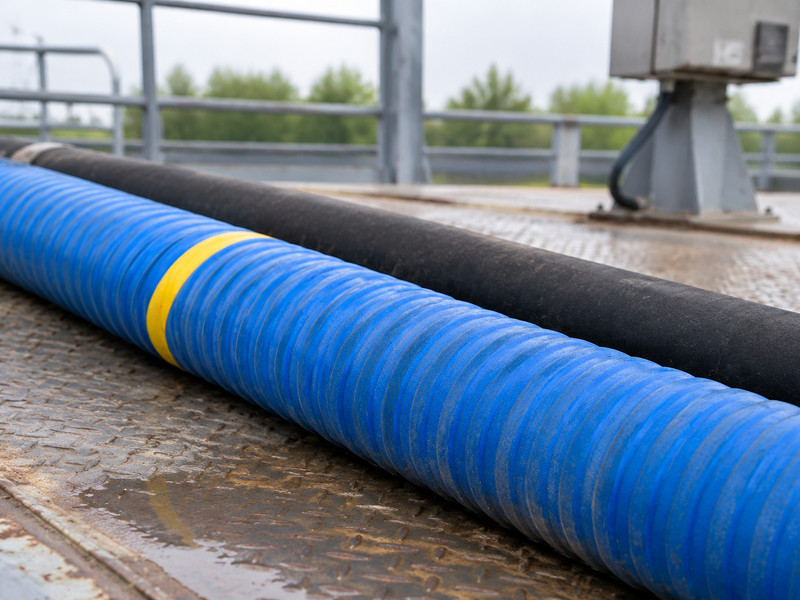
The cover matters as much as the tube. Steam vapor permeates the tube, so a perforated, pin-pricked cover is needed to vent that vapor. Without those vents the vapor lifts the cover into blisters, and those blisters hide the real condition of the reinforcement underneath. We form that vent path on every assembly we build, and it only works while nobody paints or coats over it on site.
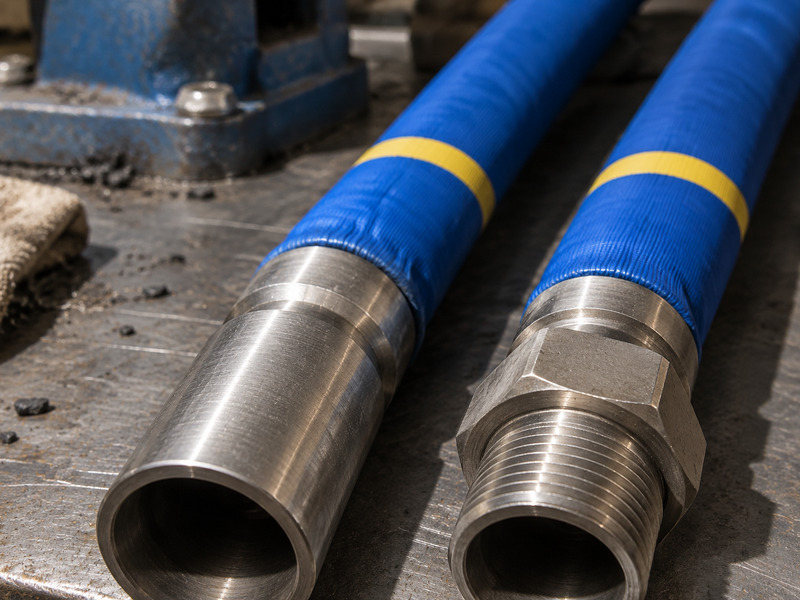
Material choice follows the duty rather than leading it. A steam hose range built on an EPDM tube with textile or steel-wire reinforcement covers the Type 1 and Type 2 envelopes. The compound science behind that construction is explained in why EPDM suits saturated steam, so this page stays with selection and routing.
Table 4. Matching the hose to each duty point and feature on the press
| Duty point | Typical value | What the hose must provide |
|---|---|---|
| Bladder heat-up, top of the envelope | Saturated steam up to 210 °C | Type 2 hose, wire reinforced, with a perforated cover |
| Bladder heat-up, lower envelope | Working pressure up to 6 bar, about 165 °C saturated | Type 1 hose, textile or wire reinforcement |
| Cure hold | High-pressure water or nitrogen | A pressure class set by the hold pressure |
| Cover, every duty | Vapor permeates the tube | Pin-pricked cover so the vapor vents instead of blistering |
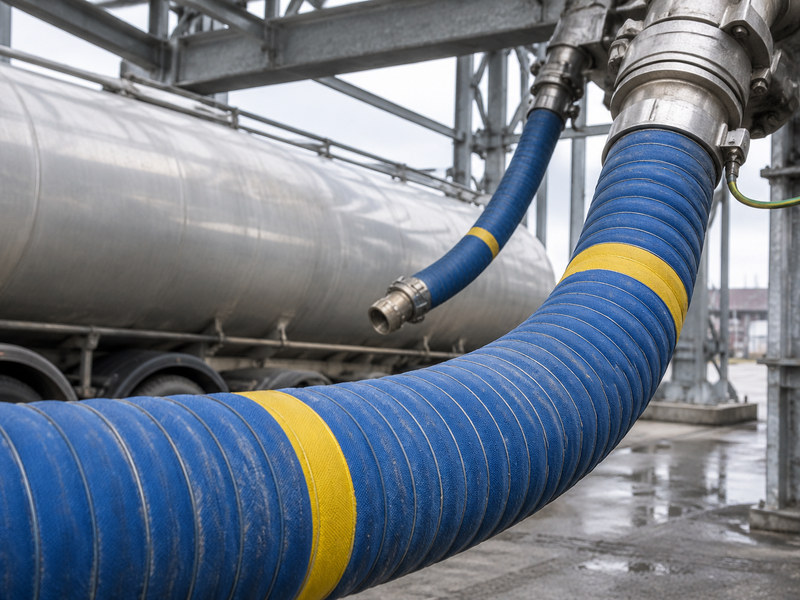
| Ends, every duty | Movement inside the press frame | Crimped or swaged ferrules, flanged ends or cam and groove couplings |
Press Hose Routing, Strain Relief and Support
Routing inside the frame is where a good specification is usually lost. The hose has to reach the bladder connection without being pulled straight or bent tighter than its minimum bend radius. A tight bend concentrates stress at the fitting, and that is where fatigue cracks start.
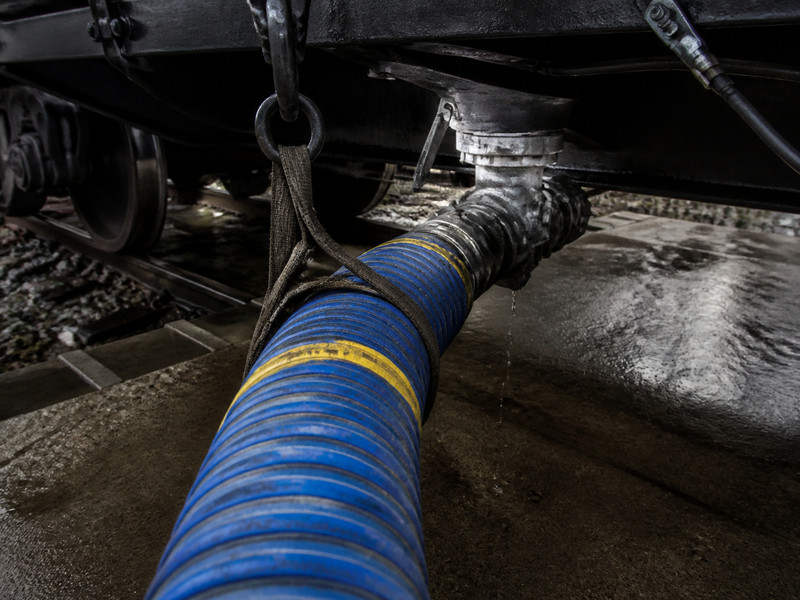
Strain relief keeps movement away from the coupling. Support the hose so the frame carries its weight instead of the fitting. Leave a service loop that flexes freely, rather than a straight run that pulls on the coupling on every cycle. A press hose supported close to the fitting and where the run changes direction keeps its movement in the service loop, where it can flex, instead of loading the coupling.
Check four points before the next campaign:
- Minimum bend radius, taken from the manufacturer’s published figure for that bore and measured on the outside of the bend at working temperature, not at ambient.
- Chafing points, where the cover touches a frame edge, a guard or another hose.
- Twist, because a hose installed with a twist tries to straighten under pressure.
- Drainage, so the lowest point drains away from the bladder connection.
The wider question of how installation practice consumes hose life is covered in this guide to hose maintenance and service life. Restraint hardware is a separate decision, and it belongs to the installation risk assessment for the press rather than to the hose purchase order.

Figure 3. A service loop and a support clamp move flexing away from the coupling inside the press.
Curing Press Steam: What Steam Quality Does to Hose Life
Wet steam heats unevenly. Droplets that reach the bladder give up their heat in patches, so the bladder wall sees a temperature gradient instead of an even temperature. That gradient thermally stresses the bladder and the tube, and it is a common reason cure quality drifts.
Steam quality is a plant problem with a hose consequence. A failed trap, an undrained separator or a low point in the curing press steam line all deliver wetter steam to the press. Fixing that supply protects the bladder and the hose together, and no hose upgrade substitutes for it.
Drainage protects both sides of the connection. Traps and separators remove condensate before it reaches the curing press steam header, and a sloped run keeps condensate moving after the steam phase ends. Standing water against a hot tube ages a hose from the inside, where no inspection can see it.
In our own assembly reviews, hoses returned with cover blisters usually came from lines where trap maintenance had slipped. That pattern matches the published guidance to protect steam quality first and review the hose second. It also explains why the same tire steam hose grade can last very differently on two presses in one plant.
Condensate changes what the hose carries, and it also changes how long the hose stays hot. Wet steam releases less heat per unit of mass than dry steam, so the bladder takes longer to reach cure temperature and the steam admission runs longer than the cycle was planned for. The hose then holds full temperature for longer on every cycle.
Service life on this page is a measurement, not a promise. Record fit dates, note the cycles each hose has run and compare hoses between presses. Heat and cure chemistry are treated in more depth in how vulcanization consumes hose life; this page stays with the supply side.

Figure 4. Traps, separators and a drain keep condensate away from the bladder and the hose.
Table 5. Steam supply checks upstream of the press and the hose benefit
| Check | What it protects | Consequence if neglected |
|---|---|---|
| Trap operation | Removes condensate before the press | Wetter steam and uneven tube heating |
| Separator drainage | Keeps carryover out of the line | Droplets arrive at the bladder wall |
| Line low points | Stops water collecting in the run | Condensate sits against a hot tube |
| Hose slope after the steam phase | Lets the hose drain itself | Standing water between cycles |
| Insulation of the run | Reduces condensing in the line | More condensate produced per cycle |
Optimizing the Hose Selection for a Tire Curing Press
Optimization is a sequence, not a shopping list. Change the cheapest and most effective item first, and re-measure before spending on the next one. On the press lines we review, the pressure class and the hose type usually show the largest gain.
Only those two set the rating at the order stage. Steam quality and routing are plant-side changes, and bore is a later refinement. Re-measure after each change, so the improvement can be attributed to one decision rather than to a general overhaul.
Two related decisions sit outside this page. The wider loop of inspection, selection and maintenance belongs to the steam hose safe use framework. Bore and working pressure are linked earlier, because sizing is where most selection errors begin.
Spare strategy matters on a press line as well. Holding one correct spare per press, in the same bore, length and class, keeps a single failure from waiting on a purchase order. Buying that spare to the same written specification also stops a wrong-class hose from entering the store.
Write the specification down where the store can read it. Bore, length, pressure class, temperature class and end connection should all appear on the purchase document. When the specification is written, a replacement hose matches the original without argument or guesswork. Table 6 ranks the changes by priority, with a way to confirm each one worked.
Table 6. What to change first on a curing press installation
| Priority | Change | Why it comes here | How to confirm it worked |
|---|---|---|---|
| 1 | Pressure class against the cure-hold phase | Sets the margin for the highest pressure in the cycle | The assembly marking matches the hold pressure |
| 2 | Type 2 hose where the steam phase runs hotter | Removes a temperature mismatch the press cannot tolerate | The steam phase sits inside the rated envelope |
| 3 | Steam quality: traps, separators, drainage | Protects the bladder and the tube at the same time | Drier steam and a more even cure |
| 4 | Routing: bend radius, support, service loop | Moves fatigue away from the coupling | No chafing or pulled coupling at the next check |
| 5 | Bore against measured flow | Fine-tuning, not a first move | Lower pressure drop at the same flow |
Tire Curing Press FAQs
These are the questions that come up most often when press shops ask about hose for a curing press.
What hose is used on a curing press?
The hose feeds saturated steam into the curing bladder for the first few minutes of the cycle, then high-pressure water or nitrogen for the remainder of the cure. It is a reinforced rubber steam hose, usually with steel-wire braid in the higher classes, and a perforated cover so permeating vapor can vent. Bore, length, pressure class and temperature class are chosen together.
What pressure class is needed on a curing press?
It has to be rated for the highest pressure the bladder sees. ISO 6134 rates Type 1 at 6 bar and Type 2 at 18 bar, so the cure-hold pressure decides which of the two applies. A high-pressure water or nitrogen hold sets the class, so specify from the hold pressure. Confirm the class on the assembly marking before ordering.
What temperature does a steam hose see on a curing press?
The hose sees steam, not the platen. Its temperature is the saturation temperature of the steam supplied to the bladder, and that value follows the supply pressure inside the type envelope. The 340–390 °F (170–200 °C) figure is a press measurement, not a hose temperature. Specify the hose on steam pressure, then read its temperature from the saturation curve.
Can I use a standard steam hose for tire curing?
Only if its pressure and temperature ratings cover both phases of the cycle. Ask for a steam hose for tire curing that is rated for the cure-hold pressure and the steam-phase temperature, with a perforated cover. A general-purpose hose chosen on temperature alone is a common and expensive mistake. Get the envelope confirmed in writing before the order is placed.
What size hose does a curing press need?
Size the bore from the flow the steam phase carries and the pressure drop you can accept, then confirm the rating of that bore. An undersized bore raises velocity and pressure drop; an oversized bore is stiff and hard to route inside a moving frame. Length counts too, because extra feet add drop and another condensate low point.
Why does the hose fail at the coupling?
Most coupling failures begin with movement. A hose that is pulled straight, clamped rigidly at both ends or bent tighter than its minimum bend radius concentrates stress at the fitting. Cyclic heating of the same spot then finishes the job. Support the weight, add a service loop and check for chafing at every shutdown.
Does wet steam damage a hose?
Wet steam produces uneven heating. Droplets give up their heat in patches, so the bladder and the tube see temperature gradients rather than even heating, which adds thermal stress on every cycle. Traps, separators and drainage upstream of the press are what fix it. A different tire steam hose grade does not correct a wet steam supply.
What is a bladder steam hose?
It is the hose that feeds the curing bladder inside the press. It has to carry saturated steam at the start of the cycle, then water or nitrogen under pressure for the rest of the cure. That dual duty is why it is specified on both pressure and temperature, and why its cover is perforated so permeating vapor can vent.
How long does a hose on a curing press last?
Service life depends on cycle frequency, steam quality, routing and the pressure and temperature margin you selected, so no single figure applies. Treat life as a measurement rather than an assumption: record the fit date, note the cycles run, and replace on condition and on a fixed interval you can defend. That record is also what a safety review will ask for.
What should I change first to extend hose life?
Start with the pressure class, then check the temperature class against the steam phase, then the steam quality. Routing and support come next, and bore tuning last. That order fixes safety and duty first, and it changes the hose only where the duty really demands it. Re-measure after each step so the gain stays visible.
Final Verdict: Tire Curing Press Hose Practice
Safe practice on a curing press is a loop: specify to the duty, route for movement, control steam quality and replace on evidence. The margin that keeps crews safe comes from the pressure and temperature class being right, not from buying a heavier hose. Every item in that loop can be checked on the plant floor.
Treat the tire curing press as what it is: a short-cycle, high-temperature machine with a confined hose path. Decisions that ignore the cycle, the routing or the steam supply show up later as premature failures. Correcting them costs less before the hose is fitted than after it has failed in service.
Before the next campaign, confirm:
- The assembly marking matches the cure-hold pressure.
- The steam phase stays inside the rated temperature envelope.
- Bend radius, support and the service loop are all correct.
- Traps, separators and drainage are working.
- Every hose carries a fit date and an inspection record.
HENGHUA manufactures steam hoses, steam hose assemblies, industrial hoses and hose fittings for distributors, EPC contractors and OEM brands worldwide. The steam hose range is built on an EPDM tube with textile or steel-wire reinforcement and a perforated, oil-resistant cover. Bore sizes and pressure classes cover the ISO 6134 Type 1 and Type 2 envelopes. The catalog also carries a high-temperature grade rated to 230 °C for duties above the saturated-steam envelope.
Assemblies are terminated with bolted safety clamps, crimped or swaged ferrules, flanged ends and cam and groove couplings, in carbon steel, 304/316 stainless steel and brass. Every assembly is hydrostatically tested to its rated working pressure before shipment and marked with its size, working pressure and identification code.
Commercial terms include factory-direct pricing, short lead times for bulk orders, private labeling, custom packaging, OEM and ODM branding, and warranty. To specify a hose for your curing press, request a quote and samples with the bore, length, pressure class and temperature class of the duty.
About the author. HENGHUA’s engineering and test team designs and assembles steam hoses for saturated steam and high-temperature duty, and supports distributors, EPC contractors and OEM brands with selection data, routing reviews and assembly records. The team works from its steam test bench and from field feedback as well as from laboratory results. Every recommendation in this article is written so that a plant engineer can check it against the press, the markings and the steam supply before acting on it.


 English
 Spanish
 Portuguese
 French
 German
 Arabic
 Russian
 Indonesian
 Japanese
 Korean