

Why This Cross Fittings Adapter Passes the Compliance Gate
A four-way junction is the busiest point in any hydraulic circuit: four flows meet there, the body carries the bending moment of four tube runs, and every sealing face is within a few millimetres of the others. That is why every XC/XD cross we make is forged as one piece, bored from the centre outward so that the four bores meet on a single axis intersection, and dimensionally inspected on all four ends — cone angle on a profile projector, thread gauged 6g go / no-go, hex and reach measured to the drawing. The first article of each lot is sectioned at the junction so wall thickness at the four-way core is measured, not assumed.
This is an equal four-way cross fitting: four metric male stud ends with external 24° cones (DIN 2353 / ISO 8434-1), all of the same size, arranged as two perpendicular run axes crossing at one point. “XC” is the light (L) series, “XD” is the heavy (S) series.
主な強み
- Fewer parts, fewer leak points. One cross replaces two tees and the nipple that would join them — three parts and six 24° cone joints become one part and four joints. Fewer joints is the single most effective way to reduce the number of places a circuit can weep.
- Lower pressure drop. Flow meets at one junction instead of passing through two branch turns and a connecting nipple, so the local loss coefficient is lower and the pipework is shorter.
- No offset between branch axes. All four ports intersect at one point, so the two run axes are exactly perpendicular and coplanar — a pair of tees cannot achieve that without machining and shimming.
- Forged one-piece body. No weld, no braze, no heat-affected zone at the highest-stress section of the fitting.
- Full L and S coverage. Tube 6 mm to 42 mm in the light series (31.5 MPa and 16 MPa) and tube 6 mm to 38 mm in the heavy series (63 MPa, 40 MPa and 31.5 MPa).
技術仕様
What Is a Cross Fittings Adapter?
It is a four-way fitting with one connection on each of the four points of a cross, used to split one flow into three or to combine three flows into one at a single junction. All four ends here are equal size, so the fitting is an equal cross rather than a reducing cross.
One Cross or Two Tees — the Trade-Off
This is the decision most buyers ask about, and the answer is a count of joints:
| Arrangement | Parts | 24° cone joints | Junction loss | Notes |
|---|---|---|---|---|
| One cross (XC/XD) | 1 | 4 | One four-way junction | Lowest leak count, one purchase line, fixed position |
| Two tees + one nipple | 3 | 6 | Two branch junctions plus a straight run | Six sealing points, three parts to stock, can be reconfigured later |
| Two tees + one adapter elbow pair | 4 | 6 | Higher | Only when the geometry demands it |
Six joints against four is a 33% reduction in sealing points from a single substitution. In a circuit that is being chased for a weep, removing two joints — and the nipple that joins them — usually ends the search. The counter-arguments are real too: a cross costs more per piece than a standard tee, it is a slower-moving part number to source, it needs wrench access on four faces at one location, and it locks the geometry — where a tee arrangement can be re-plumbed later, a cross cannot. When one of the four branches may never be used, a tee with a plug is often the cheaper engineering answer. When all four branches are live and the junction is hard to reach, the cross wins on both leak count and assembly time.
Cone Geometry — 74°, 60° and 37° Are Not Interchangeable
Four ends here are metric male 24° cone (DIN 2353 / ISO 8434-1). It is worth stating plainly that this seat does not interchange with the two other cone systems in common use:
- 74° external cone — the wide-angle cone used in Chinese and Japanese hydraulic practice with a sleeve and nut, sealing on a 74° cone face.
- 60° cone — DIN 3861 / ISO 1179 seating, used with BSP parallel threads and a 60° seat.
- 37° flare (JIC) — SAE J514 / ISO 8434-2, UNF threads and a 37° flare.
The three have different included angles, different contact diameters and different thread forms. A cross-assembled joint can pass a static pressure test and then weep once the fluid is hot, because the apparent contact is an edge or a line rather than the full cone face. Confirm the port and tube ends are 24° cone before ordering.
寸法データ
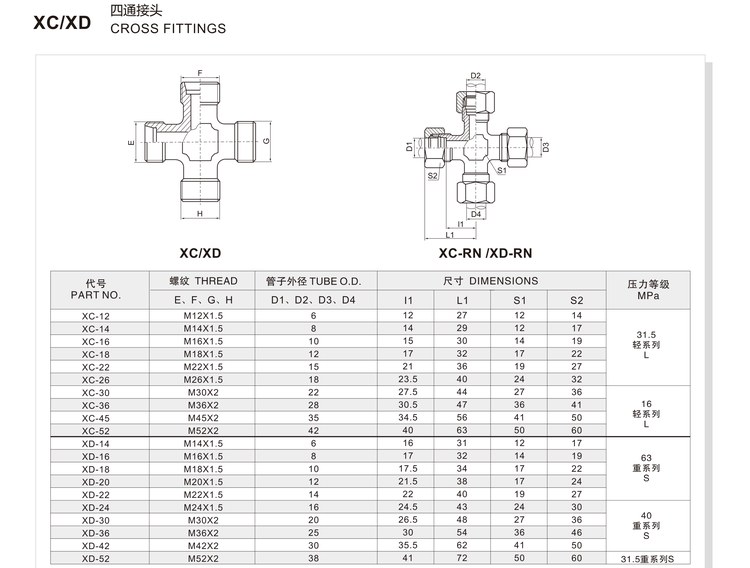
In the drawing, E, F, G, H are the four thread designations, D1, D2, D3, D4 the four tube outside diameters, l1 the stud reach from each end face to the junction axis, L1 the overall length of each leg and S1, S2 the across-flats hexes of the body and the end.
All four legs are dimensioned along two perpendicular axes. They are equal in this family, but the body is not rotationally symmetric: the four end hexes must all be reachable with a wrench at the same time, which is a packaging question as much as a dimensional one. Check the leg length and height in both directions against the installation drawing, and confirm wrench access on all four faces.
全寸法表(部品番号マトリックス)
Values as published in the HENGHUA catalogue drawing. Dimensions in millimetres.
| 品番. | THREAD E, F, G, H | D1, D2, D3, D4 | l1 | L1 | S1 | S2 | Pressure MPa |
|---|---|---|---|---|---|---|---|
| XC-12 | M12×1.5 | 6 | 12 | 27 | 12 | 14 | 31.5 — L series |
| XC-14 | M14×1.5 | 8 | 14 | 29 | 12 | 17 | 31.5 — L series |
| XC-16 | M16×1.5 | 10 | 15 | 30 | 14 | 19 | 31.5 — L series |
| XC-18 | M18×1.5 | 12 | 17 | 32 | 17 | 22 | 31.5 — L series |
| XC-22 | M22×1.5 | 15 | 21 | 36 | 19 | 27 | 31.5 — L series |
| XC-26 | M26×1.5 | 18 | 23.5 | 40 | 24 | 32 | 31.5 — L series |
| XC-30 | M30×2 | 22 | 27.5 | 44 | 27 | 36 | 31.5 — L series |
| XC-36 | M36×2 | 28 | 30.5 | 47 | 36 | 41 | 16 — L series |
| XC-45 | M45×2 | 35 | 34.5 | 56 | 41 | 50 | 16 — L series |
| XC-52 | M52×2 | 42 | 40 | 63 | 50 | 60 | 16 — L series |
| XD-14 | M14×1.5 | 6 | 16 | 31 | 12 | 17 | 63 — S series |
| XD-16 | M16×1.5 | 8 | 17 | 32 | 14 | 19 | 63 — S series |
| XD-18 | M18×1.5 | 10 | 17.5 | 34 | 17 | 22 | 63 — S series |
| XD-20 | M20×1.5 | 12 | 21.5 | 38 | 17 | 24 | 63 — S series |
| XD-22 | M22×1.5 | 14 | 22 | 40 | 19 | 27 | 63 — S series |
| XD-24 | M24×1.5 | 16 | 24.5 | 43 | 24 | 30 | 63 — S series |
| XD-30 | M30×2 | 20 | 26.5 | 48 | 27 | 36 | 40 — S series |
| XD-36 | M36×2 | 25 | 30 | 54 | 36 | 46 | 40 — S series |
| XD-42 | M42×2 | 30 | 35.5 | 62 | 41 | 50 | 40 — S series |
| XD-52 | M52×2 | 38 | 41 | 72 | 50 | 60 | 31.5 — S series |
ねじサイズとダッシュ表
| Tube OD (D1–D4) | L series (XC) thread | S series (XD) thread |
|---|---|---|
| 6 mm | M12×1.5 | M14×1.5 |
| 8 mm | M14×1.5 | M16×1.5 |
| 10 mm | M16×1.5 | M18×1.5 |
| 12 mm | M18×1.5 | M20×1.5 |
| 14 mm | — | M22×1.5 |
| 15 mm | M22×1.5 | — |
| 16 mm | — | M24×1.5 |
| 18 mm | M26×1.5 | — |
| 20 mm | — | M30×2 |
| 22 mm | M30×2 | — |
| 25 mm | — | M36×2 |
| 28 mm | M36×2 | — |
| 30 mm | — | M42×2 |
| 35 mm | M45×2 | — |
| 38 mm | — | M52×2 |
| 42 mm | M52×2 | — |
The heavy (S) series uses one thread size larger than the light (L) series for the same tube OD. The catalogue also shows the XC-RN / XD-RN versions of the same body supplied complete with sleeve and nut.
材料および熱処理
Carbon steel bodies, forged, hardened according to pressure class and plated in trivalent chromium or zinc-nickel. Stainless 304 / 316L is available to order. The four cone seats are machined in one fixturing setup so that each seat is concentric with its own thread and correctly positioned relative to the other three.
使用圧力および動作範囲
The pressure column is the working pressure of the connections, not a burst pressure; a 4:1 burst ratio is typical of the body. The four-way junction is the highest-stress section of the fitting, so when a circuit runs at the top of its class, size the cross on the branch flows it actually carries and not on the largest tube attached.
Temperature Range
−40 °C to +120 °C for standard components; up to +200 °C with FKM in associated seals. The 24° cone joint has no elastomer in the sealing path — the tube end and the fluid normally set the limit.
部品番号マトリックスの読み方
XC-14 reads: family XC (four-way equal cross, light series), size 14 = 8 mm tube / M14×1.5 on all four ends. XD-20 is the heavy equivalent: size 20 = 12 mm tube / M20×1.5. The size number follows the series ladder rather than the millimetre tube OD, which is why the same 6 mm tube appears as XC-12 and as XD-14.
選定と発注
Selection Checklist / Decision Table
| Requirement | Choose |
|---|---|
| Four live branches at one junction | Cross (this family) |
| Minimising leak points and assembly time | Cross (this family) |
| Standard pressure, tube 6–22 mm | XC (L series) |
| High pressure or heavy wall tube | XD (S series) |
| One branch may be unused or the layout may change | Two tees with a plug — more joints, more flexibility |
| Only three branches required | Equal tees adapter AC/AD |
相互参照サービス
Send the OEM number, the tube OD, the thread and the pressure class, or a photograph of the junction. We return a mapped part number with all four leg dimensions confirmed, and we will quote the two-tee alternative alongside it if the junction is not yet finalised.
包装・物流
Thread protectors on all four ends, plastic bag, carton and pallet; certificates and inspection reports referenced to the heat number. Air, sea and express shipping available.
Installation and Fitment Guide
Step-by-Step Assembly
- Verify all four ports are metric male 24° cone (DIN 2353 / ISO 8434-1) and that the thread size matches the ordered series.
- Clean the four cone seats and the mating ports. Remove swarf, paint and old sealant.
- Plan the body orientation before anything is tightened. On a cross, the position of the body fixes all four directional axes at once, and the four end hexes must all be reachable.
- Start all four threads by hand before tightening any one of them.
- Torque diagonally: the two ends of one axis first, then the other axis, using a wrench on the body hex (S1) throughout.
- Re-check all four joints after the first thermal cycle and after any work that disturbs the junction.
Torque and Sealing Notes
Four joints, four torques, all of them metal-to-metal 24° cone with no tape and no compound. Sequence matters on a cross: tightening one branch hard before the others are started can leave a joint that was correct when it was made and loose by the time the assembly is finished. Use a calibrated torque wrench on every joint that holds pressure.
インストールに関する注意事項
- Do not mix 24°, 60° and 37° cone components across the four ports.
- Do not use thread sealant anywhere on this fitting.
- Do not use a cross as a structural support or as a manifold; it has no mounting and no gauge port.
- Do not reuse a cone that has been over-torqued, galled or dented.
- Do not assume four wrenches will fit; confirm access before ordering.
Applications and Industries
Four-way crosses are used where three consumers draw from one supply line at a single point, where multiple return lines are gathered, in lubrication and pilot circuits, on press and injection-moulding manifolds, on mobile and agricultural machinery, on cranes and mining equipment, in marine systems and on test benches. The cross fittings adapter is the lowest-leak-count answer whenever three flows must be taken from one junction.
OEMカスタマイズと品質トレーサビリティ
Reducing crosses, special leg lengths, special hex, alternative materials and customer plating are produced to drawing. Incoming material verification, first-article inspection with sectioning at the four-way core, thread gauging, cone profile checks, proof pressure testing on sample lots and final inspection are recorded against the order, with EN 10204 3.1 certificates on request.
よくある質問
Is a cross better than two tees? It has two fewer sealing points and a lower junction loss. Two tees are more flexible and cheaper per piece. Choose on leak risk and packaging, not on list price alone.
How many joints does a cross save? Two. Two tees joined by a nipple make six 24° cone joints; one cross makes four.
Can I plug one branch and use it as a tee? Physically yes, but the plug adds a joint back and costs more than buying a tee. Buy the correct part.
XC or XD? Same geometry, different series — L (light) for XC, S (heavy) for XD.
Is the pressure rating the same on all four ends? Yes, the body rating applies to all four connections; the attached tubing may be rated lower.
Do I need sealant? No. Sealing is by the 24° metal cone on each end.
お見積りのお申し込み
Send the part number, the tube OD, the thread series, the material, the quantity and the working pressure. We will confirm all four end sizes, the wall thickness at the junction and the wrench access, and quote with the inspection documentation included.
Related products in this range: equal tees adapter AC/AD · branch tee fittings with swivel nut BC/BD · 90° elbow fittings adapter 1C9/1D9 · straight fittings adapter 1C/1D · metric male 74° cone adapter 1Q.
すべてを見る 油圧アダプター 家族全員向けのラインナップ、あるいは お問い合わせ 見積もり、製鋼試験報告書、およびサンプルのご依頼はこちら。.


 English
  Spanish
  Portuguese
  French
  German
  Arabic
  Russian
  Indonesian
  Japanese
  Korean