
What is a steam hose? It is a flexible, reinforced rubber hose engineered to carry saturated steam under pressure and to survive the heat, moisture and permeating gas that steam service creates.
Unlike a hot-water hose, it is defined by its construction: a heat-resistant tube, a pressure-holding reinforcement, a cover that is deliberately perforated, and an end connection that can be re-tightened. This guide takes the four steam hose layers apart in order: tube, reinforcement, cover and end fitting. It explains what each layer does, what ISO 6134:2024 requires, and how to tell a real steam hose from a look-alike on a warehouse shelf.
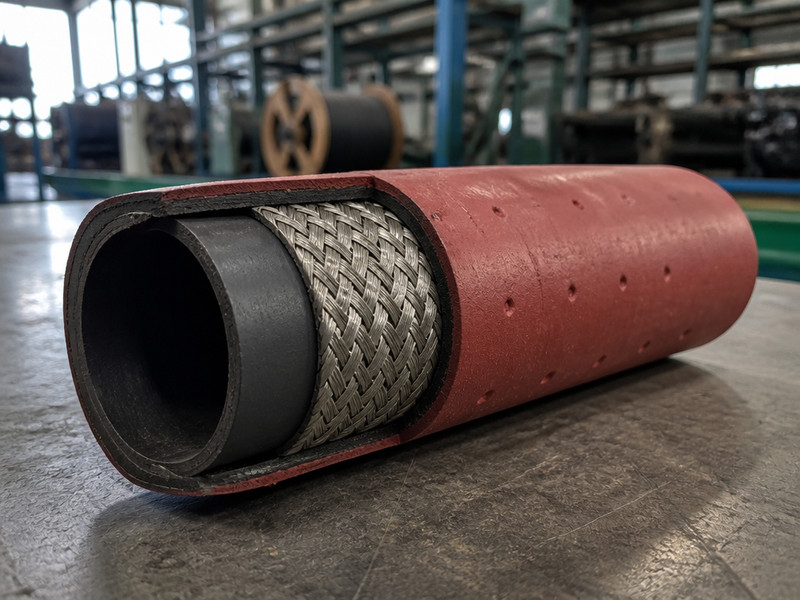
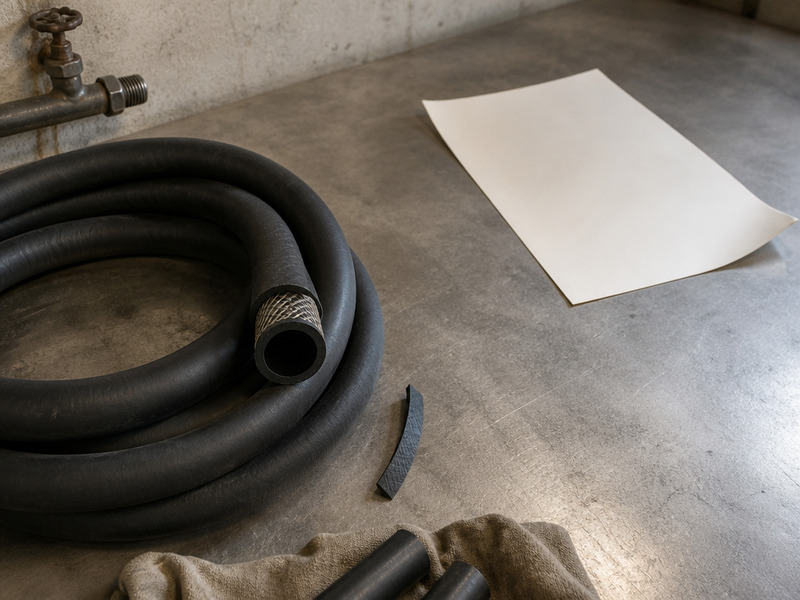
Figure 1. A cutaway of an EPDM steam hose, showing the tube, the steel wire reinforcement and the perforated cover that vents gas.
What Is a Steam Hose Made Of? The Four Layers
A steam hose is built from four working layers, and every one of them solves a specific problem. The tube carries the steam and absorbs the heat. The steam hose reinforcement holds the internal pressure and stops the hose from stretching. The cover protects the braid from abrasion, weather and impact. The end connection transfers the load from the hose to the pipe, flange or tool without leaking.
The four steam hose layers, in the order steam meets them, are:
- Tube — a seamless, steam-resistant elastomer, usually EPDM, that carries the steam and resists hot water.
- Penguatan — high-tensile steel wire braid in one or two layers, or a textile yarn for lower-pressure duty.
- Sampul — a smooth, abrasion-resistant rubber jacket; the pin pricked cover, also called a perforated cover, releases gas that collects between the layers.
- End connection — a bolted safety clamp whose clamping force stays adjustable; a permanently crimped assembly is an alternative, and the supplier must declare its steam rating.
Steam hose construction matters more than the material list, because a hose can use excellent rubber and still fail early. The usual cause is a cover that cannot vent gas, or a reinforcement that is bonded badly to the tube. That is why ISO 6134:2024 is written around the performance of the whole assembly rather than a single compound. When a buyer asks what is a steam hose made of, those four layers are what the specification has to fix.
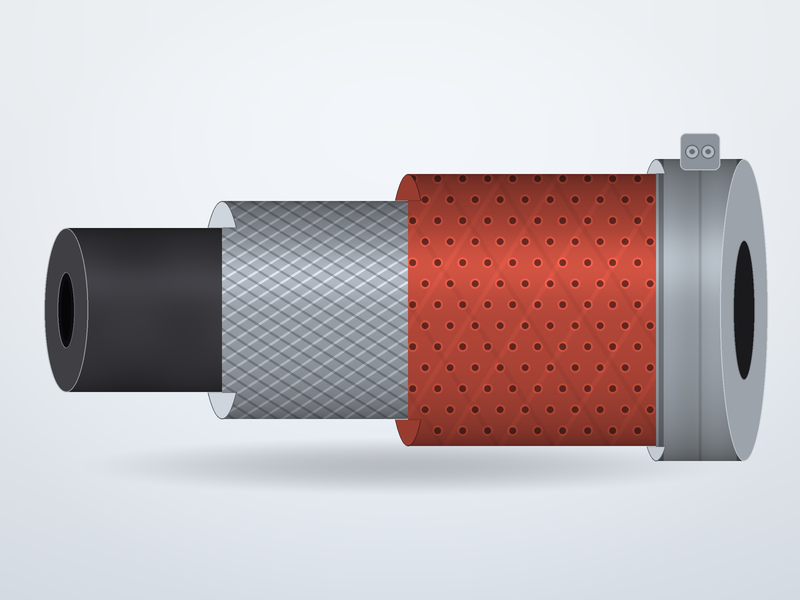
Figure 2. The four layers of a steam hose: an EPDM tube, textile or steel wire reinforcement, a perforated cover and a bolted end fitting.
The Steam Hose Tube: The Layer That Decides Survival
Why Is the Tube Extruded Seamless?
The steam hose tube is the innermost layer, and it is the only part that actually touches the steam. It is normally a seamless EPDM compound, because EPDM has a saturated polymer backbone that resists hot water, oxidation and the hydrolysis that damages many general-purpose rubbers. A seam in this layer would become the first failure point, so the tube is extruded seamless rather than wrapped. It is the first of the steam hose layers to meet the steam, and the first to show heat damage.
The steam hose tube has to do three things at once. It must not soften or crack at the working temperature. It must not swell or dissolve in the condensate that forms during warm-up. It must stay smooth enough that steam and condensate pass without turbulent erosion of the wall.
Compound selection is therefore deliberate. For the hottest duty the tube is peroxide cured instead of sulfur cured, which produces a denser cross-link network and better heat aging. Some buyers use the words steam hose lining for this same layer, and a steam hose lining really is the same barrier seen from a different angle. A steam hose lining and the tube share one job: keep the steam away from everything behind them.
The Steam Hose Reinforcement: Textile Versus Steel Wire
The steam hose reinforcement is the load-bearing layer, and it is the biggest single difference between a steam hose and a water hose. Steam pressure pushes outward on the tube, and the reinforcement converts that pressure into tension in the yarn or wire instead of letting the hose grow or burst.
Two families exist. A Type 1 steam hose uses textile reinforcement and is rated to 6 bar (0.6 MPa, about 87 psi) at 164 °C. A Type 2 steam hose uses steel wire reinforcement, braided, spiraled or wrapped, and is rated to 18 bar (1.8 MPa, about 261 psi) at 210 °C. As pressure and temperature rise, the specification moves from textile toward steel.
A wire braided steam hose usually carries high-tensile steel wire in one or two layers. Two layers are not decoration, because they raise burst strength and cut the change in length when the hose is pressurized. That stability matters on long runs and on hoses that flex repeatedly. For Type 2 duty, a wire braided steam hose is the common choice. The steam hose reinforcement is also what the end fitting grips, so a weak braid weakens the whole assembly.
The Steam Hose Cover: Why It Is Pin-Pricked, Not Smooth
What Happens If the Cover Is Not Perforated?
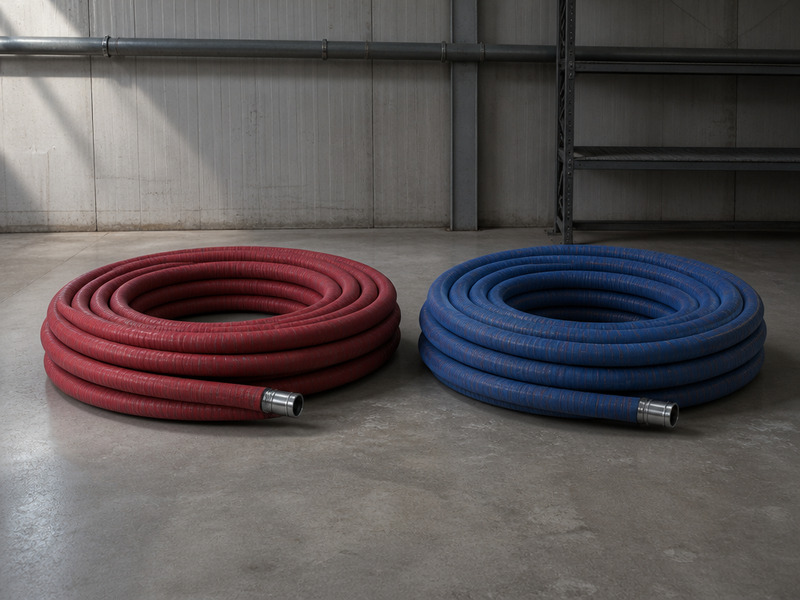
The steam hose cover is the outer jacket, and its basic job looks simple: protect the reinforcement from abrasion, sunlight, oils and impact. Most covers on a steam hose are smooth EPDM, often red or blue, with a wrapped finish.
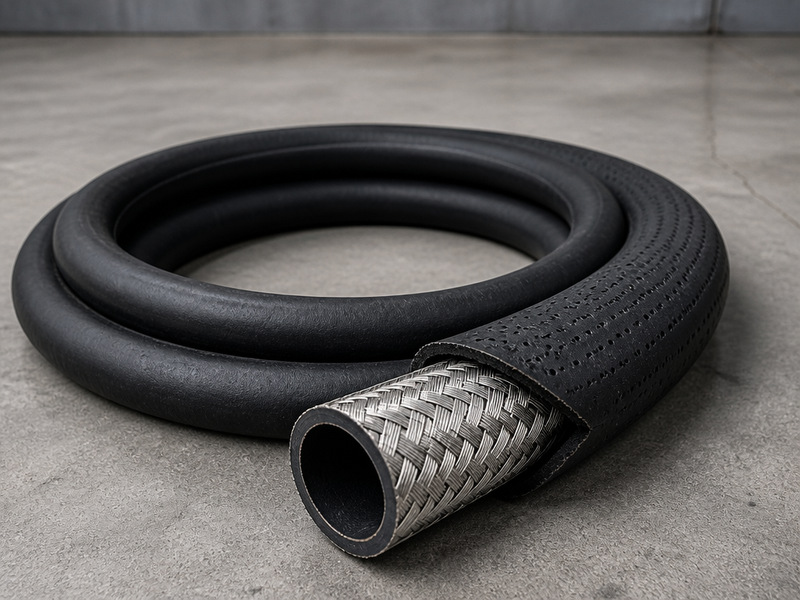
The detail that confuses new buyers is the perforation. A pin pricked cover is pierced with small holes at regular intervals around the circumference and along the length. A pin pricked cover is a specification, not a defect, and a smooth, unperforated jacket on a hose sold as steam-rated is a warning sign.
Why perforate? Steam and the gas carried in a steam system slowly permeate through the tube and the reinforcement. If the steam hose cover is sealed, that gas collects between the layers and has nowhere to go. Pressure builds, the layers separate, and a blister forms under the cover. The blister eventually splits, and the hose fails from the outside in.
Small vents let the gas escape continuously, so the cover stays bonded to the steam hose layers beneath it. ISO 6134:2024 requires this uniform perforation, and it also warns that a closed end or a vacuum condition can pull the steam hose lining away from the reinforcement and cause popcorning or lining separation.

Figure 3. The pin pricked cover vents gas that permeates between the layers, instead of letting it collect and blister.
Why a Steam Hose Is Not Just a Hot-Water Hose
A hot-water hose carries water that is already liquid. A steam hose carries a two-phase medium that is far hotter than water at the same pressure, and it must survive thermal cycling, condensate and gas permeation at the same time. That is why the question what is a steam hose cannot be answered by a single temperature number.
Pressure and temperature are linked in steam service. Saturated steam at 6 bar sits at 165 °C, at 10 bar it reaches 184 °C, and at 18 bar it reaches 210 °C. The 164 °C of the Type 1 rating describes the same 6 bar working point. Raise the pressure and the temperature rises with it, so a hose rated for hot water at 90 °C has no place on a steam line.
The safety margin on a steam hose is wider than on a hydraulic or air hose of the same bore. It is normally specified with a 10:1 factor between working pressure and burst pressure. A hydraulic hose commonly uses 4:1, and a pneumatic hose about 3:1. That wider margin exists because stored energy in a steam line is released almost instantly if a hose lets go. For a wider view of how materials behave at temperature, the flexible hose materials guide is a useful companion read.
How Steam Hose Construction Differs from Hydraulic and Air Hose
Steam hose construction is unusually conservative, because the design driver is heat, moisture and gas rather than pressure alone. The table below sets the three families side by side.
Steam, hydraulic and air hose compared by layer and safety factor
| Property | Steam hose | Hydraulic hose | Air hose |
|---|---|---|---|
| Typical tube | Seamless EPDM | NBR or synthetic rubber | Synthetic rubber or PVC |
| Penguatan | Textile or steel wire braid | Jalinan kawat baja atau spiral | Textile yarn |
| Sampul | Pin pricked, to vent gas | Smooth or abrasion-resistant | Smooth, often unperforated |
| Safety factor | 10:1 | 4:1 typical | 3:1 typical |
| End connection | Bolted safety clamp, adjustable | Crimped ferrule | Crimp or clip |
The differences are not style choices. A hydraulic hose is built for high pressure and oil, and its rubber is often oil-resistant rather than steam-resistant. An air hose is built for flexibility and low weight. Only a steam hose needs a vented cover, and only a steam hose is normally joined with a clamp that can be re-torqued once the rubber has heat-cycled.
Steam Hose Tube, Reinforcement and Cover by Service Condition
Service condition drives the specification. The steam hose lining is chosen first, because it sees the steam directly, and the reinforcement follows the pressure. The next table pairs a typical duty with the steam hose tube, the steam hose reinforcement and the cover it calls for.
Tube, reinforcement and cover by steam service condition
| Service condition | Tube | Penguatan | Sampul |
|---|---|---|---|
| Low-pressure steam, up to 6 bar (164 °C) | Steam-resistant EPDM | Textile (Type 1) | Pin pricked EPDM |
| High-pressure steam, up to 18 bar (210 °C) | Peroxide-cured EPDM | Steel wire braid (Type 2) | Pin pricked EPDM |
| Hot water and condensate return | Steam-resistant EPDM | Textile or steel wire | Pin pricked EPDM |
| Oil-contaminated steam | Oil-resistant compound | Steel wire braid | Class B cover, oil-resistant (the class describes the cover only) |
Read the service-condition table as a starting point, then confirm every number against the printed label or the maker’s data sheet. Match the grade to the line: a steam hose construction for a 164 °C cleaning line serves that duty, and a 210 °C process line calls for the higher grade, whatever the label says.
End Connections: Bolted Safety Clamps, Never Quick-Release Couplings
Why Is a Quick-Release Coupling Not Allowed?
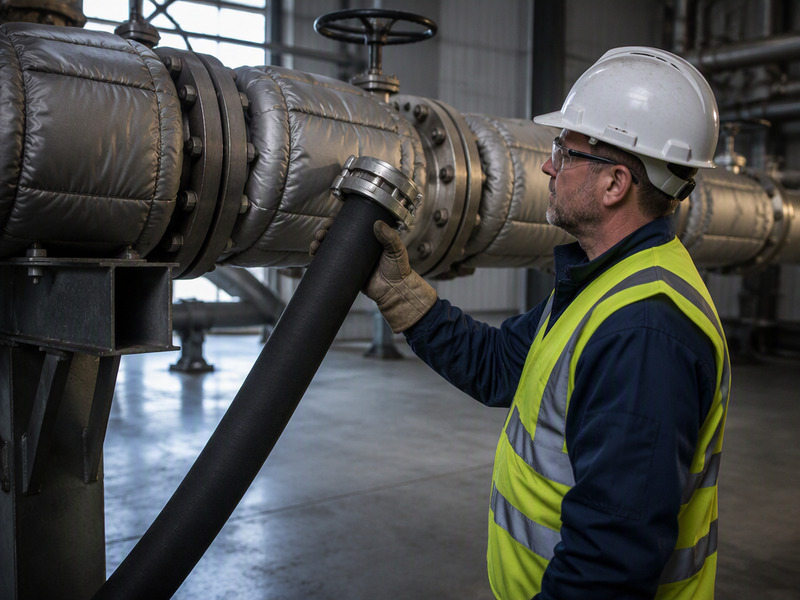
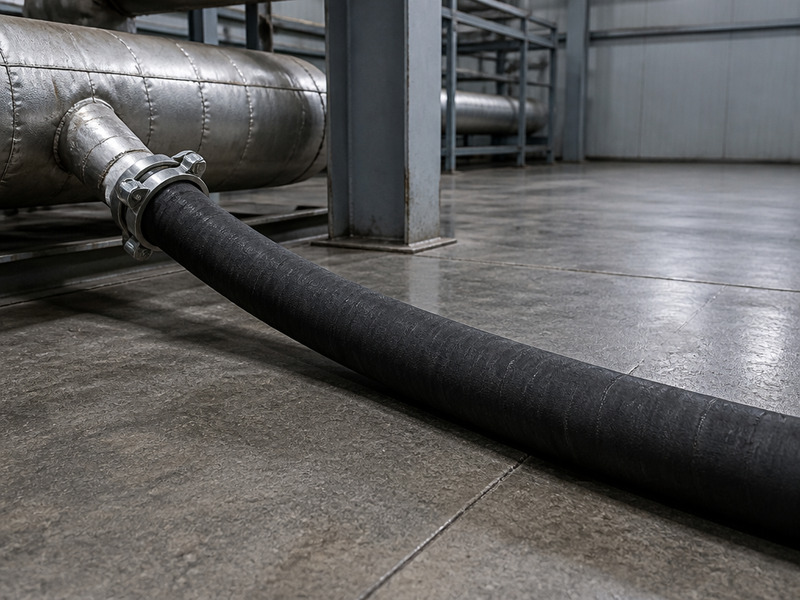
A steam hose is only as safe as its end connection. ISO 6134:2024 requires that the end fitting allow the clamping force to be adjusted, which is why the bolted safety clamp is the default for steam service. A bolted clamp can be re-tightened after the rubber has compressed or aged, so the seal does not depend on a single factory torque value.
The same standard prohibits quick-release couplings on a steam hose. A quick-release coupling is convenient, but it can be opened while the line is still under pressure, and steam releases stored energy without warning. A cam-lock or push-fit connector belongs on a water or air line, not on a hot steam hose. When a full range has to be matched, the notes on steam hoses and fittings show how hose, clamp and adapter are chosen as one system.
Two more rules belong here. The fitting must grip the reinforcement rather than only the cover, or a wire braided steam hose can pull out of the coupling under pressure. Every assembly should also be proof-tested before use; HENGHUA proof-tests every length hydrostatically at 1.5 times its working pressure.
How to Tell a Steam Hose from a General-Purpose Hose in Your Store
On a busy shelf, a steam hose and a general-purpose hose can look almost identical, so it helps to know what is a steam hose by its features rather than its label. Five quick checks separate the two, whether you are a maintenance fitter replacing a failed length or a buyer placing a first order.
- Marking — a steam hose carries a marking line with the standard, the type, the bore, the working pressure and the temperature.
- Sampul — a steam hose cover is pin pricked, so it shows regular perforations you can see and feel.
- End fitting — a steam assembly usually ends in a bolted safety clamp, not a worm-drive clip.
- Construction — a wire braided steam hose shows a visible layer of steel wire, and a Type 1 hose shows heavy textile.
- Rating — ask for the pressure and temperature in writing, because color tells you nothing.
If none of those checks raises a flag, the hose is probably safe for steam. If even one is missing, treat the product as general purpose until a data sheet proves otherwise. On marking and electrical requirements, the notes on hose marking and static control explain what a compliant line must show.
Steam Hose FAQs
What is a steam hose used for?
A steam hose moves saturated steam from a fixed line to a moving point, such as a cleaning lance, a vulcanizing press, a tank heater or a de-icing tool. It is used wherever a rigid pipe cannot follow the equipment. The hose carries both the steam and the hot condensate that forms at start-up, so it is rated as a high-temperature pressure hose rather than a water hose.
Why does a steam hose cover have holes?
The holes are vents, and a jacket without them cannot be trusted. Steam serves a rubber wall as a slow leak, so gas is always working its way out toward the surface on its own. A smooth jacket holds that gas against the reinforcement, and the pressure it builds separates the layers and lifts a blister under the jacket. The vents let the gas leave as it arrives, which is why the bond survives. Count the holes before you accept a hose that is sold as steam-rated.
How many layers does a steam hose have?
Four working layers are standard: a seamless tube, a reinforcement, a cover and an end connection. The reinforcement can be one or two layers, so a heavy-duty hose may hold five or six physical plies in total. The number of plies matters less than how they bond. A two-layer steel wire braid on a well-made hose outperforms a thicker stack with poor adhesion.
Why is a steam hose rated 10:1 and not 4:1?
The margin is set by what is stored inside the line, and a steam line stores far more energy than an oil or air line of the same bore. If a steam hose lets go, that energy can injure anyone nearby, so the working pressure is held to 10:1 against burst. Oil and air lines sit at 4:1 and 3:1, because the risk behind them is a smaller one.
Can a steam hose carry hot oil or diesel?
An EPDM steam hose suits steam and hot condensate only. Steam and hot water are the media it is built for, and mineral oil, diesel and gasoline sit outside that envelope: they swell and degrade EPDM. A line that carries oil-contaminated steam therefore needs a different, oil-resistant rubber compound and a Class B oil-resistant cover. Buyers who ignore this rule often blame the hose for a failure the medium caused.
What is the difference between Type 1 and Type 2 steam hose?
The reinforcement decides the type, and the type decides the envelope. Textile yarn gives Type 1, which covers low-pressure cleaning and light duties up to 6 bar (0.6 MPa, about 87 psi) and 164 °C. Steel wire braid gives Type 2, which reaches 18 bar (1.8 MPa, about 261 psi) and 210 °C for process steam. Ask which reinforcement the hose carries before you compare any other number.
When must a steam hose be replaced rather than repaired?
Replace, never repair: the hose leaves service once the cover is blistered, the reinforcement is exposed, the tube is cracked, or a fitting has pulled. Tape over a blister or a re-crimped end hides a defect that will release steam without warning. Any hose that has seen a steam flash or a pressure spike should be pressure-tested before it returns to service. If that test is not documented, withdraw the hose.
Sourcing Steam Hose by Construction, Not by Appearance
Two hoses can look the same and perform very differently, so buy on the specification rather than the look. Ask the supplier for the standard reference, the hose type and bore, the working pressure, the temperature rating, the reinforcement material and the cover compound. A wire braided steam hose and a textile-reinforced hose serve different pressure envelopes, even when the bore matches. In most disputes the steam hose layers tell you more than the color of the jacket, so put the construction in writing before you order.
For a fuller picture of how bore, wall thickness and ratings fit together, see the batch guide to steam hose sizes and specifications. If the open question is whether a line is saturated or superheated, the comparison in steam hose for saturated and superheated steam settles the grade. For an EPDM hose built specifically for saturated steam, the background in EPDM steam hose for saturated steam is worth reading.
When a steam hose construction has to be documented against real numbers, our own 230 °C range is listed on the EPDM high-temperature steam hose 230 °C page. Confirm the current figure on that product page, because a what is a steam hose decision should rest on the printed data sheet rather than on memory.
HENGHUA manufactures reinforced industrial hose and complete hose assemblies for plants, distributors and OEM brands. Our EPDM steam hose range covers 3/8 inch to 4 inch bore, rated 250 psi (17 bar) working pressure with a 10:1 burst safety factor.
The construction is a smooth steam-resistant EPDM tube, one or two layers of high-tensile steel wire braid, and a pin-pricked cover that vents permeating gas instead of blistering. Every length is proof-tested at 1.5 times working pressure before it leaves the plant, and each batch is date-coded. Because compounding, extrusion, braiding, vulcanization and crimping all happen in one plant, bulk lead times stay short. Send us the working pressure, the steam temperature, the bore and the end connection, and we will quote against them.
We supply cut lengths, crimped ends, protective sleeves, colour coding and OEM branding. Get a quote and free samples
Final Verdict: What Is a Steam Hose? A Specification, Not a Color
A steam hose is not defined by its color or its coil. It is defined by a specification: a steam-resistant tube, a reinforcement matched to the pressure, a pin pricked cover that vents gas, and an end connection that keeps its grip on the reinforcement. Get those four right and the hose survives the steam. Get them wrong, and no amount of care on site will save it.
When the answer to what is a steam hose comes down to a written specification, the next step is simple. Decide the steam condition, the bore and how the hose connects, then buy against those numbers instead of appearance. HENGHUA works with plants and distributors exactly this way, so tell us the pressure, the temperature and the coupling you need, and we will come back with the right construction.
Written by the HENGHUA engineering team, with input from plant maintenance and steam-system reliability teams across North America, Europe and South East Asia. HENGHUA manufactures reinforced industrial hose and hose assemblies, including an EPDM steam hose range from 3/8 inch to 4 inch bore. Those assemblies are rated 250 psi (17 bar) working pressure with a 10:1 burst safety factor, and are supplied as cut lengths or as fully crimped assemblies. Fittings, protective sleeves, colours and OEM branding are available on request.

 English
  Spanish
  Portuguese
  French
  German
  Arabic
  Russian
  Indonesian
  Japanese
  Korean