
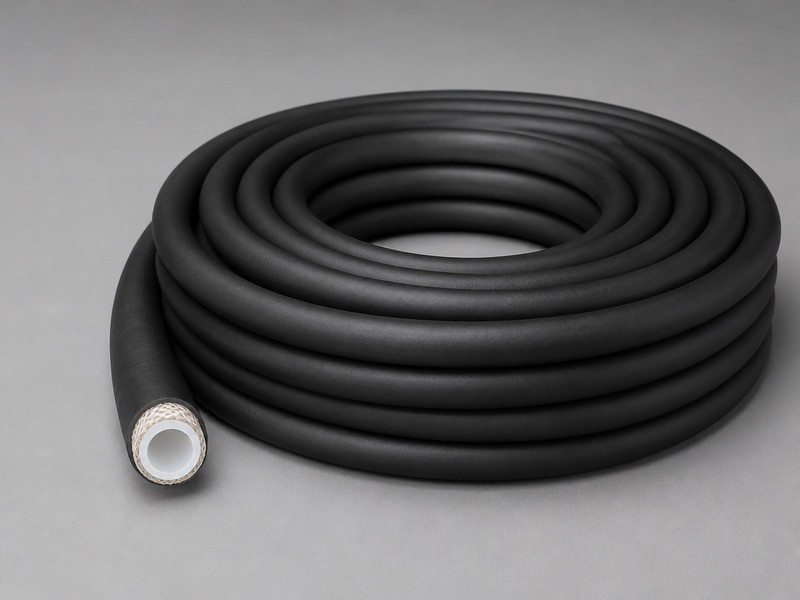
A solvent hose is selected by its tube compound, not by its reinforcement, because each common solvent family attacks rubber in a different way. The tube has to carry toluene, xylene, acetone, MEK (methyl ethyl ketone), esters, glycol ethers and chlorinated cleaners without swelling, softening or releasing particles into the fluid. The four deciding variables are the chemical family, the concentration, the working temperature and the exposure time. This guide groups the solvents by family, explains why non-polar rubber swells, compares fluoropolymer, polyolefin and rubber tubes, and gives the checklist for paint transfer and recovery lines.
1. What a solvent hose has to survive
Solvents are the hard case for rubber because they are small, mobile molecules. They move into the polymer network instead of sitting on its surface, so resistance is not a question of a coating holding them off. A tube that resists an acid can still fail on a solvent, and a tube that shrugs off water can still soften in a ketone.
The reason is polarity. A solvent that is chemically similar to the polymer will be absorbed by it, and similarity is set by the chemical family, not by how aggressive the fluid looks on a safety sheet. That is why two clear liquids of similar appearance can have opposite effects on the same tube.
Failure appears in four ways, and each one means something different for the line:
- Volume swell — the tube absorbs solvent, grows and can choke flow or loosen the coupling.
- Hardness change — the tube softens or hardens and loses its seal at the fitting.
- Extraction — plasticizers and process oils leave the compound and contaminate the fluid.
- Loss of tensile strength — the tube tears or delaminates under pressure and flexing.
Volume swell, hardness change, extraction and loss of tensile strength are exactly the changes an immersion test reports. ASTM D471 covers rubber and ASTM D543 covers plastics, and both report volume swell, hardness change and tensile or elongation change. A chemical-resistance chart does not report them; it gives a rating, and that rating only means something together with the concentration, the temperature and the exposure time it was measured at. For a solvent hose, the tube compound decides which of the four you will actually see.
2. Solvent hose families: what each one attacks
Solvents are not one group. They divide into families, each with a different effect on a polymer, so a solvent hose that works for one coating can fail on the next drum. The families that matter in plants, paint lines and tank terminals are these:
Table 1. Solvent families and what each one attacks in a hose tube
| Family | Examples | Main attack on the tube |
|---|---|---|
| Aliphatic hydrocarbons | white spirit, kerosene, hexane, naphtha | Swell non-polar rubbers; tolerated by polyolefin and fluoropolymer tubes |
| Aromatic solvents | toluene, xylene, benzene, styrene | Strongest swelling of non-polar rubber; needs fluoropolymer or a resistant polyolefin |
| Ketones | acetone, MEK, MIBK (methyl isobutyl ketone) | Aggressive to many rubbers and to some polyolefins; fluoropolymer is the safe tube |
| Esters | ethyl acetate, butyl acetate | Swell and extract non-polar rubber; fluoropolymer preferred |
| Chlorinated solvents | dichloromethane, perchloroethylene | Penetrate and swell most rubber; fluoropolymer only |
| Glycol ethers | butyl glycol (EB), PMA (propylene glycol monomethyl ether acetate) | Moderate; check the specific grade against the tube compound |
| Alcohol- and water-based coatings | ethanol, IPA, glycol-water, latex paint | Often the case where EPDM or NBR remains the right answer |
Treat this table as a screening aid. A rating describes one fluid at one concentration, at one temperature and for one exposure time, so state those conditions before you rely on it. Two drums both labeled “solvent” can behave completely differently. An aromatic solvent such as xylene is far harder on a tube than an alcohol in the same rack, and a ketone such as acetone is harder again on the wrong compound.
The family label also tells you what to ask the supplier. For an aliphatic or an aromatic service, you are asking about swelling of the tube. For a ketone, an ester or a chlorinated solvent, you are asking whether any rubber is acceptable at all.
3. Why non-polar rubber compounds swell
Rubber swells when the solvent and the polymer are chemically alike. Non-polar rubbers — natural rubber, SBR, EPDM and butyl — are built from non-polar chains, so a non-polar solvent dissolves into the network and pushes the chains apart. The tube grows, its hardness drops and its strength falls. That is why an aromatic solvent such as toluene or an aliphatic hydrocarbon such as naphtha is the hardest duty for a plain rubber tube.
Polar compounds behave differently. NBR and FKM resist non-polar oils and fuels well, which is why NBR suits mineral oils, diesel and hydraulic fluids. The same polarity that helps them with oil is what a strongly polar solvent such as acetone or MEK will attack instead.
The practical consequence is that the reinforcement does not save you. A braid or a helix stops the hose from bursting, but it cannot stop the tube from swelling or the fluid from reaching the cover. A solvent hose is therefore specified by the tube compound first and the reinforcement second.
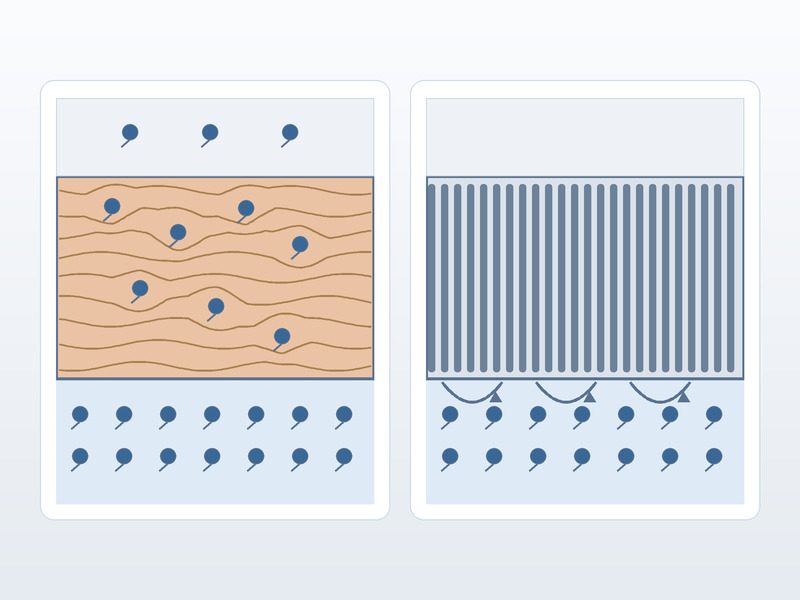
Figure 1. Non-polar solvent molecules enter a non-polar tube and push the polymer chains apart, so the tube swells.
4. Solvent hose materials: fluoropolymer, polyolefin, and where rubber still wins
Three tube families cover almost all solvent duty. Choose between them by the width of the chemical window you need, the purity you need and the budget you have.
Table 2. Tube options for solvent service and where each one fits
| Tube | Typical materials | Best for | Main limits |
|---|---|---|---|
| Fluoropolymer | PTFE, FEP, PFA | Widest solvent and chemical resistance; purity and no extraction; high temperature | Highest cost; needs correct lining and coupling design |
| Polyolefin | UHMWPE, HDPE, XLPE | Lower-cost option within a narrower window; many aliphatic hydrocarbons | Not for aggressive ketones or chlorinated solvents; lower temperature ceiling |
| Rubber | FKM, NBR, EPDM | Water-based and alcohol-based coatings with EPDM; oil-based paints with NBR; FKM for hot aggressive chemicals | Non-polar rubbers swell in aliphatic and aromatic solvents; ketones, esters and chlorinated solvents need fluoropolymer for continuous contact |
Fluoropolymer tubes are the answer where the widest resistance and the highest purity are needed. HENGHUA publishes PTFE as suitable for nearly all chemicals and rated from −70 °C to +260 °C. FEP and PFA are related fluoropolymers with the same family resistance but different temperature and flexibility behavior. They are the usual choice for solvent-based paints, lacquers and chlorinated cleaners, where nothing in the rubber family holds up.
Polyolefin tubes — UHMWPE, HDPE and XLPE — cost less and handle many aliphatic hydrocarbons, but their window is narrower and their temperature ceiling is lower. They are a good fit for a defined, single-product line and a poor fit for a color-change line that sees every cleaning solvent in the plant.
Rubber compounds remain the right answer in specific cases. For water-based and alcohol-based coatings an EPDM tube can be the correct and lower-cost choice, and for an oil-based paint an NBR tube is the one to check first. FKM handles high-temperature oils and aggressive chemicals up to +200 °C. Note honestly that HENGHUA publishes EPDM for hot water, steam up to +165 °C, brake fluid and dilute acids, and explicitly not for oils.
You can compare these materials against the wider list on our guide to types of flexible hose materials, and see how the commodity tubes differ in PVC vs TPR vs PU hose. If you already know the family your fluid belongs to, the chemical hose range is where the solvent-duty builds sit.
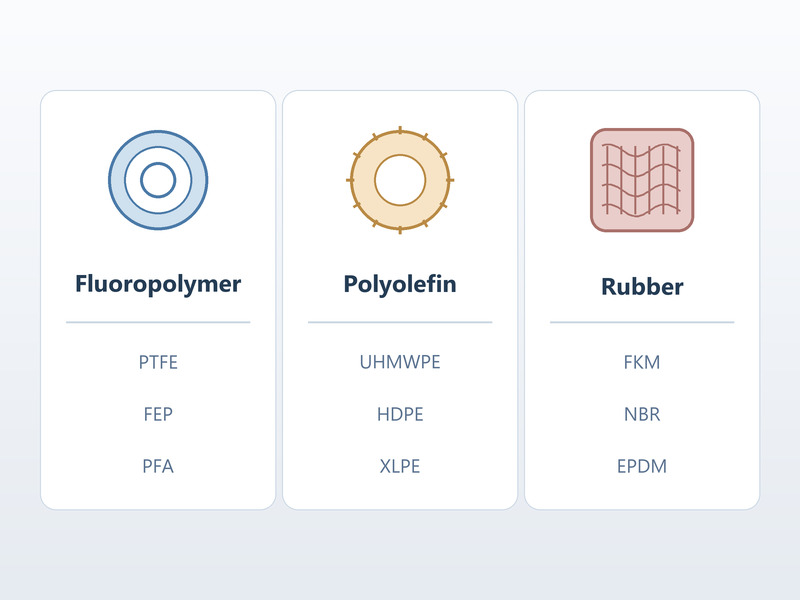
Figure 2. Fluoropolymer covers the widest window, polyolefin a narrower one, and rubber still wins for water-based and oil-based coatings.
5. Paint transfer hose: circulation, color change and cleaning
A paint transfer hose has a harder job than a bulk chemical line in one respect. It is flushed, color-changed and cleaned far more often, and every flush pushes a different solvent through the tube. The tube must resist the paint and every cleaning solvent used against it, and the cleaning solvent is frequently the more aggressive of the two.
Table 3. Paint and coating lines and the solvent duty each one carries
| Line | What runs through it | Solvent duty | Tube to consider |
|---|---|---|---|
| Paint circulation loop | base paint, lacquer, primer | Continuous resin and pigment contact; periodic solvent flush | Rubber for water-based and oil-based; fluoropolymer for solvent-based |
| Color-change line | one paint, then a cleaning solvent | Repeated short exposure to an aggressive cleaning solvent | Fluoropolymer or a resistant polyolefin |
| Flush line | dedicated cleaning solvent | Continuous solvent contact | Fluoropolymer |
| Recovery line | recovered solvent, some vapor | Continuous contact, often warm | Fluoropolymer or a compatible polyolefin |
| Vapor return line | solvent vapor | Vapor permeation and static risk | Conductive grade with a fluoropolymer liner |
On a paint transfer hose, the cleaning solvent is often more aggressive than the paint itself. A tube chosen for the coating alone can fail on the flush, so ask for compatibility data for every fluid the line will see, not only the main product. Lacquer circulation lines run continuously and often warm, which shortens the time a marginal tube has before it swells.
For a color-change line, a solvent resistant hose is usually built with a fluoropolymer tube, because the cleaning solvent is usually the hardest fluid the line sees in a normal day. Color change is also where static control meets the paint line, because the drained and flushed solvent has to go somewhere and the vapor does not always follow the liquid.
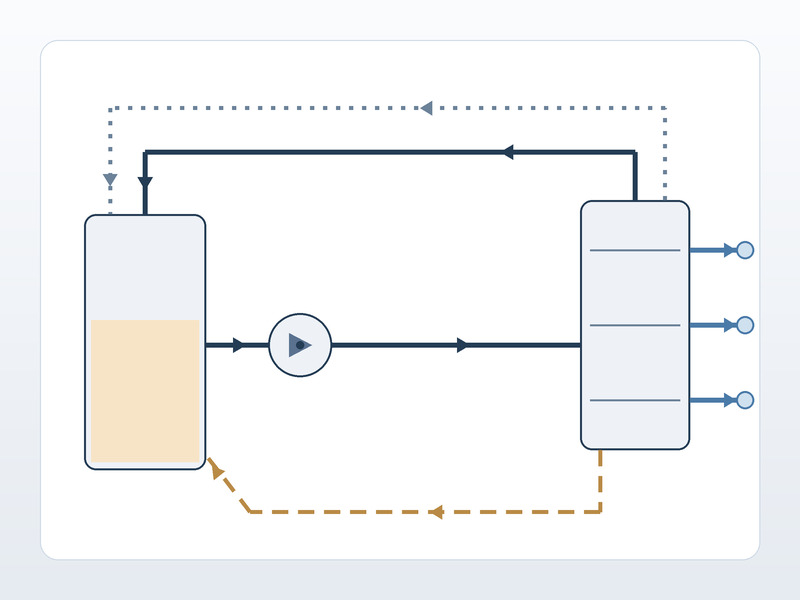
Figure 3. A paint transfer hose feeds the circulation loop, the color-change line and the recovery return within one system.
6. Solvent recovery lines and vapor return
Solvent recovery is the part of a paint or coating line that is easiest to neglect. The recovered solvent is usually warm, often mixed with water and frequently moved under suction rather than pressure. That combination rules out many tubes that look fine on the product data sheet for the clean solvent.
A recovery line commonly runs at part vacuum and carries a mix of liquid and vapor. EN 13765:2018 covers thermoplastic multi-layer composite hose for hydrocarbons, solvents and chemicals. That standard sets the scope of the class, but it does not tell you whether your particular recovered stream is compatible; only the tube data and a test do.
Vapor return lines carry a low flow of solvent vapor back to the tank or the recovery unit. Two things matter here. The first is permeation, because vapor passes through some tubes that hold the liquid. The second is static, because a low-conductivity vapor can carry charge. A tube that holds the liquid on a pressure test can still leak vapor through its wall, so the return line deserves the same material review as the liquid line.
7. Static control for flammable solvents
Flammable solvents make static control a safety function, not an accessory. When a low-conductivity solvent moves through a hose, charge builds on the fluid and on the tube, and a discharge near a vapor space can ignite it. Three parts of the line decide whether the static charge is released safely: bonding, grounding and the electrical grade of the hose itself.
EN 12115:2021 defines four electrical grades for chemical hose assemblies. M means electrically bonded, Ω means electrically conductive, and M/T and Ω/T add a through-wall electrical resistance of 10 Ω or less. The standard covers chemicals in the range −20 °C to +65 °C at a working pressure of 10 bar or less. ISO 8330 vocabulary sets the thresholds you will see on data sheets: an electrically conductive or anti-static hose is below 10⁶ Ω, and an electrically bonded or electrically continuous hose is below 10² Ω.
Before a flammable solvent goes through any line, confirm the following:
- The hose grade is matched to the fluid conductivity and the site hazard assessment.
- Bonding and grounding run continuously from the nozzle to a verified earth point.
- Conductive and bonded grades are tested at commissioning, not assumed.
- The assembly is re-checked after any repair or coupling replacement.
NFPA 77, API RP 2003 and IEC 60079-32-1 are the guidance documents to read next. They cover static ignition in general terms; they do not replace a site assessment for your solvent and your line.
8. The practical selection checklist
Work through the following before you specify a tube:
- List every fluid the line will carry, including cleaning and flush solvents.
- Record the concentration, the maximum working temperature and the exposure time for each.
- Classify each fluid by family: aliphatic, aromatic, ketone, ester, chlorinated, glycol ether, alcohol or water-based.
- Match the tube family to the hardest fluid in the list, not the most common one.
- Confirm the pressure and temperature rating against the published data, and derate where the maker gives a factor.
- Check the electrical grade if the fluid is flammable and low-conductivity.
- Plan a monitored trial with the real fluid at the real temperature, and inspect the tube afterwards.
The honest limit is this: swelling is time- and temperature-dependent. A tube that looks unchanged after a short trial can still grow over weeks at a higher temperature, so a short-term test does not prove long-term compatibility. Treat a trial as a filter, not a certificate. Where a line runs hot, cycles between products or holds solvent for long periods, confirm compatibility with the tube maker and use an immersion test rather than a visual check.
Where the fluid list is dominated by organic solvents, specify a solvent resistant hose and treat the cleaning agents as part of the duty. You can place the tube in the wider picture using our guide to types of industrial hoses and how to choose the right one. The chemical hose range carries the chemical-duty builds that suit a solvent line.
FAQ
What is a solvent hose made of?
A solvent hose is made in three main tube families. Fluoropolymer tubes such as PTFE, FEP and PFA cover the widest range of solvents and give the best purity. Polyolefin tubes such as UHMWPE and HDPE cost less but fit a narrower window. Rubber compounds such as FKM, NBR and EPDM still suit water-based and alcohol-based coatings, and for oil-based paints the rubber to check first is NBR. The reinforcement around the tube does not change that ranking.
Which rubber compounds should I avoid for strong solvents?
Avoid plain natural rubber, SBR and EPDM for aromatic, aliphatic and chlorinated solvents. These are non-polar, so the solvent enters the polymer and swells it. NBR resists oils and fuels but not the strongest solvents. For continuous contact with ketones, esters or chlorinated solvents, use a fluoropolymer tube instead of any rubber compound. Reading the specific chart for your exact fluid is still necessary.
Why does rubber swell in an aromatic solvent?
An aromatic solvent such as toluene is non-polar, and a non-polar rubber is built from similar chains, so the fluid dissolves into the network and pushes the chains apart. The tube grows, hardens or softens, and loses strength. A polar compound resists that particular attack but may fail on a polar solvent instead. That is why the tube compound, not the reinforcement, decides the outcome.
Which is better for solvents, PTFE or UHMWPE?
PTFE covers a wider chemical window than UHMWPE and tolerates the widest range of solvents, and HENGHUA publishes it from −70 °C to +260 °C. UHMWPE costs less and handles many aliphatic hydrocarbons, but it is not for aggressive ketones or chlorinated solvents and has a lower temperature ceiling. Choose PTFE where resistance and purity matter most and UHMWPE for a defined, single-product line.
Can I use a rubber hose for paint?
It depends on the coating. Where the coating is water-based or alcohol-based, an EPDM or NBR rubber tube is usually the lower-cost answer; for oil-based paints take NBR. For solvent-based paints, lacquers and the cleaning solvents used between colors, rubber is more likely to swell, and a fluoropolymer tube is the safer specification. Always check the cleaning solvent, not only the paint.
What does a paint line hose have to resist?
A hose on a paint line has to resist the paint or lacquer, the cleaning solvent used for color change, and any recovered solvent that passes back through the system. Because the line is flushed often, the cleaning solvent is frequently the harder duty. Collect the data for every fluid and choose a tube that suits the most aggressive one, not the most common one.
How is a solvent resistant hose different from a general chemical hose?
A solvent resistant hose is specified for organic solvents, while a general chemical hose may be built for acids, bases or water-based products. The materials overlap, but the duty differs. Solvents attack non-polar rubber by swelling, whereas acids and caustics act differently. A hose rated for one family is not automatically suitable for the other, so match the tube to the fluid family you actually pump.
What is solvent recovery and why does it affect the hose?
Recovery captures used solvent and vapor for reuse or safe disposal. The recovered stream is usually warm, often mixed with water and moved under part vacuum, which is a harder duty than clean solvent in a pressure line. The hose must resist the liquid, limit vapor permeation and carry the correct electrical grade, because a low-conductivity vapor can hold static charge.
Do I need a conductive hose for solvents?
If the solvent is flammable and has low conductivity, static control is a safety requirement. EN 12115:2021 defines four electrical grades for chemical hose assemblies, and ISO 8330 sets the resistance thresholds: conductive or anti-static below 10⁶ Ω, and bonded or continuous below 10² Ω. Bonding and grounding must be continuous and verified. Use a conductive or bonded grade where the site assessment calls for it.
How long should a solvent hose last?
There is no fixed life. Swelling is time- and temperature-dependent, so a tube that passes a short trial can still degrade over weeks in hot, continuous service. Life depends on the fluid, the temperature, the pressure and how often the line is flushed. Inspect the tube for swelling, softening and cracking, and replace it before the tube damage reaches the cover or the reinforcement.
About HENGHUA
HENGHUA is a hose manufacturer supplying distributors, chemical plant operators, EPC contractors and OEM programs. The chemical range includes chemical discharge hose rated 150 psi and chemical suction and discharge hose rated 150 psi and 250 psi. Internal diameters run from 3 mm to 102 mm (1/8 in to 4 in), with a 4:1 design safety factor across the range.
The material call-outs used on this site include EPDM for hot water, steam up to +165 °C, brake fluid and dilute acids, but not for oils. FKM covers high-temperature oils and aggressive chemicals up to +200 °C. PTFE suits nearly all chemicals from −70 °C to +260 °C. NBR covers mineral oils, diesel and hydraulic fluids.
The plant covers 35,000 m² with 95 production lines and 320+ employees, including 45 QC inspectors and 25 R&D engineers holding 30+ patents. Capacity is 20 million meters a year, the site is 90 km from Shanghai port, and products are exported to 70+ countries. The quality system is certified to ISO 9001, IATF 16949 and ISO 14001. The in-house test lab runs burst testing to ISO 1402 and impulse testing to ISO 6803.
If your line carries a solvent or a paint and you are not certain which tube fits, send the fluid list, the concentration, the temperature and the pressure, and the team will respond with a specification. You can read more about HENGHUA or contact us with your operating conditions.






 English
  Spanish
  Portuguese
  French
  German
  Arabic
  Russian
  Indonesian
  Japanese
  Korean