
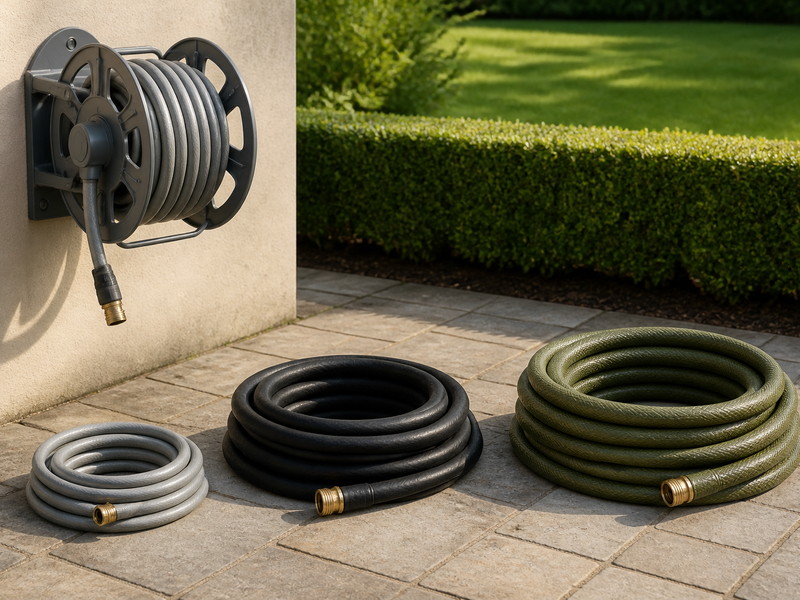
A garden hose buying guide answers one question: which five values should you fix before you compare products? The answer is material, inside diameter, length, working pressure and the couplings. Get those five right and the hose matches the job; get one wrong and it is usually replaced within two seasons. This page works through the five, then covers the garden hose sizes, water hose types and garden hose material comparison behind them, and closes with three starting routes, one for each kind of buyer.
1. The Five Decisions This Garden Hose Buying Guide Has to Make
Every hose on a shelf is a bundle of trade-offs, and each trade-off can be measured before you pay. The five decisions that matter most are the material the tube is built from, the inside diameter of that tube, the length you actually need, the working pressure the maker rates, and the couplings at both ends. A sixth decision, UV and heat tolerance, decides how long the first five keep working.
Why Does the Job Decide the Hose You Buy?
The job sets the requirements before the product does. A hose dragged across a lawn and a hose left attached to a pressure washer feed make different demands on kink resistance, pressure rating and coupling strength. Write down the hardest thing you will ask the hose to do, then buy for that job instead of the easiest one.
What Does Each Decision Cost You?
Each decision is paid for somewhere else in the specification, and the price is rarely printed on the label:
- Thicker walls add weight and cut flexibility, and they resist kinks and abrasion.
- Larger bores carry more water, and they weigh more and need more pressure to fill.
- More length adds reach, and it also adds friction loss along the run.
- Harder coupling metal resists corrosion, and it raises the price at the till.
- Stronger UV protection adds cost, and it decides how many seasons the cover lasts.
What Belongs on the Buyer Checklist?
Before comparing products, settle these items in writing so the shelf cannot decide for you:
- Material and construction: the tube, any reinforcement, and the cover.
- Inside diameter: the nominal bore, not the outside appearance.
- Length: short enough to limit friction loss, long enough to reach.
- Working pressure: a continuous rating, not a burst figure.
- Couplings: thread form, metal, and whether they can be replaced.
- UV and temperature tolerance: what the cover is built to survive.
- Warranty: the term, and what voids it.
How Do You Rank the Decisions?
Rank them in the order you cannot change later. Material and diameter are fixed at the factory, length is fixed when you buy the wrong reel, couplings can sometimes be swapped, and storage is entirely in your hands. Buyers who spend the budget on the changeable decisions usually replace the hose sooner, because the part they could have adapted was never the part that failed first.
2. How to Choose a Garden Hose by Material
Material decides weight, cold-weather behavior, kink resistance and how long the hose keeps its shape. Four families cover most domestic water hose: vinyl (polyvinyl chloride, or PVC), rubber, hybrid polymer blends, and reinforced multi-layer constructions that combine two of the first three. Material and wall thickness decide how long a hose stays durable, and the pigment in the cover decides how long it resists UV.
What Garden Hose Material Options Exist?
Table 1 compares the four families on properties a buyer can feel and repeat. Every mass figure is calculated from a stated wall thickness and an assumed compound density, so you can run the same arithmetic on any hose you are offered.
Table 1. Four hose material families compared. Mass per meter is calculated from a 5/8 in inside diameter, the stated wall thickness and the assumed compound density.
| Construction | Stated wall | Density assumed | Calculated mass per meter | Behavior to expect |
|---|---|---|---|---|
| Vinyl, unreinforced | 1.5 mm | 1.40 g per cm3 | about 115 g | Light, and stiff in cold |
| Rubber (EPDM) | 2.0 mm | 1.20 g per cm3 | about 135 g | Heavier, flexible when cold |
| Hybrid polymer blend | 2.0 mm | 1.25 g per cm3 | about 140 g | Middle weight, mid flexibility |
| Reinforced multi-layer | 2.5 mm | 1.15 g per cm3 | about 166 g | Most kink resistant |
Two hoses with the same 5/8 in bore differ by roughly 50 g per meter between the lightest and the heaviest construction above, which is about 1.5 kg over a 30 m reel (calculated). That difference is felt on every drag, and it is the honest trade against kink resistance. Water adds weight on top of the tube, and a full hose is heavier than the dry weight implies.
Which Garden Hose Material Suits Your Climate?
A garden hose material that stiffens below about 5 °C (41 °F) is a poor choice for a hose left outdoors through a cold season. Vinyl behaves that way, while rubber keeps more flexibility at the same temperature. HENGHUA, the hose manufacturer behind this site, treats vinyl lines as warm-weather products and rubber lines as the near-freezing option in its own compound guidance.
For a climate-by-climate comparison, the site’s separate analysis of PVC versus rubber garden hose by climate and use case covers the detail; this page keeps only the parts a buyer needs to decide.
Which Construction Suits Daily Use, and Which Does Not?
Two constructions suit daily use: a reinforced tube, and a multi-layer hose with a coupling that can be replaced. A thin single-layer tube suits occasional hand watering on a short run, where a light wall kinks less often than it does in a daily rotation. A crimped fitting without a metal insert turns a small leak into a discarded hose. Both are limits rather than defects.
How Do You Judge Material Quality in the Store?
Two hoses of the same size can be compared by hand before you buy. Press the wall between finger and thumb: a wall that springs back evenly suggests a consistent compound, while a wall that stays dented suggests a soft, thin tube. Bend the hose into a tight loop and hold it, because a hose that kinks twice at the same radius will kink in service.
What Does Flexibility Cost You?
Flexibility is paid for in wall thickness and density: the heaviest construction above carries about 44 percent more mass per meter than the lightest (calculated). That mass is what buys kink resistance.
Where flexibility comes from the compound rather than the wall, the underlying polymer behavior is covered in the flexible hose materials guide, which explains how different polymers behave under repeated bending.
3. How to Choose a Garden Hose: Diameter and Garden Hose Sizes
Inside diameter is the number that changes how a hose behaves most, and it is the number buyers misread most often. Marketers sometimes quote outside diameter, which tells you nothing about flow. Garden hose sizes are always stated as a nominal inside diameter, and the three figures sold most widely in North America are 1/2 in, 5/8 in and 3/4 in. That single figure is the first thing any garden hose buying guide has to pin down. If you want one number, the standard garden hose size in North America is 5/8 in inside diameter.
What Do Garden Hose Sizes Mean in Practice?
The size chart below converts each nominal size to millimeters and to relative flow, calculated from the circular area.
Table 2. Nominal hose sizes, converted inside diameters, and relative flow calculated from inside area at equal water velocity.
| Nominal size | Inside diameter (calculated) | Inside area (calculated) | Relative flow at equal velocity (calculated) |
|---|---|---|---|
| 3/8 in | 9.5 mm | 71 mm2 | 0.56 |
| 1/2 in | 12.7 mm | 127 mm2 | 1.00 |
| 5/8 in | 15.9 mm | 198 mm2 | 1.56 |
| 3/4 in | 19.1 mm | 285 mm2 | 2.25 |
| 1 in | 25.4 mm | 507 mm2 | 4.00 |
Moving from 1/2 in to 5/8 in adds about 56 percent more area at the same velocity, and moving to 3/4 in more than doubles it (calculated). The 3/8 in row is the light-duty end of the range: at equal velocity it carries a little over half the flow of 1/2 in (calculated).
Does a Bigger Diameter Always Mean More Flow?
No, because pressure loss along the hose works against the gain. In the Hazen-Williams relationship used for water pipe, friction loss falls with roughly the 4.87 power of diameter at equal flow. Doubling the bore cuts friction loss by about 29 times at equal flow, calculated from that published exponent. That is why a long 1/2 in hose can deliver less at the far end than a short 5/8 in hose on the same tap.
How Do You Measure the Bore You Already Have?
If you are replacing a hose and the label is gone, measure the inside diameter rather than the outside. Push a marked dowel into a clean end, or measure across the opening with calipers and round to the nearest standard size. Outside diameter is no help, because two hoses with the same bore can differ in wall thickness by a millimeter or more.
Where the Size Guide Goes Deeper
Garden hose sizes interact with tap pressure, run length and nozzle restriction, and that arithmetic is longer than a garden hose buying guide should carry. The hose size selection guide works through the selection in full; use it once you have narrowed your choice to two candidates.
4. How Long Should a Garden Hose Be?
A garden hose should be the shortest one that reaches your worst-case route. Length is paid for twice: friction loss rises with distance, and every extra meter adds water weight once the hose is full.
Why Does Length Cost You Flow?
Friction loss is proportional to length at a given flow, so a 30 m hose loses about twice the pressure of a 15 m hose of the same bore (calculated). A hose that reaches the far bed with pressure to spare at 15 m may dribble at 30 m if the bore is small. Buy the shortest hose that reaches, and increase the bore rather than the pressure when the run is long.
A common rule of thumb is to buy more hose than you measure, so nothing is out of reach. That rule holds only at a large bore; on a small bore the extra meters cost pressure before they add reach.
How Do You Measure the Run You Need?
Measure along the path the hose will take, not in a straight line, and add a little slack:
- Start at the tap or spigot and note its height above the ground.
- Walk the route the hose will actually follow around obstacles.
- Add one meter for each tight corner the hose will round.
- Add two meters of slack at the far end for movement.
- Round the total up to the nearest standard length.
Should You Buy One Long Hose or Two Short Ones?
Two short hoses joined by a coupling are easier to store and cheaper to replace, but they lose pressure at the joint and add a place to leak. One long hose has fewer joints and cannot come apart mid-job. If the run is long and the pressure is low, one large-bore hose beats two small-bore hoses joined together.
5. Water Hose Types and Pressure Ratings
Water hose types are usually described by how the tube is built rather than by the water they carry. A single-layer tube, a reinforced tube with a mesh or spiral, and a multi-layer tube with a bonded cover are the three constructions you will meet. Pressure rating, coupling style and price all follow from that construction. Any garden hose buying guide that starts with color or fittings has started in the wrong place.
Which Water Hose Types Suit Which Job?
Choosing between water hose types is a construction question first and a price question second. A light single-layer hose suits occasional hand watering, a reinforced hose suits daily dragging and reeling, and a multi-layer hose with a bonded cover suits jobs where abrasion and sun are constant. For the full taxonomy, the types of water hoses guide breaks the categories down; this page keeps only what a buyer needs to decide.
What Do Working, Test and Burst Pressure Mean?
Three pressure numbers appear on labels, and they are not interchangeable. Working pressure is the figure the hose is designed to hold continuously. Test pressure is a short proof load applied in the factory. Burst pressure is the point of destruction, and it is safety information rather than a usable rating.
Table 3. Three pressure figures on a hose label, what each one describes, and how a buyer should read it.
| Figure | What it describes | How a buyer should use it |
|---|---|---|
| Working pressure | A continuous design load | Must exceed your supply pressure with margin |
| Test pressure | A short factory proof load | Evidence of a quality step, not a service rating |
| Burst pressure | The destruction point | Safety information only, never a buying figure |
What Pressure Does Your Tap Actually Deliver?
Supply pressure varies by property, by time of day and by how many taps are open at once. A pressure gauge fitted to an outdoor tap, read while nothing else is drawing water, gives a usable working figure. Compare that figure with the hose working pressure, and leave margin for the surge that arrives when a valve closes quickly.
What Does a Flow Claim Really Measure?
A flow claim means nothing without the pressure and the length attached to it, because the same hose delivers very different volumes at 30 psi and at 80 psi. When a listing quotes liters or gallons per minute, look for the pressure at which it was measured and the length of hose used. If either is missing, treat the figure as marketing rather than specification.
Which Spec-Sheet Claims Are Worth Ignoring?
Some label claims carry no information a buyer can act on, and they are worth skipping:
- A burst figure quoted with no working figure beside it.
- A diameter given as outside size when you asked for bore.
- A temperature range with no stated test condition.
- A warranty that excludes the failure you actually expect.
- A flow claim with no stated pressure and no stated length.
- A “no kink” claim quoted with no bend radius and no temperature.
6. Couplings, Fittings and Compatibility
A coupling is the part that decides whether the hose can be repaired, and it is the part most buyers examine last. Any garden hose buying guide that treats the fitting as an accessory has the order backwards, because the hose is useless until the connection seals. Water hose coupling types reach the shelf in two families: threaded and quick-connect.
What Thread Form Should You Expect?
In North America the common garden hose thread is a 3/4 in nominal, 11.5 threads-per-inch form known as Garden Hose Thread (GHT), or National Hose (NH) in older catalogs. It is not compatible with NPT pipe thread, which looks similar and will not seal. In metric markets, 1/2 in, 5/8 in and 3/4 in bores usually arrive with a barbed or clamped fitting instead of a threaded one.
What Makes a Coupling Last?
Couplings fail where metal meets water and where the crimp meets the tube. Brass and stainless steel resist corrosion longer than plated zinc, and a coupling that can be unscrewed and replaced extends the life of the hose well past its first fitting. If a coupling is molded to the tube and cannot be cut back and refitted, the hose dies with the first leak.
Should You Buy Quick-Connect or Threaded Couplings?
Quick-connect couplings trade a small amount of flow and a small amount of money for speed, and they are worth it if you swap nozzles often. Threaded couplings seal with more force and cost less, but each swap takes time and each thread is a place to cross-thread. Whichever you choose, keep the system consistent, because mixing two connector families means buying an adapter for every change.
How Do You Check Compatibility Before Buying?
Water hose connector types and water hose connection types both reduce to three checks: thread form, diameter and gender. A female coupling on the hose joins a male tap outlet, and two hoses joined end to end need a double-female connector. If your tap uses a metric or non-standard thread, buy the matching adapter with the hose rather than after it.
7. UV, Temperature and Storage
UV, freezing and storage decide how many seasons a hose survives, and all three are settled after the purchase rather than at the till.
How Does UV Degrade a Cover?
Ultraviolet light attacks the polymer at the surface of the cover. The damage shows first as a chalky, faded skin, then as surface cracking, and finally as a crack that reaches the reinforcement. On an unprotected vinyl cover the difference between sun and shade appears within one season. HENGHUA states its own production position plainly: a black cover loaded with carbon black resists UV longer than a bright, lightly pigmented one.
What Temperature Range Should You Plan For?
Plan for the coldest weather the hose will meet while it still holds water. Vinyl reaches that limit first: it stiffens below about 5 °C (41 °F), while rubber keeps useful flexibility closer to freezing, so a hose left out through winter should be the rubber one. Drain both types before a hard freeze. Ice expands, and a plug of ice inside a tube can split it at a coupling. If you water in near-freezing weather, choose the garden hose material for cold rather than for weight.
How Should You Store a Hose Between Uses?
Coil the hose loosely on a reel or a hook rather than pulling it tight, because a hose stored under tension takes a set and kinks at the same place next time. Keep it out of direct sun when it is idle, and disconnect it from the tap if frost is forecast.
8. How to Choose a Garden Hose for Each Job
A garden hose buying guide is only as useful as the job list attached to it, so write the list before the shortlist. The five jobs below cover most domestic use, and each one shifts the priority between bore, pressure and coupling type.
Watering a Lawn
A lawn wants coverage and reach more than pressure. A 5/8 in hose on a 20 m run with a sprinkler is usually enough, and a larger bore only helps when the run is long or the tap pressure is low. Reel storage matters here more than on any other job, because a lawn hose is dragged twice a week and left in the sun between uses.
Watering Beds and Containers
Beds and containers want control, so the bore can stay at 1/2 in or 5/8 in and the nozzle does the work. A lighter hose is easier to steer between plants, and kink resistance matters because you will turn tight corners around beds. For containers, a short hose plus a watering can often beats a long hose with a spray head.
Washing a Car
Car washing wants volume at moderate pressure so that rinsing is quick and grit lifts away. A 5/8 in bore with a decent nozzle does this well, while a 1/2 in hose makes the job take longer and uses more water for the same result. Keep the hose off the paintwork, and use a dedicated nozzle rather than a pressure washer on body panels.
Feeding a Pressure Washer
A pressure washer feed hose is a supply line, not a cleaning tool. The machine needs a hose that will not flatten under suction, and the bore should match the machine inlet. A soft hose can collapse under the pull of the pump and starve the machine, which shortens pump life. Match the feed to the inlet rather than to the outlet.
Filling a Tank, RV or Potable Supply
Filling an RV tank or a drinking-water container changes the requirement to material safety. A hose marketed for potable water uses a tube and cover intended for that service, and a general garden hose does not. Use a potable-rated hose for anything you will drink, and keep a separate general hose for watering, stored apart, because the inside of a garden hose is not maintained to a drinking-water standard.
9. Cost, Warranty and Where to Buy: The Last Three Decisions in This Garden Hose Buying Guide
Where to buy garden hose matters, but the specification decides whether the purchase was right. Price differences between two hoses of the same size are usually explained by three things: wall thickness, the metal in the couplings, and the length of the warranty. A garden hose buying guide that skips those three is comparing packaging rather than product.
How Do You Compare Two Hoses Fairly?
Compare at the same length, the same bore and the same working pressure. A heavier hose at a wider bore is not stronger. A cheaper hose at a shorter length is not cheaper. Reduce both candidates to a price per meter at equal specification, then weigh the difference against the coupling metal and the warranty term. That comparison is the one the label usually avoids. Once you have a shortlist, the shop’s standard lengths show what is held in stock.
What Should a Warranty Cover?
A useful warranty covers the failures a hose is likely to suffer, which are kinks that become cracks, couplings that separate, and covers that fail in UV. A warranty that excludes normal wear covers almost nothing. Read the exclusion list before you read the term.
What Do You Get for a Longer Warranty?
A longer term usually reflects a stronger construction rather than a kinder supplier. Manufacturers price a warranty against the failure rate they expect, so a five-year term on a hose that normally fails in two years would be expensive to offer. Treat the term as evidence about the construction, then read the exclusions.
If you are specifying for a program or a shelf, send the bore, the length, the working pressure and the coupling you need, and the technical team will confirm the matching construction.
Where the Numbers Come From
Every figure in this guide is either arithmetic on stated inputs, marked calculated, or a statement of HENGHUA’s own production position. Where a label claim could not be traced to a standard, a test condition or a stated input, it was left out rather than repeated. HENGHUA’s consumer products catalog shows the constructions and coupling styles each line is supplied with.
10. A Starting Route for Three Buyer Profiles
How to choose a garden hose gets easier once you accept that most buyers fall into one of three profiles, and each profile has a sensible default. Pick the profile that matches how often you will drag the hose, not the one that matches the price you hoped to pay.
The Occasional User
Buy a 5/8 in reinforced hose at a length that reaches the far corner, keep it on a reel out of the sun, and accept a shorter warranty. The occasional user gains little from a heavy wall, because the hose is not dragged often enough to wear one out. Spend the money on storage instead.
The Weekly Gardener
Buy a 5/8 in or 3/4 in reinforced hose with repairable brass couplings and a UV-resistant cover. The extra mass per meter is repaid in fewer kinks and a longer service life, and repairable couplings mean a cut near the end does not end the hose.
The Trade or Institutional User
Buy for the worst job in the rotation, not the average one. Specify the bore, the working pressure, the coupling metal and the warranty term in writing, then buy several identical hoses so that spares are interchangeable. Potable service needs its own separately marked hose, kept apart from watering stock.
The One-Page Decision
Write the five values on one line before you open a catalog: material, bore, length, working pressure and coupling. Then compare only the products that satisfy all five, and let price sort what remains. That single line is what a garden hose buying guide is for.
11. Buying Mistakes That Cost You a Season
Hose purchases that disappoint were usually decided wrong before any money changed hands. The three checks below are the ones that carry a price.
What Mistake Do Buyers Make Most Often?
Measuring the run in a straight line is the most common and the most expensive mistake. A run that measures 18 m in a straight line can need 24 m of hose once it follows the route around obstacles. Buyers who shorten it then find the far bed out of reach and need a second hose and a coupling.
Which Shortcuts Fail First?
Several shortcuts look harmless at the till and fail inside a season:
- Buying by outside diameter instead of bore.
- Choosing a hose whose couplings cannot be replaced.
- Storing a hose in full sun on a bare reel.
- Leaving water inside a hose through a hard freeze.
- Matching a pressure washer inlet to the wrong bore.
What Should You Check Before You Pay?
Before you pay, confirm four things at the shelf: the bore matches your worst job, the working pressure exceeds your tap pressure with margin, the couplings match the fittings you own, and the warranty covers the failures you expect. If one is uncertain, step back to the checklist.
FAQ
How do I choose a hose for a first home?
How to choose a garden hose for a first home comes down to reach, weight and storage. Measure the longest run from the tap, pick a 5/8 in bore unless the run is very long, and choose a construction you can lift comfortably when it is full. Buy a reel at the same time: shade extends the life of the cover more than any label feature.
What size garden hose do I need, and what is the most common size?
Match the bore to the longest run you have to cover: 5/8 in handles most yards, 1/2 in suits short light-duty runs, and 3/4 in suits long runs or higher flow. The most common size sold in North America is 5/8 in inside diameter.
Should I buy rubber or vinyl?
Rubber keeps its flexibility at low temperatures and resists UV well, which suits a hose left outside through a cold season. Vinyl is lighter and cheaper, but it stiffens in cold weather and its cover fades in strong sun. If you water through winter, choose rubber or a hybrid; if you water in summer and store the hose indoors, vinyl is adequate.
Is a heavy duty garden hose worth it for a small yard?
A reinforced hose resists kinks and holds its shape under pressure, which matters if the hose is dragged, reeled or bent around corners. An unreinforced hose is adequate for occasional hand watering on a straight run. Reinforcement also raises the working pressure the maker can rate.
What working pressure should I look for?
Look for a working pressure comfortably above the highest pressure your supply can deliver. Domestic supply in North America is commonly cited at 40 to 80 psi, so a hose rated well above that figure leaves margin for surges. Ignore a burst figure quoted on its own.
How long can a hose be before flow drops?
Flow falls with length because friction loss rises with the distance the water travels. A 30 m hose loses about twice the pressure of a 15 m hose of the same bore at the same flow, calculated from that relationship. If the run is long, increase the bore before you increase the pressure.
Can I use a garden hose for drinking water?
Only if the hose is marked for potable water service. A general garden hose is not made or maintained to a drinking-water standard, and the inside of the tube can support growth between uses. Keep a separate potable-rated hose for filling tanks and containers, and use it for that duty only.
How should I store a hose over winter?
Drain the hose completely, coil it loosely, and store it out of sunlight and above freezing. Water left inside can freeze and split the tube, especially at a coupling where the wall is thin. A hose frozen while full often fails at the first fitting the following spring.
Does a bigger diameter raise water pressure?
No. A larger bore lowers friction loss, which means more of your supply pressure survives to the far end of the run. The pressure at the tap does not change. A bigger hose can therefore feel stronger at the nozzle, even though nothing at the supply has changed.
What does a garden hose warranty usually cover?
A useful warranty covers manufacturing faults such as a separated coupling or a delaminated cover, and it usually excludes wear, freezing and cutting. Read the exclusion list before you read the term. Keep the receipt, since most claims require proof of purchase.
Are expandable hoses worth buying?
Expandable hoses are light and easy to store, but the inner tube stretches with every use and the couplings take the strain. They suit light, occasional watering on a short run and are a poor choice for daily use or high pressure. If you need a hose that folds away and you water gently, they work.
How much does a full garden hose weigh, and does it matter?
Water is most of what you lift. A 5/8 in bore holds about 0.20 liters per meter, so a 30 m hose carries roughly 5.9 kg of water before the tube itself is counted (calculated from the internal area used in Table 2). A wider bore holds more per meter. Weight matters when you carry a coiled hose or lift a full one onto a hook, so if the carry is long or the grip is weak, choose a lighter construction and a shorter run.
About HENGHUA
HENGHUA is a hose manufacturer supplying distributors, retailers and OEM programs from its own production lines. The corporate brand covers the group’s garden and water hose output, GLOBHOSE covers high-performance hydraulic hose, and FLEXMAX covers flexible industrial hose. The company supports private label and custom branding, and it publishes the working pressure, material and coupling options for each line rather than a single headline claim. This garden hose buying guide follows the same approach: state the inputs, show the arithmetic, and leave the superlatives to other pages.
Need a hose specified for your market, your climate or your shelf? Send the bore, the length, the working pressure and the coupling you need, and the technical team will confirm the matching construction and quotation; the contact page is the fastest route.






 English
  Spanish
  Portuguese
  French
  German
  Arabic
  Russian
  Indonesian
  Japanese
  Korean