
Hose assembly fittings, also called hose ends, are the metal ends that turn a chemical hose into a finished assembly. They set the pressure that the joint can hold and define the interface the plant connects to. This article compares the four attachment methods and three interface types.
This article is about termination rather than hose construction. It compares crimped, swaged, banded and reusable ends, explains flanged ends to ASME and EN patterns, and covers camlock couplings. It closes with selection logic for common chemical services and the factory test and marking routine we apply to every assembly we ship.
All pressure figures are working-pressure ratings at 23 °C ambient; regulation citations refer to the current text of the cited section. About 13 min read.
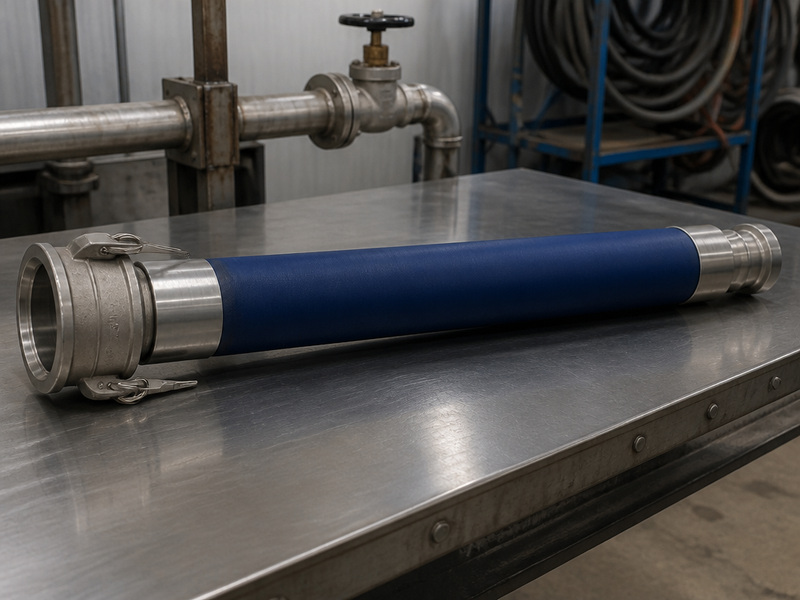
Figure 1. A finished chemical hose assembly with crimped ends and camlock couplings, presented for hydrostatic test.
Why Hose Assembly Fittings Decide the Whole Assembly
A chemical hose is a system, not a tube. The inner tube carries the medium, the reinforcement carries the pressure, and the cover carries the environment. None of those layers reaches the plant. The connection happens at the end, so that is where the assembly is won or lost.
When we strip a returned assembly, the tube is usually intact. Damage sits at the fitting: a pulled crimp, a galled thread, a flange face scored by over-torque, or a camlock arm bent by side load. Hose assembly fittings therefore carry two duties at once. They must hold the hose, and they must present a mating interface the receiving equipment already uses.
For a chemical hose assembly, the rated working pressure is the lower of the hose rating and the end rating. A hose rated to the top of its class, fitted with a light-duty coupling, is only as strong as that coupling. That is why we publish an assembly rating and not just a hose rating, and why the chemical hose collection we supply is ordered as a complete assembly.
Four decisions fix the end before any tool touches the hose:
- Attachment method: how the metal grips the hose, whether crimped, swaged, banded or reusable.
- Interface type: what the plant connects to, whether thread, flange or quick coupling.
- Material and lining: the body and the wetted path against the medium.
- Rating and marking: the pressure the joint holds and how that is recorded.
Hose End Connections: Crimped, Swaged, Banded and Reusable
A hose end connection is graded by how the metal is locked to the hose. The four common methods differ in tooling, reusability and the care they demand during assembly. Choosing between them is the first real decision in building an assembly.
Crimping is the default for factory-built chemical hose assemblies. A hydraulic press closes a ferrule over the hose, and the ferrule bites into the reinforcement. The result is a permanent, tamper-evident joint with a repeatable crimp diameter. Because a machine sets the crimp, we can reproduce it batch after batch and record the setting against each assembly.
Swaging forms the ferrule inward by drawing it through a die rather than pressing it. Swaged ends suit smaller bores and give a smooth outside diameter where a hose has to pass through a tight route. The trade-off is that each bore and wall combination needs its own die.
Banded ends use a bolt or screw clamp to press the hose onto an insert. They need no press and can be serviced in the field, but the holding force depends on the person with the wrench. Clamp choice matters as much as the fitting itself, and the hose clamp selection guide covers band material and tightening practice.
Reusable ends screw together over the hose and can be removed and refitted. Site assembly and hoses that must be shortened or rotated are their main use. A reusable end reaches rated pressure when the maker’s assembly sequence and torque are followed.
Table 1. Comparing the four ways a chemical hose assembly can be terminated.
| Attachment method | How it is formed | Reusable | Best fit |
|---|---|---|---|
| Crimped | Hydraulic press closes a ferrule onto the hose; the ferrule bites the reinforcement. | Tidak | Factory assembly, repeatable joints, most chemical service. |
| Swaged | Ferrule is drawn through a die and formed inward. | Tidak | Smaller bores, smooth outside diameter, tight routing. |
| Banded | Bolt or screw clamp presses the hose onto an insert. | Yes | Low pressure, field repair, temporary runs. |
| Reusable | Threaded body clamps the hose as it is tightened. | Yes | Site assembly, hoses that must be shortened or rotated. |
In our factory, crimped hose fittings account for the large majority of the chemical assemblies we ship. We keep swaged ends for small bores and tight bends, and we supply banded or reusable ends mainly as service items. For most chemical duty, the crimped end is the first choice, because the joint can be measured, recorded and repeated. Each crimp is checked by measuring its diameter against the tooling record for the hose size.
Flanged Ends: Hose End Connection Types to ASME and EN Patterns
A flanged end turns a hose into a bolt-up connection. It spreads the load across a full circle of bolts, handles large bores, and lets a technician break the line with nothing more than a wrench. In chemical plants, flanged ends are the usual choice where the mating equipment is already flanged or where the medium must not see a threaded crevice.
Two standard families dominate flanged hose end connection types. The ASME route uses ASME B16.5 for steel pipe flanges and ASME B16.24 for cast copper-alloy flanges, with Class 150 and Class 300 the classes specified most often in industry. The European route uses EN 1092-1, where sizes are named by nominal pressure, such as PN10 and PN16.
ASME and EN flanges use different bolt circles, bolt counts and face details. Match the pattern on the hose to the pattern it will meet: an ASME B16.5 flange bolts to ASME B16.5 pipework, and an EN 1092-1 flange bolts to EN pipework.
Table 2. Flange patterns used on flanged hose ends and where each is specified.
| Standard | Applies to | Size designation | Typical use on a hose |
|---|---|---|---|
| ASME B16.5 | Steel pipe flanges and flanged fittings | Class 150, Class 300 | Plants built to ASME pipework. |
| ASME B16.24 | Cast copper-alloy pipe flanges | Class 150, Class 300 | Corrosion-conscious and non-ferrous interfaces. |
| EN 1092-1 | European steel flanges | PN10, PN16 | Plants built to European pipework and EN tables. |
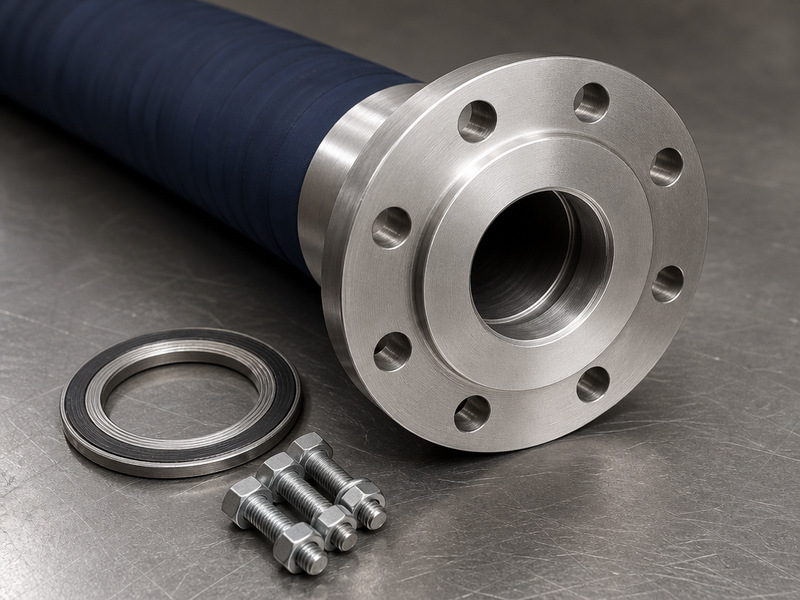
Figure 2. A flanged hose end connection in ASME B16.5 pattern, shown with its raised face and bolt holes.
The flange face and its gasket are part of the assembly, not an accessory. Raised-face, flat-face and ring-type joints each need a matching gasket and bolt set. We machine the bodies, and the flange fittings range shows the shapes available. Material and gasket selection against a specific medium is a separate question, handled in the companion guide to chemical hose fittings, types and materials, which should be read alongside the manufacturer’s chemical resistance chart.
Camlock Hose Couplings: A-A-59326 Styles, Sizes and Service Limits
A camlock hose coupling, also called a cam and groove coupling, trades a little pressure headroom for speed. It connects with a quarter turn, so a hose can be swapped without tools and without draining the whole line. The cost is that the seal sits in the adaptor groove and the arms can be bent by side loading. We therefore size the coupling to the hose and support the line so its weight does not hang on the arms.
The governing specification is A-A-59326, which supersedes MIL-C-27487 and is also referenced as DIN 2828. Commercial sizes run from about 1/2 in to 6 in, with 1 in, 1.5 in, 2 in and 3 in the most common on chemical service. Eight body styles are defined: A, B, C, D, E, F, DC and DP. Distinguishing them is a matter of interface, and the wider guide to hose couplings, types and selection places camlocks beside threads, flanges and quick-disconnects.
Table 3. A-A-59326 body styles commonly used on camlock ends.
| Style | Half | End | Usual pairing |
|---|---|---|---|
| A | Male adaptor | Female thread | Mates with D; seals with a dust plug. |
| B | Female coupler | Male thread | Mates with E; seals with a dust cap. |
| C | Female coupler | Hose shank | Mates with E; common hose-side coupler. |
| D | Female coupler | Female thread | Mates with A; screws onto a male thread. |
| E | Male adaptor | Hose shank | Mates with C; common hose-side adaptor. |
| F | Male adaptor | Male thread | Mates with C or D. |
| DC | Dust cap | Closed | Seals a coupler when the line is open. |
| DP | Dust plug | Closed | Seals an adaptor when the line is open. |
Where transfer falls under U.S. Coast Guard rules, the permitted quick couplings are those meeting ASTM F1122 rather than camlocks. That rules package belongs to dock, barge and ship transfer, and the marine and offshore transfer article covers it in full. For land-based chemical transfer, A-A-59326 camlock remains the everyday choice.
Flexible Hose with Flange or Camlock? A Selection Table
A flexible hose with flange ends and a flexible hose with camlock ends solve different problems, and the choice usually follows the mating equipment rather than personal preference. Start from what is already bolted to the tank or the pump, then work back to the hose.
Flanged ends win when the bore is large, the flow is high, or the receiving connection is already a flange. They hold a steady bolt load and present a defined face for the gasket. The cost is time, because breaking a flanged joint means loosening several bolts, and the joint should be re-checked after thermal cycles.
Camlock ends win when the same hose is connected and disconnected often. A quarter turn connects the line, and no tools are needed. The limits are pressure headroom and the mechanical care the arms need. A camlock left hanging under its own hose weight will eventually deform.
Threaded ends sit between the two. They are compact and economical, and they suit small bores and semi-permanent connections. The hazard is thread mismatch, because NPT threads to ASME B1.20.1 and metric threads look similar but do not seal together.
Table 4. Choosing between a flanged end, a camlock end and a threaded end on a flexible chemical hose.
| Interface | Connect time | Reason to choose it | Watch out for |
|---|---|---|---|
| Flanged | Bolted, slower | Large bore, high flow, mating equipment already flanged. | Gasket face must match; re-check bolts after cycles. |
| Camlock | Quarter turn | Frequent connect and disconnect, operator speed. | Seal wear, bent arms, side loading. |
| Threaded | Threaded, slow | Small bore, compact, semi-permanent joints. | Thread standard mismatch, for example NPT versus metric. |
Match the interface to the receiving equipment first, then match the hose to the interface. Size the bore so the velocity stays reasonable, and check the pressure drop over the run; the hose size selection guide works through both.
How a Chemical Hose Assembly Is Specified Before the End Is Chosen
An end cannot be chosen in isolation, because the hose sets the envelope. For thermoplastic multi-layer composite chemical hose, the governing standard is EN 13765. It covers hose and hose assemblies for the transfer of hydrocarbons, solvents and chemicals, defines five types, and sets a bore range of 25 mm to 250 mm. Working pressures run from 4 bar to 14 bar, and working temperatures from -30 °C to +160 °C.
EN 13765 also carries an annex for inner-wall material selection against the chemical conveyed. That annex is the reason the hose choice and the end choice move together. A liner chosen for a solvent must survive the same medium inside the fitting, and the bore sets which coupling sizes are available in the first place.
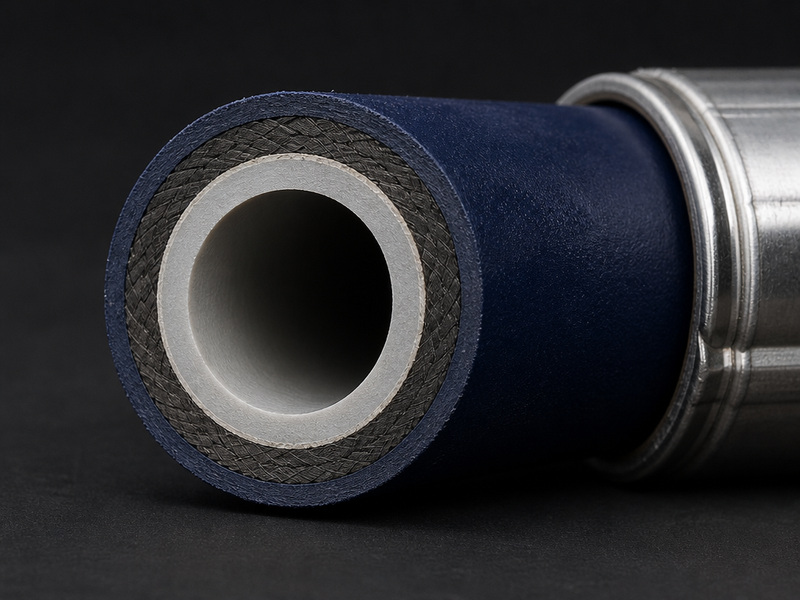
Figure 3. A cut-away of an EN 13765 composite chemical hose, showing the multi-layer wall that the end fitting must grip.
Table 5. The EN 13765 chemical hose and hose assembly envelope at a glance.
| Parameter | EN 13765 range or content |
|---|---|
| Construction | Thermoplastic multi-layer, non-vulcanized composite hose and hose assemblies. |
| Types | Five types covering hydrocarbon, solvent and chemical service. |
| Bore | 25 mm to 250 mm. |
| Working pressure | 4 bar to 14 bar. |
| Working temperature | -30 °C to +160 °C. |
| Inner wall | Annex A links inner-wall material to the chemical conveyed. |
For rubber-based chemical hose, EN 12115 describes hose assemblies for liquid or gaseous chemicals and is the reference most distributors quote. We work to it where a customer specifies rubber construction, and the deep treatment of its assembly types and electrical grades sits in the material guide rather than here. Whichever standard applies, the assembly rating is set by the lower of the hose and the end.
How Are Hose Assembly Fittings Tested and Marked Before Shipment?
Every assembly we build is hydrostatically tested before it ships. The test takes the assembly to its rated working pressure and holds it there. On our pressure test bench, the hose is supported so its full external surface stays visible, with both ends open to view where the design allows. We watch for weeping at the fitting, movement at the crimp, and any bulge in the hose body.
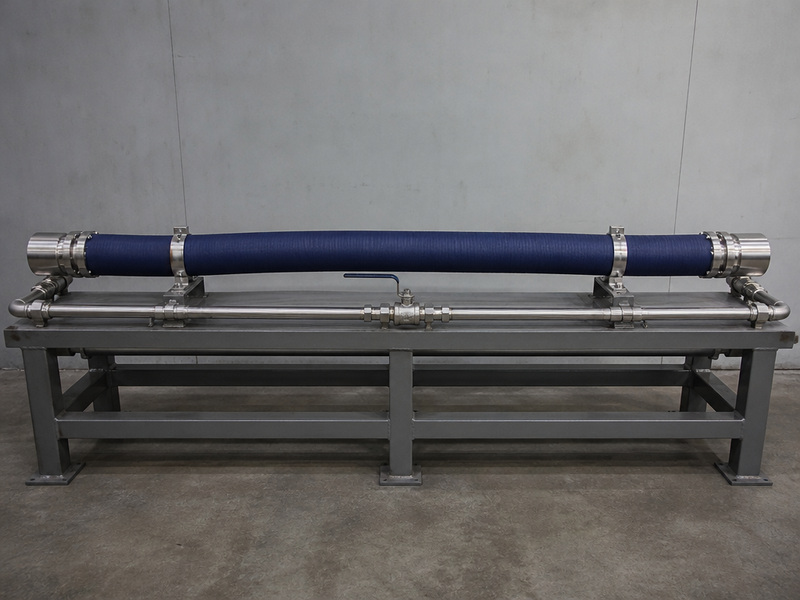
Figure 4. A chemical hose assembly on the factory test bench, held at its rated working pressure before shipment.
Marking is part of the deliverable, not paperwork added later. A finished assembly carries its maximum allowable working pressure, its size, and an identification code that ties it to its test record. Where a customer’s operations manual asks for it, we add a service marking and a symbol keyed to their hose list. The record travels with the assembly so an inspector can match the hose to its test.
Scope: the marking and test duties apply to hose assemblies in U.S. Coast Guard service, such as dock, barge and ship transfer. In that service, burst pressure and test pressure must not appear on the hose, and the facility retests at not less than 1.5 times the maximum allowable working pressure on a fixed schedule. Those obligations belong to the operator, and we build assemblies that satisfy them when a customer specifies that service.
A short pre-shipment check catches most end-related faults:
- Confirm the interface: thread, flange pattern or coupling style against the order.
- Measure the crimp: crimp diameter within the tooling record for the hose size.
- Verify the marking: pressure, size and identification code legible and correct.
- Protect the end: caps or plugs fitted so the seal face arrives clean.
Chemical Hose Assembly Fittings FAQs
What are hose assembly fittings?
Hose assembly fittings are the metal ends attached to a chemical hose to make a finished assembly. They include crimped, swaged, banded and reusable ends, plus the interface that meets the plant, such as a flange, a camlock coupling or a thread. Fittings are chosen so that the joint holds the hose and matches the equipment it connects to.
Which hose end connections are best for chemical service?
For most chemical service, crimped hose end connections are the practical default. They are permanent, repeatable and easy to record. Swaged ends help where the outside diameter must stay smooth, and banded or reusable ends suit low pressure and field repair. The right answer depends on the pressure, the bore and how often the line is broken.
How many hose end connection types are there?
There are four common ways to attach an end and three common interfaces. The attachment methods are crimped, swaged, banded and reusable. The interfaces are threaded, flanged and quick coupling, and quick couplings split again into camlock and other designs. Most ends on chemical service combine one attachment method with one interface.
Are crimped hose fittings permanent?
Yes. Crimped hose fittings are formed by a press that closes a ferrule over the hose, so they cannot be removed and refitted. That permanence is an advantage, because the joint is tamper-evident and its crimp diameter can be measured against the tooling record. It also means a damaged crimp calls for a new end rather than a repair.
Which chemical services suit a camlock hose coupling?
Camlock couplings suit most chemical service at moderate pressure, while a flanged end is the better choice at high pressure or with a very aggressive medium. Pressure headroom and the care the cam arms need are the limits. A camlock also depends on the seal sitting correctly in the adaptor groove. Match the coupling body and seal material to the medium before you specify the end.
When should I specify a flexible hose with flange ends?
Specify flanged ends when the bore is large, the flow is high, or the receiving equipment is already flanged. Flanged ends spread the load across a full bolt circle and give a defined gasket face. Most process plants already own a flange standard, so matching it avoids adaptors and keeps the assembly simple.
What pressure should be marked on a hose assembly?
The assembly should be marked with its maximum allowable working pressure, not its burst pressure or test pressure. Under U.S. Coast Guard rules the burst and test pressures must not appear on the hose at all. A chemical hose assembly should also carry its size and an identification code so the marking can be matched to a test record.
Do I need different ends for suction hose?
Yes. A suction hose must resist collapse, so the end fitting has to support the hose and often carries a built-in or bolt-on flange for the pump side. The fitting also adds weight, which affects how the hose is supported. For suction and discharge duty, tell the supplier the vacuum condition as well as the working pressure.
How do I stop a flange face from leaking?
Match the gasket to the face and the medium, clean both faces, and tighten the bolts in a cross pattern to a controlled torque. Re-check the torque after the joint has seen a thermal cycle. A leaking flange face usually means a wrong gasket, a scratched face or uneven bolt load rather than a fault in the hose.
Are camlock and cam and groove the same thing?
Yes. Camlock is the everyday name for cam and groove couplings covered by A-A-59326, which supersedes the older MIL-C-27487 and is also referenced as DIN 2828. The two halves lock with cam arms and a quarter turn. Sizes range from about 1/2 in to 6 in, with 1 in to 3 in the most common on chemical hose.
Which end suits which project role?
The same assembly is specified differently by role. A distributor building to stock needs repeatable crimped ends and a recorded crimp diameter, while a plant engineer replacing a failed end needs the interface named to its standard, plus a matching gasket or seal. A contractor specifying a new line starts from the mating flange or thread and works back to the hose. Dock and barge transfer adds the U.S. Coast Guard end-connection list.
What is the difference between a crimped and a swaged end?
Crimping presses a ferrule inward with a hydraulic press, while swaging draws the ferrule through a die to form it inward. Both produce a permanent joint. Crimping suits a wide range of bores with one press and tooling, while swaging suits smaller bores and gives a smooth outside diameter where the hose must pass through tight routes.
Ordering Checklist: Getting Hose Assembly Fittings Right
A chemical hose assembly is bought once and used for years, so the specification deserves a few minutes of care. Send the receiving equipment’s details, not just a hose size, and the end will be right the first time.
Before you release a purchase order for a chemical hose assembly:
- State the interface: thread, flange or quick coupling, named to the exact standard.
- Name the attachment: crimped, swaged, banded or reusable, and whether the end must be field-replaceable.
- Confirm the envelope: bore, length, working pressure and temperature for the medium.
- Fix the test and marking: test pressure, marking content and the record you expect.
- Plan the spares: gaskets, seals and a second assembly for the same duty.
When those five points are clear, the assembly can be built, tested and marked without guesswork. HENGHUA builds chemical hose assemblies with hose assembly fittings selected to the medium and the mating equipment, and pressure-tests every one before it ships. For a quote and samples, contact our team.
About HENGHUA. HENGHUA is a professional manufacturer of chemical hoses, chemical hose assemblies, industrial hoses and hose fittings, supplying distributors, EPC contractors and OEM brands worldwide. Chemical hose construction covers rubber (EPDM and other compounds), UHMWPE, PTFE-lined and thermoplastic composite builds. Assemblies are terminated with crimped, swaged or banded ends, flanged ends to ASME or EN patterns, and cam and groove couplings, in carbon steel, 304/316 stainless steel, aluminium, brass and PP/PVDF where the medium demands it. Every assembly is hydrostatically tested to its rated working pressure before shipment and marked with its MAWP, size and identification code. We offer factory-direct pricing, short lead times for bulk orders, private labeling, custom packaging, OEM/ODM branding and warranty.
About the author. This article was prepared by the HENGHUA engineering and quality team, which designs and pressure-tests chemical hose assemblies for distributors, EPC contractors and OEM brands. The team works daily with crimping tooling, flange patterns and cam and groove couplings, and maintains the assembly records behind every hose we ship. Names and verified credentials are added by the publisher before release.






 English
  Spanish
  Portuguese
  French
  German
  Arabic
  Russian
  Indonesian
  Japanese
  Korean