
A composite chemical hose handles hazardous transfer because its layers are chosen separately: a fluoropolymer or polypropylene film for the product, reinforcing fabric for the pressure, and metal helixes for crush and vacuum duty. Selecting one means classifying the task first, then the build, then the static control. This guide covers the classification step, the build options by chemical family, the pressure and vacuum envelope, static electricity control, end fittings, operating rules, inspection and retirement.
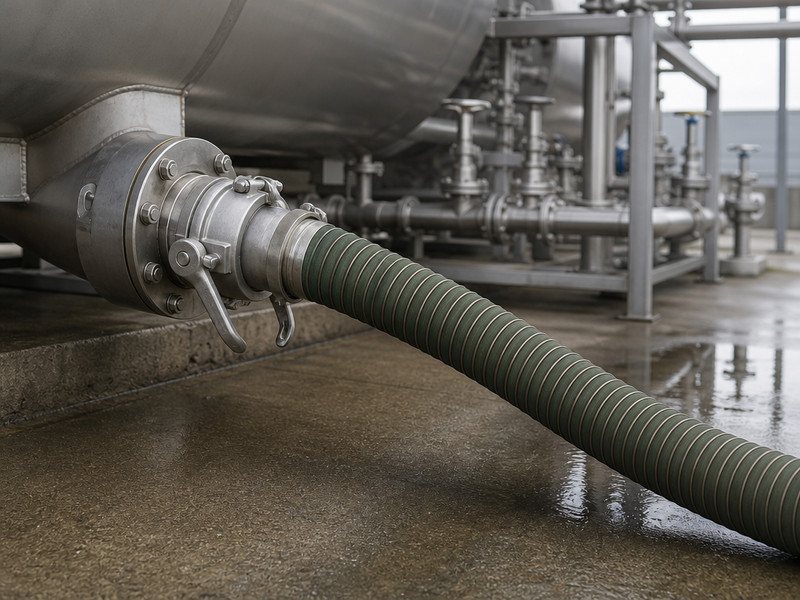
Figure 1. A composite chemical hose made up to a tank truck outlet before transfer.
Short Answer: What Makes a Transfer Task Hazardous
A transfer is hazardous when three conditions overlap: the product can harm people or the environment, the quantity is large enough to matter, and the connection is made and broken by hand. Any one of those alone is manageable. Together they define the duty for which a composite chemical hose is built and inspected.
The classification drives everything downstream. A transfer of an aggressive but non-flammable product needs chemical resistance and containment. A transfer of a flammable product adds static control and an earth. A transfer of both needs all three, and the cheapest hose that satisfies only two of them is not a saving.
Work through the classification before you look at a catalogue. In Europe the construction itself is normally specified to EN 13765:2018, which covers thermoplastic multilayer hose for hydrocarbons, solvents and chemicals. The remaining sections follow that order, starting with the product and ending with the connection.
Classifying the Task Before Selecting the Hose
Four questions settle most of the classification of a chemical transfer hose. Table 1 lists them with the decisions each one drives.
Table 1. Classifying a hazardous transfer task before hose selection
| Question | Why It Matters | What It Decides |
|---|---|---|
| Is the product flammable? | Static electricity plus vapour is the main ignition risk | Antistatic grade, bonding and earthing |
| How aggressive is the product? | Determines whether the film survives the exposure | Lining film and end fitting materials |
| Is the duty pressure or suction? | A suction line must resist collapse | Helix requirement and vacuum rating |
| How often is the joint broken? | Each break is an exposure and a wear event | End fitting family and inspection interval |
For a composite chemical hose the classification drives every later choice, so where the answers are unclear, treat the task as more hazardous rather than less. The cost of an antistatic build and an earth connection is small next to the cost of an incident, and the extra precautions rarely change the operating procedure much.
Temperature belongs in the classification too, even though it does not appear above. A hot product raises permeation, lowers the working pressure the hose can carry, and increases the rate at which a lining film ages. Note the continuous and the peak figure for both, because the peak is what damages the film even when it lasts only minutes.
Hose Build Options by Chemical Family
The lining film is the only wetted layer, so it carries the whole chemical decision wherever hazardous chemicals are handled. Table 2 maps common families to a build and to the duty the assembly can then take.
Table 2. Composite chemical hose builds matched to chemical families
| Chemical Family | Suitable Film | Helix | Duty |
|---|---|---|---|
| Mineral acids | Polypropylene for dilute, PTFE for concentrated | Stainless steel | Suction and discharge |
| Alkalis and caustics | Polypropylene or UHMWPE | Stainless steel | Suction and discharge |
| Aromatic solvents | PTFE or ECTFE | Stainless steel | Suction and delivery |
| Chlorinated solvents | PTFE | Stainless steel | Suction and discharge |
| Hydrocarbons and fuels | Polypropylene or PTFE | Galvanised or stainless | Pressure duty only |
Read the table as a starting point rather than a ruling. Concentration, temperature and the presence of water all change the answer, and a mixture can behave differently from every component in it. Confirm the film against the supplier chemical resistance data for the exact composition before you commit to a purchase.
Film choice also sets a temperature ceiling. As a working reference the continuous ceilings sit near +260 °C for PTFE, +204 °C for FEP, +150 °C for ECTFE and PVDF, +100 °C for polypropylene and +80 °C for UHMWPE. The supplier data sheet governs, because compounding and wall thickness move the ceiling.
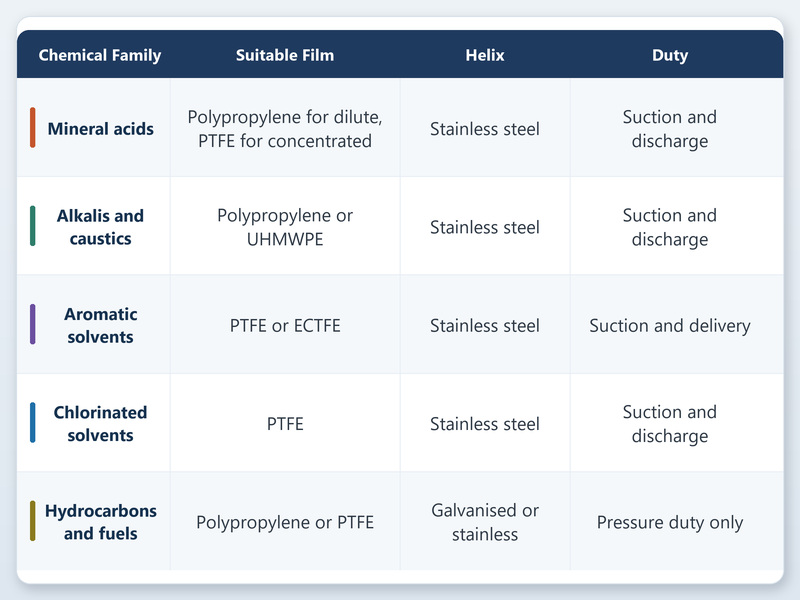
Figure 2. Film and helix selection by chemical family, with the duty each build supports.
Galvanised helixes are acceptable where the outside of the hose stays dry and the product is not strongly corrosive to zinc. Stainless steel helixes are the safer default wherever water, brine or acid splash is possible, because a corroded helix is a structural failure rather than a cosmetic one.
Pressure, Vacuum and Temperature Envelope
Three figures govern the duty: the working pressure, the vacuum rating and the temperature range. A composite chemical hose is unusual in that it can normally do both pressure and suction duty in the same construction, which is why one chemical transfer hose often serves loading and unloading.
The vacuum rating depends on the inner helix and on how straight the hose is. A hose laid in a gentle curve holds more vacuum than the same hose bent close to its minimum. Where suction duty is the critical case, plan the route so the hose runs as straight as the layout permits during the pull.
The quoted pressure and vacuum figures sit inside a published envelope. Where a project works to EN 13765:2018, the typical range for thermoplastic multilayer hose runs from DN 25 to DN 300, at working pressures from 4 bar to 14 bar, over −30 °C to +150 °C. The vacuum figure is verified to EN ISO 7233. Treat those as the standard’s typical range and confirm the exact figures for the construction on its data sheet. EN 12115 covers single-layer hose, and a multilayer assembly sits outside its scope.
Working pressure is quoted with a safety factor, normally four to one on multilayer hose, and it applies at a stated reference temperature. Above that temperature the films and the fabric lose strength and the permissible pressure falls. Ask the supplier for the derated figure at your actual product temperature rather than working from the ambient number.
The working pressure figure on the label assumes the assembly is straight and new, so leave margin on a used line. Vacuum duty also changes how the hose must be handled. A hose under suction that is closed at one end while full can whip if a connection lets go. Where the duty requires pulling a vacuum, open the far end first, and vent the line to a safe point before the pump starts.
Static Control: Bonding, Grounding and Antistatic Grades
Static electricity is the risk that catches people out, because it is invisible and it builds during normal operation. Four things matter: where the charge comes from, how it reaches earth, what grade the hose is, and what that grade cannot do.
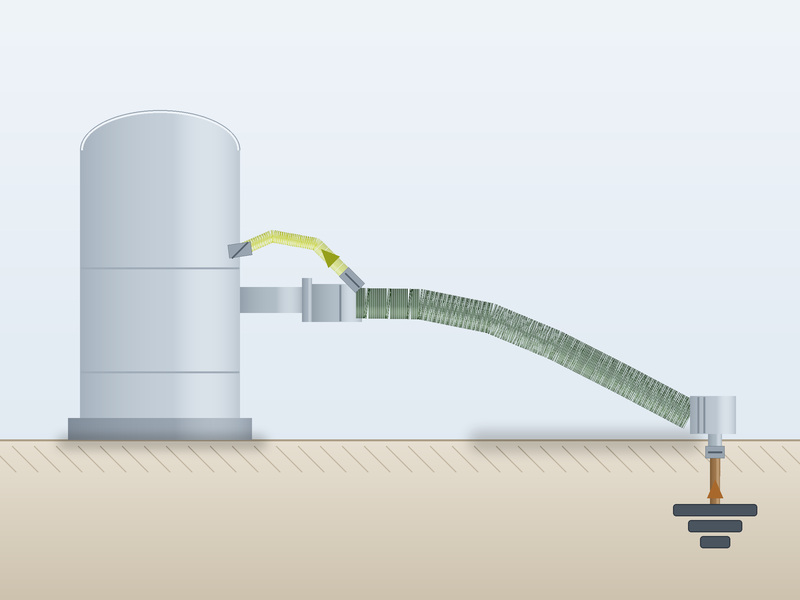
Figure 3. Bonding the hose to the vessel and earthing the assembly.
Bonding
Bonding ties the equipment together so that no potential difference can develop between them. The hose, the tank, the receiving vessel and the pump frame all need to sit at the same potential before a valve is opened. A bonding connection is short, visible and easy to verify, which is why it should be a step in the procedure rather than a habit.
Grounding
Grounding gives that common potential a path to earth. A bonded installation that is not earthed simply floats, and a floating system can hold a charge indefinitely. Confirm the earth point is bare metal and that the resistance is low. A clamp placed on painted steel, or on a plastic-lined fitting, provides no path at all.
Antistatic Grades
Electrical grades differ in how far the conductive path reaches. A grade may provide a conductive lining only, a conductive cover only, or a path through the wall, and each is tested separately. The required grade follows from the area classification and the product, not from preference. The grades defined for EN 12115 hose show how lining and through-wall resistance are separated in practice.
Static electricity control is expressed as a grade rather than as an option. EN 12115:2021 defines four grades, set by where the conductive path runs and by the resistance limit that applies. Grade M is electrically bonded, so the assembly is bonded to its fittings. Grade Ω adds a conductive lining with a lining resistance of 10⁶ Ω or less. Grades M/T and Ω/T keep those definitions and add a through-wall resistance of 10⁹ Ω or less. All four are verified to EN ISO 8031.
Where the hazardous chemicals are also flammable, the grade and the earth work as one system. A grade is not a licence to ignore the earth. It reduces charge accumulation inside the hose, but the charge still has to leave the system, and it leaves through the fittings and the bonding connection. Treat the grade and the earth as two halves of one protection scheme.
End Fittings for Hazardous Transfer
The fitting decides the exposure. Every connection is a place where a person is close to the product, and every family involves a different compromise between speed, pressure and containment.
Camlock
A camlock coupling is fast and repeatable, and the usual choice for tank truck and IBC work at moderate pressure. The gasket is the sealing element, so its material must match the product.
Flange
A flanged end suits fixed piping and large bore, where rigidity and a bolted joint matter more than speed.
Threaded
A threaded end is simple and compact for small bore, but it depends on a sealant, and it is the easiest joint to cross-thread in a hurry.
Two further families cover the remaining cases. A hammer union is robust and reusable on larger bore service where the joint is made and broken frequently. A sanitary clamp suits clean duty, where the joint must strip for inspection.
Whichever family is used, the wetted parts must suit the product and the fitting must be rated for the pressure the assembly carries. A camlock coupling rated below the hose is the limiting item, and the assembly rating should be stated for the weakest element. Where the fitting choice is the awkward part of a project, the hose couplings and end connections catalogue covers the families in more depth.
Operating Rules for Tank Truck, Rail Car and IBC Transfer
The procedure protects people where the chemical transfer hose cannot. Six rules cover most of the exposure, and all six are cheap to follow.
- Earth first — make the bonding and earthing connections before any valve opens, and confirm them by inspection rather than by assumption.
- Open slowly — start the flow at a low rate so that any vapour space is filled gently and charge generation stays low.
- Stay inside the velocity limit — keep the flowrate within the figure the product and hose grade allow, because static electricity builds sharply as velocity rises.
- Never break a live joint — depressurise and drain the line before any camlock coupling is released, and drain to a safe point. Where an end must stay open, fit a rated blind and leave the line vented.
- Renew the seal — replace the gasket in a camlock coupling whenever it hardens or swells.
- Keep the route clear — no point tighter than the minimum bend, no contact with hot surfaces, and no trip hazards along the path.
Table 3 sets out the exposures that account for most incidents and the control that addresses each.
Table 3. Common hazardous transfer exposures and the control for each
| Exposure | How It Arises | Control |
|---|---|---|
| Static discharge | Charge builds as product moves through the hose | Bonding, earthing and a low initial flowrate |
| Live joint | A coupling is released before the line drains | Depressurise and drain before breaking any joint |
| Wrong product | A shared line is used without a confirmed clean | Film selection plus a documented cleaning step |
| Vacuum collapse | Suction duty applied to a hose bent past its limit | Inner helix and a route inside the minimum bend |
| Film damage | Creasing or chemical attack goes unnoticed | Pre-transfer inspection and a scheduled pressure test |
Where a transfer is repeated several times a day, write the order down and treat it as a checklist. Verbal procedures drift, and the step that drifts first is usually the earth connection, because it is the least visible part of the job.
Inspection, Hydrostatic Testing and Retirement
Inspect before each transfer, and record the result against the assembly identity. The checks are quick, and each one catches a failure mode while it is still a warning rather than an incident.
- Cover and fabric — cuts, blisters, exposed fabric and hardening of the cover.
- Helixes — broken, flattened or corroded outer wire, and any sign of an inner wire that has moved.
- Fittings — movement on the tail, damaged sealing faces, gasket condition and correct torque.
- Electrical continuity — confirm that the conductive path still runs from fitting to fitting.
- Records — the last pressure test date, the interval your procedure sets, and any excursion above the permitted temperature or pressure.
Test hydrostatically to EN ISO 1402 rather than with air. A stored-energy test on a failed hose releases far more energy than a water test, and a composite chemical hose that has been weakened by chemical exposure can fail at a fraction of its original burst pressure. Where the duty falls under EN 13765, keep the test record with the assembly so the history survives a change of crew. Where the assembly is graded, re-check continuity after any work on the fittings.
Safety: Stop-Use Conditions
Stop use immediately when any of the following appears, and tag the assembly so it cannot return to service by mistake. The conditions to look for are:
- Cover damage — a cut that reaches the fabric.
- Wall damage — a bulge or a blister, which means the film has separated.
- Kinks — a permanent crease left in the film after the hose is straightened.
- Helix damage — broken or heavily corroded outer wire.
- Fitting movement — any shift of the fitting on its tail.
- Continuity — any reading outside the specified range on a graded hose.
None of those conditions can be repaired in the field, and none of them can be deferred to the next shift. Depressurise, drain and flush the assembly before it is handled, then destroy it or return it to the supplier under a documented scrap route.
The same stop-use rules apply to every transfer of hazardous chemicals, whatever the volume. Retirement is also due on schedule, not only on damage. A composite chemical hose that has carried aggressive product at temperature for a full service interval may be weakened without any external sign. Pressure test on the interval, and shorten the interval where the duty sits at the top of the temperature range.
Composite Chemical Hose FAQs
How do I decide between a composite chemical hose and a rubber chemical hose?
Start with the duty. If the line needs suction and discharge duty, crush resistance or a very light assembly, the composite construction is usually the better answer. If the product attacks the film options available, neither works and the duty needs a different lining. Compare on the layer structure, not on the colour of the cover, and check the EN 13765 type against the duty.
Does an antistatic hose remove the need for grounding?
No. An antistatic grade reduces charge accumulation on the wetted surfaces and gives the charge a path to the fittings. The route to earth and the bonding connection are separate items. Both are required on any flammable duty, and the resistance check confirms the path is still intact.
Can the same hose be used for loading and unloading?
Usually yes, if it is rated for both pressure and vacuum and the films suit the product. That flexibility is one of the practical advantages of the multilayer construction. Confirm the vacuum figure at the temperature you run, and check that the hose stays inside its minimum bend on both operations, not only on the one it was bought for.
What film should be used for a mixed stream of solvent and water?
That depends on the solvent and on the proportions. A polypropylene film handles water well but is attacked by aromatic and chlorinated solvents. Where a solvent is present, a PTFE or ECTFE film is normally the safer choice. Give the supplier the full composition, including the water content, because the mixture can be more aggressive than either component alone.
How often should the assembly be pressure tested?
Follow the interval your site procedure sets. Many operators test at a fixed period, and shorten the interval where the product is aggressive or the duty runs hot. Any chemical transfer hose that has been drained, flushed, re-made or dropped should be tested before it returns to service. Record the date against the assembly identity so the history is visible.
Why does the manufacturer ask so many questions before quoting?
Because the film decision drives the cost and the safety case at the same time, and a wrong answer is expensive on a bulk order. Product, concentration, temperature, pressure, duty and connection family each narrow the options. A supplier who quotes without those fields is quoting a different hose from the one you need, and the difference tends to appear at the first transfer rather than at the quotation stage.
What is the most common cause of a hazardous transfer incident?
The connection, not the hose. Either a joint is broken while the line is still live, or a coupling is left partly engaged, or the earth is never made. Materials and pressure ratings are usually specified correctly. The failures cluster around the human steps, which is why the procedure and the checklist matter as much as the hardware.
Source Composite Chemical Hose for Hazardous Duty
Buy the hose and the fittings as one specification, and ask for the electrical grade and the pressure rating in the same document. A hose that meets the chemical requirement but not the electrical one is not a compliant assembly.
HENGHUA manufactures chemical transfer hoses and complete hose assemblies for chemical plants, tank farms, distributors, and OEM brands. Every hose we build is specified by its lining, its reinforcement, and its cover, and the assembly leaves the factory with crimped or reusable stainless steel fittings, a hydrostatic proof test, and a documented pressure rating.
Our chemical hose range covers PTFE, FEP, polypropylene, UHMWPE, and EPDM linings from 1/2 inch to 8 inch bore, rated to 16 bar, with conductive and antistatic builds on request. Where a plant standardises on one construction, a bulk order across several bores is cheaper per metre than buying sizes one at a time.
Because we control film extrusion, lining, winding, and fitting assembly in one plant, a bulk order moves quickly and the specification on the label is the specification you get. Every bulk order ships with a proof test record for each assembly. A clear specification also makes the price comparable between suppliers. If you are moving hazardous chemicals for a tank farm, a distribution line, or OEM supply, send us your specification and we will quote against it. Get a quote and free samples
The EN 13765 multilayer hose standard is the reference most European projects work to, and the construction guide explains the layer stack behind it. Where a joint has to hold under vibration, the clamp selection data gives the torque figures.
Written by the HENGHUA engineering team, with input from chemical plant, tank farm, and maintenance teams across North America and Europe. HENGHUA manufactures chemical transfer hoses and hose assemblies with PTFE, FEP, polypropylene, UHMWPE, and EPDM linings, from 1/2 inch to 8 inch bore, rated to 16 bar, with crimped or reusable stainless steel fittings and OEM branding.






 English
  Spanish
  Portuguese
  French
  German
  Arabic
  Russian
  Indonesian
  Japanese
  Korean