
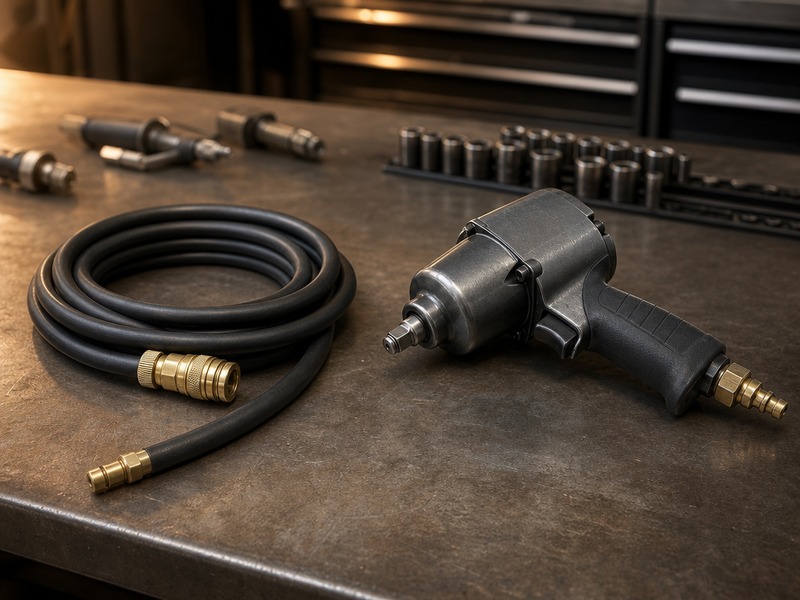
For most impact wrenches, the correct air hose for impact wrench work is 3/8 inch: it carries enough airflow for common 1/2 inch and 3/4 inch drive tools without choking peak demand. Choose 1/4 inch only for a compact 3/8 inch drive tool on a short run, and step up to 1/2 inch for 1 inch drives or long lengths. What decides the size is the combination of impact wrench air consumption, air hose inside diameter, and pressure drop over the air hose length. Get those three aligned and the tool keeps its rated 90 PSI at the inlet.
What Size Air Hose for an Impact Wrench?
Match the bore to the drive and the run length, then confirm the tool’s airflow. A 1/4 in. bore carries 5–10 SCFM and suits compact 3/8 in. drive tools on runs under 25 ft. A 3/8 in. bore carries 10–20 SCFM, covers 1/2 in. and most 3/4 in. drives up to 50 ft, and is the practical default. A 1/2 in. bore carries 20–35 SCFM and is the safe choice above 50 ft or for 1 in. drives.
Two numbers drive the whole decision. The first is the airflow your tool needs at its inlet, and the second is what your hose can deliver at that same pressure. When the second number is smaller than the first, the tool runs weak, and the tightening torque you paid for never reaches the fastener. Pressure at the tool is the outcome you are protecting; the air hose inside diameter and its length are the levers you control. If you are still deciding the bore, start with the guide to which bore your tool needs.
How an Impact Wrench Uses Air: Average CFM vs Peak Demand
An impact wrench is not a steady consumer of air. It idles near nothing, then snaps its air motor open for a fraction of a second, and repeats that hammering cycle many times a minute. The figure printed on the tool label is an average, so it smooths out the peaks. That is why impact wrench air consumption is published as a typical catalog value at 90 PSI, and why you should always check the tool manual for the number that applies to your exact model.
Typical Impact Wrench Air Consumption by Drive Size
Larger drives need more air. A typical 1/2 inch drive tool averages about 4–5 CFM, a 3/4 inch drive tool about 6–8 CFM, and a 1 inch drive tool about 8–12 CFM. Those are typical catalog values at 90 PSI, not guarantees, so treat them as a planning band and confirm them against the tool manual before you choose a hose. A tool sold as high output usually sits at the top of its band.
Why Peak Demand Matters More Than the Average
Peak demand, not average consumption, sizes an impact wrench hose. During each hammering burst the tool can draw two to three times its catalog average for a fraction of a second. If the hose and fittings cannot supply that burst, inlet pressure sags, the driving force at the fastener falls, and the tightening result becomes inconsistent, even though the average CFM printed on the tool label looks satisfied.
Hose Size by Impact Wrench Drive (3/8, 1/2, 3/4, and 1 Inch)
Drive size is the quickest way to narrow the choice. Match the drive on your wrench to the row below, then compare your run length with the maximum in the fourth column. If your run is longer, move up one bore size or shorten the line before you order. Before you settle on a bore, read the impact wrench air consumption figure on the tool label and treat it as a typical value to confirm in the manual. Then start with the size chart by bore before you order an air hose for impact wrench work.
Table 1. Typical air hose size and airflow by impact wrench drive size (airflow figures are typical catalog values at 90 PSI; verify against the tool manual and the printed hose label).
| Impact wrench drive | Typical average air consumption at 90 PSI | Recommended hose inside diameter | Recommended maximum hose length | Airflow the hose carries at 90 PSI |
|---|---|---|---|---|
| 3/8 in. | Around 2–3 CFM (typical range) | 1/4 in. | 25 ft | 5–10 SCFM |
| 1/2 in. | Around 4–5 CFM (typical catalog value) | 3/8 in. | 50 ft | 10–20 SCFM |
| 3/4 in. | Around 6–8 CFM (typical catalog value) | 3/8 in. to 1/2 in. | 50–75 ft | 10–35 SCFM |
| 1 in. | Around 8–12 CFM (typical catalog value) | 1/2 in. | 100 ft | 20–35 SCFM |

Figure 2. Hose size and airflow for 3/8, 1/2, 3/4 and 1 inch impact wrenches at 90 PSI.
The table also explains why a 1 inch drive tool rarely runs well on 3/8 inch hose over a long run. A 3/8 inch hose carries 10–20 SCFM at 90 PSI, which sounds like plenty for a tool averaging 8–12 CFM, until peak demand and a long run cut into the margin. A 1/2 inch bore, with 20–35 SCFM of capacity, leaves the headroom a big drive needs. Keep the air hose length inside the maximum in Table 1, and the same bore stays adequate. Sizing an air hose for impact wrench duty is really keeping capacity above demand through the whole cycle.
Why Hose Length Changes the Air Hose Size You Need
Length is the variable most people forget. Air does not travel for free, and friction along the bore consumes pressure the tool never sees. The longer the run, the more pressure you lose, and the loss grows faster than the length itself once flow rises. That is why the same impact wrench can feel strong on a 25 ft hose and sluggish on a 75 ft one of the same bore. The air hose length you can get away with always depends on the bore, so when you choose an air hose for impact wrench work the two questions become one.
How Pressure Drop Grows With Length
The reference figures used across this site put pressure drop on 3/8 inch hose at roughly 2–5 PSI per 25 ft, and a measured 1/4 inch example at about 6 PSI over 50 ft at 8 SCFM. Those are planning numbers rather than laboratory guarantees, but they show the shape of the problem: a 75 ft 3/8 inch run can quietly cost you 6–15 PSI before the coupler. Push flow higher and the loss climbs further.
Air hose length and bore have to be chosen together to keep the inlet near 90 PSI. An impact wrench is an intermittent peak load, more sensitive to short dips than a continuous tool such as a sander, so protect the bore first to hold the torque at the fastener.

Figure 3. Pressure drop from the compressor to the tool grows with hose length and flow.
When you shorten the run, you recover inlet pressure without buying a bigger tool. When you cannot shorten it, increase the bore instead. As a working rule, keep 1/4 inch runs under 25 ft, 3/8 inch runs under 50 ft, and 1/2 inch runs under 100 ft. Cross those limits and you should size up rather than hope the compressor will compensate.
Which Restricts Flow on an Impact Wrench: Inside Diameter or Fittings?
Two hoses with the same 3/8 inch label can behave differently at the tool, because the air hose inside diameter is the number that actually sets flow. The outside of the hose sells the product; the inside moves the air. A nominal 3/8 inch bore from one supplier may measure a little differently, and a thick-walled hose can hide a smaller true bore than a thin one of the same nominal size.
Inside Diameter Sets the Ceiling
The air hose inside diameter is the ceiling on everything downstream. Doubling the bore roughly quadruples the cross-sectional area, which is why moving from 1/4 inch to 3/8 inch changes a run far more than most people expect. If you are unsure of your hose’s true bore, measure it instead of trusting the label or the outside diameter; the steps are in measuring the bore.
Fittings and adapters, by contrast, are where flow gets pinched. Every quick connect coupler adds a narrow throat, and a chain of reducers, swivels, and hose barbs can cost more pressure than several feet of hose. A high flow air hose, paired with a matching high flow coupler, keeps that throat wider, and the benefit shows most on high-consumption tools such as a 1 inch impact wrench. Put a 1/4 inch throat on a 3/8 inch line and the assembly behaves like 1/4 inch, because the narrowest point sets the flow; a high flow air hose simply widens that throat.
Because the air hose for impact wrench setups runs in bursts, a wide throat and a well-matched quick connect coupler matter more than an extra foot of hose. Keep the coupler style and thread consistent across the shop so a good hose is never choked by a mismatched joint; see couplers and fittings for the full range. Three things pinch flow on an impact wrench line:
- Undersized bore — a true inside diameter smaller than the label suggests.
- Long fitting chain — each adapter, swivel, and reducer adds a narrow throat.
- Sharp kinks — a short-radius bend that chokes flow like a partly closed valve.
What Hose Material and Working Pressure Suit Impact Wrench Work?
Material decides how the hose feels in the hand, how it handles oil and abrasion, and how it behaves when the temperature swings. Impact wrench work is rough on a hose: it gets dragged, pinched under a bumper, and coated in oil. Rubber stays the shop favorite for exactly that reason. The pressure rating, not the material name, is what keeps the hose safe, and it must exceed your regulator setting with margin; check the burst pressure margin before you buy.
Table 2. Hose material, pressure rating, and temperature ranges for impact wrench work (typical values; check the printed label).
| Matériau | Typical pressure rating | Plage de températures | Best use with an impact wrench |
|---|---|---|---|
| Rubber | 300–500 PSI (industrial), 200–300 PSI (consumer) | −40 °C to +70 °C (−40 °F to +158 °F), ISO 2398:2024 | Heavy shop use with oil and abrasion exposure |
| Hybrid | Around 300 PSI (typical) | −10 °C to +60 °C (14 °F to 140 °F) | Everyday garage use where weight matters |
| PVC | 200–300 PSI | −10 °C to +60 °C, ISO 5774:2023, practical flexibility floor around 0 °C (32 °F) | Light duty in a warm shop only |
| Polyurethane | 200–300 PSI | −10 °C to +60 °C, ISO 5774:2023, some grades to −20 °C | Light, flexible hose for smaller drives |
For an impact wrench, rubber is the safe default because it shrugs off oil and stays flexible when the shop is cold. PVC is the weakest option here: its rated low end is −10 °C, but it stiffens and can crack near 0 °C (32 °F). A stiff hose kinks easily, and a kink becomes a flow restriction with a sharp bend. For impact wrench hose duty, weigh oil resistance and cold flexibility above price. If the tool is a 1/2 inch drive or larger and the hose will be dragged around a bay all day, choose rubber or a hybrid rather than the cheapest PVC coil.
What to Check Before You Buy an Air Hose for Impact Wrench Work?
Work through these six items before you order. Each one removes a common reason a brand-new hose disappoints at the tool.
- Drive size and torque rating — note the rated output and the pressure at which it is quoted, almost always 90 PSI.
- Air consumption — read the average CFM on the tool label and allow headroom for peak demand.
- Air hose length — measure from the compressor outlet to the tool, including any reel or extension.
- Inside diameter — pick the bore from Table 1 and never undersize it for a long run.
- Fittings and coupler — match the quick connect coupler style, choose a high flow air hose where the tool draws hard, and confirm the thread, usually 1/4 in. NPT.
- Working pressure and standard — confirm the hose rating exceeds the regulator setting, with ISO 2398:2024 or ISO 5774:2023 marked on the cover.
A short note on threads: most air tools in North America use 1/4 inch NPT, so match NPT ports to NPT fittings; BSPT is a different thread family. Seal threaded joints with PTFE tape, and check every joint with soapy water after the first pressurization. A tiny leak at a coupler wastes air on every cycle and looks exactly like an undersized hose, which is why so many sizing problems turn out to be connection problems.
Safety: What Must Be Replaced, Not Repaired
Hose safety is not about the day it works; it is about the day it fails. Compressed air at 90 PSI carries enough energy to drive debris into skin and eyes, so a damaged hose is a hazard rather than an inconvenience. The rule is simple and not negotiable: replace, never repair. A hose with a cut cover that exposes reinforcement, a bulge, a blister, or a soft spot near a fitting has lost its rated strength. Take it out of service, and never tape over or splice a damaged hose.
Safe operating limits for impact wrench hose work: stay within the manufacturer’s rated pressure at all times, as required by OSHA 29 CFR 1926.302(b)(5). Depressurize the line before you disconnect a coupler or coil a hose, and carry tools and workpieces by hand so the hose carries air only. If a coupling leaks, replace the coupler and plug as a set so the joint seals on the first try. When in doubt, retire the hose, because the cost of a new one is trivial against the cost of an injury.
Impact Wrench Air Hose FAQs
What size air hose do I need for a 1/2 inch impact wrench?
For most 1/2 inch drive impact wrenches, a 3/8 inch hose is the right choice as long as the run stays within about 50 ft. It carries 10–20 SCFM at 90 PSI, which covers a tool whose impact wrench air consumption averages 4–5 CFM, and it still leaves headroom for peak demand. On longer runs, or if you also feed bigger tools from the same line, move up to 1/2 inch bore.
Can I use a 1/4 inch air hose on an impact wrench?
Yes, but only on a compact 3/8 inch drive tool with a short run under about 25 ft. A 1/4 inch hose carries just 5–10 SCFM at 90 PSI, so any larger drive or longer length will starve the tool and cost you performance. If you already own a 1/4 inch hose, keep it for the small wrench and buy 3/8 inch for everything bigger.
Does a longer hose reduce impact wrench torque?
Yes. Rated output is normally quoted at 90 PSI at the tool, and pressure drop takes its share of that. A longer run, a smaller air hose inside diameter, or a restrictive coupler all lower inlet pressure, and as pressure falls, so does the hammering force at the fastener. Keeping the run short and the bore generous is how you protect the torque the tool was sold to deliver.
What is the best impact wrench hose in cold weather?
Rubber is the safest choice. Rubber stays flexible across a wide temperature range, from −40 °C to +70 °C under ISO 2398:2024. PVC is the opposite: it is rated only to −10 °C and becomes stiff around 0 °C (32 °F), which makes it kink and eventually crack. If you work in an unheated shop or outdoors in winter, choose rubber, or a high flow air hose in a hybrid build, over PVC.
Do high flow fittings make a difference on an impact wrench?
They can, especially on high-consumption tools. A high flow air hose with matching high flow couplers has a wider throat, so it restricts the air less than a standard coupler pair. For a big drive on a long run, that upgrade is worth it. On a small 3/8 inch drive tool, the gain is much smaller and often not worth the extra cost.
How do I know my impact wrench is getting 90 PSI?
Fit a pressure gauge with a tee at the tool inlet, right before the wrench, and hold the trigger while you read it. That reading shows the pressure the tool actually sees under flow, which is the number that matters. A gauge on the compressor tank tells you almost nothing, because it sits upstream of every coupler and every foot of hose.
Should I order a single air hose for impact wrench work or a bulk order?
That depends on how many bays you run. One hose per tool is fine for a home garage, but a shop with several stations usually gets a better price and a more consistent specification by ordering in volume. A bulk order also lets you standardize the bore, the quick connect coupler style, and the working pressure rating across the whole floor.
My 3/4 inch impact wrench runs 60 ft from the compressor — is a 3/8 inch air hose enough?
Past 50 ft, a 3/8 inch bore is working beyond its recommended maximum, and a hard-hammering 3/4 inch drive tool notices the shortfall first. Step up to 1/2 inch bore, which carries 20–35 SCFM at 90 PSI and stays inside its length limit out to about 100 ft.
Order the Right Air Hose for Impact Wrench by Specification
HENGHUA manufactures reinforced air hoses and complete hose assemblies for workshops, distributors, and OEM brands. Every air hose we build uses a high-tensile textile reinforcement layer with an abrasion- and oil-resistant cover, is rated 200–500 PSI, and leaves the factory with crimped brass fittings and a pressure test on every batch. We supply 1/4, 3/8, and 1/2 inch bore in rubber, PVC, polyurethane, and hybrid constructions, with custom lengths, fittings, colours, reels, and OEM/ODM branding.
Because we control compounding, extrusion, braiding, and crimping in one plant, lead times stay short for bulk orders and the specification on the label is the specification you get. If you are sourcing air hoses for retail, distribution, or industrial use, send us your specification and we will quote against it. Get a quote and free samples
When you specify an air hose for impact wrench assemblies, the three numbers to send us are the bore, the working pressure, and the end fittings.
Final Verdict: A 3/8 Inch Air Hose for Impact Wrench Work, 1/2 Inch for Big Drives
For the majority of impact wrenches, a 3/8 inch air hose for impact wrench work is the right size, and it will keep a 1/2 inch drive tool near 90 PSI on a normal shop run. Reach for 1/2 inch bore when the drive is 3/4 inch or 1 inch, or when the run stretches long. Keep 1/4 inch for small 3/8 inch drive tools on short leads. Choose rubber for rough handling and cold shops, confirm the working pressure on the label, and match every quick connect coupler so a good hose is never wasted by a bad joint.
Size the bore to the flow, keep the run as short as the job allows, and the power you paid for will reach the fastener. For the wider picture, review the air hose selection basics. Send us your bore, pressure rating, and fitting details, and HENGHUA will quote against them.
Written by the HENGHUA engineering team, with input from workshop and maintenance teams across North America and Europe. HENGHUA manufactures reinforced air hoses and hose assemblies in rubber, PVC, polyurethane, and hybrid constructions, from 1/4 inch to 1/2 inch, rated 200–500 PSI, with custom lengths, fittings, colours, and OEM branding.






 English
  Spanish
  Portuguese
  French
  German
  Arabic
  Russian
  Indonesian
  Japanese
  Korean