
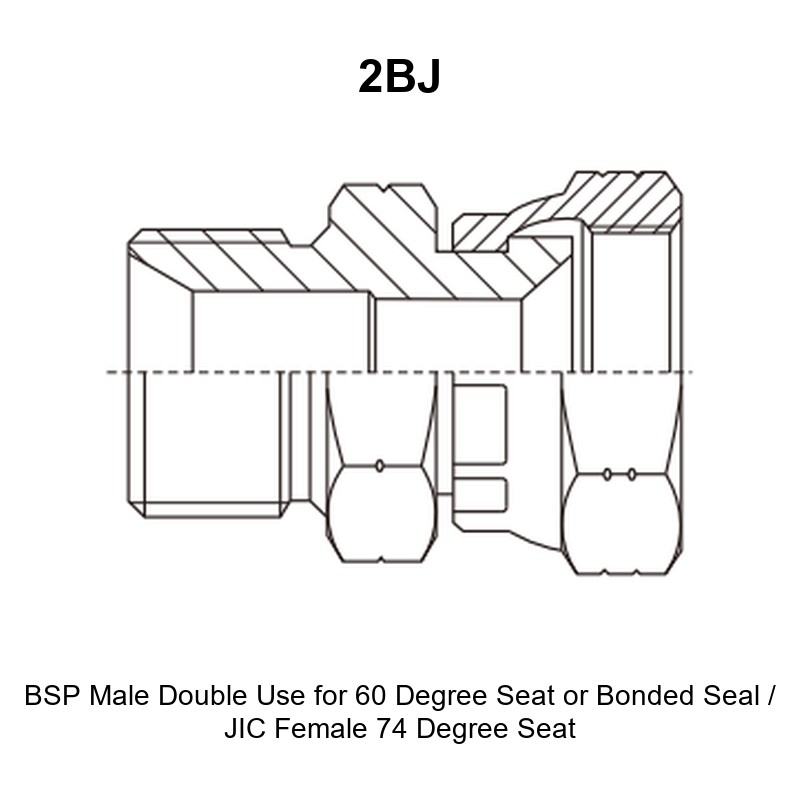
Series 2BJ | straight adapter | BSP male stud end to JIC female swivel end
1. What a 2BJ Adapter Does
A 2BJ adapter is a straight conversion adapter that joins a BSP male stud end to a JIC female swivel port. The BSP end carries a parallel pipe thread made to ISO 228-1, in the 60° cone seat or bonded seal configuration that ISO 1179 defines for BSPP ports. The opposite end is a JIC female swivel with a 74° seat, machined to the geometry published in SAE J514.
The value of the part is exact fit at both ends. An adapter removes leakage risk at the conversion point only when the two threads, the two seat forms and the two sealing methods all match the ports they meet. On this series the BSP stud end seals either by 60° cone contact against the mating port cone or by a bonded seal washer compressed against a flat port face. The JIC female end seals by metal-to-metal contact between its 74° seat and the cone nose of the mating stud end.
The series solves one assembly problem in a single hydraulic conversion adapter: a British Standard port on one side, an SAE J514 port on the other, held in one straight body. Nothing else has to be stacked between the two ports, so the assembly keeps a short overall length and one tightening point instead of two.
2. 2BJ Adapter Specifications
2.1 Connection 1 — BSP male stud end (60° seat or bonded seal)
- Thread family: BSPP parallel pipe thread, G series, to ISO 228-1.
- Size range in this series: G1/8″x28 through G2″x11.
- Gender: male stud end, with hex flats for wrench engagement.
- Sealing method: 60° cone seat against the mating port cone, or bonded seal washer against a flat port face.
- Mating port standard: ISO 1179 BSPP port, 60° seat form or flat face with bonded seal.
As a BSP male adapter end it is machined with parallel threads to ISO 228-1, and one stud end serves both sealing configurations, which is why the series is described as double use. The thread is parallel, so pressure tightness is never obtained on the thread flanks themselves. Sealing happens at the 60° cone contact or at the bonded seal washer, and the thread only provides the clamping load that holds that contact closed. A buyer who specifies the wrong one of the two configurations will find that the joint bottoms on the wrong surface: a cone seat tightened into a flat port face has nothing to deform against, and a bonded seal washer has no flat land to sit on if the port is a recessed cone seat.
2.2 Connection 2 — JIC female swivel, 74° seat
- Thread family: SAE J514 straight thread, UNF series.
- Size range in this series: 7/16″x20 through 2.1/2″x12.
- Gender: female swivel nut with a 74° internal seat.
- Sealing method: 74° seat (inverted flare) metal-to-metal contact with the mating cone nose.
- Mating port standard: SAE J514 74° seat / inverted flare stud end.
The JIC end follows SAE J514. Within that family there are two sealing geometries a buyer must keep apart: the 37° flare and the 74° seat. A 37° flare joint seals where the flared tube or the male cone contacts the internal cone of the mating nut, with a shallower sealing angle that spreads the contact load over a longer cone surface. A 74° seat, also called an inverted flare, uses a steeper internal cone of 74° included angle inside the swivel nut, and it seals against the matching cone nose of the stud end it is screwed onto.
The practical consequence is that the two forms do not interchange. A 37° flare stud end will not seat correctly in a 74° seat nut, and a 74° seat nut will not seal on a 37° flare nose. They may screw together on the thread and still leak under pressure, because the contact lines are at different angles. When ordering this series, confirm that the port on the equipment side is a 74° seat port, not a 37° flare port.
2.3 Construction and Materials
Bodies are machined from bar stock on CNC lathes, with the thread formed to the port standard named for each end. The 60° seat face and the 74° seat face are cut in the same setup as the threads, so the seat runs true to the thread axis.
- Body material options: carbon steel, 304 stainless steel, 316 stainless steel, brass.
- Plating options for carbon steel bodies: trivalent chromium zinc plating (Cr3+), zinc-nickel plating.
- Seal material options for the bonded seal configuration: NBR, FKM (Viton-type), EPDM.
- The JIC end is a metal seat and uses no elastomer, so the JIC side has no seal to replace.
- Hex features: S1 across flats on the main body, S2 across flats on the JIC swivel nut, per the dimension table in 2.5.
- Identification: series and size code marked on the body where the size allows.
2.4 Pressure and Temperature
Temperature limits follow the seal material that is selected, not the body:
| Seal material | Typical service temperature range |
|---|---|
| NBR | -30°C to +100°C |
| FKM (Viton-type) | -20°C to +200°C |
| EPDM | -40°C to +120°C |
Working pressure is not a single fixed figure for the whole series. It is governed by the thread size, the wall thickness of the body at that size, the sealing method selected and the material grade, and it is confirmed per order by HENGHUA engineering against the drawing. For the JIC end, capability follows SAE J514 tube-end practice and depends on the mating stud end the customer pairs with it. Customers working to a defined system pressure should send the duty point with the inquiry so that the correct size and material can be confirmed before ordering.
2.5 Part Number and Dimension Table
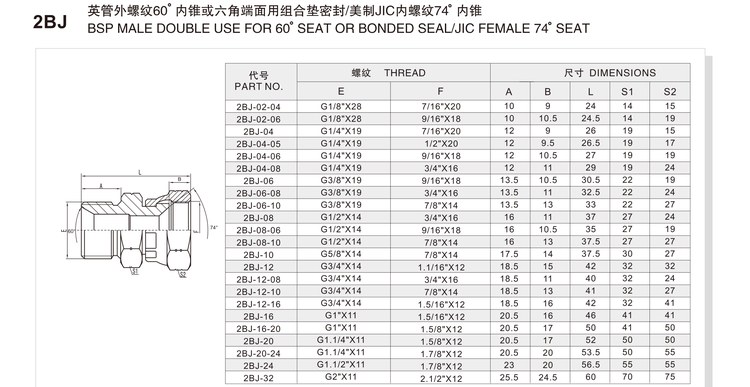
| PART NO. | E THREAD (BSP male stud) | F THREAD (JIC female 74° seat) | A | B | L | S1 | S2 |
|---|---|---|---|---|---|---|---|
| 2BJ-02-04 | G1/8″x28 | 7/16″x20 | 10 | 9 | 24 | 14 | 15 |
| 2BJ-02-06 | G1/8″x28 | 9/16″x18 | 10 | 10.5 | 24.5 | 14 | 19 |
| 2BJ-04 | G1/4″x19 | 7/16″x20 | 12 | 9 | 26 | 19 | 15 |
| 2BJ-04-05 | G1/4″x19 | 1/2″x20 | 12 | 9.5 | 26.5 | 19 | 17 |
| 2BJ-04-06 | G1/4″x19 | 9/16″x18 | 12 | 10.5 | 27 | 19 | 19 |
| 2BJ-04-08 | G1/4″x19 | 3/4″x16 | 12 | 11 | 29 | 19 | 24 |
| 2BJ-06 | G3/8″x19 | 9/16″x18 | 13.5 | 10.5 | 32.5 | 22 | 19 |
| 2BJ-06-08 | G3/8″x19 | 3/4″x16 | 13.5 | 11 | 32.5 | 22 | 24 |
| 2BJ-06-10 | G3/8″x19 | 7/8″x14 | 13.5 | 13 | 33 | 22 | 27 |
| 2BJ-08 | G1/2″x14 | 3/4″x16 | 16 | 11 | 37 | 27 | 24 |
| 2BJ-08-06 | G1/2″x14 | 9/16″x18 | 16 | 10.5 | 35 | 27 | 19 |
| 2BJ-08-10 | G1/2″x14 | 7/8″x14 | 16 | 13 | 37.5 | 27 | 27 |
| 2BJ-10 | G5/8″x14 | 7/8″x14 | 17.5 | 14 | 37.5 | 30 | 27 |
| 2BJ-12 | G3/4″x14 | 1.1/16″x12 | 18.5 | 15 | 42 | 32 | 32 |
| 2BJ-12-08 | G3/4″x14 | 3/4″x16 | 18.5 | 11 | 40 | 32 | 24 |
| 2BJ-12-10 | G3/4″x14 | 7/8″x14 | 18.5 | 13 | 41 | 32 | 27 |
| 2BJ-12-16 | G3/4″x14 | 1.5/16″x12 | 18.5 | 16 | 42 | 32 | 41 |
| 2BJ-16 | G1″x11 | 1.5/16″x12 | 20.5 | 16 | 41 | 41 | 41 |
| 2BJ-16-20 | G1″x11 | 1.5/8″x12 | 20.5 | 17 | 50 | 41 | 50 |
| 2BJ-20 | G1.1/4″x11 | 1.5/8″x12 | 20.5 | 17 | 52 | 50 | 50 |
| 2BJ-20-24 | G1.1/4″x11 | 1.7/8″x12 | 20.5 | 20 | 53.5 | 50 | 55 |
| 2BJ-24 | G1.1/2″x11 | 1.7/8″x12 | 23 | 20 | 56.5 | 55 | 55 |
| 2BJ-32 | G2″x11 | 2.1/2″x12 | 25.5 | 24.5 | 60 | 70 | 75 |
Column notes: E is the BSP male stud end thread, F is the JIC female swivel thread with its 74° seat. A is the length of the E-end section as shown on the series drawing, B is the length of the F-end section, L is the overall length, S1 is the across-flats of the body hex and S2 is the across-flats of the JIC swivel nut. Dimensions are in millimetres. Thread designations keep the inch callout plus the threads-per-inch count, for example G1/2″x14 for the BSP end and 7/8″x14 for the JIC end. The captive bonded seal adapter variant of the same sizes is listed under series 2BJ-WD.
3. How to Read a 2BJ Adapter Part Number
The part number carries three pieces of information: the series, the BSP-end size and the JIC-end size.
- 2BJ: series prefix, a straight adapter with a BSP male stud end and a JIC female 74° seat.
- First size code (BSP end): 02 = G1/8″x28, 04 = G1/4″x19, 06 = G3/8″x19, 08 = G1/2″x14, 10 = G5/8″x14, 12 = G3/4″x14, 16 = G1″x11, 20 = G1.1/4″x11, 24 = G1.1/2″x11, 32 = G2″x11.
- Second size code (JIC end): 04 = 7/16″x20, 05 = 1/2″x20, 06 = 9/16″x18, 08 = 3/4″x16, 10 = 7/8″x14, 16 = 1.5/16″x12, 20 = 1.5/8″x12, 24 = 1.7/8″x12.
- Single code: one number only, used where the two ends follow the standard coded pair for that size, for example 2BJ-04, 2BJ-06, 2BJ-08, 2BJ-10, 2BJ-12, 2BJ-16, 2BJ-20, 2BJ-24 and 2BJ-32.
Worked example: 2BJ-08-10. The prefix 2BJ fixes the series. The first code 08 sets the BSP stud end at G1/2″x14, an ISO 228-1 parallel thread for an ISO 1179 port. The second code 10 sets the JIC end at 7/8″x14 with a 74° seat to SAE J514. Reading the table, the adapter is A 16 mm, B 13 mm, L 37.5 mm, S1 27 mm across the body hex and S2 27 mm across the swivel nut. A buyer only needs to quote 2BJ-08-10, the seal choice (60° cone seat service or bonded seal) and the material and plating to place the line.
A “-WD” suffix in the same family marks the captive seal version, where the bonded seal washer is held on the stud end. That variant is listed separately under series 2BJ-WD. A hydraulic conversion adapter of this family is ordered by its part number alone, once the two threads, the seat form and the seal type have been confirmed against the ports.
4. Installation and Fitment
Correct installation of this adapter starts before the first turn of the wrench. Check the port on the equipment side: a 60° cone seat port and a flat face port both accept the stud end, but only one bonded seal washer or seat contact is correct for the port in front of you. Clean both threads and both sealing faces, and confirm that no old washer, thread sealant residue or swarf remains in the port.
- Bring the adapter in by hand until the stud end contacts the seat or the bonded seal washer touches the flat face.
- Hold the body hex S1 with one wrench and tighten the JIC swivel nut S2 with a second wrench. Never tighten the swivel nut against a body that is free to turn, because that loads the body thread instead of the seat.
- Torque practice is snug contact first, then a controlled tightening angle to reach the seating load the joint needs. Because the correct figure depends on thread size, material and seal type, it is confirmed per order rather than quoted as one number for all sizes.
- The bonded seal washer is a single-use item. Replace it whenever the joint is opened, or it will not re-seal.
- The 74° seat end is a metal seat. Inspect the seat face for score marks or embedded debris before reuse, and keep a spare swivel nut assembly on the shelf if the seat face is damaged.
- Support hose runs so that vibration is not carried into the adapter thread, and check the joint again after the machine has reached working temperature.
Common fitment errors and their symptoms: a bonded seal washer fitted to a recessed cone seat port leaks at the body face and never reaches a solid stop. A 74° seat nut paired with a 37° flare stud end tightens on the thread but weeps under pressure because the contact lines do not meet. Cross-threading at the JIC swivel, usually caused by starting the nut by wrench rather than by hand, shows as a nut that turns with heavy drag and a thread that will not seat. Over-torquing the swivel nut to stop a leak that comes from the wrong seal type deforms the seat face and turns a seal change into a part replacement.
5. Applications and Industries
Application tags: hydraulic systems, water jetting, oil and gas, industrial equipment, construction machinery, agriculture, marine, material handling.
This adapter is used where a British Standard port meets an SAE J514 line:
- Cross-standard equipment integration. A machine built to European practice carries BSPP ports on its manifolds, cylinders and pumps, while the hose assemblies or tube ends supplied with the installation follow SAE J514. One adapter of this series at each port removes the need for a chain of two adapters and keeps the assembly envelope compact.
- Repair and replacement on imported machinery. When a damaged adapter is removed from an imported machine, the replacement has to match a BSP port at one end and a JIC 74° seat line at the other. Reading the thread callouts off the old part and matching them to the table above identifies the correct line.
- Test benches and service tooling. Test rigs commonly mix port standards because the pump, the valve block and the pressure line come from different suppliers. A stocked range of 2BJ sizes lets a workshop build a leak-free connection without welding or re-machining the port.
- OEM assembly lines. For a production line, the 74° seat end gives a repeatable metal-to-metal joint that does not depend on an elastomer at the equipment interface, which simplifies the bill of materials and the assembly instruction.
6. Replacement and Cross-Reference Guide
Cross-reference any BSP adapter by standard and sealing method, never by another maker’s catalogue number. The three things to measure on the part you are replacing are the thread, the seat angle and the seal type, because a JIC adapter and a bonded seal adapter that look alike on the shelf behave very differently at the port. Take the reading from the adapter itself rather than from a parts list, because a machine may have been repaired with a different variant during its service life.
- Thread. Measure the outside diameter of the BSP stud end and identify the threads per inch. A G1/2″x14 stud end has a diameter of about 20.9 mm and 14 threads per inch; the same measurement on a taper thread identifies a BSPT end instead. On the JIC side, measure the nut thread: 7/16″x20, 9/16″x18, 3/4″x16, 7/8″x14, 1.1/16″x12, 1.5/16″x12 and larger sizes are UNF.
- Seat angle. Look at the internal cone inside the swivel nut. A 74° seat is clearly steeper than a 37° flare seat. If the mating nose has a long shallow cone, the part is a 37° flare and this series is the wrong choice.
- Seal type. If there is a washer on the stud end, the part works with a flat face port and a bonded seal. If there is a bare machined cone, the part works against a 60° seat port. If the washer is captive in a groove or held by a lip on the stud, you need the 2BJ-WD variant rather than the standard 2BJ.
Related families in the same HENGHUA British Adapters range, by function: 1BJ covers a BSP stud end to a JIC male 74° cone (the male-to-male counterpart); 2BJ-WD covers the same connection with a captive bonded seal; 5B and 7B cover BSP male to BSP female connections within ISO 1179; 1BT-SP covers BSP male to BSPT male for straight threads meeting taper threads.
7. Ordering, Packaging and Delivery
To place a quotation request for this BSP adapter, send these six items: series code, full part number, the thread size of each end, the seal material, the plating or material grade, and the annual or first-order quantity.
Example of a complete inquiry line: series 2BJ, part number 2BJ-08-10, BSP end G1/2″x14 to ISO 228-1, JIC end 7/8″x14 with 74° seat to SAE J514, bonded seal in NBR, carbon steel body with trivalent chromium zinc plating, 500 pieces.
- Packaging. Parts are bagged and cartoned in quantities suited to distributor shelf handling, with larger sizes cartoned loose in single size groups. Carton labels carry the series code, the part number and the quantity.
- Labelling. Neutral labelling is available for distributors who re-label under their own brand, and customer label artwork can be applied where supplied.
- Samples. Single pieces or small sample sets can be supplied for fit validation before a production order. Sampling a new size on the actual port is the fastest way to confirm the seat type and the across-flats clearance in a tight installation.
- Lead time. Lead time depends on the size mix, the material grade and the plating selected, and is confirmed at quotation per order. Repeat orders on standard carbon steel sizes follow the shortest route.
- Traceability. Each carton is checked against the drawing with thread gauges and dimensional checks before packing, and the batch is identified by the part number on the label.
8. FAQ
Q1. What is the difference between BSPP and BSPT, and can they be interchanged? BSPP is a parallel pipe thread to ISO 228-1, where pressure tightness is made on the seat or on a washer and not on the thread. BSPT is a taper pipe thread to ISO 7-1, where pressure tightness is made on the thread flanks and a sealant is required. They must not be interchanged: a BSPT male end screwed into a BSPP female port will engage only a few turns and will damage the parallel thread, and a BSPP male end in a BSPT port will bottom without sealing. Part numbers ending in -SP in this range, such as 1BT-SP, are the taper-thread series.
Q2. What is the difference between a 60° cone seat and a bonded seal, and which should I choose? The 60° cone seat seals where a machined cone on the stud end meets the matching cone in the port, so it needs a port with that internal cone. A bonded seal seals where a metal washer with a bonded elastomer ring is compressed against a flat port face, so it needs a flat face port and a clean, square surface. Choose the cone seat when the port is a machined cone seat, and choose a bonded seal adapter when the port face is flat. The 2BJ stud end serves both, which is why it is called a double use end, but only one option matches the port in front of you.
Q3. How do I identify the correct 2BJ adapter size? Read two threads: the BSP stud end and the JIC swivel end. Measure the outside diameter and the pitch of the BSP thread to get the G size, then measure the swivel nut thread to get the UNF size such as 7/16″x20 or 9/16″x18. Match that pair against the part number table, and confirm at the same time that the JIC end is a 74° seat and not a 37° flare. If the pair you measured is not listed, it can be produced to drawing as a special.
Q4. What seal material should I select for my fluid and temperature? NBR covers general hydraulic oil service from about -30°C to +100°C and is the usual first choice. FKM (Viton-type) runs from about -20°C to +200°C and suits higher temperature and many aggressive fluids. EPDM runs from about -40°C to +120°C and suits water, water-glycol and many brake and steam applications, but it is not suitable for mineral oil. Send the fluid and the working temperature with the inquiry and the seal selection will be confirmed against them.
Q5. How is the working pressure of this adapter determined? Working pressure is not one figure for the whole series. It depends on the thread size, the wall thickness of the body at that size, the sealing method and the material grade, and it is confirmed per order by HENGHUA engineering. On the JIC side, pressure capability also follows the mating SAE J514 stud end. State the system working pressure and the peak pressure with the inquiry so the size and grade are confirmed for the duty.
Q6. What is the minimum order quantity and can I get samples? Sample quantities can be supplied for fit validation before a production order. The minimum order quantity depends on the size, the material grade and the plating selected, and is confirmed in the quotation. Because of that, the fastest route is to send the part numbers, seal material and expected annual quantity in one inquiry so the quotation covers the sample set and the production release together.
Q7. Can the 74° seat end be connected to a 37° flare hose end? No. A JIC adapter with a 74° seat and one with a 37° flare use different SAE J514 sealing geometries. The threads may engage, but the sealing cones are at different angles, so the joint does not form a reliable contact line and will usually weep under pressure. Match the seat form of the port before ordering.
Q8. Is the bonded seal washer included with the adapter? The bonded seal washer is supplied with the adapter as the standard arrangement for the flat face port configuration. It is a single-use item, so order replacement washers with the adapters and change them whenever a joint is opened. If you need the washer to stay on the adapter during handling and assembly, specify a bonded seal adapter with the captive washer, series 2BJ-WD.
Browse the full Adaptateurs hydrauliques range for the complete family, or contact us to request a quote, mill test reports, and samples.



 English
  Spanish
  Portuguese
  French
  German