
1. What a 9B Adapter Does
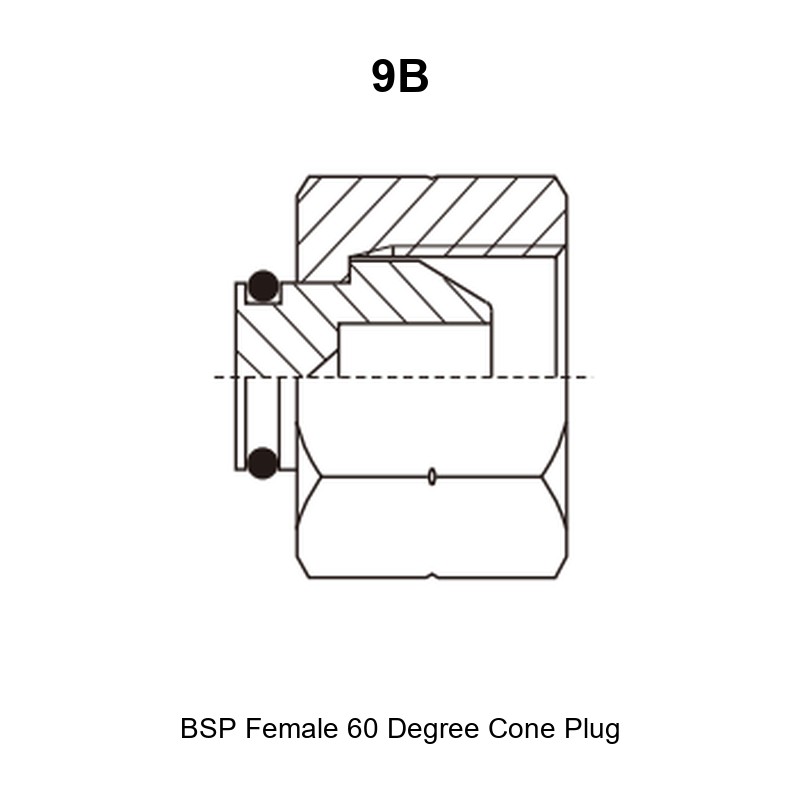
The 9B adapter is a BSPP female plug that caps a male stud end which is not in use. Its internal G (BSPP) parallel thread to ISO 228-1 screws onto the male stud end of a port fitting, an adapter or a hose insert, and it closes that male end so no line can be connected to it. The sealing face is a 60° internal cone, so the plug seals against the 60° cone of the male stud end it is fitted to.
A plug has one interface only, so that interface decides whether the end stays dry. The internal thread must match the male stud end exactly, and the cone must match the cone angle of that stud end, because the joint between the two cones is the only barrier between the fluid system and the atmosphere.
This series works in the opposite direction to the male plugs of the range. Instead of entering a port, the 9B plug receives a stud end. That makes it the right part for closing a male threaded end that is left open on a manifold, a hose assembly, a valve or a machine after a line has been removed or before one is connected.
2. 9B Specifications
2.1 Connection 1 — BSPP female thread (onto the male stud end)
- Thread standard: ISO 228-1 parallel pipe thread, G series, the thread family used by ISO 1179 stud ends and ports.
- Gender: female.
- Size range: G1/8″x28 up to G1.1/2″x11, nine sizes in the published table. Larger sizes are confirmed with the supplier before ordering, because they are not listed in the published chart.
- Sealing: 60° internal cone seat against the 60° cone of the male stud end.
- Mating part: a BSPP male stud end to ISO 1179 with a 60° cone.
2.2 Connection 2 — closed head (no line connection)
- Function: the head closes the plug and provides the drive for tightening.
- Drive: external hex, dimension S2 in the table.
- Face: a closed head. No hose, tube or fitting connects to this end.
- Sealing face: the internal 60° cone inside the thread bore, which contacts the cone of the male stud end.
2.3 Construction and Materials
The body is machined from bar stock on CNC lathes, with the internal cone cut to the 60° seat geometry and the internal thread gauged to the male stud end it will cap. Standard material is carbon steel with trivalent chromium zinc plating (Cr3+) for general hydraulic service. Zinc-nickel plating, 304 stainless steel, 316 stainless steel and brass are available for corrosive and marine duties. No separate elastomer is required in the standard configuration, because the joint is a metal-to-metal 60° cone seat; where a soft seal is required by the application, that is agreed with HENGHUA engineering for the specific port.
2.4 Pressure and Temperature
Pressure is not fixed by the part number alone. It is governed by the thread size, the wall thickness of the plug, the sealing method and the body material, so working pressure for these sizes is confirmed per order by HENGHUA engineering, based on the sealing method, thread size and material selected. Where an elastomer is used in an alternative configuration, its material limits apply as material facts: NBR approximately -30°C to +100°C, FKM approximately -20°C to +200°C, EPDM approximately -40°C to +120°C.
2.5 Part Number and Dimension Table
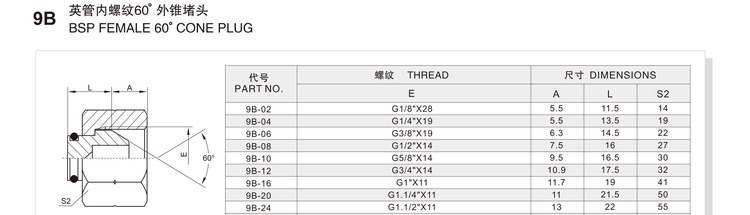
Every value below is taken from the published series chart. All dimensions are in millimetres. E is the thread designation of the plug, A is the depth measured from the open end face of the plug, L is the overall length, and S2 is the hex across flats of the head.
| PART NO. | THREAD E | A | L | S2 |
|---|---|---|---|---|
| 9B-02 | G1/8″x28 | 5.5 | 11.5 | 14 |
| 9B-04 | G1/4″x19 | 5.5 | 13.5 | 19 |
| 9B-06 | G3/8″x19 | 6.3 | 14.5 | 22 |
| 9B-08 | G1/2″x14 | 7.5 | 16 | 27 |
| 9B-10 | G5/8″x14 | 9.5 | 16.5 | 30 |
| 9B-12 | G3/4″x14 | 10.9 | 17.5 | 32 |
| 9B-16 | G1″x11 | 11.7 | 19 | 41 |
| 9B-20 | G1.1/4″x11 | 11 | 21.5 | 50 |
| 9B-24 | G1.1/2″x11 | 13 | 22 | 55 |
Sizes larger than G1.1/2″x11 are not listed in the published chart for this series; [VERIFY WITH SUPPLIER] before ordering a larger size, and send the male stud end dimensions so that the thread and the cone can be confirmed.
Note on thread notation: a designation such as G1.1/4″x11 means a 1 1/4 inch BSPP thread with 11 threads per inch. The number after the x is the thread pitch in threads per inch.
3. How to Read a 9B Adapter Part Number
A 9B part number has a fixed structure: series prefix and size code.
- 9B identifies a BSPP female plug with a 60° internal cone seat, the female plug of the British Adapters range that caps a male stud end.
- The two digits are the size code, expressed as the nominal bore in sixteenths of an inch. 02 is 2/16 inch, or 1/8 inch; 04 is 4/16, or 1/4 inch; 06 is 6/16, or 3/8 inch; 08 is 8/16, or 1/2 inch; 10 is 10/16, or 5/8 inch; 12 is 12/16, or 3/4 inch; 16 is 16/16, or 1 inch; 24 is 24/16, or 1 1/2 inch.
- The size code matches the male stud end it caps. A 9B-08 plug fits the same nominal size as a BSPP male stud end with a G1/2″x14 thread and a 60° cone.
Worked example from the table: 9B-08. The prefix 9B shows a female plug with a 60° internal cone. The code 08 gives a 1/2 inch nominal bore, so the internal thread is G1/2″x14 with 14 threads per inch. The depth A is 7.5 mm from the open end face, the overall length L is 16 mm, and the hex across flats S2 is 27 mm, so the plug needs 27 mm of wrench clearance where the stud end is capped.
4. Installation and Fitment
Check the male stud end first: the thread must be clean and undamaged, and the 60° cone must be free of scores, corrosion and old sealant. Hand-start the plug onto the stud end, then tighten with a wrench on the hex until the two cones contact and the plug is firm. The joint seals metal to metal at the cone, so once the cones are seated, further rotation does not improve the seal and can deform the cone or the port boss.
Do not use a thread sealant on a 60° cone joint, because the seal is at the cone and not on the threads. Do not fit a bonded seal washer under the head either; the head of this plug has no flat sealing face for a washer, and adding one holds the cones apart. Keep the cone clean during fitting, since a chip between the cones produces a leak that looks like a thread fault.
Common fitment errors and their symptoms:
- Fitting the plug onto a stud end with a damaged or corroded cone. Symptom: leakage at the joint despite firm tightening.
- Fitting the plug onto a parallel-faced stud end with no cone. Symptom: the plug bottoms out and still leaks.
- Cross-threading onto a stud end that is not square to the plug. Symptom: the plug stops hard before the cones meet.
- Over-tightening a small size. Symptom: a deformed cone, a cracked port boss or a rounded hex.
- Using the plug on a taper thread stud end. Symptom: the plug enters a few turns and then binds.
Inspect the internal cone and the thread before reuse. A cone that has been deformed by over-tightening may still seal on a different stud end, but it should be checked against the mating part before it is returned to service.
5. Applications and Industries
Typical applications and industries for this plug include hydraulic systems, water jetting equipment, oil and gas service equipment, industrial machinery, construction machinery, agriculture, marine hydraulics and material handling equipment.
Four concrete uses:
- Capping an open male stud end. A manifold, valve or hose assembly is supplied with a stud end that the current build does not use. This female plug caps that stud end so the assembly can go into service.
- Isolating an unused branch. When a line is removed during a rebuild, the male stud end that fed it stays open. A female plug isolates that point from the rest of the system.
- Capping a line during commissioning. Sub-circuits are pressurised one at a time on a test bench while the remaining stud ends stay closed, which lets part of a machine be tested without dismantling the rest.
- Protecting a stud end during transport. Hose assemblies, adapters and spare ports ship with their male ends capped to keep out moisture, dust and insects and to protect the 60° cone from impact damage during handling.
The female plug is also used to blank a stud end temporarily while a machine is cleaned, flushed or moved between sites.
6. Replacement and Cross-Reference Guide
Identify a replacement by standard and sealing method, not by the source of the original part. BSPP threads are defined by ISO 228-1 and the 60° cone stud end geometry by ISO 1179, so any female plug that matches the thread and the cone angle performs the same duty. Separate the thread families first: BSPP (parallel, G) to ISO 228-1, BSPT (taper, R) to ISO 7-1, JIS gas thread to JIS B 0203, and the metric and SAE families to their own standards.
Measure these three things before ordering:
- The stud end thread. Measure the outside diameter of the male thread and match it to the size code table, then confirm the pitch with a thread gauge. The size code of the plug is the same as the size code of the stud end it caps.
- The cone. Look at the end of the stud end. A machined 60° external cone means this series is the correct choice. A stud end with a flat face takes a bonded seal washer instead, and a taper thread stud end needs a taper threaded cap. Where the cone is damaged, the replacement should be fitted only after the stud end has been checked.
- The drive and the space. Measure the clearance around the stud end and compare it with the hex S2 and the length L. The head of this plug is the part that takes the wrench, so the clearance is measured at the head.
7. Ordering, Packaging and Delivery
To place an order or request a quotation, send the series code, the full part number, the thread size, the material or plating, and the quantity. Example: 9B-08, G1/2″x14, carbon steel with trivalent chromium zinc plating, 500 pieces. State the male stud end it will cap, including the cone angle, so that the internal cone and the thread are confirmed against the mating part. Sizes outside the published table are quoted as specials from a drawing or from the male stud end dimensions.
Plugs are packed in sealed polyethylene bags inside cartons, with the part number, thread size, material and quantity printed on the label. Bulk cartons and labelled shelf packs are available for distributor stock. Sample orders are accepted so that the cone seat can be validated on the actual stud end before a production order. Lead time is confirmed per order, since it depends on the size, the material grade and the order quantity.
8. FAQ
Q1. What is the difference between BSPP and BSPT, and can they be interchanged? BSPP is a parallel pipe thread to ISO 228-1, where the pressure-tight joint is not made on the threads; sealing comes from a 60° cone seat or a bonded seal washer. BSPT is a taper pipe thread to ISO 7-1, where the joint is made on the threads and a sealant is required. The two cannot be interchanged: a parallel plug on a taper stud end binds, and a taper plug on a parallel stud end never seats.
Q2. What is the difference between a 60° cone seat and a bonded seal, and which should I choose? A 60° cone seat seals metal to metal between the cone on the stud end and the cone inside the plug, as defined for BSPP stud ends in ISO 1179. A bonded seal washer seals on a flat face, with the elastomer bonded to a metal backing ring. Check the male stud end you intend to cap: a machined 60° cone means this series is correct, and a flat face means a bonded seal plug is correct.
Q3. How do I identify the correct 9B adapter size? Measure the outside diameter of the male stud end thread and match it to the size code table; the two-digit code is the nominal bore in sixteenths of an inch, so 08 is 1/2 inch and the internal thread is G1/2″x14. Confirm the pitch with a thread gauge, confirm that the stud end carries a 60° cone, and check that the hex S2 clears the surrounding parts.
Q4. Why is a female plug used instead of a male plug? The choice follows the thread on the part that is left open. A male port thread is closed with a male plug that screws into it. A male stud end is closed with a female plug that screws onto it. This series is the female plug, so it is the part used when the open connection is a stud end rather than a port.
Q5. How is the working pressure of this adapter determined? Working pressure is governed by the thread size, the wall thickness of the plug, the sealing method and the body material, so it is not one figure for the whole series. Working pressure for these sizes is confirmed per order by HENGHUA engineering, based on the sealing method, thread size and material selected.
Q6. What seal material should I select for my fluid and temperature? The standard 9B configuration seals metal to metal at the 60° cone and needs no elastomer, so the fluid compatibility question is answered by the body material and by the cone seat. Where an application calls for a soft seal, NBR suits mineral hydraulic oil at approximately -30°C to +100°C, FKM suits higher temperatures and aggressive fluids at approximately -20°C to +200°C, and EPDM suits water and water-glycol service at approximately -40°C to +120°C.
Q7. What is the minimum order quantity and can I get samples? Sample orders are accepted so that the cone seat can be checked against the actual stud end before a production order is placed. Minimum order quantity depends on the size, the material grade and the finish, and is confirmed with the quotation. Send the part numbers and the expected annual volume so that the sample and the production batch are quoted together.
Q8. Can a 9B adapter be reused after it has been in service? Yes, if the internal cone and the thread are undamaged. Inspect the cone for scores, corrosion and deformation, check the thread for galling, and confirm that the hex is not rounded. A cone that has been deformed by over-tightening should be checked against the mating stud end before the plug is returned to service.
Browse the full Adaptateurs hydrauliques range for the complete family, or contact us to request a quote, mill test reports, and samples.



 English
  Spanish
  Portuguese
  French
  German
  Arabic