
1. What a 3B9 Adapter Does
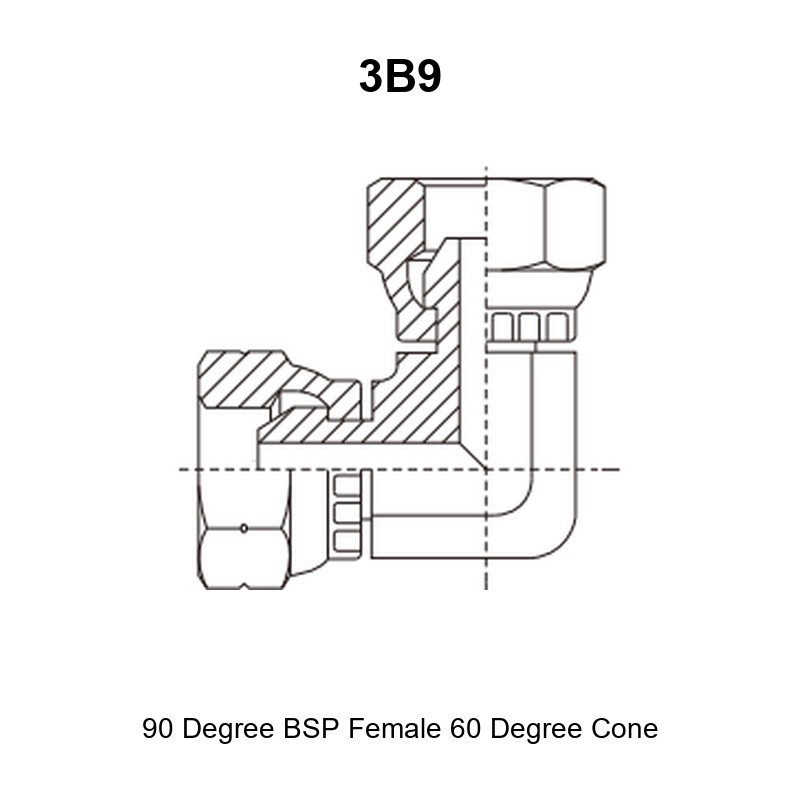
A 3B9 adapter is a 90° elbow hydraulic adapter with a BSP female 60° cone end at both ports. It joins two BSP male stud ends that would otherwise have to meet in a straight line, and it turns the connection through a right angle.
Both ends must match their mating stud ends exactly, in thread form, cone angle and hex clearance, because a correct match at both ends is the precondition for eliminating leakage at the conversion point.
Each port of the 3B9 seals on an internal 60° cone seat that receives the matching male cone, following the ISO 228-1 thread form and the ISO 1179 seat geometry. The thread provides the clamping force only.
2. 3B9 Adapter Specifications
| Parameter | Connection 1 (port E) | Connection 2 (port F) |
|---|---|---|
| Thread standard | ISO 228-1, BSPP / G thread | ISO 228-1, BSPP / G thread |
| Thread size range | G1/8″x28 to G2″x11 | G1/8″x28 to G2″x11 |
| Gender | Female | Female |
| Sealing method | Internal 60° cone seat | Internal 60° cone seat |
| Mating part standard | BSP male stud end with 60° cone, ISO 1179 | BSP male stud end with 60° cone, ISO 1179 |
| Elbow angle | 90° | 90° |
| Body style | One-piece elbow with a female cone end at each leg | – |
2.1 Connection 1 – BSP female, 60° cone (port E)
Port E is a BSPP female end with an internal 60° cone seat, offered from G1/8″x28 to G2″x11. It accepts a male stud end carrying the matching 60° cone or a male cone end made to ISO 1179.
The joint is metal to metal at the cone, so no separate sealing element is required and the joint releases cleanly for service.
2.2 Connection 2 – BSP female, 60° cone (port F)
Port F mirrors port E: a BSPP female end with an internal 60° cone seat, from G1/8″x28 to G2″x11. Because the two ends are dimensioned in the same way, the 3B9 is a mirror pair and each leg in the chart carries the same seat depth on a same-size part number.
Note that the chart below lists both port E and port F seat depth columns as equal values, which is the expected result for an elbow whose two ports share one nominal size. Use the hex columns to confirm the wrench size before installation.
2.3 Construction and Materials
The body is machined from bar stock on CNC lathes, with the 90° bend and both female cone ends produced in one part. Threads are gauged and both internal cones are inspected for a full contact form before packing.
- Body material options: carbon steel, 304 stainless steel, 316 stainless steel, brass.
- Plating options: trivalent chromium zinc plating (Cr3+), or zinc-nickel plating for more aggressive environments.
- Seal options: the cone joint needs no separate seal, and no bonded seal or O-ring is fitted at either port.
- Hex flats at both legs are dimensioned on the drawing so each end can be tightened with a wrench.
2.4 Pressure and Temperature
Working pressure is not a single figure for the series. It depends on the thread size, the wall thickness at the elbow, the sealing method and the body material. Working pressure for these sizes is confirmed per order by HENGHUA engineering, based on the sealing method, thread size and material selected.
Because the 3B9 uses cone joints, the seal material question belongs to the mating stud ends rather than to this part. Where a bonded seal or an O-ring is used elsewhere in the same assembly, these material ranges apply:
| Seal material | Plage de températures typique |
|---|---|
| NBR | approximately -30°C to +100°C |
| FKM (Viton-type) | approximately -20°C to +200°C |
| EPDM | approximately -40°C to +120°C |
Carbon steel with zinc plating suits general hydraulic service. Choose 304 or 316 stainless steel where the adapter sees moisture, washdown or corrosive media.
2.5 Part Number and Dimension Table
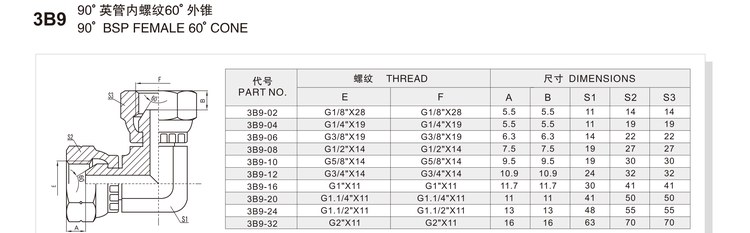
All values are millimetres. Thread designations follow ISO 228-1. Column A is the 60° cone seat depth at port E and column B is the 60° cone seat depth at port F; the two values are equal because both ports of a given part number share the same nominal size. S1, S2 and S3 are the hex dimensions of the drawn wrench features.
| PART NO. | THREAD E | THREAD F | A | B | S1 | S2 | S3 |
|---|---|---|---|---|---|---|---|
| 3B9-02 | G1/8″x28 | G1/8″x28 | 5.5 | 5.5 | 11 | 14 | 14 |
| 3B9-04 | G1/4″x19 | G1/4″x19 | 5.5 | 5.5 | 11 | 19 | 19 |
| 3B9-06 | G3/8″x19 | G3/8″x19 | 6.3 | 6.3 | 14 | 22 | 22 |
| 3B9-08 | G1/2″x14 | G1/2″x14 | 7.5 | 7.5 | 19 | 27 | 27 |
| 3B9-10 | G5/8″x14 | G5/8″x14 | 9.5 | 9.5 | 19 | 30 | 30 |
| 3B9-12 | G3/4″x14 | G3/4″x14 | 10.9 | 10.9 | 24 | 32 | 32 |
| 3B9-16 | G1″x11 | G1″x11 | 11.7 | 11.7 | 30 | 41 | 41 |
| 3B9-20 | G1.1/4″x11 | G1.1/4″x11 | 11 | 11 | 41 | 50 | 50 |
| 3B9-24 | G1.1/2″x11 | G1.1/2″x11 | 13 | 13 | 48 | 55 | 55 |
| 3B9-32 | G2″x11 | G2″x11 | 16 | 16 | 63 | 70 | 70 |
The chart above reproduces the full 3B9 range. Seat depth rises with nominal size, which is what sets how far a mating stud end has to travel before the two cones make full contact.
3. How to Read a 3B9 Part Number
A 3B9 part number has two elements: the series prefix and the size code.
- 3 – the BSP female 60° cone family in the British Adapters range.
- B – BSP thread, here BSPP to ISO 228-1.
- 9 – the 90° elbow version. The 3B family is also supplied without the elbow, as series 3B.
- Size code – two digits giving the nominal thread size in sixteenths of an inch: 02 is 1/8, 04 is 1/4, 06 is 3/8, 08 is 1/2, 10 is 5/8, 12 is 3/4, 16 is 1, 20 is 1.1/4, 24 is 1.1/2, 32 is 2.
Worked example: 3B9-12. Port E and port F are both G3/4″x14 female 60° cone ends (code 12). From the chart, the seat depth A and B is 10.9 mm, and the hexes S1, S2 and S3 are 24 mm, 32 mm and 32 mm. This is the part to order when two male cone stud ends on a 3/4 inch circuit have to meet around a corner.
Because this elbow has a single size code, it cannot be ordered as a reduced combination. If the two ports differ, use a male-to-female elbow from the same range and add the length you need, or ask HENGHUA for a special.
4. Installation and Fitment
Both ends of the 3B9 are female cone seats. Each joint is completed by a male stud end carrying the matching 60° cone, so bring the stud end in by hand, confirm that it turns smoothly for the first turns, then tighten with a wrench until the cones seat.
- Do not use thread sealant or tape, because the joint seals on the cone and not on the thread flanks.
- Fit the mating stud end to the hose or tube first, then make up the connection into the elbow, so the hose is not twisted during tightening.
- Keep both internal cones clean and free of swarf, paint or old sealant before assembly.
- Set the elbow direction before final tightening, since turning the body afterwards can score a seated cone.
Common fitment errors and the symptoms they cause:
| Error | Symptom |
|---|---|
| BSPT male end fitted into a BSPP female cone port | Thread interference, high wrench effort, leak that tightening cannot stop |
| Sealant or tape used on the cone joint | Debris pushed into the circuit, cone not fully seated, weep |
| Cone joint used where the mating part has a 37° flare | Line contact instead of full cone contact, early leak |
| Internal cone scratched during handling | Persistent seep under pressure |
| Elbow turned after the cones are seated | Cone scored, joint cannot be resealed by tightening |
A 3B9 adapter may be reused if the internal cones, the threads and the hexes are undamaged. Replace the mating stud ends or their cone faces if they show a pitted or broken contact ring.
5. Applications and Industries
Application tags: hydraulic systems, industrial equipment, construction machinery, agriculture, material handling, oil and gas, marine, water jetting.
5.1 Why an elbow instead of a straight adapter
A 90° elbow changes the direction of the connection at the port. Where both ends are female, the routing benefit and the access benefit usually decide the choice.
Routing in a tight envelope: the space in front of a manifold, pump or valve port is often occupied by another component. The elbow turns the line away immediately, so the hose or tube leaves parallel to the machine surface instead of projecting into free space.
Protecting the hose bend: a hose that leaves a port along the port axis and then has to bend sharply behind the machine is bent at a radius smaller than its design allows. The elbow removes that bend from the assembly.
Respecting the minimum bend radius: every hose has a minimum bend radius below which the reinforcement is stressed and service life falls. Moving the direction change into a machined steel elbow lets the hose run at a radius it was designed for.
Access and service: with both ends of this elbow female, the wrench works on the elbow hex rather than on a nut that faces a wall. On buried ports this is often the reason a 3B9 is selected over a straight adapter at all.
Fluid-dynamic trade-off: a 90° elbow adds a local pressure loss that a straight adapter does not have, because the flow must turn and the turn creates turbulence. Keep the bore matched to the hose and tube bore, avoid stacking several 90° elbows in one short run, and use a swept or larger-bore elbow where the circuit is sensitive to pressure loss. On return, pilot and gauge lines the loss is normally accepted in exchange for the routing and access benefit.
5.2 Concrete applications
Cross-standard equipment integration: a machine with BSPP ports is linked to a line built around a different port standard, and the female cone ends of the 3B9 accept the stud ends the line already uses.
Repair and replacement: when a male stud end or a hose end fails, the female-to-female elbow restores the connection on both sides in one step and keeps the existing routing.
High-pressure test benches: elbows hold hoses clear of the bench frame and out of the operator’s working area, and they let several lines leave one manifold with parallel runs.
OEM assembly lines: a fixed 90° geometry gives every unit the same routing, shortens the hose used, and removes the assembly step where a straight fitting has to be bent by hand.
6. Replacement and Cross-Reference Guide
Identify a replacement by standard and sealing method, never by brand. Three checks settle the identity of the part:
- Thread: measure the outside diameter over the thread and count the threads per inch, then match to ISO 228-1 (BSPP, parallel, G) or ISO 7-1 (BSPT, taper, R and Rc). Pitch differs between the families, so a caliper plus a thread gauge is more reliable than a visual match.
- Seat: confirm the seat at each connection, 60° cone, flat face for a bonded seal, 37° flare to SAE J514, 74° seat, or an O-ring port to ISO 6149-3 or ISO 11926-3. A 60° cone and a 37° flare both look conical but do not mate.
- Gender and seal type: state whether each end is male or female and whether it seals on a cone, on a bonded seal washer or on an O-ring, because one thread size is supplied in several configurations.
Useful equivalences within the HENGHUA range:
| Your requirement | Series to order |
|---|---|
| BSP female 60° cone elbow, both ends female | 3B9 |
| Straight BSP female 60° cone adapter | 3B |
| BSP male 60° seat elbow to BSP female 60° cone | 2B9 |
| BSP male 60° seat elbow, both ends male | 1B9 |
| BSP female ISO 1179 elbow, female to female | 7B9-PK |
| BSP male 60° seat elbow to BSP female ISO 1179 | 5B9 |
| BSP female 60° cone plug | 9B |
| BSP female ISO 1179 adapter | 7B |
If the mating stud ends are BSPT, order a BSPT female series rather than forcing a 3B9 adapter onto a taper thread.
7. Ordering, Packaging and Delivery
To place an order or ask for a quotation, send the following: series code (3B9), the full part number, the thread size at both ports, the body material and plating, and the quantity. State the mating stud end standard as well, so HENGHUA can confirm that the cone angle and seat depth match the parts you already use. If you work from a drawing rather than a catalogue part number, send the drawing and HENGHUA will confirm the nearest standard part number or quote a special.
Packaging and delivery:
- Standard packing in polyethylene bags inside export cartons, with desiccant where the destination or the season requires it.
- Cartons labelled with part number, thread sizes, material, quantity and batch reference, so a distributor can place the box straight on a shelf.
- Bulk packing and kit packing are available for OEM line delivery.
- Samples are available for validation before a production order; state the quantity and the part numbers you want to test.
- Lead time is confirmed per order, because it depends on part number, material, plating and quantity.
Every batch is checked against the drawing with thread gauges before packing, and the dimensional values on this page are taken from the series chart.
8. FAQ
Q1. What is the difference between BSPP and BSPT, and can they be interchanged? BSPP is the parallel thread defined by ISO 228-1, where pressure tightness is not made on the thread itself. BSPT is the taper thread defined by ISO 7-1, where the joint seals on the thread flanks and needs a sealant. They are not interchangeable: a tapered male end damages a parallel female port, and a parallel male end will not seal in a tapered port.
Q2. What is the difference between a 60° cone seat and a bonded seal, and which should I choose? A 60° cone seat seals metal to metal on a machined cone and needs no separate sealing element. A bonded seal seals on a flat face, using a metal washer bonded to a rubber ring. Choose the cone when the port is machined with a 60° cone to ISO 1179, and the bonded seal when the port face is flat and the joint depends on the washer.
Q3. How do I identify the correct 3B9 size? Read the two ports, not the hose. Measure the thread outside diameter and count the threads per inch, then match to ISO 228-1 to get the G size. Both ends of the 3B9 elbow carry the same nominal size, so one size code describes the whole part, for example 3B9-12 for G3/4″x14 at both ports.
Q4. What seal material should I select for my fluid and temperature? The 3B9 seals on a 60° cone and does not contain a seal element, so the seal material is decided by the mating stud ends. Where bonded seals or O-rings are used in the same assembly, NBR suits mineral oil from approximately -30°C to +100°C, FKM approximately -20°C to +200°C, and EPDM water and steam service approximately -40°C to +120°C.
Q5. How is the working pressure of this adapter determined? Working pressure depends on the thread size, the wall thickness at the elbow and the body material, so the series has no single figure. Working pressure for the sizes you order is confirmed by HENGHUA engineering per order, based on the thread size and material you specify.
Q6. What is the minimum order quantity and can I get samples? Minimum order quantity depends on the part number, the material and whether the item is standard or special, and it is quoted with the price. Samples are available for validation, and a sample order can be placed before a production quantity so fit and routing can be checked on the machine.
Q7. Can a 3B9 adapter join two male cone ends of different sizes? No. The 3B9 range is built as a same-size elbow, so both ports share one nominal size. For a mixed pair, use the male-to-female series in the same range, ask HENGHUA for a special with an unequal seat depth at the two ports, or use two straight adapters with an elbow in the line.
Q8. How do I tell a 60° cone seat from a 37° flare seat? Look at the angle of the internal cone and at the mating part. A 60° cone seat is the BSPP cone joint of ISO 1179 and mates with a 60° male cone. A 37° flare is the SAE J514 JIC joint and mates with a 37° male flare. The angles are different, so the two do not seal against each other even when the thread sizes look similar.
Browse the full Adaptateurs hydrauliques range for the complete family, or contact us to request a quote, mill test reports, and samples.
 English
  Spanish
  Portuguese
  French
  German