
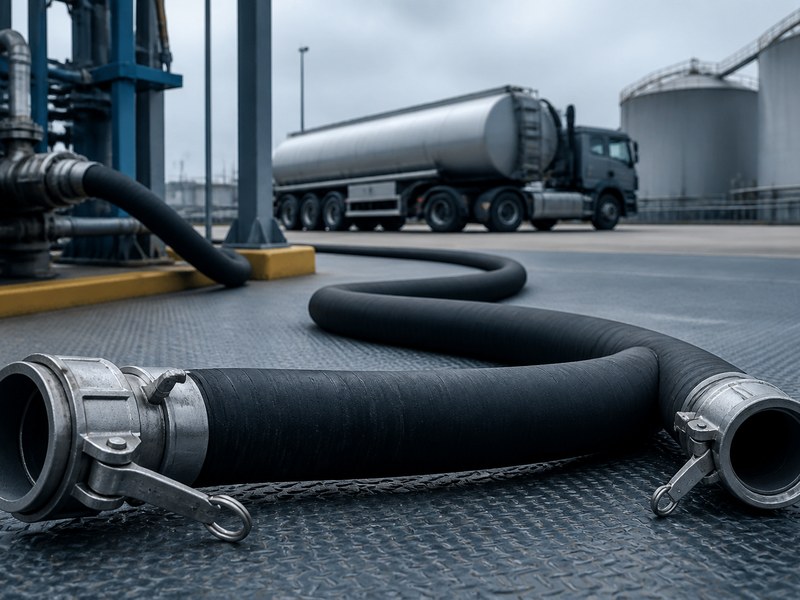
The right oil transfer hose is chosen by matching five specifications — inner diameter, working pressure, temperature range, end fittings, and construction (suction, discharge, or both) — to the fluid, flow rate, and duty of the line. This guide walks through every step of oil hose selection in order, provides the size chart and pressure table you need, and ends with a checklist you can hand to any supplier. It also covers how a transfer hose differs from a fuel or hydraulic hose, the standards behind the markings, and how to buy at a fair price.
What Is an Oil Transfer Hose?
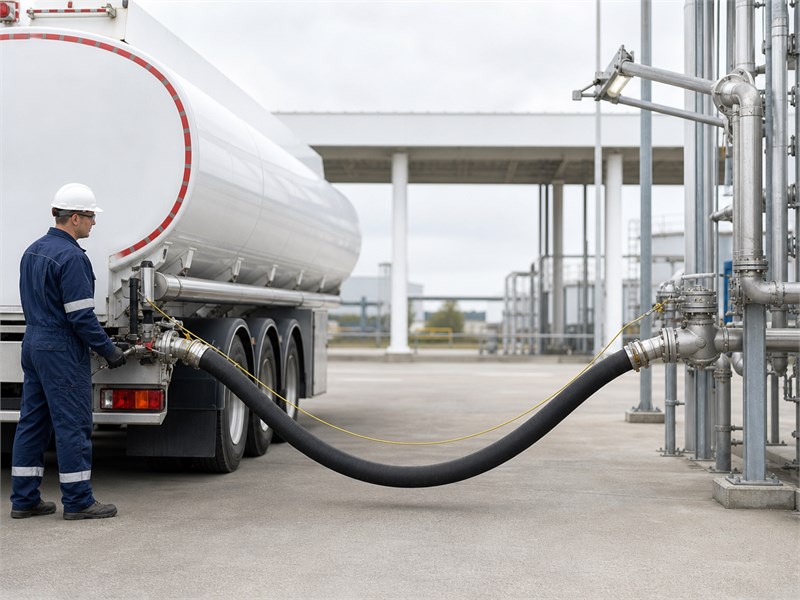
A petroleum transfer hose is a flexible rubber hose built to move diesel, gasoline, lubricating oil, fuel oil, and hydraulic oil between tanks, trucks, drums, machines, and loading racks. It bends with the layout where rigid pipe cannot, which is why nearly every tank truck, oil depot, and workshop uses it for loading and unloading.
The construction follows a three-layer design, plus one extra element for suction service:
- Tube: an oil-resistant synthetic rubber inner layer, almost always nitrile (NBR), smooth-bore and conductive for static safety.
- Reinforcement: multiple plies of synthetic textile and, for suction duty, a steel helix wire that keeps the hose round under vacuum.
- Cover: an oil-, abrasion-, ozone-, and weather-resistant rubber outer layer, often chloroprene (CR), sometimes flame-retardant.
- Grounding: a copper wire bonded to the fittings that drains static charge away from the fluid.

Figure 1. A transfer hose is a tube-reinforcement-cover assembly; the helix wire is what allows suction service.
Transfer hose construction, layer by layer
| Layer | Typical material | Job |
|---|---|---|
| Tube | Nitrile (NBR), conductive | Carries the oil without swelling; drains static charge |
| Reinforcement | Synthetic textile plies + steel helix wire | Carries pressure; resists collapse under vacuum |
| Cover | Chloroprene (CR) or NBR/CR blend | Resists oil splash, abrasion, ozone, and weather |
| Grounding | Copper wire | Bonds fittings together for static dissipation |
One number defines the whole category: this is a low-pressure product by design. The industry standard for tank truck, in-plant, and oilfield loading is about 150 PSI (10 bar) working pressure — a small fraction of what a hydraulic hose carries. Buy a transfer hose for transfer duty, not for pressurized hydraulic circuits.
Oil Transfer Hose vs Fuel Hose vs Hydraulic Hose: What Is the Difference?
Buyers often compare a transfer hose with a fuel hose because the two products look similar on a shelf. They are related but not identical, and the difference decides whether the hose survives the job:
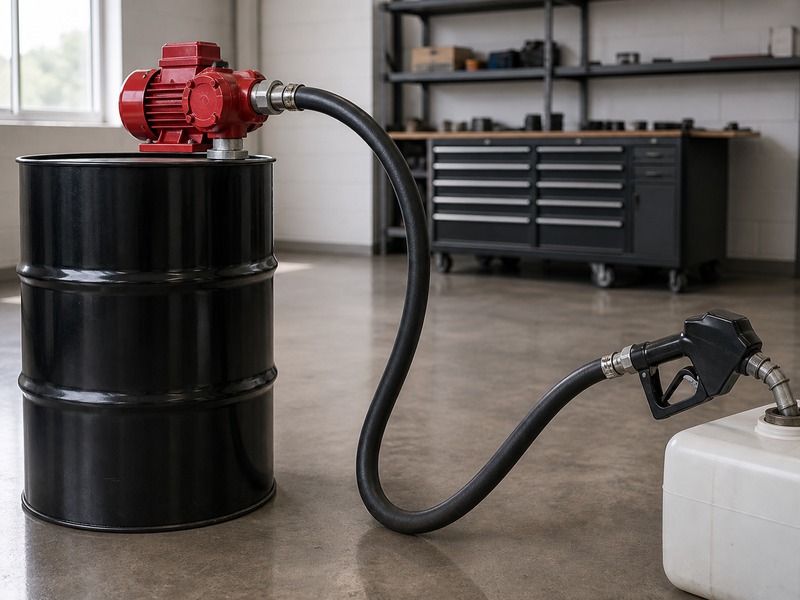
- Fuel transfer hose is built for petrol and diesel delivery at service stations and small dispensers. It is lighter, often 3/4 to 1 inch bore, and frequently paired with a nozzle or swivel for hand-held refuelling.
- Oil suction and discharge (OS&D) hose — the heavy-duty version for bulk loading and unloading. It is helix-reinforced, rated for full vacuum, and available from 3/4 to 4 inches, and up to 6 inches in larger bore classes.
- Hydraulic hose is a high-pressure product (up to thousands of PSI) with steel wire braid or spiral reinforcement, built to transmit fluid power. Hydraulic hose carries no vacuum rating — for transfer work, including suction service, use an OS&D or fuel hose as appropriate.
Transfer hose vs fuel hose vs hydraulic hose at a glance
| Feature | Transfer hose (OS&D) | Fuel transfer hose | Hydraulic hose |
|---|---|---|---|
| Typical working pressure | 150 PSI (10 bar), up to 300 PSI dock | 150-300 PSI | 1,000-6,000 PSI |
| Vacuum rating | Full vacuum (0.9 bar) | Usually none | None |
| Reinforcement | Textile plies + steel helix | Textile plies | Steel wire braid or spiral |
| Typical bore | 3/4-4 in (up to 6 in dock/marine) | 3/4-1 inch | 1/4-2 inches |
| Main job | Bulk loading, suction and discharge | Hand-held refuelling | Transmitting fluid power |
If your line pulls oil from a tank or pushes it at low pressure in bulk, you need an oil suction and discharge hose. If you are refuelling equipment by hand, a fuel transfer hose may be enough. If the line carries pressurized fluid power, see our hydraulic hose selection guide instead — that is a different product family.
Step 1: Size the Oil Transfer Hose by Flow, Not by the Port
Size the bore from flow, never from the port size you happen to have. A hose that is too small for the flow raises velocity, which increases pressure drop, heats the oil, and — in suction service — risks cavitation and pump damage. A hose that is too large costs more and is harder to handle.
The classic guidance is to keep fluid velocity at or below about 5 ft/s (1.5 m/s) on suction lines and 10-15 ft/s (3-4.5 m/s) on discharge lines. At those velocities, the table below gives typical flow capacity by inner diameter. These are planning values; confirm against the manufacturer’s flow table for the exact hose you choose.
Oil hose size chart — typical flow capacity by inner diameter (planning values)
| Inner diameter (in) | Inner diameter (mm) | Typical flow at 10–15 ft/s (US gpm) — planning values | Common use |
|---|---|---|---|
| 3/4 | 19 | 18-20 | Small pumps, transfer pumps, lubrication lines |
| 1 | 25 | 30-35 | Fuel and oil transfer pumps, shop delivery |
| 1-1/2 | 38 | 70-80 | Larger transfer pumps, waste oil lines |
| 2 | 51 | 120-140 | Tank truck drop lines, in-plant transfer |
| 3 | 76 | 280-320 | Suction and discharge on tank trucks, rail loading |
| 4 | 102 | 500-550 | Bulk loading racks, marine bunkering, dock service |
Values shown cover the 10–15 ft/s discharge range; at 10 ft/s the flow is roughly 25–30% lower.
Not sure of your flow rate? Send us the pump output and line length — our engineers will confirm the bore, typically within one working day. Ask HENGHUA’s engineers.
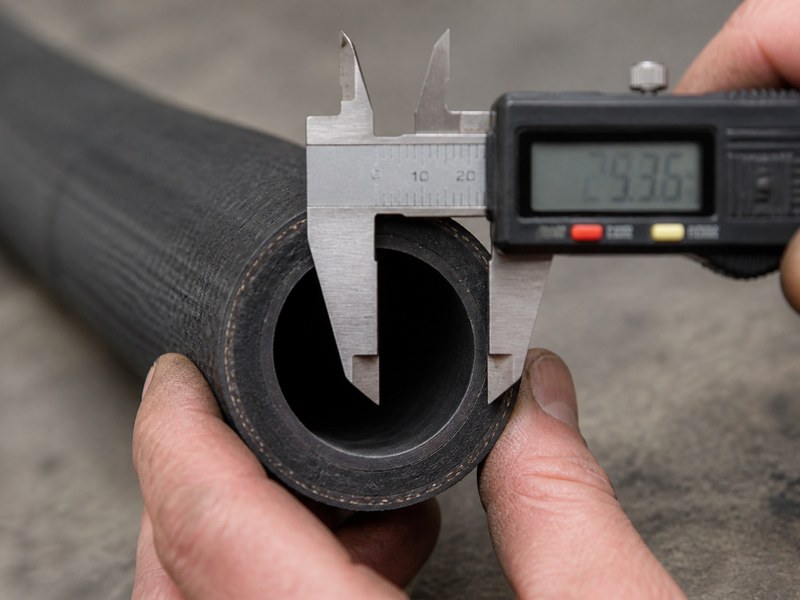
Figure 2. Measure the inner diameter of the cut end with a caliper — size always means ID, never OD.
To identify an unmarked hose, measure the inner diameter across the bore of the cut end with a caliper, or compare the outer diameter of the hose end against a fitting gauge. Size is always the inner diameter (ID), never the outer diameter — the OD depends on the number of plies and the helix wire, and two hoses with the same ID can have different ODs. If the hose still has its printed markings, the size line usually reads something like “EN 12115 SD 2 inch” — that 2 inch is the ID.
To use the chart: find your pump output in gpm, read across to the bore that keeps velocity inside the recommended range (at or below 5 ft/s on suction, 10-15 ft/s on discharge), then confirm both end fittings accept that bore. If a port forces a smaller bore than flow requires, the line needs a larger port or a reducer with a pressure-drop check.
Length is the last dimension to confirm. Measure the straight-line distance between the two connection points, add 5-10% for routing bends and fitting allowance, then order the next standard length up. A hose that is exactly tight is a hose already under stress.
Step 2: Check Working Pressure, Burst Pressure, and Vacuum Rating
Every transfer hose datasheet lists three pressure numbers, and each has a different job:
- Oil hose working pressure is the continuous operating rating — the number that matters.
- Burst pressure is the destruction-test value — the safety factor varies by standard: roughly 3:1 for EN 12115 Type SD, 4:1 for standard OS&D, and 5:1 for premium dock hose.
- Vacuum rating is how much suction the hose can pull without collapsing — 0.9 bar (about 27 inHg) means full vacuum service.
Transfer hose pressure classes by service (typical ratings)
| Service class | Working pressure | Burst pressure | Safety factor |
|---|---|---|---|
| Standard OS&D, tank truck (150 PSI class) | 150 PSI (10 bar) | ~600 PSI (40 bar) | 4:1 |
| EN 12115 Type SD, 16 bar class | 16 bar (232 PSI) | 48 bar (696 PSI) | 3:1 |
| Dock / export hose, premium class | 200-300 PSI | 1,000-1,500 PSI | 5:1 |
| Discharge-only light hose | 100-150 PSI | 400-600 PSI | 4:1 |
Select a transfer hose by its oil hose working pressure rating — the number printed on the cover. Burst pressure is a destruction-test reference used to confirm the design margin, not an operating value. For reference, a premium dock hose rated 200 PSI working is built to burst at 1,000 PSI — a 5:1 design margin that absorbs pressure surges, fatigue, and aging.
The vacuum rating is the number most often forgotten. Use a full-vacuum-rated hose (0.9 bar) for any suction service — unloading tanks, draining drums, or pump inlets. A discharge-only hose carries no vacuum rating; on a suction line it collapses flat and starves the pump. When in doubt, buy an oil suction and discharge hose: it does both jobs.
Transfer duty is rarely steady. Every pump start and stop sends a pressure wave through the line that can briefly exceed the static reading, and cold, thick oil raises pressure drop on long runs. A hose selected exactly at the pump rating leaves no room for those transients, so a small margin above the system pressure is a sensible planning rule.
Step 3: Match the Fluid and the Temperature Range
The inner tube must tolerate the actual fluid. Petroleum products vary in aromatic content, and aromatics attack ordinary rubber compounds. The EN 12115 standard covers fuels and petroleum derivatives with up to 50% aromatic content, using a conductive nitrile (NBR) tube — which is why NBR is the default tube for this category. If your fluid is outside that range — high-aromatic solvents, hot bitumen, or aggressive chemicals — specify a hose certified for that fluid and confirm the tube compound with the manufacturer.
Check the temperature range against your line before ordering. A typical EN 12115 Type SD transfer hose operates from -30°C to +90°C (-22°F to 194°F); heavy-duty dock hose extends to about -40°C to +121°C (-40°F to 250°F). Verify three temperatures before ordering: the coldest ambient temperature the line sees, the hottest fluid temperature in continuous service, and any localized heat source near the routing. If the fluid runs hot, ask for a high-temperature transfer hose construction rather than derating a standard one.
In practice the line sees a mix of products over its life — diesel one week, hydraulic oil the next, waste oil on a bad day. The tube has to handle all of them, which is one more reason the conductive NBR default is so common in this category.
Step 4: Select the Right Fittings and Connections
The most common oil hose fittings are camlock (cam and groove) couplings, threaded ends, and flanges. The choice is driven by how often the line is connected and disconnected.
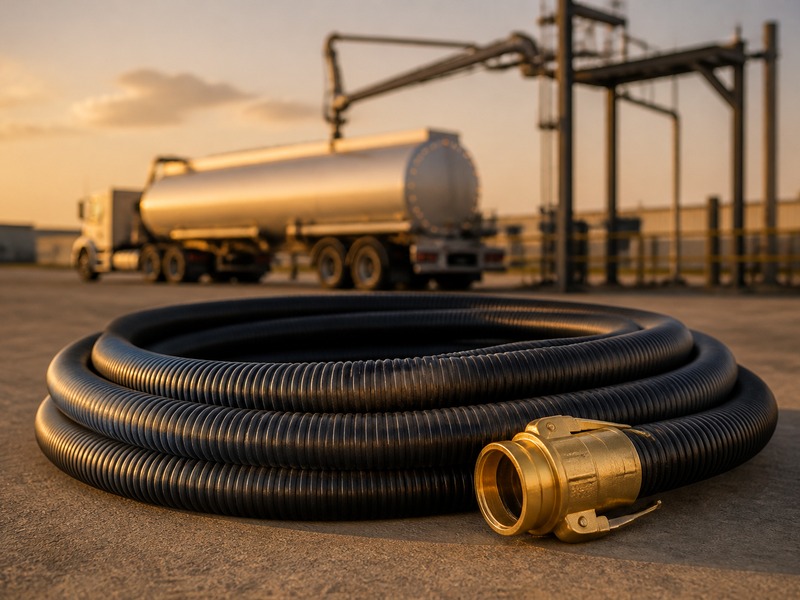
- Camlock couplings are the workhorse of transfer work. Two halves snap together with levers, no tools required, and they disconnect in seconds. They are the standard on tank truck drop lines and loading racks.
- Threaded ends (BSP or NPT) screw onto pump ports, tank outlets, and adapters. BSP dominates European and Asian equipment; NPT dominates North American pipe threads. Use the same thread family (BSP or NPT) at both ends of the line; a mixed pair leaks immediately. For a full comparison, see our NPT vs BSP thread guide.
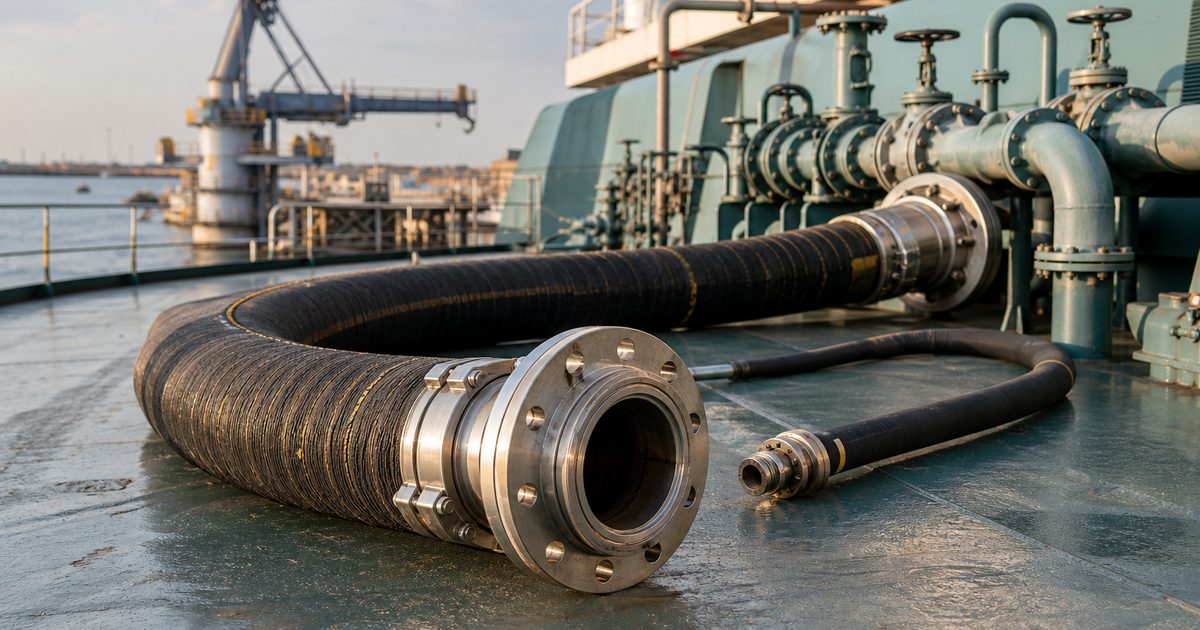
- Flanged ends suit large bores (3 inches and up) where bolted connections are safer and more rigid, common on docks and marine bunkering lines.
Oil hose fittings and typical working pressure
| Fitting type | How it connects | Typical working pressure | Best for |
|---|---|---|---|
| Camlock (cam & groove) | Two halves, snap-on levers | 1/2-2 in: 250 PSI; 2-1/2-4 in: 150 PSI; 5-6 in: 75 PSI | Tank trucks, loading racks, frequent hook-up |
| Threaded BSP / NPT | Screw-on, pipe threads | Up to hose rating | Pump ports, fixed connections |
| Flange | Bolted, flat face + gasket | Up to hose rating | Large bores, docks, marine |
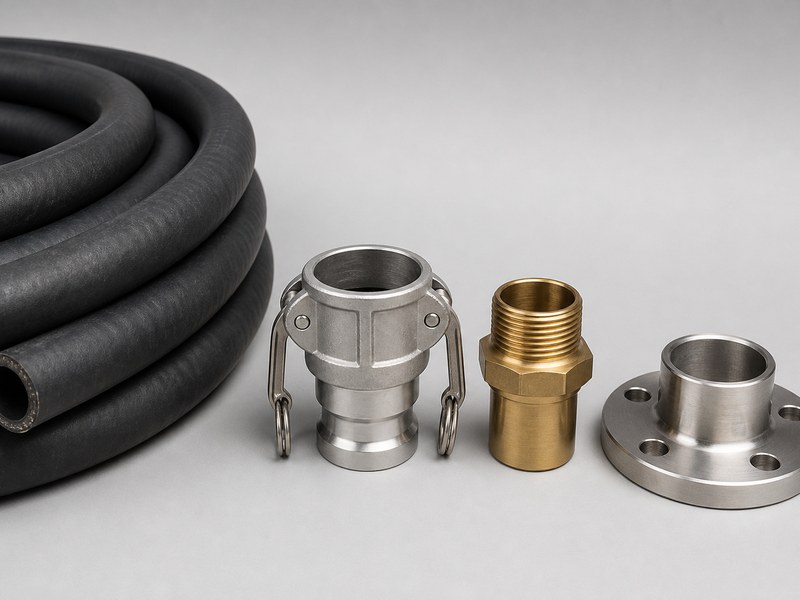
Figure 3. Camlock couplings, threaded ends, and flanges cover nearly all oil transfer connections.
Two practical details. First, crimped or clamped ends must be applied by the manufacturer or with certified equipment — a swage that is too loose weeps under pressure, one that is too tight crushes the tube, and both are common leak sources at the fitting. Second, if the hose is stored on a reel, confirm the fitting swivel or elbow does not create a sharp bend at the connection; that point is where fatigue cracks start. Record the crimp specification with every assembly so a replacement can be built identically. For hand-held refuelling from a hose reel, add a swivel fitting and keep the bend radius at the reel above the hose’s minimum bend radius.
Step 5: Suction vs Discharge — Pick the Right Construction
The single most common confusion in this category is the difference between a suction hose and a delivery (discharge) hose. Both move oil, but they are built differently:
- A suction hose is helix-reinforced and rated for full vacuum. The steel helix keeps the hose round when the pump pulls on it; without it, the hose flattens and collapses.
- A discharge hose only pushes fluid, so it can be lighter, more flexible, and cheaper. Suction service requires a full-vacuum-rated hose; use an OS&D hose when the line may pull.
The formal name for the combined product — built for both jobs — is the oil suction and discharge (OS&D) hose, specified in ISO 1823. It is the default choice for tank truck loading and unloading, because the same line often pulls from a tank and pushes into another. Unless you are certain the line only ever discharges, choose an OS&D hose and remove the risk.
Many tank truck fleets standardize on one construction for everything — a full-vacuum OS&D hose — so the driver never has to ask which line can suck and which can only push. Standardizing removes the most common misuse we see in the field.
Static Electricity and Safety: Why a Conductive Oil Transfer Hose Matters
Flowing petroleum generates static charge, and low-conductivity fuels hold that charge instead of draining it. Every transfer operation is therefore a controlled static event: the hose, the truck, and the rack must be bonded and grounded so the charge drains safely instead of sparking.
That is why the tube of a proper transfer hose is conductive and a copper wire bonds the two ends together. The EN 12115 standard requires the conductive path for exactly this reason, and flame-retardant anti-static covers are standard on premium constructions. The hose is one link in a chain that also includes bonding cables and grounding clamps — follow API RP 2003 (protection against ignitions from static) and NFPA 77 guidance for loading operations.
A short safety checklist, from our workshop and field experience:
- Bond the tank truck and loading rack together before any connection.
- Use a conductive transfer hose with an intact continuity wire.
- Keep flow velocities low — high velocity multiplies static generation.
- Cap hose ends when not in use; never store open to dirt or water.
- Inspect the cover for cracks and the ends for loose fittings before each use.
- Keep the line away from sharp edges, hot surfaces, and vehicle traffic.
- Replace any hose that has kinked, been crushed, or failed a continuity check.
Static is invisible, and the failures it causes are rare — until they are catastrophic. The conductive tube and grounding wire are not optional extras; they are part of the product’s job.
Grounding practice is simple and non-negotiable: attach the bonding cable to the truck chassis and the rack before the first connection, keep the continuity wire intact end to end, and verify it with a multimeter between the two coupling halves at every inspection. In our field checks, a failed continuity reading almost always traces back to a crushed or corroded wire at the fitting — rarely to the tube itself.
In one fleet customer’s monthly inspection program we ran last year, five of seven failed assemblies traced to loose or crushed crimps at the fittings — not to the tube. Re-crimping to the recorded spec eliminated recurrences across 12 months.
Hot Oil Transfer and Special-Duty Hoses
Standard transfer hose works within its printed temperature window, but some lines run hotter. Hot bitumen, thermal oil, and heavy fuel oil in circulation systems are the common cases — the fluid can sit well above the +90°C standard window for hours, which softens ordinary NBR compounds and accelerates cover aging.
For those duties, specify a hot oil transfer hose with a heat-stabilized tube compound and a certified construction rated for the actual fluid temperature. Two field rules apply: confirm the continuous fluid temperature, not the occasional peak, and keep hot-oil and cold-fuel lines separate and clearly marked — a line that alternates between the two duties ages faster than either one alone.
Standards and Certification: ISO 1823, EN 12115, EN 1761
Standards tell you what a hose was tested to, and the marking on the cover is only as good as the testing behind it. Four documents cover nearly all oil transfer service:
Transfer hose standards and their scope
| Standard | Scope | Typical marking |
|---|---|---|
| ISO 1823:2015 | Rubber hose and hose assemblies for oil suction and discharge service — four hose types | ISO 1823 |
| EN 12115:2021 | Rubber and thermoplastic hoses for chemicals and petroleum products with up to 50% aromatics; Type SD = suction and discharge | EN 12115 Type SD |
| EN 1761 | Rubber hoses for fuel truck delivery | EN 1761 |
| API RP 2003 | Protection against ignitions from static, lightning, and stray currents in loading operations | n/a — procedure |
A certified petroleum transfer hose is proof-tested, burst-tested, and date-stamped on the cover, and its conductive path is verified. Buy only from manufacturers who test to these standards — a marking printed without certification is just paint. Ask for the test report with any bulk order; a serious supplier ships it without hesitation.
How Much Does an Oil Transfer Hose Cost?
The price of a transfer hose depends mainly on bore, pressure class, and construction. As a 2026 planning benchmark in USD (verify against current quotes): a 1-inch standard OS&D hose runs roughly 4−4−8 per foot, 2-inch about 6−6−12 per foot, 3-inch about 9−9−16 per foot, and 4-inch dock-grade about 12−12−22 per foot, with fittings on top — a camlock coupling typically 5−5−40 depending on size and material. Factory-direct manufacturers typically undercut distributor pricing by 20-40% on identical standard constructions — an estimate based on HENGHUA’s published price comparisons and customer feedback.
When comparing quotes, compare the whole package: unit price, MOQ (minimum order quantity), lead time, crimping certification, and warranty terms. A clear warranty — covering manufacturing defects and premature failure under specified conditions — is a signal that the manufacturer stands behind the testing it claims. Ask for samples and a test report before a bulk order, and confirm the markings you will receive match the standard you specified.
Get a factory-direct quote covering unit price, MOQ, lead time, and warranty in one document. Request a factory-direct quote.
Seven Mistakes That Cause Oil Transfer Hose Failure
Most premature failures trace back to selection, not manufacturing. These are the seven mistakes we see most often:
- Sizing by outer diameter instead of inner diameter — the hose fits the fitting but starves the flow.
- Using a discharge-only hose on suction — it collapses and the pump cavitates.
- Selecting by burst pressure instead of the oil hose working pressure — the hose passes the bench and fails in service.
- Ignoring the vacuum rating on tank truck lines — the helix is missing exactly where it is needed.
- Buying a non-conductive hose for petroleum — static has nowhere to drain.
- Mixing BSP and NPT threads at the ports — a leak no torque setting fixes.
- Routing tight bends at the fittings and skipping abrasion protection — fatigue and chafing end the hose early.
Each of these is preventable at the specification stage, which is why this guide exists.
How Long Does a Transfer Hose Last? When to Replace It?
A common industry reference for transfer hose service life is five to ten years from the date code, with hot, oily, UV-exposed, or ozone-rich service at the short end. Hoses stored outdoors in sunlight age faster than hoses kept in a bay; check the date code printed on the cover — it tells you the manufacturing date, and it is the starting point of the service life.
Inspect hoses at every scheduled maintenance. Replace a transfer hose if you see: cover cracks or blisters; a soft or bulging section; kinks that will not straighten; exposed helix wire; leaks at the fitting or along the body; or a failed continuity check on the grounding wire. Also replace any hose that has been through a burst, a severe impact, or a pressure-test failure. Keeping a simple log of each line — position, bore, pressure class, fittings, install date, and date code — turns a repair history into a replacement plan, so lines get replaced on schedule instead of on failure.
Frequently Asked Questions
What size oil transfer hose do I need?
Size the bore from flow, not from the port. At recommended velocities, a 1-inch hose carries roughly 30-35 gpm, a 2-inch about 120-140 gpm, and a 3-inch about 280-320 gpm. Keep suction velocity at or below about 5 ft/s and discharge between 10 and 15 ft/s, then confirm the end fittings accept the bore.
What PSI is a transfer hose rated for?
Standard oil suction and discharge hose is rated 150 PSI (10 bar) working pressure for tank truck and in-plant service. EN 12115 Type SD hose is rated 16 bar (232 PSI). Premium dock hose runs 200-300 PSI. The safety factor between burst and working pressure depends on the standard: EN 12115 Type SD uses 3:1 (48 bar burst for the 16 bar class), standard OS&D hose uses 4:1, and premium dock hose uses 5:1. The working rating printed on the cover is the binding value.
What is the difference between a suction hose and a discharge hose?
A suction hose is helix-reinforced and rated for full vacuum so it keeps its round shape when the pump pulls on it. A discharge hose only pushes fluid, so it is lighter and cheaper but has no vacuum rating and collapses on suction. An OS&D hose does both jobs.
Can I use a fuel transfer hose for oil transfer?
Only for light hand-held refuelling. A fuel transfer hose is a lighter product with no vacuum rating and smaller bores. For bulk loading and unloading, tank trucks, or any suction service, use a proper OS&D hose — the helix reinforcement and full vacuum rating are what keep the line working.
What fittings does an oil hose use?
The three families of oil hose fittings are camlock (cam and groove) couplings, threaded BSP or NPT ends, and flanges. Camlock is the standard for frequent hook-up; threaded ends suit fixed pump and tank connections; flanges suit large bores and marine service. Match the thread family exactly and never mix BSP with NPT.
How do I measure oil hose size?
Measure the inner diameter of the cut end with a caliper. Size always means ID, never OD — the OD depends on the plies and helix wire. If the hose is marked, the printed size line (for example “EN 12115 SD 2 inch”) gives the ID directly.
How much does a transfer hose cost per foot?
As a 2026 planning benchmark in USD, standard OS&D hose runs roughly 4−4−8 per foot at 1 inch, 6−6−12 at 2 inches, 9−9−16 at 3 inches, and 12−12−22 at 4 inches dock-grade, plus fittings. Factory-direct manufacturers typically undercut distributor prices by 20-40%. Compare unit price, MOQ, lead time, and warranty together.
What temperature range can a petroleum transfer hose handle?
A typical EN 12115 Type SD hose operates from -30°C to +90°C (-22°F to 194°F). Heavy-duty dock hose extends to about -40°C to +121°C (-40°F to 250°F). Check both the coldest ambient temperature and the hottest fluid temperature before ordering.
How long does a transfer hose last?
A common industry reference is five to ten years from the date code in normal service, shorter in hot, sunny, or ozone-rich conditions. Inspect at every maintenance interval and replace on the failure signs listed above.
Can I use a regular transfer hose for hot oil?
Only within the hose’s printed temperature window. Standard EN 12115 Type SD hose is rated up to +90°C (194°F); heavy-duty dock hose to +121°C (250°F). For hot bitumen or thermal-oil service above the standard window, specify a hose certified for that fluid — hot oil transfer hose uses a specialized tube compound and is never derated from a standard construction. Confirm the compound with the manufacturer before ordering.
Transfer Hose Selection Checklist
Print this page and tick each box before you order — it covers every number a supplier needs to quote correctly:
- Flow first: bore sized to the pump output at or below 5 ft/s suction and 10-15 ft/s discharge.
- Working pressure: at or above system pressure, with room for start-stop surges.
- Vacuum rating: full vacuum (0.9 bar) if the line ever sucks.
- Fluid compatibility: aromatics up to 50% for EN 12115 service.
- Plage de températures : coldest ambient and hottest fluid inside the printed window.
- Fittings: camlock, threaded, or flange — and the exact thread family at both ends.
- Static safety: conductive tube and an intact continuity wire, verified.
- Marking: ISO 1823, EN 12115, or EN 1761 on the cover, with a date code.
- Test report: proof-test and continuity records with the quote.
- Commercial terms: warranty, MOQ, and lead time compared side by side.
Send us this completed checklist for a quick spec confirmation and samples on request. Send your checklist.
Final Verdict: Specify by the Numbers, Buy from a Certified Manufacturer
Choosing the right hose is a sequence of five checks: flow, pressure, vacuum, temperature, and fittings — then a certified construction from a manufacturer who tests. Get them right and the hose is the most reliable part of your transfer line. Get one wrong and it becomes a spill, a shutdown, or worse. HENGHUA manufactures transfer hose from 3/4 to 4 inch bore (up to 6 inches in larger bore classes for dock and marine service) to EN 12115, EN 1761, and ISO 1823, with factory-fitted camlock, BSP, NPT, and flange ends; every line is proof-tested and continuity-checked before shipment. Request our transfer hose catalogue and size chart, send us your specification checklist, and our engineers will confirm the right oil transfer hose for your line — request a quote and samples.

 English
  Spanish
  Portuguese
  French
  German