

An oil hose is a flexible rubber or thermoplastic tube engineered to carry petroleum-based fluids — hydraulic oil, lubricating oil, engine oil, and diesel fuel — without swelling, softening, or shedding particles into the fluid. This guide explains the main oil hose types, the industries and machines that use each one, and the selection steps that prevent leaks, bursts, and premature failure, with size charts and pressure data you can apply directly to your next purchase.
What Is an Oil Hose?
The inner tube is the only layer that touches the oil, so its material decides chemical compatibility; the layers wrapped around it decide strength, flexibility, and service life.
Every hose in this family shares the same three-layer anatomy:
- Inner tube — an oil-resistant rubber compound, almost always nitrile (NBR) for mineral oils, which keeps the fluid inside without swelling or shedding particles.
- Reinforcement — textile braid for low-pressure lines, steel wire braid for medium and high pressure, or a wire helix for suction and large-diameter transfer hose.
- Outer cover — an abrasion-, oil-, and weather-resistant rubber layer that protects the reinforcement from the working environment.

Figure 1. The tube carries the oil, the reinforcement carries the pressure, and the cover carries the abuse.
Not every rubber hose is oil-rated. EPDM, for example, is an excellent general-purpose rubber but softens and swells in contact with oil. A true oil resistant hose must be built around an oil-compatible tube compound such as NBR or chloroprene (CR); for hot or chemically aggressive oils, specialty compounds such as FKM (fluoroelastomer) take over. In our production experience, the most common specification error is not the pressure rating but the tube compound — a compatible hose never fails chemically, while an incompatible one can swell, shed particles, and plug filters within months.
The Main Types of Oil Hose
Hose types fall into six families, distinguished by pressure class, bore size, and construction. The table below summarizes them; the sections that follow explain when to choose each one.
| Hose type | Construction | Typical working pressure | Typical applications |
|---|---|---|---|
| Hydraulic oil hose (SAE 100R1/100R2/100R12) | NBR tube, steel wire braid or spiral | 1,000–6,000 PSI | Excavators, forklifts, presses, mobile equipment |
| Oil suction and discharge hose | NBR tube, textile + wire helix | 10–20 bar (145–290 PSI) | Transfer pumps, oil changers, tank trucks |
| Oil transfer hose | Smooth NBR tube, fabric + helix, static-dissipative options | 150–300 PSI | Tank farm loading, lube oil dispensing |
| Fuel oil hose | Low-permeation NBR tube, conductive options | 150–300 PSI | Diesel, kerosene, heating oil lines |
| Oil return hose | Textile braid, NBR tube | 250–500 PSI | Return lines in hydraulic and lubrication systems |
| Oil cooler hose | Textile or wire braid, high-temp compound | 250–500 PSI | Engine and transmission oil cooling circuits |
Hydraulic Oil Hose — the High-Pressure Family
Hydraulic oil hose is the highest-pressure branch of the hose family. Standard constructions follow SAE 100R ratings: 100R1 with one steel wire braid (2,250 PSI working at 3/8-inch bore), 100R2 with two braids (4,000 PSI), and spiral-wound 100R12/13/15 for 4,000–6,000 PSI impulse-heavy circuits. The NBR inner tube resists mineral hydraulic oil, and the steel reinforcement carries pressures no textile hose can. For the full series comparison, see our SAE 100R hydraulic hose guide; for a step-by-step buying process, see how to select a hydraulic oil hose.
Oil Suction and Discharge Hose — Built for Vacuum and Flow
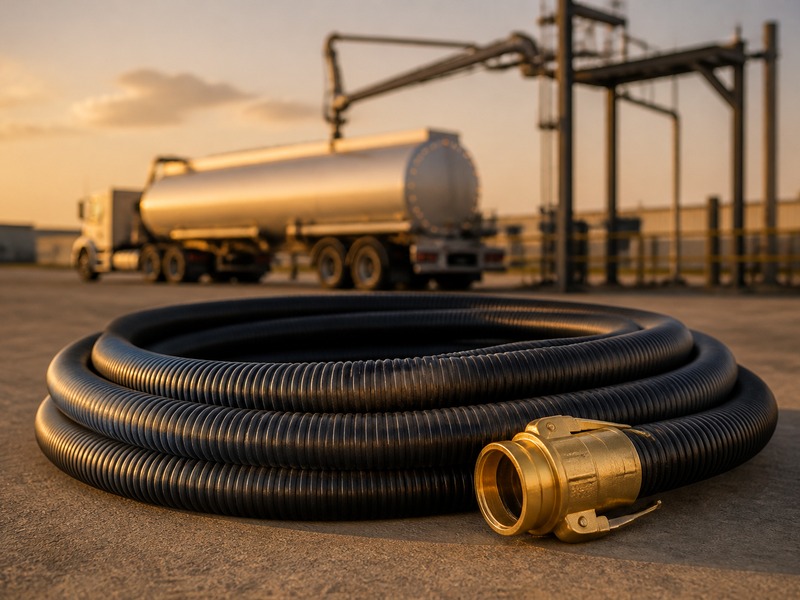
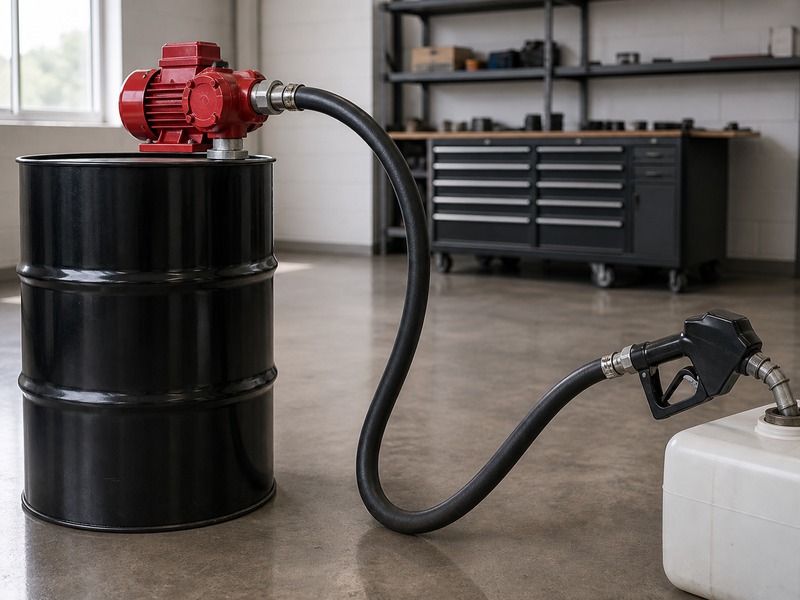
Oil suction hose is designed for lines that pull oil into a pump and push it out again. The wire helix in the wall prevents the hose from collapsing under vacuum, which is the failure mode a plain pressure hose cannot survive. Common ratings are 10 bar working (the frequently searched “oil suction hose 10 bar” class) and 20 bar for discharge-duty versions; bore sizes from 3/4 inch up to 4 inches are standard. You will find this type on workshop oil changers, waste-oil extractors, and tank-truck pump lines.
Oil Transfer Hose — for Moving Oil Between Points
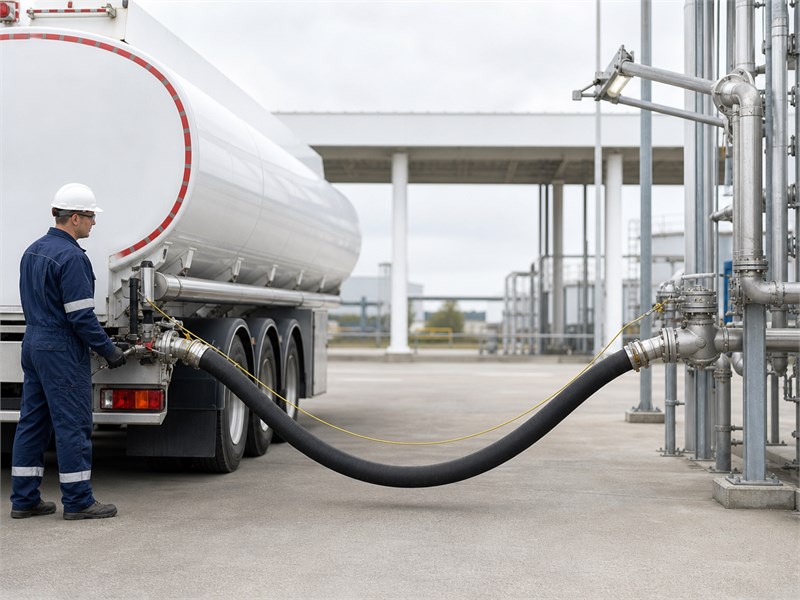
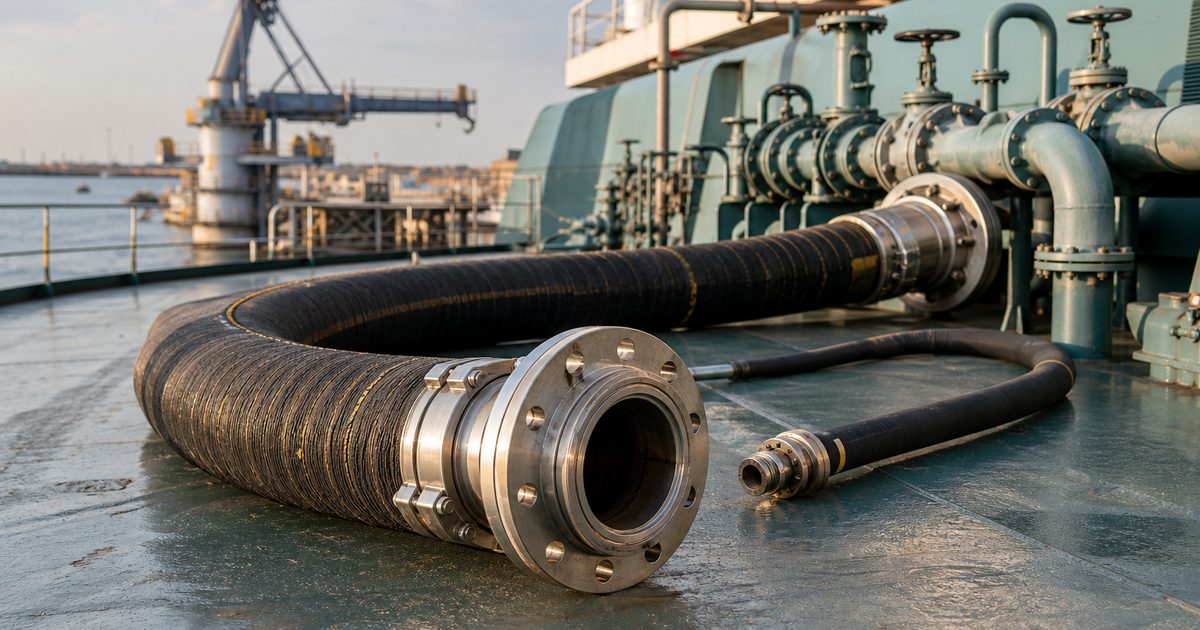
Oil transfer hose carries petroleum products between tanks, trucks, and machines — loading arms at depots, lubrication oil dispensing lines, and plant transfer circuits. It uses a smooth NBR tube for low flow resistance and fast draining, with fabric and helix reinforcement that keeps the hose flexible without kinking. Static-dissipative constructions are available for flammable-service duty, a safety feature worth requesting whenever the oil is a fuel or solvent.
Fuel Oil Hose — the Low-Permeation Specialists
Fuel oil hose handles diesel, kerosene, and heating oil. Its tube is compounded for low fuel permeation and, in conductive versions, built to dissipate static charge — properties a general-purpose hose does not guarantee. The practical rule in the fuel hose vs oil hose comparison is one-way: a fuel hose is oil-resistant, but a standard hose is not automatically fuel-rated. If the line carries fuel, specify a fuel hose.
Oil Return and Oil Cooler Hose — the Low-Pressure Workhorses
Oil return hose and oil cooler hose carry oil at low pressure — back to the tank, or to and from an engine or transmission cooler. Textile braid handles the 250–500 PSI range comfortably, and the tube compound must still be oil-resistant because the fluid is hot, circulated oil. Oil cooler hose often sees sustained temperatures of 100°C and above, so check the temperature rating before using a standard return hose in a cooler circuit.
Where Each Oil Hose Type Is Used: Applications by Industry
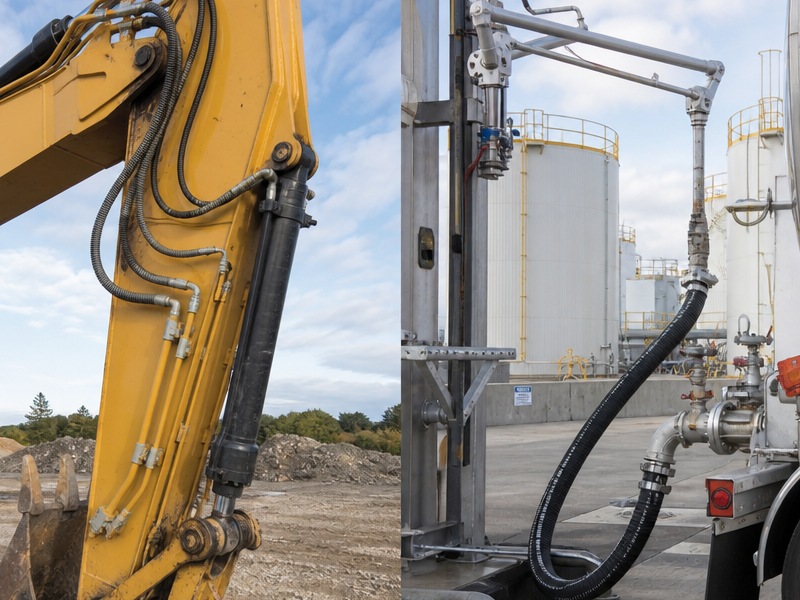
Figure 2. Hydraulic oil hose on mobile equipment, oil suction and transfer hose around storage and dispensing points.
- Mobile and industrial hydraulics — excavators, loaders, forklifts, and presses use hydraulic oil hose at 2,250–6,000 PSI for power transmission.
- Oil transfer and tank farms — loading and unloading, transfer pumps, and drum dispensing use transfer and suction-and-discharge hose.
- Lubrication systems — centralized lube lines and oil dispensing equipment use oil resistant hose at moderate pressure.
- Engine and transmission cooling — oil cooler hose carries hot oil to and from coolers in vehicles and stationary engines.
- Agriculture — tractor hydraulic lines and farm fuel and oil transfer circuits.
- Marine and offshore — bunker transfer, lube oil lines, and deck transfer duties with saltwater- and UV-resistant covers.
- Workshops and garages — oil changers, extractors, and waste-oil collection rely on vacuum-rated suction hose.
The application decides the pressure and duty cycle, and the pressure and duty cycle decide the hose family. A workshop oil changer runs at a few bar; an excavator boom runs at 4,000 PSI with shock loads. Specifying for the application — not for the “closest hose in the bin” — is the single biggest factor in service life.
How to Select the Right Oil Hose
Selection is a sequence of five decisions: fluid and temperature, pressure, size, fittings, and environment. Work through them in order and the correct family selects itself.
Step 1: Match the Fluid and the Temperature First
Start with what the hose will carry and how hot it will get. Mineral hydraulic oil, lube oil, and diesel all need NBR-based tubes; brake fluid and some synthetic oils need different compounds entirely. Confirm the fluid type on the machine plate or the material safety data sheet before selecting. Temperature is the second gate: a standard NBR hose operates from roughly -40°C to +100°C (-40°F to +212°F). Above 100°C — hot engine oil in a cooler circuit, for example — step up to a high-temperature compound such as FKM. In cold climates, verify low-temperature flexibility so the hose does not crack on the first cold start.
Step 2: Set the Working Pressure — Never the Burst Pressure
Every hose rated for oil service carries two numbers: working pressure and burst pressure. Burst is a destruction-test value; working pressure is the safe continuous operating limit, defined per SAE J517 as one-quarter of minimum burst (the 4:1 safety factor). Select so the hose’s working pressure equals or exceeds the maximum system pressure, plus a margin for pressure spikes — a common rule is 125% of the relief setting in shock-loaded circuits. For the full explanation of the two ratings and how they interact, see our oil hose working pressure vs burst pressure guide. Behind the rating is testing: certified oil hoses are impulse-tested for 500,000 cycles at 133% of working pressure before the design is approved, and every HENGHUA hose is proof-tested before shipment.
Step 3: Choose the Right Oil Hose Size (Use the Size Chart)
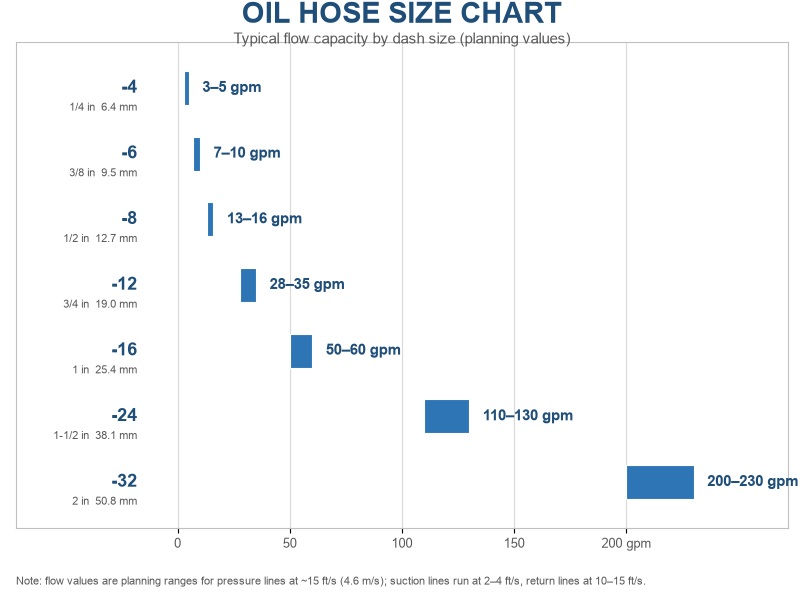
Oil hose size always refers to the inner diameter (ID), because ID determines flow capacity. Hydraulic sizes are expressed as dash numbers (each dash = 1/16 inch); transfer and suction sizes are usually quoted in plain inches. The oil hose size chart below gives typical flow capacity for pressure lines at a recommended velocity of 15 ft/s (4.6 m/s) — keep suction lines at 2–4 ft/s and return lines at 10–15 ft/s, and match the bore to the pump or pump flow rate.
| Taille des tirets | Inner diameter (in) | Inner diameter (mm) | Typical flow (US gpm) | Common use |
|---|---|---|---|---|
| -4 | 1/4 | 6.4 | 3–5 | Pilot lines, small lubrication lines |
| -6 | 3/8 | 9.5 | 7–10 | Engine oil lines, small hydraulic circuits |
| -8 | 1/2 | 12.7 | 13–16 | Main hydraulic pressure lines, oil cooler lines |
| -12 | 3/4 | 19.0 | 28–35 | Return lines, oil transfer pump lines |
| -16 | 1 | 25.4 | 50–60 | Large transfer and suction lines |
| -24 | 1-1/2 | 38.1 | 110–130 | Heavy oil transfer and discharge lines |
| -32 | 2 | 50.8 | 200–230 | Bulk transfer and tank-farm service |
A hose that is too small for the flow starves the circuit, raises pressure drop, and heats the oil; a hose that is far too large wastes money and makes routing harder. If the machine manual gives a flow rate in gpm or l/min, use it with the chart above; if you are replacing an existing line, measure the ID of the old hose with a caliper — size is stamped in the printed markings when available.
Step 4: Choose the Fittings and Ends
The hose is only as reliable as its connections. For hydraulic oil hose, the five connection families are JIC (37° flare), ORFS, NPT, BSP, and the SAE 4-bolt flange; thread type and size must match both ports, and mixing families (JIC with BSP, for instance) produces leaks that no torque setting fixes — see our NPT vs BSP thread guide for how to tell them apart. Fittings are crimped (permanently swaged, the standard for OEM and replacement work) or reusable (screwed on with a wrench). Transfer and suction hose more often uses camlock couplings, NPT or flange ends, or banded barbed fittings depending on the application. Order the hose and fittings as a tested assembly, not as separate parts guessed at the counter.
Step 5: Check the Environment and the Standard
Tell the supplier how the hose will be used, not just what it will carry. Abrasion against machine frames, UV exposure, ozone from motors and welders, and chemical splash all shorten cover life — a spiral abrasion sleeve or an abrasion-resistant cover costs less than an early replacement. Standards define the quality level: SAE J517 covers the hydraulic 100R series, DIN EN 853 and EN 856 are the European equivalents, and ISO 18752 harmonizes pressure classes worldwide. A certified hose carries printed markings, a date code, and evidence of impulse and burst testing; without certified testing, the marking is just paint.
Selection Checklist
- Fluid type and maximum/minimum temperatures
- Maximum system working pressure plus surge margin (125% rule)
- Required bore from the oil hose size chart, matched to pump flow
- Hose length per line with 5–10% routing allowance
- Fitting types and sizes at both ends (JIC, ORFS, NPT, BSP, flange, camlock)
- Environment: abrasion, UV, ozone, chemical splash
- Standard family (SAE J517, DIN EN 853, EN 856, ISO 18752)
- Quantity, target price, and delivery date
How to Install and Maintain an Oil Hose
Installation mistakes cause more premature failures than manufacturing defects, and the pattern repeats across every industry we supply. Four rules cover most of them. Route with bends at or above the hose’s minimum bend radius — a tighter bend kinks the reinforcement and the hose fails at that point, often months later and at pressure; if the routing forces a tight turn, use a 45° or 90° adapter fitting instead. Never let the hose twist while tightening an end: hold the body so torsion is not transferred into the hose, because twisting creates stress concentrations that surface later as spiral cracks. Support long horizontal runs with clamps every 1 to 1.5 meters, and wherever the hose can rub a frame or a sharp edge, add a spiral abrasion sleeve at installation rather than after the first leak.
For flammable products — fuel, solvents, hot lube oil — a static-dissipative hose only works if it is grounded: bond the end fittings to the tank and to the pump or receiving vessel so charge cannot build up across the line. A conductive hose with ungrounded ends is no safer than a standard one.
Storage matters almost as much as installation. Keep spare hose in its original packaging, coiled without kinks, indoors, away from direct sunlight, ozone sources such as electric motors and welders, and temperatures above 40°C. Rubber compounds age from the outside in, and a hose stored for ten years is past its useful life regardless of how it looks — check the date code printed on the cover before installation.
Oil Hose vs Fuel Hose: What Is the Difference?
The short answer to the fuel hose vs oil hose question: a fuel hose is an oil-resistant hose with two extra properties — low fuel permeation and, usually, static dissipation — while a standard hose is not guaranteed to have either. That is why the reverse substitution fails: running fuel through a general-purpose hose risks permeation smell, tube softening, and static accumulation in flammable service.
| Property | Oil hose | Fuel hose |
|---|---|---|
| Oil resistance | Yes (NBR or CR tube) | Yes |
| Low fuel permeation | Not guaranteed | Yes — compounded for it |
| Static dissipation | Standard versions no | Conductive versions available |
| Typical pressure | Up to 6,000 PSI (hydraulic) | 150–300 PSI |
| Typical standards | SAE J517, DIN EN 853/856 | SAE J30, ISO 7840 |
Can you use a fuel hose for oil? Usually yes, for low-pressure oil lines — the fuel hose’s tube resists oil. The reverse question — “can I use this hose for fuel?” — should be answered no unless the hose is explicitly marked fuel-rated. That one-way compatibility is the practical core of the fuel hose vs oil hose decision.
How Long Does an Oil Hose Last? When to Replace It
A common industry reference for rubber hose service life is five to ten years from the date code on the cover, with hot, oily, or UV-exposed service at the short end of that range. Heat dominates that aging: as a rule of thumb, every additional 10°C of sustained fluid temperature roughly doubles the aging rate of the tube compound, which is why cooler circuits with adequate flow outlast hot ones. Replace the hose when you see any of these signs:
- Cover cracks, blisters, or hard spots
- Exposed reinforcement (braid or helix visible through the cover)
- Soft or bulging sections along the body
- Leaks at fittings or along the hose wall
- Kinks that will not straighten, or permanent flattening
- Fittings that spin on the hose end
| Failure mode | What you see | Typical cause | Prevention |
|---|---|---|---|
| Cover cracking | Fine cracks, stiff cover | Ozone, UV, or heat aging | Shielded routing; store away from ozone |
| Blistering or soft spots | Bubbles, spongy sections | Incompatible fluid or sustained heat | Confirm the tube compound matches the fluid |
| Kinking or collapse | Permanent crease, flattened bore | Bend below minimum radius; vacuum on a non-helix hose | Respect bend radius; use suction hose for vacuum duty |
| Fitting leaks | Drips at the ends | Mixed thread families, over-torque, wrong crimp | Match threads, torque to spec, factory crimp |
In our own burst and impulse testing, two patterns repeat across every hose family we make: failures cluster within a few centimetres of the fittings, and hoses that fail young were almost always mis-installed rather than mis-manufactured — a kinked routing, a twisted body, or an over-torqued end. That is why we proof-test every assembly before shipment, and why we ask customers for a photo of the routing when a line fails early: the diagnosis is usually visible in the installation itself.
Replacement cost depends on type, size, and length — a 1/2-inch hydraulic line with two crimped fittings costs far less than a 3-inch suction hose for a tank truck. Keep a simple log of each line (position, size, family, install date, date code) so machines get re-hosed on schedule instead of on failure. When replacing, copy the printed markings from the old hose — they contain the entire specification.
How Much Does an Oil Hose Cost?
Hose price tracks construction. Rough market ranges per foot: 100R1 hydraulic hose $1.50–$3.00, 100R2 $2.00–$5.00, spiral-wound $5.00–$12.00; oil suction and transfer hose in 1-inch bore runs roughly $3.00–$8.00 per foot depending on helix and cover; fittings add $5–$40 per end. Factory-direct manufacturers typically undercut distributors by 20–40% on identical standard constructions because no middle layer exists. Compare the whole package when quoting: unit price, MOQ (minimum order quantity), lead time, crimping certification, and warranty terms. A clear warranty covering manufacturing defects is a signal that the manufacturer stands behind its testing; ask for samples and a test report before any bulk order.
Frequently Asked Questions
What is an oil-resistant hose made of?
An oil resistant hose is built around an oil-compatible inner tube — nitrile (NBR) for mineral oils, chloroprene (CR) for general oil service, and FKM (fluoroelastomer) for high temperatures or aggressive oils — reinforced with textile braid, steel wire braid, or wire helix, and covered with an abrasion- and weather-resistant rubber layer.
Is PVC hose oil resistant?
Standard PVC hose is not oil resistant — oils soften and swell it. Oil-resistant PVC and nylon constructions exist for light, low-pressure duty, but rubber (NBR-based) is the durable choice wherever pressure, heat, or continuous oil contact is involved.
What is the difference between oil suction hose and discharge hose?
Suction hose is built to hold vacuum without collapsing, using a wire helix in the wall; discharge hose is built for pressure on the outlet side. Many modern oil hoses are rated for both (for example, 10 bar suction-and-discharge), and the printed rating on the cover is the binding value.
What size oil hose do I need for a car?
Engine oil lines in passenger cars are typically 5/16 to 3/8 inch ID (dash -5 to -6); oil cooler lines are often 3/8 to 1/2 inch (dash -6 to -8). Verify against the vehicle manual or the original hose markings — automotive oil systems are low-pressure (usually under 100 PSI) but can run hot, so temperature rating matters more than pressure.
Can a hydraulic hose be used for oil transfer?
Yes, for pressure transfer, if the fluid is compatible and the pressure rating fits. But for suction duty or low-pressure bulk transfer, a purpose-built oil suction hose or oil transfer hose is cheaper, more flexible, and correctly rated for vacuum; a hydraulic hose has no vacuum rating.
How can I tell if a hose is oil resistant?
Check the printed markings on the cover (SAE 100R, EN 853, or “oil resistant” text), inspect the cut-end tube material with the supplier’s chemical compatibility table, or soak a short sample in the actual oil for 24 hours — a compatible tube shows no swelling, softening, or discoloration.
Final Verdict: Match the Oil Hose to the Duty, Not the Habit
Choosing the right hose comes down to five answers — fluid and temperature, working pressure, bore size, fittings, and environment — then one verification: a certified construction from a manufacturer who tests. Get those right and the hose becomes the least-likely-failure component in the system; get one wrong and it becomes the most likely. HENGHUA manufactures hydraulic oil hose, oil suction and discharge hose, transfer hose, and custom assemblies from 1/4 to 4 inch bore to SAE J517, DIN EN 853, EN 856, and ISO standards, with factory-crimped fittings and proof-tested lines. Send us your application details and our engineers will confirm the correct oil hose and quote within one working day — request a quote and samples.

 English
  Spanish
  Portuguese
  French
  German