
Hydraulic hose specifications are the set of published values a hose must meet — bore and its acceptance band, construction, working pressure, proof pressure, minimum burst pressure, temperature range, minimum bend radius, weight and fluid compatibility — and the three values that decide whether a line is safe are the maximum working pressure, the minimum burst pressure and the bore tolerance. Read those three together on a single row of a table and you know more about a hose than any headline claim attached to it will tell you.
This hydraulic hose specification guide covers the twelve fields on a published datasheet and shows how to read one complete row value by value. It explains why working, proof and burst pressure are three different numbers rather than one, compares what changes when the standard family changes at the same bore, and sets out how to verify a supplier’s row before an order is released. Two sections cover ground most datasheets leave out: the difference between a quotation and an enforceable order line, and the documents that prove a specification before it ships.
Jump to the section you need:
- What a hydraulic hose specification is
- The 12 fields on a specification sheet
- How to read one row of a specification table
- Why working, proof and burst pressure are three numbers
- What the temperature specification covers
- How to decode construction codes
- What changes when the standard family changes
- How to read a specification sheet from a PDF or catalogue
- How to verify a specification before you order
- Which standards and certifications this guide references
- The traps that cause wrong orders
What Is a Hydraulic Hose Specification?
A hydraulic hose specification is a written promise about measurable values. It states the standard family the hose is built and tested to, the bore and the acceptance band around it, the reinforcement and cover, the three pressure figures, the temperature window, the smallest bend the hose tolerates, its mass per metre and the fluids its tube is rated for. Every one of those values is checkable with a caliper, a pressure gauge, a tape and a thermometer — which is what separates a specification from a description.
The practical value of reading a specification properly is that it moves the argument out of the showroom and onto the bench. A claim such as “high pressure” gives you nothing to measure. A row that prints a 16 MPa working pressure, a 32 MPa proof pressure and a 64 MPa minimum burst pressure can be checked three separate ways.
The first field on every datasheet is the standard family, and that is where a hydraulic hose specification guide starts: ISO hydraulic hose standards and their SAE and EN counterparts each define the full row, so a family name tells you which rulebook the remaining eleven fields are written against.
What Is the Difference Between the Layline and the Specification?
The layline is what is printed on the hose; the specification is what is published about the family. The layline gives a compressed summary — standard family, dash size, pressure, and a date code — because there is only so much surface on a cover. The specification table gives the full row, including the columns nobody prints on a hose: proof pressure, weight per metre, bend radius and fluid compatibility. This guide works from the published table; separately, we walk through reading the marking on a hose itself in our guide to Comment lire la ligne de position d'un flexible hydraulique.
The Three Documents Behind One Hose Order
An order passes through three different documents, and most specification disputes come from treating them as one. The published datasheet describes the family the factory makes. The quotation describes the row the supplier offers, which may be a different family at the same bore. The order line is what the factory builds, and it is the only one of the three that is enforceable. When a hose arrives and does not fit, the failure is almost always a gap between the second and third documents — a family that was offered in a conversation and a family that was written down.

Figure 1. The twelve fields of a hydraulic hose specification, mapped onto the columns of a published datasheet row. The bore band and the three pressure columns are the values worth checking first.
The 12 Fields on a Hydraulic Hose Specification Sheet
Twelve fields carry everything a buyer needs, and each one answers a different question. The twelve-field table on this page is the hydraulic hose specifications chart we use when a customer sends a photograph of a datasheet and asks what matters. The right-hand column is the test to run, not a description to read.
The twelve fields of a hydraulic hose specification sheet, what each states and how a buyer checks it
| # | Specification field | What it states | How a buyer checks it |
|---|---|---|---|
| 1 | Standard family and type | The performance class the row is built and tested to, for example EN 853 1SN, SAE 100R1AT or SAE 100R12 | Confirm the family on the quotation matches the family printed on the layline of the delivered hose |
| 2 | Construction | Reinforcement style and count — single wire braid, double wire braid, four or six spiral, textile braid, thermoplastic | Count the reinforcement described in words; a code such as 2SC and the phrase “two steel wire braids” should agree |
| 3 | Dash size and inch size | The nominal bore label, also called the dash number and counted in sixteenths of an inch, for example -8 and 1/2 inch | Check the dash number and the inch fraction describe the same bore before anything else |
| 4 | Inside diameter and tolerance band | The acceptance window the finished bore must fall inside, in millimetres | Measure a sample at the cut end with a caliper and compare with the printed band, not with the dash size |
| 5 | Outside diameter | The external dimension that governs clearance, clamps, sleeves and grommets | Confirm the OD for the construction offered, because OD at one dash size changes with the reinforcement |
| 6 | Maximum working pressure | The highest continuous pressure the hose is rated for | Compare it with the highest sustained system pressure, not with the relief valve setting |
| 7 | Proof pressure | The pressure every length is held at during factory proof testing | Ask for the proof test record rather than an assurance that testing takes place |
| 8 | Minimum burst pressure | The safety ceiling the family must exceed in a burst test | Divide it by the working pressure and confirm the result still clears four times |
| 9 | Plage de températures | The fluid and ambient window for the tube compound and the cover | Compare the range with the fluid temperature at the hose, which is normally the hottest point in the circuit |
| 10 | Minimum bend radius | The tightest routing bend the hose tolerates, measured to the centreline | Measure the tightest bend on the routing drawing and add a margin rather than using the published figure as a target |
| 11 | Weight per metre | The mass of one metre of hose, used for support spacing, reels and freight | Multiply by route length to size clamps and to check the mounting interval |
| 12 | Fluid compatibility | The fluid families the tube compound is rated for and the temperature ceiling each one carries | Match the fluid actually in the system, including the temperature that fluid reaches |
Two things sit outside the twelve because they belong to verification rather than to the row: the marking and traceability block, and the dynamic test schedule the family must survive. Both are covered in the section on verifying a specification before an order is released.
How Do You Read One Row of a Specification Table?
Learning how to read hydraulic hose specifications is mainly a matter of reading one row in one direction — bore, then pressure, then temperature, then routing — because each value constrains the next. This section reads the complete published EN 853 1SN row at dash -8 — the single steel wire braid family — field by field, in the order that avoids rework.
The published EN 853 1SN row at dash -8 reads as follows: standard family EN 853 Type 1SN, technically equivalent to SAE 100R1AT and DIN 20022 1SN, with compliance to ISO 1436. Construction, single steel wire braid. Dash size -8, inch size 1/2 inch. Inside diameter 12.3 mm to 13.5 mm. Maximum working pressure 16 MPa, printed as 2,320 psi. Proof pressure 32 MPa, printed as 4,640 psi. Minimum burst pressure 64 MPa, printed as 9,280 psi. Minimum bend radius 180 mm. Weight 0.45 kg/m. Temperature range -40 °C to +100 °C, printed as -40 °F to +212 °F.
Read in six steps it resolves quickly. First, confirm the family and construction agree, because 1SN and 2SN share a bore table but not a pressure table. Second, take the bore band as the real size and treat 12.7 mm as a nominal label rather than a dimension, which is the distinction a hydraulic hose size chart is built to carry. Third, take the working pressure as the operating limit. Fourth, confirm the burst figure is at least four times the working figure, which it is here: 64 divided by 16 is exactly 4. Fifth, check the temperature window against the fluid, not the workshop. Sixth, check the bend radius and the weight against the routing before the length is cut.
What Does the Inside Diameter Tolerance Band Actually Mean?
The printed band is the acceptance window, and it is not centred on the nominal bore. For EN 853 1SN at dash -8 the window is 12.3 mm to 13.5 mm, which sits 0.4 mm below and 0.8 mm above the 12.7 mm nominal figure. A hose measuring 12.4 mm and a hose measuring 13.4 mm are therefore both in specification while their bores differ by a full millimetre.
That millimetre is not cosmetic. Flow capacity scales with the square of the bore, so at a fixed fluid velocity of 20 ft/s the difference between a 12.4 mm and a 13.4 mm bore is about 16.8 percent more flow capacity — the area ratio is 1.1678. This is why hydraulic hose ID tolerance belongs in the specification conversation with the supplier rather than in a footnote: two compliant deliveries can shift a circuit’s flow by roughly one sixth at the same velocity. It also explains why a hose that measured at the low edge of the band in one order can behave differently in the next.
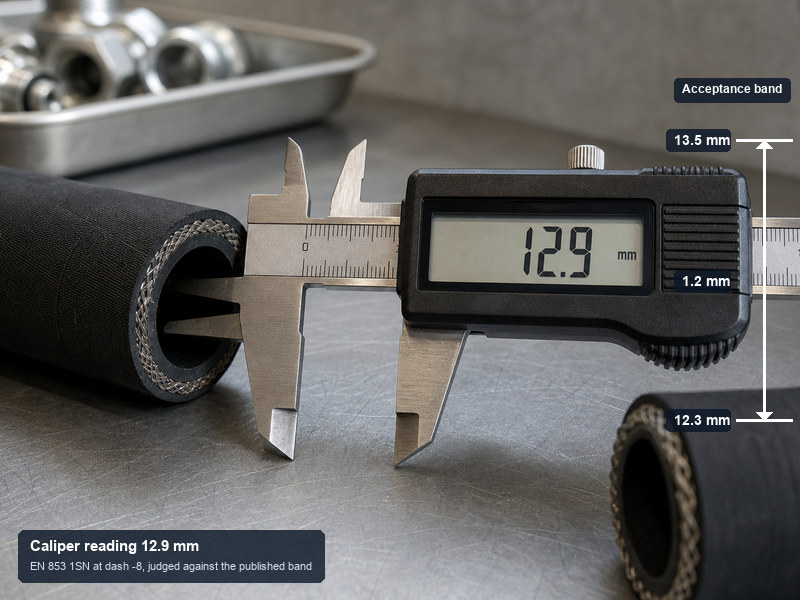
Figure 2. Measuring the bore at the cut end against the published 12.3 mm to 13.5 mm band for EN 853 1SN at dash -8. Two hoses inside this band can differ by a full millimetre of bore.
Two deliveries of the same dash size measured 12.4 mm and 13.4 mm — is either one out of specification? Neither is out of specification. Both readings sit inside the 12.3 mm to 13.5 mm band for EN 853 1SN at dash -8, so the bore is judged against the band rather than against the nominal figure, and that judgement is the one to record against the delivery.
Why Are Working, Proof and Burst Pressure Three Different Numbers?
Working, proof and burst pressure measure three different things: the working figure is the continuous operating limit, the hydraulic hose proof pressure figure is the pressure the factory holds every length at to test it, and the burst figure is the minimum the family must exceed before it is allowed to carry the working rating. A specification that gives only one pressure figure has removed two thirds of the information a buyer needs.
The EN 853 1SN pressure table is the complete published pressure specification for that family, the single wire braid hose, from dash -3 to dash -32. Read it as a pressure chart rather than a pump curve: pressure falls as the bore rises, from 25 MPa at dash -3 down to 4 MPa at dash -32.
Published EN 853 1SN hydraulic hose specifications chart: inside diameter, working pressure, hydraulic hose proof pressure and minimum burst pressure, bend radius and weight by dash size
| Dash | Inch | Diamètre (mm) | Working (MPa) | Working (psi) | Proof (MPa) | Proof (psi) | Minimum burst (MPa) | Minimum burst (psi) | Min bend radius (mm) | Weight (kg/m) |
|---|---|---|---|---|---|---|---|---|---|---|
| -3 | 3/16 | 4.6 to 5.4 | 25 | 3,625 | 50 | 7,250 | 100 | 14,500 | 90 | 0.20 |
| -4 | 1/4 | 6.2 to 7.0 | 22.5 | 3,260 | 45 | 6,525 | 90 | 13,050 | 100 | 0.25 |
| -5 | 5/16 | 7.7 to 8.5 | 21.5 | 3,120 | 43 | 6,235 | 85 | 12,325 | 115 | 0.31 |
| -6 | 3/8 | 9.3 to 10.1 | 18 | 2,610 | 36 | 5,220 | 72 | 10,440 | 130 | 0.36 |
| -8 | 1/2 | 12.3 to 13.5 | 16 | 2,320 | 32 | 4,640 | 64 | 9,280 | 180 | 0.45 |
| -10 | 5/8 | 15.5 to 16.7 | 13 | 1,885 | 26 | 3,770 | 52 | 7,540 | 200 | 0.52 |
| -12 | 3/4 | 18.6 to 19.8 | 10.5 | 1,520 | 21 | 3,045 | 42 | 6,090 | 240 | 0.65 |
| -16 | 1 | 25.0 to 26.4 | 8.8 | 1,280 | 17.5 | 2,540 | 35 | 5,075 | 300 | 0.91 |
| -20 | 1-1/4 | 31.4 to 33.0 | 6.3 | 910 | 15 | 2,175 | 25 | 3,625 | 420 | 1.30 |
| -24 | 1-1/2 | 37.7 to 39.3 | 5 | 725 | 10 | 1,450 | 20 | 2,900 | 500 | 1.70 |
| -32 | 2 | 50.4 to 52.0 | 4 | 580 | 8 | 1,160 | 16 | 2,320 | 630 | 2.00 |
One quirk of published tables is worth knowing before you use the psi columns. In the EN 853 1SN pressure table, the psi value is the MPa value multiplied by 145 and then rounded, so the printed psi number sits within about 4 psi of that product. Because one megapascal is 145.038 psi, the printed figure can land up to roughly 0.4 percent below the exact conversion — 6.3 MPa is printed as 910 psi against an exact 913.7 psi. Where the two columns disagree with a calculator, the MPa column is the controlling value and the psi column is the conversion shown for convenience. For a purchase order, enter the MPa figure as the rating and record the psi figure as the secondary unit.
Published-value exceptions. Two rows in the EN 853 1SN pressure table carry a published proof figure that is not exactly twice the working figure: dash -16 prints 17.5 MPa against a computed 17.6 MPa, and dash -20 prints 15 MPa against a computed 12.6 MPa. Both values are carried through from the published table unchanged. Check one remains the gate that must hold, and check two is a plausibility test that can sit slightly off two wherever a table rounds its pressure values to whole or half megapascals.
Can You Run Three Arithmetic Checks on a Datasheet?
Three division sums catch almost every problem in a quoted row, and all three take less time than reading the covering email. Check one: divide minimum burst pressure by maximum working pressure and confirm the result still clears four, which is the safety factor our EN 853, EN 857, SAE 100R12 and SAE 100R13 families are published to. Check two: divide proof pressure by working pressure and expect a figure near two, because proof testing is normally run at twice the working rating. Check three: divide proof pressure by minimum burst pressure and expect a figure near one half, which is the interval a proof test occupies between normal operation and failure.
On the eleven published EN 853 1SN rows — the single wire braid family — the minimum burst figure is at least 3.95 times the working figure on every row, and exactly four times it on eight of them. On the remaining three rows check one clears the four-to-one design factor at 3.95 to 3.98, because the published values are rounded to whole or half megapascals. The proof figure is exactly twice the working figure on nine of the eleven rows, with the two exceptions listed under the pressure table. Treat the published proof column as the controlling figure, treat check one as the mandatory gate, and use check two as the plausibility test in the pressure table.
Across our four published families — EN 853 1SN, EN 857 2SC, SAE 100R12 and SAE 100R13 — the same design factor and the same arithmetic hold, and the full row set for each family is available on request.
For the deeper treatment of the pressure relationship — the four-to-one design factor, impulse pressure and how a rating degrades with temperature and service life — see our explainer on working pressure versus burst pressure.

Figure 3. The three pressure columns of a specification row and the ratios that connect them: proof is typically twice the working figure, and minimum burst at least four times it.
How Do You Read a Working, Proof and Burst Pressure Chart?
A pressure chart is read across one row rather than down one column: for a single dash size, the three MPa values on the same line are the working, hydraulic hose proof pressure and minimum burst figures, and the psi columns beside them are those same three values converted at 145 psi per megapascal.
Three passes cover the whole chart. First, find the dash size you need in the first column. Second, read the three pressure columns left to right and confirm both relationships — the proof column near twice the working figure, and the minimum burst column near four times it. Third, read the bend radius and weight columns from that same row, because routing and support spacing follow the bore rather than the pressure class.
What a chart cannot tell you is which row applies to your duty. A chart prints every row a family offers; it does not print which one your machine needs. That comes from the highest sustained pressure in the circuit, the fluid temperature at the hose and the routing envelope — the three inputs that this hydraulic hose specification guide turns into a nine-line order specification.
What Exactly Does the Temperature Specification Cover?
A temperature specification covers the tube compound, and the headline range normally describes that compound running on mineral oil. The same hose carrying a water-based fluid has a lower ceiling, which means the temperature line on a datasheet is a starting point rather than a universal limit.
The published ranges across four families we manufacture show the split clearly. EN 853 1SN and EN 857 2SC are both rated -40 °C to +100 °C, which is printed as -40 °F to +212 °F on the 1SN datasheet. SAE 100R12 and SAE 100R13 are both rated -40 °C to +121 °C. Moving from a single wire braid to a six spiral construction therefore buys 21 °C on the hot end of the window, and that extra margin comes from the tube compound and the reinforcement rather than from the cover.
Published temperature ranges by hydraulic hose family, with the fluid-family ceilings that override the headline range
| Family | Published temperature range | Fluid and published ceiling |
|---|---|---|
| EN 853 1SN | -40 °C to +100 °C (-40 °F to +212 °F) | Petroleum and water-based hydraulic fluids as defined by ISO 6743-4; mineral oils rated excellent |
| EN 857 2SC | -40 °C to +100 °C | Petroleum-based hydraulic fluids |
| SAE 100R12 | -40 °C to +121 °C | Mineral hydraulic oils (ISO 11158 HM and HV) rated excellent at 121 °C; polyalphaolefins excellent at 121 °C; synthetic esters good at 100 °C; water-glycol HFC good at 80 °C; water-oil emulsions HFA and HFB good at 70 °C |
| SAE 100R13 | -40 °C to +121 °C | Petroleum-based hydraulic oils, mineral oils and selected industrial fluids |
Why Does One Temperature Range Not Cover Every Fluid?
The 121 °C headline on the SAE 100R12 row is a mineral oil figure. Put a water-glycol HFC fluid in the same hose and the published ceiling drops to 80 °C; put a water-oil emulsion in it and the ceiling falls to 70 °C. That is a 51 °C cut inside the same hose, produced entirely by the fluid rather than by the hose. Prerequisite for water-based duty: specify a hose whose published ceiling sits at or above the fluid’s operating temperature — 80 °C for water-glycol HFC and 70 °C for water-oil emulsions HFA and HFB — measured at the hose rather than at the reservoir.
The practical consequence is that a specification review done on fluid identity alone is incomplete. Two questions belong together: which fluid is in the circuit, and what temperature does that fluid reach at the hose. Fluid temperature at the hose is normally the hottest point in the system, because the hose sits next to the heat source the fluid is cooling. Measuring it at the reservoir instead is the most common way a compliant hose gets blamed for a thermal failure. Our published compatibility table lists mineral oils, hardware lubricants and polyalphaolefins as excellent at the top of the range, with water-based fluids and synthetic esters stepping down, and we publish the full fluid compatibility chart by tube compound separately. For selection work in hot or cold duty, the hydraulic hose temperature rating guide covers derating in detail.
My machine runs a water-glycol fluid rather than mineral oil — does the temperature rating change? Yes. The -40 °C to +121 °C headline on the SAE 100R12 row is a mineral oil figure; the same hose publishes 80 °C with water-glycol HFC and 70 °C with a water-oil emulsion HFA or HFB. The fluid identity sets the ceiling the hose is actually rated to, so the fluid line on the order decides the temperature line.
How Do You Decode the Construction Codes in a Specification?
Construction codes are counts, not grades: the number in a family code tells you how many steel reinforcement layers the hose carries, and the letter tells you the style. A 1SN hose has one steel wire braid, a 2SN hose has two, a 2SC hose has two in a compact construction, and the 100R12 and 100R13 families carry four and six spiral layers respectively. Read the count first and the pressure column second, because the count explains the pressure. The column that maps those counts onto ISO hydraulic hose standards and their SAE equivalents is the one worth comparing line by line.
Published construction, equivalent standards and compliance for four hydraulic hose families
| Family | Renfort | Published equivalents and compliance | Cover as published |
|---|---|---|---|
| EN 853 1SN | One steel wire braid | EN 853 Type 1SN, SAE 100R1AT, DIN 20022 1SN; compliance with ISO 1436, ISO 9001:2015, RoHS and REACH | Weather-resistant synthetic rubber with a cloth impression finish |
| EN 857 2SC | Two steel wire braids, compact | EN 857 2SC, technically equivalent to ISO 11237 2SC and SAE 100R16; ISO 9001 certified quality management system | Abrasion, corrosion, weather, ozone, aging, sunlight and cut-resistant synthetic rubber |
| SAE 100R12 | Four spiral steel wire layers | SAE J517, SAE 100R12, ISO 3862 Type R12, EN 856, GB/T 10544; ISO 9001:2015 facility, CE compliant, DNV type approval on request, MSHA compliance for underground mining | High quality synthetic rubber cover |
| SAE 100R13 | Six spiral steel wire layers | SAE J517 and SAE 100R13 in full compliance; ISO 3862, EN 856 and GB/T 10544 as equivalent standards | Black synthetic rubber |
Treat the word “equivalent” carefully in a hydraulic hose specification. An equivalent standard — for example SAE 100R1AT quoted against EN 853 1SN — describes the same duty and the same test regime; it does not oblige two suppliers to publish the same numbers for the same bore. ISO hydraulic hose standards state their requirements in their own clauses and units, and a family that meets one standard has met that standard rather than every standard it resembles. Our own published rows make this concrete: EN 853 1SN and SAE 100R1AT are described as technically equivalent, and their published working pressures for the same dash size are not identical, because the two standards set their own minimum values. When a quotation says a hose is “equivalent to” the family you specified, ask for the row it is equivalent at rather than accepting the word.
Where a supplier appends a suffix to a family code, trace that suffix to the standard clause it refers to before assuming it raises the pressure class. Our published datasheets describe the cover in words — a weather-resistant synthetic rubber with a cloth impression finish on the 1SN family, an abrasion and ozone-resistant synthetic rubber on the 2SC family — rather than relying on a suffix, and that description is the part a buyer can actually inspect on a delivered hose.
Construction Count Explains More Than Family Name
Two families can share a bore table and differ entirely in pressure, and the reinforcement count explains why. Moving from a single braid to a double braid roughly doubles the steel carrying the load; moving from braid to spiral changes how those layers are laid, which is why the spiral families hold their rating at large bores where braided families have to step down. That sequence is how the SAE hydraulic hose standards order their 100R families, and it is why the family code predicts pressure better than the bore does. At the same dash -12 bore, the single braid EN 853 1SN family publishes 10.5 MPa working pressure while the six spiral SAE 100R13 family publishes 35 MPa — bought with reinforcement and paid for in weight.
For the wider view of how the reinforcement families relate across SAE hydraulic hose standards and their EN equivalents, our SAE 100 series hose specifications guide maps the 100R1 to 100R19 families, and the SAE, ISO and DIN hydraulic hose standards comparison covers the standard systems themselves.
Does the Specification Change When the Standard Family Changes?
Yes, and at the same bore the change is large. Holding the bore constant at dash -12, which is 3/4 inch and 18.6 mm to 19.8 mm across all four families, the published working pressure rises from 1,520 psi to 5,075 psi and the published weight rises from 0.65 kg/m to 2.10 kg/m. Nothing about the bore changed; everything about the specification did.
Published hydraulic hose specifications at the same bore (dash -12, 3/4 inch, ID 18.6 to 19.8 mm) across four standard families
| Family | Renfort | Working (MPa) | Working (psi) | Proof (MPa) | Minimum burst (MPa) | Min bend radius (mm) | Weight (kg/m) |
|---|---|---|---|---|---|---|---|
| EN 853 1SN | One steel wire braid | 10.5 | 1,520 | 21 | 42 | 240 | 0.65 |
| EN 857 2SC | Two steel wire braids, compact | 21.5 | 3,120 | 43 | 86 | 200 | 0.80 |
| SAE 100R12 | Four spiral steel wire layers | 28 | 4,060 | 56 | 112 | 240 | 1.43 |
| SAE 100R13 | Six spiral steel wire layers | 35 | 5,075 | 70 | 140 | 240 | 2.10 |
Read the dash -12 comparison as a set of trade-offs rather than a ladder. The SAE hydraulic hose standards and their EN counterparts each set their own minimum values at the same bore, so a substitution only holds when the two rows are compared directly. The six spiral SAE 100R13 family carries 3.33 times the working pressure of the single braid EN 853 1SN family at the same bore, and it weighs 3.23 times as much, so the pressure and the mass move together almost exactly. The compact double braid family is the outlier worth noticing: it carries 3,120 psi, more than double the single braid rating, while publishing a tighter minimum bend radius than either the single braid or the spiral families at 200 mm against 240 mm. Compact construction buys pressure and routing flexibility in the same move, which is why it is the family we reach for when a machine needs a pressure upgrade inside an existing routing envelope.
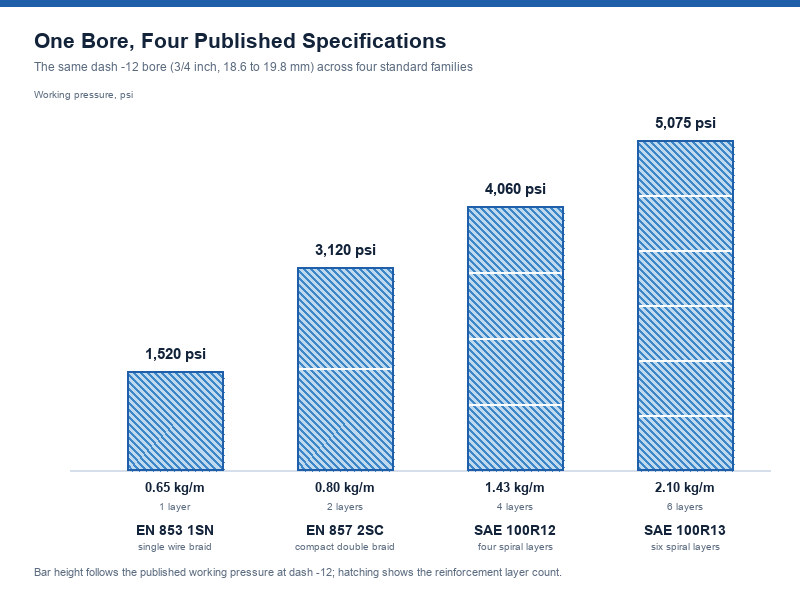
Figure 4. One bore, four published specifications: dash -12 working pressure and weight per metre across the single braid, compact double braid, four spiral and six spiral families.
Which Specification Should You Change First?
Change the construction family before you change the dash size. Increasing the dash size raises the flow capacity but also the bore, the outside diameter, the bend radius and the weight, which usually means new routing, larger clamps and a different fitting set. Changing the construction family and changing the dash size both have to be checked against the published minimum bend radius calculation for the family under consideration, because the bend figure follows the construction rather than the bore. Changing the family from a single braid to a compact double braid holds the bore, the fittings and the flow capacity while raising the pressure rating, and it can even reduce the published bend radius.
The decision rule we use on the crimping floor is that a pressure shortfall at a fixed bore is a construction question, while a flow or velocity shortfall at a fixed pressure is a bore question. Keep the two apart and a rework becomes a substitution. Our engineering team keeps compact and spiral families in the same dash sizes specifically so that a pressure upgrade does not force a routing change.
My machine is losing cycle speed rather than pressure — which specification line do I check first? The bore, not the pressure class. Cycle speed follows flow capacity, which scales with the square of the bore, so a hose sitting at the low edge of the published band at dash -8 moves about 16.8 percent less fluid than one at the high edge at the same velocity. Measure the bore against the 12.3 mm to 13.5 mm band before you change the family.
Which Specification Matters Most if You Are…?
The field to read first depends on the job you are doing rather than on the family you are buying. The table on this page maps four buyer situations onto the field that decides the answer.
Which specification field to read first, by the buyer’s situation
| If you are… | Read this field first | The check that catches the expensive mistake |
|---|---|---|
| An OEM design engineer specifying a new line | Standard family, then minimum burst pressure and minimum bend radius | Confirm the minimum burst figure still clears the four-to-one design factor at the working pressure you have chosen, and that the routing bend sits inside the published radius rather than on it |
| An MRO or maintenance buyer replacing a failed hose | Inside diameter tolerance band, then family consistency and the date code | Measure the bore against the printed band rather than against the dash label, so hydraulic hose ID tolerance is judged on the same window as the last delivery |
| A distributor or reseller quoting a substitution | Published equivalence, then the proof test record | Compare the two rows at the same bore rather than the two family names, and ask for the proof test record rather than a statement that proof testing takes place |
| A single-machine workshop or farm operator | Maximum working pressure with its unit, then temperature and fluid | Read the working pressure against the highest sustained pressure in the circuit, and the temperature against the fluid at the hose rather than the ambient temperature in the yard |
The four situations share one habit that this hydraulic hose specification guide returns to throughout: read the field that disqualifies the hose before you read the field that describes it. Pressure and temperature disqualify a hose; construction and weight only cost.
How Do You Write a Purchase Specification for a Hydraulic Hose?
You write it as nine lines in the same order as the datasheet: family, size, construction, pressure, temperature and fluid, ends, length, bend radius, then marking and test records. A specification written in that order can be checked line by line on delivery, which is the only property that matters. Free-text orders that describe a hose in a sentence are the ones that end in substitutions.
What Are the Nine Lines a Supplier Needs?
- Standard family and type, for example EN 853 1SN, equivalent SAE 100R1AT.
- Dash size, inch size and bore band, for example -8, 1/2 inch, ID 12.3 mm to 13.5 mm.
- Construction and compounds, for example one steel wire braid, oil-resistant synthetic rubber tube, weather-resistant synthetic rubber cover.
- Required working pressure, stated as a minimum, for example 16 MPa minimum continuous.
- Temperature range and fluid identity, for example mineral oil per ISO 6743-4, -40 °C to +100 °C.
- End fittings with thread and seat, for example JIC 37 degree male 3/4-16, skive or no-skive (skive removes the cover at the crimp to expose the wire, no-skive does not).
- Assembly length and its measurement basis, for example 1,850 mm centreline to centreline.
- Routing envelope, for example minimum bend radius 180 mm inside the existing sleeve.
- Marking, proof test record and traceability, for example layline with date code plus proof test certificate.
What Does a Complete Order Line Look Like?
Written out in full, the nine lines read as one paragraph that a factory can build against without asking a question: EN 853 1SN single steel wire braid hydraulic hose, dash -8 (1/2 inch), ID 12.3 mm to 13.5 mm, oil-resistant synthetic rubber tube, weather-resistant synthetic rubber cover, working pressure 16 MPa / 2,320 psi minimum, temperature -40 °C to +100 °C, mineral oil per ISO 6743-4, JIC 37 degree male 3/4-16 both ends, no-skive, assembly length 1,850 mm centreline to centreline, minimum bend radius 180 mm, proof test record and date code required, quantity 60.
Two habits make that paragraph work. First, every pressure is stated with its unit and the word minimum, so nobody can substitute a lower rating. Second, the bore is given as a band in millimetres rather than as a dash number alone, so the deliverable can be measured against the same window the datasheet prints.
Expect the supplier to return their own catalogue part number, and expect it to differ from ours. A part number is the supplier’s internal key to a catalogue entry; the specification paragraph is the shared language. When a supplier changes a hose to an equivalent part, the specification paragraph is what makes the change visible — either the new row still clears every line or it does not.
How Do You Read a Specification Sheet From a PDF or a Catalogue Page?
I am reading a PDF datasheet rather than a web page — does anything change? The columns change; the rules do not. A PDF datasheet or catalogue page usually prints fewer columns than a full table: the family, the dash size and one pressure figure are common, while proof pressure, weight per metre and minimum bend radius are often left out. Treat every missing column as an item to request rather than as an item the hose does not have.
Three rules carry across from a printed chart to a PDF unchanged. First, the MPa value is the controlling figure and the psi value beside it is that figure converted at 145 psi per megapascal, so a psi-only catalogue entry should be converted back before it reaches a specification. Second, the three arithmetic checks run on a PDF row exactly as they run on a web row: divide minimum burst by working pressure, divide proof by working, and divide proof by minimum burst. The SAE hydraulic hose standards and the ISO hydraulic hose standards publish their rows in the same three-column form, so a catalogue entry is checked the same way as a datasheet page. Third, where a catalogue page prints a single pressure figure with no column label, treat the row as incomplete — a rating without a unit and a column heading cannot be checked against anything, and it belongs back with the supplier for clarification before it reaches an order line.
A catalogue part number is the supplier’s internal key to a catalogue entry, and it will differ between suppliers for the same hose. The nine-line specification this guide sets out is the language that travels between them, and the hydraulic hose testing standards behind the row do not change because the document happens to be a PDF.
How Do You Verify a Specification Before You Release an Order?
How do I check a row I was sent in a quotation email? Verifying hydraulic hose specifications takes three steps in this order: the numbers add up, the documents exist, and a sample measures what the documents claim. Skipping the third step is the most common reason a specification review passes on paper and fails on the machine. The hydraulic hose testing standards named on a certificate tell you which of the three steps the supplier has already performed.
The hydraulic hose testing standards behind each claim in a quotation, and the document that verifies it
| Claim in the quotation | Document that verifies it | What to check inside the document |
|---|---|---|
| Standard family and type | Certificate of conformance naming the standard and type | The family and type match the order line word for word |
| Working and minimum burst pressure | Published datasheet row | The MPa column, and a minimum burst figure at least four times the working figure |
| Hydraulic hose proof pressure achieved | Proof test record for the batch | The test pressure applied, the hold duration, the date and the batch identification |
| Dynamic performance | Impulse test report to EN ISO 6803 | 133 percent of working pressure at 100 °C, mineral oil per ISO 6743-4, at least 200,000 cycles |
| Bore and tolerance | Dimensional inspection record | A measured band in millimetres against the published window |
| Fluid duty | Published compatibility table | The fluid family in the machine and its published ceiling temperature |
| Traceability | Layline with date code plus the batch record it maps to | Whether the date code on the hose resolves to the test batch on the certificate |
What Must a Test Record Contain?
A test record that is not matched to a hose is not traceability. The record our factory issues identifies the assembly or batch, the hose family and dash size, the fitting type and thread, the proof pressure applied and the time it was held, the date and testing station, and the pass result. Those seven items are the minimum that lets a buyer connect a certificate to a physical hose through its date code.
The reason the impulse item matters is that sustained pressure and dynamic pressure are different duties. A hose can hold a proof pressure comfortably and still fail early in an impulse cycle, which is why the impulse specification exists as a separate line: 133 percent of working pressure at 100 °C, cycled at 0.5 to 1.25 Hz for at least 200,000 cycles. For the -8 row we have been reading, 133 percent of a 16 MPa working pressure is 21.28 MPa, or about 3,086 psi, applied a fifth of a million times. Our impulse life testing article covers what that cycle count means in service.
The last step is physical, and it takes about ten minutes on one length from the delivery. Cut a short offcut so the bore is exposed, measure it with a caliper against the printed band, read the layline with a light, check the fitting thread against a gauge, and hold the assembly at proof pressure. Where a pressurised line is involved, hold a piece of cardboard or a mirror in front of the joint instead of your hand, and keep hands and eyes away from the stream; a pinhole in a hydraulic line cuts rather than sprays, so a leak is found with a shield rather than with a fingertip. A bare hand is never the instrument for finding a pressurised leak, on this assembly or any other.
Which Standards and Certifications Does This Guide Reference?
Every standard and certification named in this guide — including the hydraulic hose testing standards behind the proof and impulse records — appears in the table on this page with the claim it supports and the way a buyer can verify it.
Standards and certifications referenced in this guide, the claim each one supports, and how a buyer verifies it
| Standard or certification | What it supports on this page | How a buyer verifies it |
|---|---|---|
| EN 853 Type 1SN and Type 2SN | The bore table and pressure classes used for the single and double wire braid families | The family and type named on the certificate of conformance and on the layline of the delivered hose |
| EN 857 2SC | The compact double braid family and its tighter published bend radius at the same bore | The family name on the quotation row, checked against the layline |
| SAE J517 with SAE 100R12 and SAE 100R13 | The four spiral and six spiral families, their pressure classes and the published 100 percent pressure testing note | The family on the certificate of conformance together with the published proof test record |
| SAE 100R1AT and SAE 100R16 | The published equivalence statements for the 1SN and 2SC families | Comparing the two published rows at the same bore rather than the two family names |
| ISO 1436, ISO 11237 and ISO 3862 | The international standard each of the four reference families is measured against | The compliance line on the datasheet and the certificate of conformance |
| EN 856 and GB/T 10544 | The spiral family equivalents published alongside SAE 100R12 and SAE 100R13 | The equivalent-standards column for the family being quoted |
| DIN 20022 1SN | The European equivalent published for the single wire braid family | The equivalent-standards column on the 1SN datasheet |
| EN ISO 6803 | The impulse regime: 133 percent of working pressure at 100 °C, 0.5 to 1.25 Hz, at least 200,000 cycles | The impulse test report for the family, and the cycle count recorded inside it |
| ISO 6743-4 | The fluid classification the published temperature and compatibility rows are written against | The fluid identity on the order line, matched to the published compatibility table |
| ISO 11158 HM and HV | The mineral hydraulic oil classes published as excellent at the top of the 100R12 temperature range | The fluid specification sheet for the oil that is in the machine |
| ISO 9001:2015 | The quality management system certification of the manufacturing facility | The certificate itself, including its scope, issue date and expiry date |
| RoHS and REACH | The material compliance published for the 1SN family | The declaration of conformity issued for the batch |
| CE | The compliance published for the spiral families | The declaration of conformity and the technical file it references |
| DNV type approval | Available on request for the spiral families | The type approval certificate, requested before the order is placed rather than after delivery |
| MSHA | Compliance published for underground mining applications | The approval number and the certificate that carries it |
The table is a reading aid for the row you are checking, not a substitute for the standard itself or for the document the supplier issues.
Two entries in the standards table are request-based rather than standing. DNV type approval and the MSHA approval are issued for a defined scope and product range, so ask for the certificate before the order is placed. Where a certificate cannot be produced for the family you are buying, the correct conclusion is that the claim does not apply to your order, which is a finding rather than a formality.
What Specification Traps Cause Wrong Orders?
Seven traps account for most specification errors we see on returned orders, and each one is avoidable with a single extra check before the order is placed.
- Treating the dash number as a measurement. The dash number is a nominal label, not a dimension. At dash -8 the label reads 12.7 mm while the acceptance band runs from 12.3 mm to 13.5 mm, so a delivered hose can sit a millimetre away from the label and still be compliant, and hydraulic hose ID tolerance can only be judged against the band.
- Using DN as a synonym for dash size. DN 10 describes a 10 mm nominal bore, while dash -10 describes a 15.875 mm nominal bore, nearly 6 mm larger. At dash -20 the two systems almost meet by accident, because 31.75 mm rounds into the DN 31 band of 31.5 mm to 31.8 mm.
- Treating outside diameter as fixed by dash size. Confirm it against the construction instead, because outside diameter at one dash size changes with the reinforcement. At dash -8 the published outside diameter runs from about 20.0 mm to 21.4 mm on a single braid hose, 22.5 mm to 23.0 mm on a two-wire braid hose, and 23.8 mm to 25.4 mm on a four spiral hose — roughly 5 mm of spread at one bore.
- Quoting the rounded psi figure. Printed psi values run up to about 0.4 percent below the exact conversion, so an order written only in psi can name a rating slightly below the row it intends to buy. Put the MPa figure in the order and keep psi as the secondary unit.
- Reading the headline temperature range as universal. The 121 °C headline on the four spiral family is a mineral oil figure; the same hose publishes 80 °C with a water-glycol fluid and 70 °C with a water-oil emulsion.
- Hearing “equivalent standard” as “identical specification”. EN 853 1SN and SAE 100R1AT are described as technically equivalent, and the two standards still publish different working pressures for the same dash size. Compare the row, not the family name.
- Upgrading the family without re-checking bend radius and weight. Moving from a single braid to a six spiral hose at dash -12 raises the working pressure 3.33 times and the weight 3.23 times, from 0.65 kg/m to 2.10 kg/m, which changes clamp spacing and routing loads even though the bore is unchanged.
Hydraulic Hose Specifications: Frequently Asked Questions
Which hydraulic hose specifications matter most? Bore band, working pressure and minimum burst pressure, in that order. Bore decides fit and flow, working pressure decides whether the line survives its duty, and minimum burst pressure decides the safety margin. Temperature, bend radius and fluid compatibility come next because they disqualify an otherwise correct hose.
Is DN the same as dash size? No. Dash size counts sixteenths of an inch of nominal bore; DN states a nominal bore in millimetres. They track roughly at small sizes and diverge at others, so convert rather than translate.
Why does the same dash size have different outside diameters? Because reinforcement layers sit outside the tube. Each added braid or spiral layer increases the outside diameter while the bore stays fixed, which is why a size chart gives an OD range rather than a single OD figure.
What is the difference between proof pressure and burst pressure? The hydraulic hose proof pressure figure is a factory test every length is held at and must survive; minimum burst pressure is the ceiling the family must exceed in a destruction test. Proof sits at roughly twice the working figure and burst at roughly four times it, so proof is a quality gate and burst is a safety limit.
How much can the inside diameter of a compliant hose vary? Hydraulic hose ID tolerance is roughly a millimetre at dash -8, where the published band is 12.3 mm to 13.5 mm. At a fixed fluid velocity that spread is worth about 16.8 percent of flow capacity, which is why the bore band belongs on the purchase order.
Which pressure figure should go on a purchase order? The maximum working pressure, stated as a minimum, with its unit. Minimum burst pressure belongs on the same line as a ratio rather than as a separate requirement.
What temperature should I compare the rating against? The fluid temperature at the hose, not the ambient temperature and not the reservoir temperature. The hose normally sees the hottest fluid in the circuit.
Are EN 853 1SN and SAE 100R1AT interchangeable? They are technically equivalent families sharing a bore table, and they publish different working pressures at the same dash size. Treat them as interchangeable only after comparing the rows you are actually being offered.
Is a proof test record enough, or do I also need the impulse report? Both, because the hydraulic hose testing standards behind them cover different duties. A proof test proves a length holds static pressure; an impulse report proves the family survives 133 percent of working pressure at 100 °C for at least 200,000 cycles.
Can I specify a higher pressure family to gain margin without other changes? Only if you recheck bend radius, weight and outside diameter. A compact double braid hose can raise pressure at a tighter bend radius, while spiral families raise pressure and mass together.
What if a supplier cannot produce a specification row or a test record? The missing document is itself the finding. Specify a named standard family, ask for the published row, and treat a supplier who cannot supply either as an unverified risk rather than as a cheaper option.
Does a specification cover the finished assembly or only the hose? Only the hose. Crimped ends, assembly length and proof testing belong to the assembly specification, so both documents belong in the order file.
I need to replace a hose on a machine whose relief valve is set at 210 bar — which working pressure do I specify? Start from the highest sustained pressure in the circuit rather than from the relief valve setting, which is a ceiling reached only briefly. A 210 bar setting is 21 MPa, and it is the sustained figure in megapascals that the working pressure column has to cover; the minimum burst column is then checked at four times that figure.
My supplier quoted a cheaper hose that is “equivalent” to EN 853 1SN — how do I check it clears my row? Ask for the published row at the bore you are buying and compare it value by value: bore band, working pressure, minimum burst pressure, temperature range, bend radius and weight. An equivalent standard describes the same duty and the same test regime, and it does not oblige two suppliers to publish the same numbers for the same bore.
I am ordering for a machine that runs 16 MPa at 60 °C on mineral oil — do I need the pressure, temperature or fluid line first? Pressure first, because it disqualifies the row fastest: the working pressure column has to cover 16 MPa continuously, with a minimum burst figure at four times it. Temperature and fluid are checked next and are checked together, because the fluid identity sets the ceiling the hose is actually rated to.
If I only have the layline and not the datasheet, can I still write the specification? Partly. The layline carries the standard family, the dash size, a pressure figure and the date code, which covers four of the nine lines. Proof pressure, weight per metre, minimum bend radius and fluid compatibility are not printed on a hose cover, so those have to come from the published table before the order line is complete.
How do I know whether the 12.3 mm hose I measured is the same specification as the last delivery? Compare it against the published band rather than against the nominal figure, and against the record you kept for the previous delivery. A 12.3 mm reading is inside the 12.3 mm to 13.5 mm window for EN 853 1SN at dash -8, and a reading of 13.4 mm is also inside it. Same dash size, same band, up to a millimetre of difference in bore: it is the measured figure, not the dash label, that makes hydraulic hose ID tolerance comparable between two deliveries.
I need a pressure upgrade without changing the bore or the fittings — which family do I change to? Change the construction family at the same bore rather than the dash size. Moving from the single braid EN 853 1SN family to the compact EN 857 2SC family at dash -12 raises the published working pressure from 1,520 psi to 3,120 psi while holding the bore and the fittings, and it publishes a tighter bend radius rather than a wider one.
What should a hydraulic hose specifications chart show? At minimum: the standard family, the dash size and inch size, the inside diameter band in millimetres, working, proof and minimum burst pressure in both MPa and psi, the minimum bend radius and the weight per metre. Every one of those columns is checkable. A chart that prints a single pressure figure without a unit has left out the two figures that decide the safety margin.
Specification Checklist Before You Order
Nine items, in the order they should appear on the order line. This is the short hydraulic hose specification guide we send out with quotations, and working through it takes a few minutes while removing almost every reason a hydraulic hose order comes back.
- Family and type written with the full standard name, not an abbreviation.
- Dash size, inch size and the bore band in millimetres.
- Construction and compounds in words: reinforcement, tube and cover.
- Working pressure as a minimum, with the MPa figure leading.
- Minimum burst pressure, or a stated four-to-one relationship to working pressure.
- Temperature range compared against the fluid temperature at the hose.
- Fluid family and its published ceiling temperature.
- Bend radius checked against the routing drawing, plus the fitting thread and seat.
- Proof test record, date code and traceability confirmed in writing.
Send those nine lines to our engineering team and they will confirm the family, the dash size, the fitting thread and the proof requirement, then quote with lead time: send your specification for review and free samples.
HENGHUA: Specifications We Publish, Rows You Can Check
HENGHUA manufactures hydraulic hose and finished hose assemblies across the families this guide describes: EN 853 1SN and 2SN single and double wire braid, compact EN 857 2SC, four and six spiral SAE 100R12 and SAE 100R13, and thermoplastic and PTFE families for duties where a rubber tube is not the right answer. Every family is published with a full row per dash size, printing working pressure, proof pressure, minimum burst pressure, minimum bend radius and weight per metre rather than a headline rating alone.
Because we compound the tube and cover, braid or spiral the reinforcement, extrude the hose, crimp the assemblies and pressure-test finished lines in our own plant, the numbers on our datasheets are the numbers our process produces. The four spiral family is published with 100 percent pressure testing and proof pressure testing at 50 percent of minimum burst pressure, and the 1SN family is published against an EN ISO 6803 impulse regime of 133 percent of working pressure at 100 °C for at least 200,000 cycles. The manufacturing facility holds ISO 9001:2015 certification, with CE compliance, DNV type approval available on request for the spiral families, and MSHA compliance for underground mining applications. Each assembly leaves with a test record that identifies its dash size, construction, fitting thread and the proof pressure it was tested to, so the certificate can be matched to the hose through its date code.
Where we add most value is in the cases this guide describes as conflicts: a pressure upgrade that keeps the bore, the fittings and the flow capacity is a construction question rather than a bore question, and it is worth a conversation before the hose is cut.
Applies within the published envelope. A published row describes performance under the tested conditions and for the impulse life the family is qualified to, so the working pressure and the temperature window both hold inside that envelope.
Outside the envelope. A machine running past its impulse regime, or a fluid outside the published compatibility list, needs a different family — for those duties we will say which family applies rather than quote the one in hand. In a fluid mismatch the failure mode is the tube compound rather than the reinforcement, and no pressure rating compensates for it.
Send the nine-line specification to our engineers and they will confirm the family, dash size, fitting thread and proof requirement for your duty, then quote with lead time and free samples for qualification, whether the requirement is a single sample assembly or bulk replacement stock. Request a quote and free samples.
Final Verdict: Read the Row, Run the Checks, Write the Specification
Reading hydraulic hose specifications well comes down to three habits. Read the row rather than the headline, because the working, proof and burst figures only mean something together and the bore band only means something in millimetres. Run the arithmetic checks, because a minimum burst figure that fails to clear four times the working figure is a finding, and a proof column that cannot be reconciled tells you the table is imprecise. Write the nine-line specification, because an order that can be checked line by line is the only order that can be rejected correctly.
The payoff is not academic. Two hoses can sit inside the same published bore band and still differ by a millimetre of bore, which is about 16.8 percent of flow capacity at a fixed velocity. Two families can share a bore and differ by more than three times in working pressure and weight. Neither difference is visible unless the specification is read as a set of values rather than a label, and both become obvious once it is.
How do I compare two suppliers whose specification rows will not reconcile? Every published row in this guide comes from our own product datasheets, which print the MPa figure as the controlling value and the psi figure as its conversion. If you are comparing hydraulic hose specifications across suppliers and the rows will not reconcile, send them to our engineering team with the duty data and we will read them alongside you. Request a quote and free samples.
About the author. HENGHUA Engineering Team — hose design, crimping and test engineering at the HENGHUA hydraulic hose plant. The team writes the published specification rows referenced in this guide and handles assembly qualification requests for excavator and other mobile equipment, industrial hydraulic and mining duty.






 English
  Spanish
  Portuguese
  French
  German
  Arabic
  Russian
  Indonesian
  Japanese
  Korean