
An air hose is a flexible reinforced line that carries compressed air from a compressor or an air-line outlet to a tool, a machine, or an air motor. Choosing one comes down to nine decisions — material, bore size, pressure rating, fittings, construction and handling, temperature, application, maintenance, and sourcing — and this page works through them in the order they are actually made.
This article is the complete guide to air hoses: the entry point to the whole subject, covering compressed-air hose only; water hose, garden hose and hydraulic hose have their own pages, starting with hydraulic hose vs air hose. Each decision gets a short answer here and a link to its full guide. The six-question decision tree at the end condenses all nine into one specified hose.
What Is an Air Hose?
An air hose has three layers: an inner tube that contains the air, a reinforcement layer — textile braid, textile spiral, or wire — that carries the pressure load, and an outer cover that protects against abrasion, weather, and chemicals. The tube sets chemical and temperature compatibility; the reinforcement sets the pressure rating; the cover sets how long the hose survives its environment.
Everything else in this guide refines those three air hose layers. If you want the definitional answer first, start with our what is an air hose guide.
This complete guide to air hoses is organised as nine decisions, following the sequence in which they are made.
How to Use This Guide
Start with the decision in front of you. Each section opens with the short answer and links to the full method: material, bore, pressure, fittings, construction, temperature, application, maintenance and sourcing.
1. Air Hose Materials
Which air hose material suits a home garage, a cold-climate service van or a food packing line? The answer changes with temperature and with where the hose is used — the short version:
- PVC — cheapest and lightest; stiffens below about 25°F and ages fastest.
- Hybrid (PVC blended with rubber or PU) — general-purpose choice; flexible to about -20°F at 20–30% less weight than rubber.
- Polyurethane (PU) — the lightest and most abrasion-resistant of the common materials; preferred for coils, cold stores, and food areas.
- Rubber — toughest and coldest-capable (EPDM to about -40°F); heaviest and most expensive.
Table 1. Air hose materials at a glance. Ranges are typical for textile-reinforced 3/8-inch hose; always read the printed rating on the product.
| Matériau | Plage de températures | Weight, 50 feet at 3/8 in | Pression de service | Best at |
|---|---|---|---|---|
| PVC | 25°F to 140°F | 4–5 lb | 200–300 PSI | Light indoor use, lowest cost |
| Hybrid | -20°F to 150°F | 5.5–6.5 lb | 200–300 PSI | General workshop use, cold garages |
| Polyurethane | -40°F to 140°F | 3–4 lb | 250–400 PSI | Coils, abrasion, low weight |
| Rubber (EPDM) | -40°F to 200°F | 7–9 lb | 300–500 PSI | Abrasion, oil, deep cold, long life |
Full comparisons: PVC vs rubber air hose differences, PVC vs rubber vs hybrid air hose, hybrid vs rubber, and what is a hybrid air hose. See how to choose an air hose for the decision itself.
2. Air Hose Sizes (Bore)
Air hose sizes are stated as inside diameter: 1/4, 3/8 and 1/2 inch, or the nominal metric sizes 6, 10 and 13 mm. Outside diameter is not the size you need.
- 1/4 inch (6 mm) — blow guns, small nailers, short runs.
- 3/8 inch (10 mm) — the workshop all-rounder; impact wrenches and spray guns at moderate distance.
- 1/2 inch (13 mm) — high-flow tools, sandblasters, long runs.
Two rules decide the answer in practice: never use a 1/4-inch hose beyond about 25 feet, and increase bore rather than accepting pressure loss over a long run. Details in our air hose size chart, what size air hose do I need, and how to measure an air hose.
3. Pressure Ratings
Every air hose carries two pressure numbers: working pressure and burst pressure. Pression de service is the limit you may operate at. Burst pressure is the pressure at which it fails, typically three to four times the working rating. Compressed air stores energy, so that margin is a safety feature, not a marketing figure.
Never operate above the working pressure, and never treat the burst figure as an operating target. The safety arithmetic is set out in our working pressure vs burst pressure guide.
4. Fittings and Couplers
Three families of air hose fittings cover nearly every connection:
- Barb and ferrule — for low-pressure hose, repairable in the field.
- Threaded — NPT, BSP, or JIC ends into a port. Thread standards are not interchangeable.
- Quick connect — for tools you swap. Coupler styles A, M, E, and T do not interchange.
The most common cause of a “weak tool” is not the hose at all — it is a reduced-bore coupler or a mismatched thread throttling the line. See our air hose fittings and couplers guide and the hose coupling selection guide.
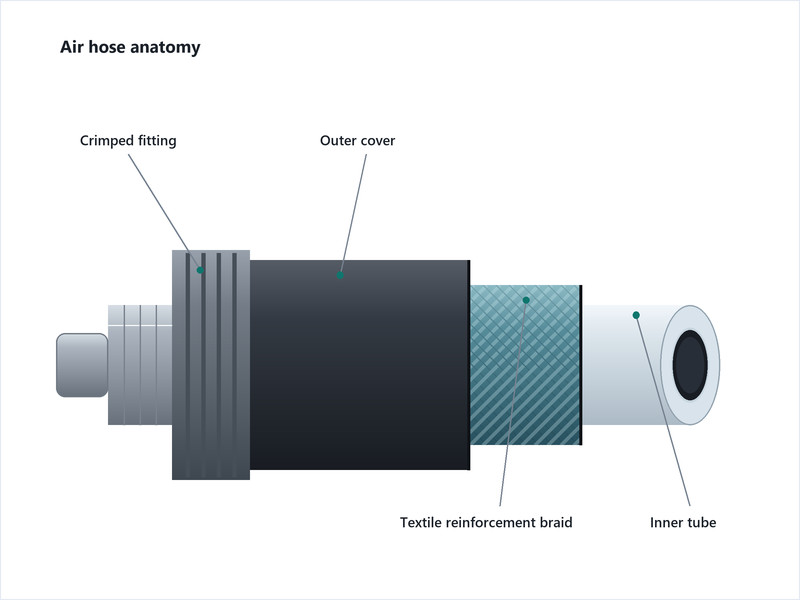
Figure 1. Air hose anatomy: tube, reinforcement, cover, and crimped end fittings.
5. Air Hose Types by Construction and Handling
- Straight hose — flat-stored, any length, largest bore. The default.
- Coiled (recoil) hose — heat-set into a helix so it self-retracts; typically 1/4-inch bore, 150–200 PSI. Best for fixed bench and bay work. Compared in air hose vs coiled air hose.
- Braided hose — textile or wire braid reinforcement. Braid geometry and material are separate questions from tube material; see our braided hose guide and benefits of braided hoses.
- Spiral-reinforced hose — higher pressure and better impulse life than braid, at a larger bend radius.
- Delivery vs suction hose — delivery hose carries pressurised air on the inside; suction hose is reinforced to resist collapse when the air is drawn through it. The distinction is explained in our delivery vs suction hose guide.
6. Temperature and Environment
If you work outside all winter, temperature decides material more than any other single factor. Below 25°F, PVC is out. Below -20°F, hybrid leaves the table. Choose PU from -20°F down to -40°F, or rubber in that same range. Below -40°F no standard compound applies — ask the factory to confirm a special low-temperature compound. Above 140°F, textile reinforcement becomes the limiting layer and compound selection matters more than nominal material.
Environment adds four more criteria: abrasion (cover thickness and hardness), oil (tube compound, not cover), UV (carbon-black-filled black compounds outlast bright colours), and cleanliness (food and pharmaceutical areas need washdown-rated compounds and smooth bores). Our best air hose for cold weather covers the low-temperature end in detail.
7. Applications: Matching Hose to Tool
Table 2. Typical air hose specification by application.
| Demande | Bore | Matériau | Remarques |
|---|---|---|---|
| Blow gun, bench cleaning | 1/4 pouce | PVC, hybrid, or PU coil | Lowest demand; coil works well |
| Nail guns, staplers | 1/4–3/8 in | Hybrid or PU | Intermittent, high peak demand |
| Impact wrench, 1/2 in drive | 3/8 in minimum | Hybrid or rubber | Starved by 1/4-inch coils |
| Spray painting | 3/8 pouces | Rubber | Continuous flow at constant pressure |
| Sandblasting | 1/2 pouce | Rubber, abrasion-grade cover | Very high demand, harsh environment |
| Tyre bay inflation | 1/4 in coil | PU | Short reach, repetitive |
| Air motor, continuous duty | 3/8–1/2 in | Rubber or hybrid | Sized from the motor’s air consumption — see our air motor hose guide |
| Construction site, outdoor | 3/8–1/2 in | Rubber | UV, abrasion, rough handling |
Air-motor selection follows its own method because the motor runs continuously; the sizing arithmetic is in our guide to choosing an air hose for an air motor.
8. Maintenance, Inspection, and Repair
An air hose is a pressure component and should be inspected like one. Check five things monthly:
- Cuts or bulges in the cover — a bulge means the reinforcement is compromised; replace, do not patch.
- Fitting security — look for movement, corrosion, or seepage at the crimp.
- Kinks held in shape — a hose that retains a kink has taken a permanent set at that point.
- Stiffness compared to a new hose — the first sign of plasticizer loss in PVC and hybrid hose.
- Leak points along the line — soapy water is still the fastest field test.
Two rules make this routine effective. Any hose with a bulge in the cover comes out of service immediately — a bulge means the reinforcement has failed locally and the burst margin at that point is unknown. And any hose that retains a kink is retired, because a permanent set at a bend is where it will fail next.
Two checks need a longer interval:
Table 3. Air hose checks that run on a longer cycle than the monthly five.
| Interval | What to check | Action if it fails |
|---|---|---|
| Quarterly | Bend-radius compliance of the installed route | Reroute or add support |
| Annually | Compare against a new hose of the same specification | Plan replacement if stiffness has increased noticeably |
Repair options are limited by construction: barbed low-pressure hose can be re-ended in the field, crimped high-pressure assemblies cannot. Our air hose leak repair guide covers diagnosis and safe repair limits.
9. Buying and Sourcing
For end users, the buying decision is the nine-decision sequence above. For distributors, retailers, and OEM buyers, it is a procurement question — specification sheets, price drivers, MOQ, lead time, test reports, and supplier audit. That side is covered in our air hose buyer’s guide.
Using this complete guide to air hoses with a specification sheet
The sections above cover the nine decisions in the order they arise. If you are specifying a hose for someone else to buy, work through them in sequence and write down the answer to each one; that list is your specification sheet. A complete guide to air hoses is only useful if it ends in a written specification rather than an opinion.
The One-Page Air Hose Decision Tree
The nine decisions above collapse into six questions. Answer them in order and the specification writes itself.
- What is the tool’s air demand? Low (blow gun, nailer) → 1/4 inch. Moderate (impact wrench, spray gun) → 3/8 inch. High (sandblaster, air motor) → 1/2 inch.
- How far must the air travel? Over 25 feet rules out 1/4 inch; over 50 feet at moderate flow points to 3/8 inch or larger.
- What temperature will the hose see? Above 25°F, any material. Below 25°F, hybrid or PU. Below -20°F, PU down to -40°F, or rubber. Below -40°F, confirm a special low-temperature compound with the factory.
- What will it touch? Concrete and carts → rubber. Clean benches → PVC, hybrid, or PU.
- Will it be oiled or in a lubricated circuit? Choose rubber for long-term oil exposure.
- How will it be stored? Flat on a hook → straight hose. Fixed bench or bay → coil.
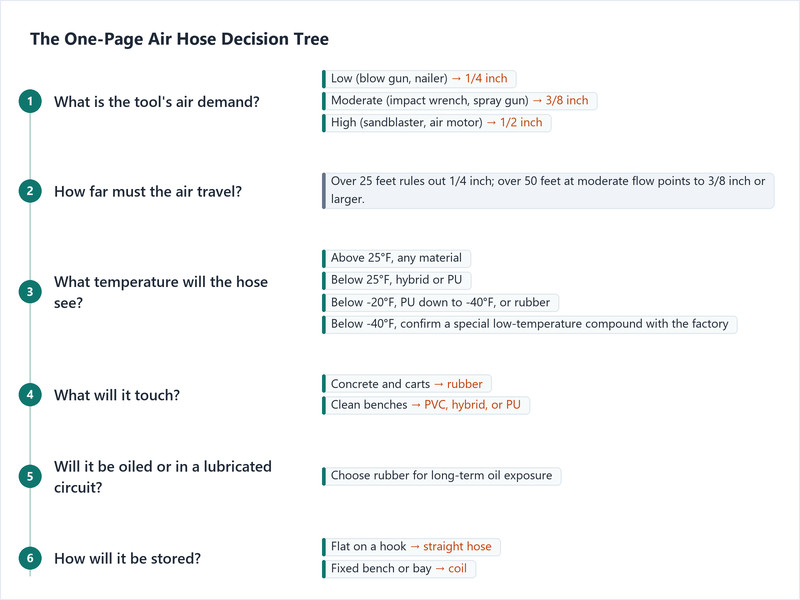
Figure 3. The six decision-tree questions in order, each branching to a bore size, a material class and a storage style.
What the Standards and Markings on an Air Hose Actually Mean
A complete guide to air hoses has to cover the markings, because they are the only specification most buyers ever see. Four items and two standard families cover almost everything printed on a hose cover.
Table 4. Common air hose cover markings and their meaning.
| Marking | Signification | Why it matters |
|---|---|---|
| Working pressure, e.g. “300 PSI” or “20 BAR” | Maximum operating pressure | The only pressure figure you may design to |
| Burst pressure | Pressure at which the hose fails | Confirms the safety factor; often omitted at retail |
| Inside diameter, e.g. “3/8 in” or “10 mm” | Bore, not outside diameter | Sets airflow; the most common source of wrong purchases |
| Plage de températures | Usable limits in °C and °F | Exposes material class more reliably than any other marking |
| Reinforcement type | Textile braid, spiral, or wire layers | Sets the pressure class |
| Manufacturing standard | e.g. ISO 5774 (thermoplastic) or ISO 2398 (rubber) | Lets you verify the claim independently |
Read an air hose cover in this order: standard, working pressure, bore, temperature, then reinforcement. For an unprinted air hose, request the specification sheet and the test certificate: without cover printing there are no specified limits.
Troubleshooting: Seven Symptoms and What They Mean
Table 5. Common air hose symptoms, likely causes, and fixes.
| Symptom | Most likely cause | Fix |
|---|---|---|
| Tool feels weak at the far end | Bore too small or run too long | Increase bore before increasing compressor size |
| Hose stiffens and cracks | Plasticizer loss in PVC or hybrid | Replace; switch material for the environment |
| Hose holding a kink after straightening | Permanent set at a bend, often from cold storage | Replace; store coiled loosely indoors |
| Leak at the fitting | Crimp damage or bend-radius violation | Replace the assembly; correct the routing |
| Bulge in the cover | Local reinforcement failure | Remove from service immediately |
| Coil stops retracting | Heat-set memory lost to heat or full extension | Replace; store coils relaxed and out of sun |
| Condensation and water at the tool | No water trap or separator in the line | Fit a separator and drain the receiver regularly |
Notice how many of those seven symptoms are installation or storage problems rather than manufacturing faults. That proportion is normal, and it is why a complete guide to air hoses spends as much time on routing, storage, and inspection as on material selection.
Where to Go Next
This complete guide to air hoses covers the nine decisions in summary. Each one has a dedicated page on this site with the tables, measurement methods, and worked examples:
- Matériau — the PVC vs rubber vs hybrid air hose comparison and the PVC vs rubber air hose difference guide.
- Size — the air hose size chart and what size air hose do I need.
- Pression — the working pressure vs burst pressure guide.
- Fittings — the air hose fittings and couplers guide.
- Construction — the braided hose guide, air hose vs coiled air hose, and types of industrial hoses and how to choose the right one.
- Applications — the air hose for air motor guide and best air hose for cold weather.
- Repair — the air hose leak repair guide.
- Sourcing — the air hose buyer’s guide.
A Complete Guide to Air Hoses: FAQs
What is the best air hose?
There is no single best air hose — the best hose is the one matched to your tool’s air demand, your run length, your working temperature, and how the hose is handled. A 3/8-inch hybrid hose covers the widest range of general workshop use.
What size air hose do I need?
Air hose sizes start with the tool’s air consumption, not the compressor’s size. Most light tools run on 1/4 inch, impact wrenches and spray guns need 3/8 inch, and high-flow tools need 1/2 inch — and 1/4 inch should not be used beyond about 25 feet.
What is the difference between a working pressure and a burst pressure on an air hose?
Working pressure is the maximum pressure the hose may operate at. Burst pressure is where it fails, typically three to four times higher. The gap is a safety margin for stored energy, not an operating allowance.
How long should an air hose last?
In daily shop use, roughly 1 to 2 years for PVC, 2 to 3 for hybrid, and 3 to 5 for rubber. In occasional home use, hoses age out rather than wear out, and storage conditions matter more than material.
Can I use one air hose for every tool in my shop?
Yes, in most workshops, if you accept reduced performance on the hungriest tool. A 3/8-inch hybrid hose is the best single compromise. If you run both a blow gun and a sandblaster, two hoses — 1/4 inch and 1/2 inch — will outperform any one-size answer.
About HENGHUA
HENGHUA manufactures air hoses and reinforced hose assemblies for workshops, distributors, and OEM brands worldwide. The range covers PVC, hybrid, polyurethane, and rubber constructions from 1/4 to 3/4 inch, rated 200–500 PSI, in straight, coiled, textile-braided, and spiral-reinforced styles, supplied with factory-crimped brass or steel fittings.
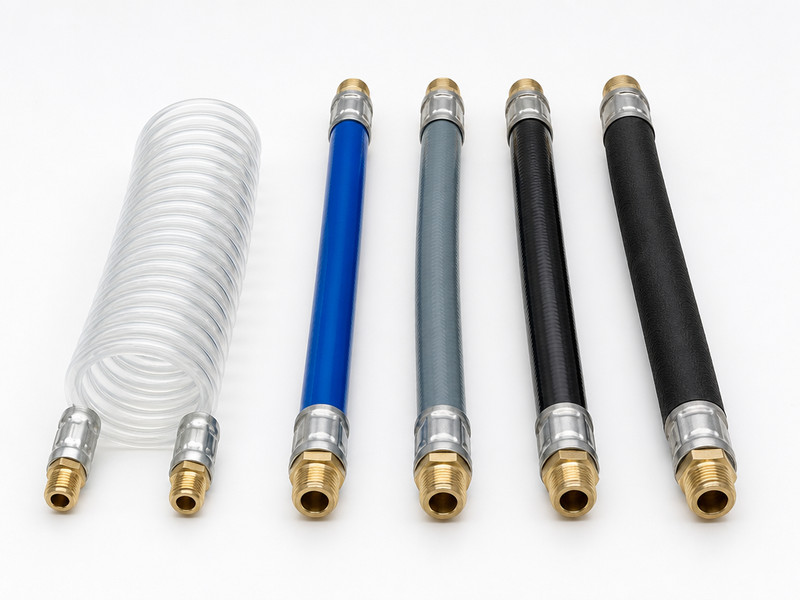
Figure 2. The HENGHUA air hose range in four materials — PVC, hybrid, PU and rubber — in straight and coiled form with crimped end fittings.
Every HENGHUA air hose batch is pressure-tested before shipping, and custom lengths, colours, cover printing, packaging, and OEM/ODM branding are available at factory-direct pricing. Tell us your tool, run length, temperature, and pressure — contact our engineering team for a quote and samples.
Written by the HENGHUA Engineering Team — the engineers who compound, build, and pressure-test the hoses we manufacture — with input from workshop users across the US and Europe. HENGHUA manufactures air hose assemblies from 1/4 inch to 3/4 inch, rated 200–500 PSI, with custom lengths, fittings, and OEM branding available.






 English
  Spanish
  Portuguese
  French
  German
  Arabic
  Russian
  Indonesian
  Japanese
  Korean