
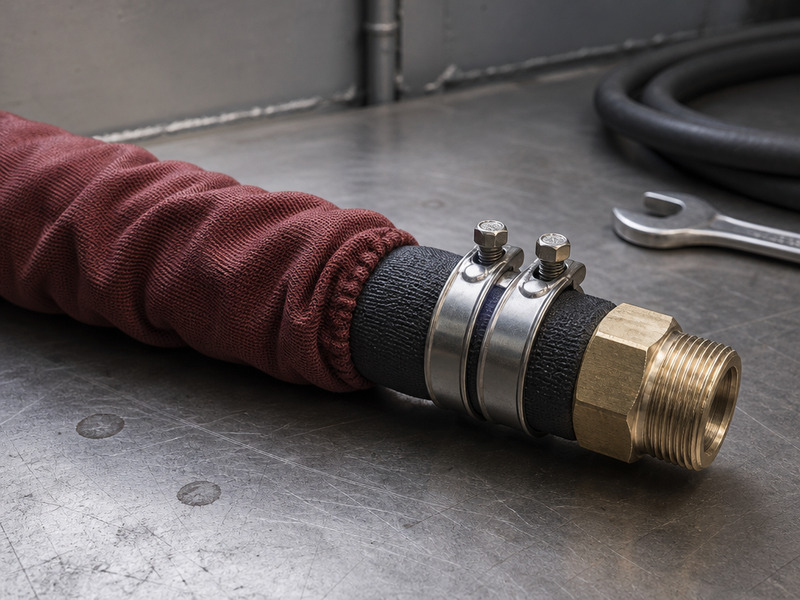
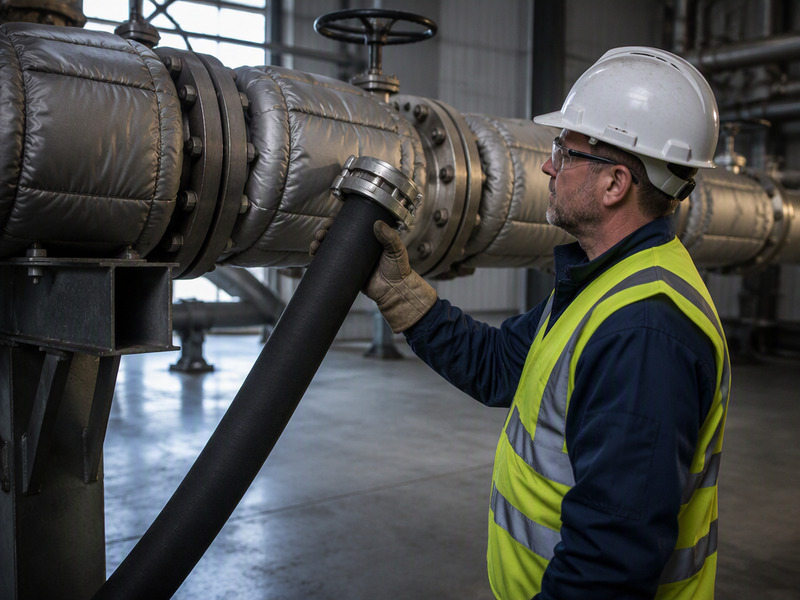
A complete range of steam hoses and fittings is one matched system, not a hose plus whatever clamp sits in the stores bin. The hose sets the bore, the working pressure and the temperature class. The fittings set the end connection, the clamp torque and the thread.
ISO 6134:2024, the standard for saturated steam hose, expects an end connection that can be clamped with an adjustable force, and it does not permit quick-release couplings. The practical answer is to buy the hose, the clamp, the adapter and the thread as one part number. This overview follows the whole chain from 3/8 inch to 4 inch bore.
What Belongs in a Complete Steam Hoses and Fittings Range
A complete range has five groups. A plant that buys them separately usually ends up with one weak link inside an otherwise sound line.
- Hose — EPDM steam hose from 3/8 inch to 4 inch bore, rated 250 psi (17 bar) working pressure with a 10:1 burst safety factor.
- End connections — bolted steam hose clamps as the standard default, with crimped assemblies offered as an alternative.
- Adapters and tails — a steam hose adapter, a hex nipple and a reducer in NPT or BSPT, sized to the equipment port.
- Sealing hardware — PTFE tape or paste for tapered threads, and the correct gasket for a flange joint.
- Protection and handling — sleeves, guards, reels and the steam hose and gun set used for washdown duty.
Steam hose fittings are only half of that range, and they are usually the half that fails first. The hose body is cured for steam and pressure-tested before it ships, while the fittings are often bought on price alone. Steam hoses and fittings form one pressure boundary, so every group belongs in the same order.
Each group also has its own failure mode. A clamp rated below the hose temperature will relax before the hose ages out. An adapter in the wrong thread form will leak at the joint rather than at the hose. A review of steam hose types and sizes is a useful first step, because the hose choice drives every other part on the list.
Steam Hoses and Fittings Have to Match: Bore, Rating and Thread
Three numbers decide whether the parts in your hand will work together: the bore, the pressure class and the thread form. Get any one of them wrong and the line will leak, blow off, or simply not fit.
Three Numbers That Must Agree Before You Buy
Bore is measured inside the hose, so a 3/4 inch hose needs a tail, a clamp and a stud sized for that same bore. Pressure class is set by the weakest part, not by the strongest. A 250 psi (17 bar) hose on a lower-rated adapter is only as strong as that adapter. Steam hose fittings must match the port as well, and NPT and BSPT are both tapered yet not interchangeable.
Temperature class has to agree across the whole joint too. A 230 °C hose end held by a polymer insert rated below that temperature will not hold at all. The same logic applies to a gasket, a seal, or a hose tail with a lower figure than the hose. Rate the assembly at the lowest number on the drawing, then confirm it against the printed label. Start with what a steam hose is made of if the hose body itself is still open.
What Happens When the Clamp Is Rated Below the Hose
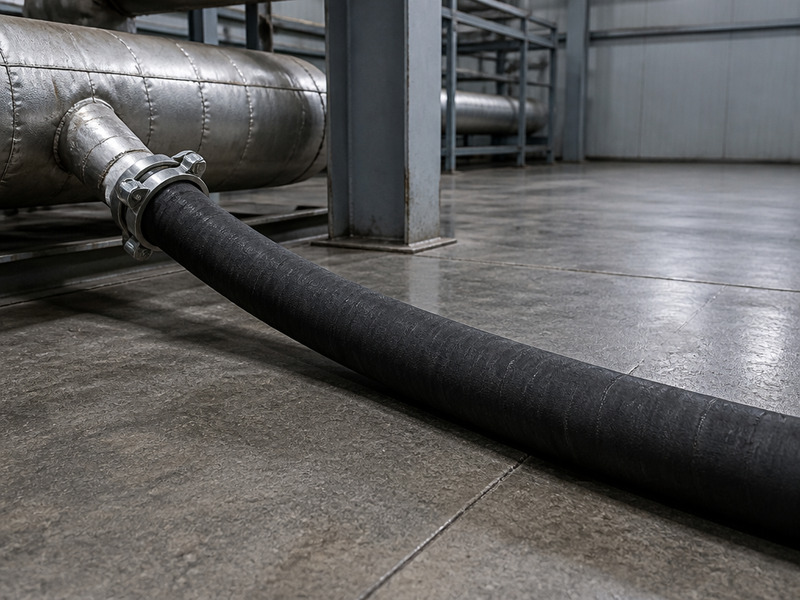
A clamp that loses torque at temperature lets the hose creep out of the tail under pressure. Steam then escapes at the joint, and the operator hears it before anyone sees it. This is the classic case of a sound hose retired by a cheap end. The fix is not a second clip behind the first. It is a clamp of the right material, tightened to the right torque and sized to the hose outside diameter.
Steam Hose End Connections Compared
A handful of end styles cover almost every steam job, and they do not carry the same level of approval. The table below compares how each style grips the hose, and what that means in saturated steam service. Every steam hose coupling in this list has to hold with an adjustable clamping force a fitter can re-check; a spring latch does not provide one.
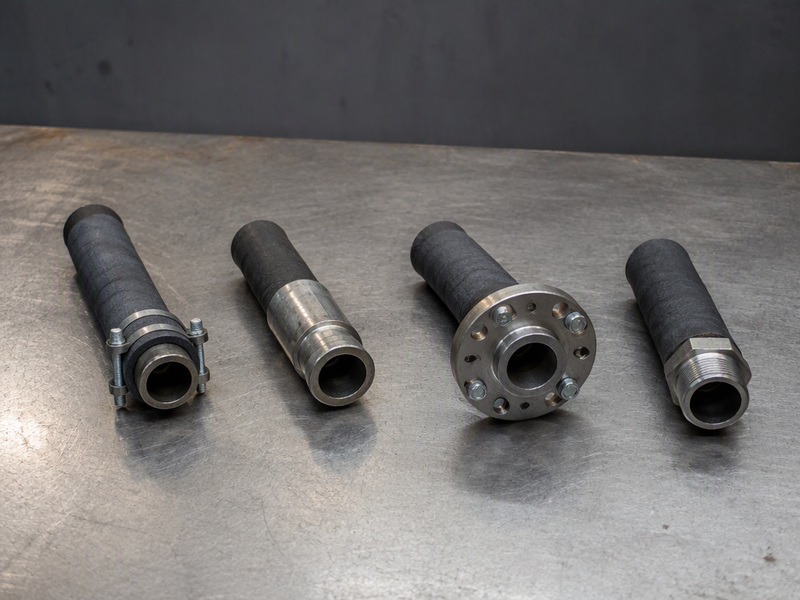
Figure 2. Four steam hose end styles side by side: bolted safety clamp, crimped ferrule, flange and threaded tail.
| End connection | How it holds the hose | Steam service verdict | Use it when |
|---|---|---|---|
| Bolted safety clamp | Two or more bolts draw a band down onto the cover | Standard default; clamping force can be adjusted and re-checked | Every rubber steam hose end |
| Crimped ferrule assembly | A metal ferrule is pressed over the tail and the hose | Alternative only, with a declared crimp specification and a verified steam rating | Fixed factory-made lengths and high-vibration duty |
| Flange | The hose end is clamped or crimped to a flange and bolted to a mating flange | Accepted at fixed connections with the correct gasket | Headers, vessels and permanent pipework |
| Threaded steam hose connector | A male thread is machined on the tail and sealed with PTFE tape | Common and accepted for portable work | Guns, lances and manifold ports |
| Quick-release steam hose coupling | A latch or cam arm locks two halves together | Not permitted by ISO 6134 for steam service | Never on a steam line |
A steam hose assembly is only as strong as its weakest joint. Steam hose fittings in a mixed set are the usual weak point. Write the end style on the order, and buy steam hoses and fittings as one line item so the decision stays visible. Guidance on how to choose steam hose for your duty covers the same choice from the process side.
Steam Hose Clamps: Why a Worm-Drive Clip Is the Wrong Answer
Steam is a hot, cycling load. A worm-drive clip is designed for a cold, static one. As the hose heats and cools, the cover relaxes and the clip loses its grip. The screw housing also sits proud of the band, where it snags gloves and cuts through insulation.
Bolted steam hose clamps solve both problems. A bolt holds far more force than a worm screw of the same band width, and it can be re-tightened in service. Stainless steel is the usual choice for the band and the bolt, because plain steel corrodes in a wet plant. Check the material of your steam hose fittings and clamps against the cover for the same reason.
Torque is a number, not a feeling. Ask the clamp maker for the band torque for the outside diameter you are using, then tighten with a torque wrench and record the value. Over-tightening cuts the cover and crushes the wire braid, while under-tightening lets the hose creep.
Proper steam hose maintenance starts with a torque check on the day the line is commissioned, and it repeats after the first week of running. A steam hose coupling that needs re-torquing twice is the wrong part for the duty. Torque and material data for the wider clamp family is set out in this hose clamp torque and material guide.
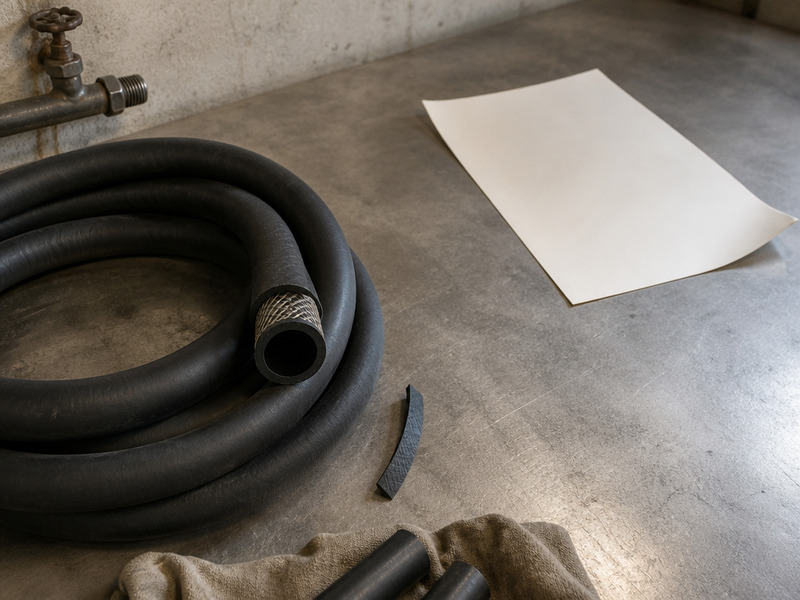
Retire any joint that has been overheated, that still weeps after re-torquing, or whose cover is cut through at the band line. A steam hose has no field repair. Replace the hose. A patched cover, a re-banded swollen end and a reused tail all leave an unverified joint. The rule is replace, never repair. The 10:1 burst safety factor belongs to the factory assembly, and a field fix has no verified margin. Steam hoses and fittings bought as one tested unit avoid that risk.
Steam Hoses and Fittings Sizing Chart
Use the chart to move from the hose you need to the hardware you order. Clamp sizes are quoted as the band range that spans the hose outside diameter, because cover thickness changes with the grade. Band ranges and tail threads are typical values; confirm each against the maker’s data sheet and your port.

Figure 3. Matching bore, clamp band and tail thread for steam hose from 3/8 inch to 4 inch.
| Hose bore | Hose OD (mm) | Bolted clamp band to order | Typical tail thread |
|---|---|---|---|
| 3/8 in. | 21 | 18-24 mm | 1/2 in. NPT or BSPT |
| 1/2 in. | 25 | 22-28 mm | 1/2 in. or 3/4 in. NPT |
| 5/8 in. | 28 | 24-30 mm | 3/4 in. NPT |
| 3/4 in. | 32 | 28-35 mm | 3/4 in. NPT or BSPT |
| 1 in. | 39 | 34-42 mm | 1 in. NPT |
| 1-1/4 in. | 46 | 41-49 mm | 1-1/4 in. NPT |
| 1-1/2 in. | 54 | 48-57 mm | 1-1/2 in. NPT |
| 2 in. | 67 | 60-70 mm | 2 in. NPT |
| 2-1/2 in. | 83 | 76-86 mm | 2-1/2 in. NPT |
| 3 in. | 95 | 88-98 mm | 3 in. NPT |
| 3-1/2 in. | 110 | 102-114 mm | 3-1/2 in. NPT |
| 4 in. | 124 | 115-128 mm | 4 in. NPT |
A wrong clamp size is the most common cause of a weeping end. Order the band to the hose outside diameter, never to the nominal bore, because steam hose covers run thicker than a general-purpose hose of the same bore. Steam hose clamps sized by pipe size come out too small. The same care applies to a steam hose adapter: match the thread form first, then the size, then the seal.
Adapters, Flanges and Thread Systems: NPT, BSP and Flange
NPT and BSPT are both tapered thread forms, and they are not interchangeable. A 1/2 inch NPT male will start into a 1/2 inch BSPT female because the diameters are close, but it will not seal. The thread engages a few turns, distorts, and weeps as soon as it sees pressure. An adapter has to be ordered in the form that matches the port, not the form that is on the shelf.
NPT and BSPT Are Not Interchangeable
NPT has a 60 degree thread angle. BSPT has a 55 degree angle and a different pitch, so the two forms cannot share a seat. Use PTFE tape on a tapered thread, wrapped in the direction of the thread, and leave the first thread bare so tape does not enter the line. Never put tape on a flange gasket face. For a flange joint, use the gasket specified for the pressure and the temperature, and bring the bolts up in a cross pattern.
A steam hose connector in the wrong form is the usual cause of a drip that appears an hour after start-up. Where a plant mixes US and European equipment, standardize on one form per line and put a steam hose adapter at the boundary. A steam hose coupling holds one thread form only; once the joint is under pressure, two different forms cannot be bridged.
The wider coupling family is covered in this hose couplings comparison, and the thread families are set out in this Guide des filetages NPT et BSP. For one standard across a whole plant, read treating hose and fittings as one system.
Protective Sleeves, Guards and Reels for Steam Service
Steam hose is a pressure part, and it deserves the same protection as the pipe around it. A protective sleeve handles abrasion where the hose drags on concrete or crosses a steel edge. Choose the sleeve for the cover temperature, not only for the size. A steam hose connector left hanging on a gun loads the tail every time the hose moves.
Guards matter more on a washdown line. A steam hose and gun set brings hot water and steam within arm’s reach of an operator, so the guard, the handle and the trigger all need insulation. Fit a whip arrestor at the gun end, because a failed steam joint will whip before anyone reacts. Route any reel line so the bend never falls below the minimum bend radius of its grade, which differs between a 170 °C build and a 230 °C build.
Reels carry their own rules. Wind the hose so the natural bend follows the drum, and leave the last turn slightly loose so the end is not under tension for months. Steam hose maintenance on a reel means checking the first meter behind the end fitting, where the hose leaves the drum and takes the most flex.
A second steam hose and gun set kept as a spare shortens every changeover and removes the temptation to run a damaged line to the end of a shift. A road tanker unloading line on a reel uses the same hardware in a larger bore.
Steam Hoses and Fittings Checklist Before You Order
Work down the list and put every answer on the purchase order. A supplier cannot quote a matched steam hose assembly from a bore size alone, and steam hose maintenance planning starts with the same list.
- Bore and length — state the bore in inches or millimeters, plus the finished length and the tolerance you accept.
- Pressure and temperature — give the working pressure, the steam temperature and the duty cycle, not just a class name.
- Steam condition — confirm saturated steam, and flag any superheated steam, which shortens service life.
- End connection — name the style, and use a bolted clamp as the default rather than a quick-release part.
- Thread — say NPT or BSPT, give the size, and mark the sealing method.
- Clamp — specify the band material, the range and the torque figure to be applied.
- Protection — list sleeves, guards, whip restraints and reel fittings as separate line items.
- Documentation — ask for the proof test record, the marking text and the batch code.
Two entries on that list deserve extra care. Steam hose fittings must match the hose outside diameter and the port. Everything else is a choice, but those two are limits. A steam hose connector with the wrong thread form will not seal at any torque, and no amount of tape will change a thread angle. Confirm both figures before the order goes out, and ask for the clamp torque in writing.
Steam Hose FAQs
What is the difference between a steam hose and a steam hose assembly?
A steam hose is the length of hose on its own. A steam hose assembly is that hose with both ends finished, tested and marked as a unit. A finished assembly carries a known burst margin, because the end fittings were fitted to a stated specification. A field-fitted end has no verified margin.
Are worm-drive clips acceptable on a steam hose?
No. A worm-drive clip loses torque as the cover relaxes under heat cycling, and the screw housing can cut insulation and gloves. Steam hose clamps for this duty should be bolted, in stainless steel, and tightened to a stated torque. Check the torque after the first week of running, because the first heat cycle is when a joint moves most.
Can I use a standard quick-release coupling on steam?
No. ISO 6134:2024 does not permit quick-release couplings on steam hose, because a latch or cam can release under pressure or vibration. A steam hose coupling on a steam line has to hold with an adjustable clamping force that a fitter can check. If a quick-release part is already in the line, replace it before the next start-up.
What size connector do I need for a 1 inch steam hose?
Start from the hose outside diameter, not the bore. On a typical 230 °C build a 1 inch hose has an outside diameter near 39 mm, so order a band that spans that figure. The tail thread is usually 1 inch NPT or BSPT, but the value to confirm first is the port. A steam hose connector ordered by bore alone often arrives one size small.
Do I need a steam hose adapter between NPT and BSPT equipment?
Yes, if the two ends differ. NPT and BSPT share a similar look but not a seat, so a joint between them will weep under pressure. Order a steam hose adapter with the correct form on each end and mark the direction on the body. Standardizing on one thread form per line removes the problem at the source.
What does a steam hose and gun set include?
A washdown set usually pairs a light steam hose with a gun, a lance and a trigger. Specify the guard, the insulation and the whip restraint at the same time. The set should be rated as a unit, because every part in a steam hose and gun set sees the same pressure. Ask for the pressure and temperature rating of every part in the set.
How often should steam hose maintenance be done?
Inspect before each shift, torque-check the clamps after the first week and then at each planned shutdown, and pressure-test on the plant schedule. Continuous steam service retires a hose in roughly two to four years, and intermittent use lasts five to seven. Steam hose maintenance is mostly inspection, because a steam hose rarely fails without a warning sign first.
What should I check if a joint drips only when the line is hot?
Check the clamp torque first, because a joint that is dry cold and wet hot has usually lost clamping force rather than thread seal. Re-torque to the maker’s figure, then run one heat cycle and check again. If it still drips, retire the end: a weeping joint cannot be repaired in place.
Buy Steam Hoses and Fittings as One Assembly
HENGHUA manufactures reinforced industrial hose and complete hose assemblies for plants, distributors and OEM brands. Our EPDM steam hose range covers 3/8 inch to 4 inch bore, rated 250 psi (17 bar) working pressure with a 10:1 burst safety factor.
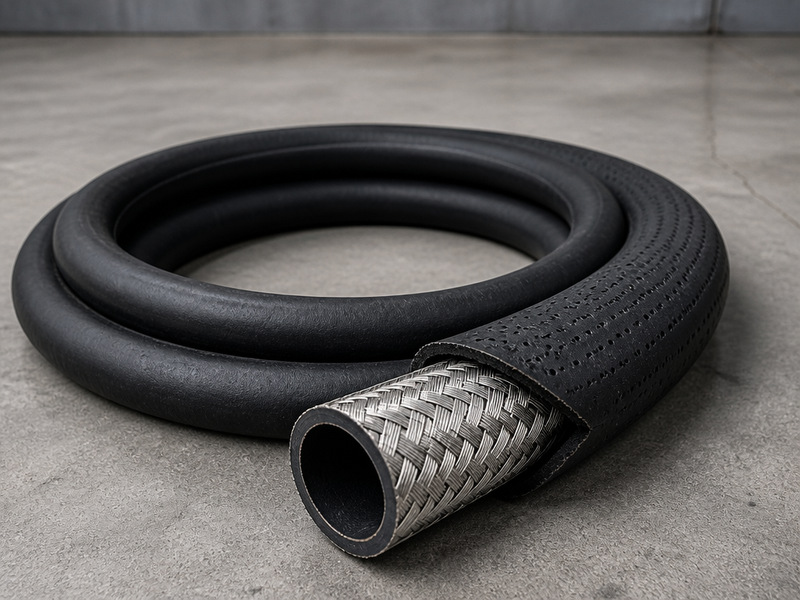
The construction is a smooth steam-resistant EPDM tube, one or two layers of high-tensile steel wire braid, and a pin-pricked cover that vents permeating gas instead of blistering. Every length is proof-tested at 1.5 times working pressure before it leaves the plant, and each batch is date-coded. Because compounding, extrusion, braiding, vulcanization and crimping all happen in one plant, bulk lead times stay short. Send us the working pressure, the steam temperature, the bore and the end connection, and we will quote against them.
We supply cut lengths, crimped ends, protective sleeves, colour coding and OEM branding. Get a quote and free samples
Final Verdict: One Standard Across the Whole Steam Line
Hold one standard across the whole line and the spare-parts problem disappears. The steam hoses and fittings on a plant are a system, so a clamp bought on price alone can retire a hose that was specified correctly. Write the end style on every order, keep the thread form consistent on each line, and record the clamp torque beside the tag number.
Inspection discipline is the same after start-up. Where a permanent end is preferred, a crimped steam hose assembly is a legitimate alternative, provided the supplier declares the crimp specification and shows a verified steam rating. Anything less is an unverified joint on a pressure line. Review the whole set, not the single part. Send the bore, the working pressure, the steam temperature and the end style, and we will quote the assembly as one part number.
Written by the HENGHUA engineering team, with input from plant maintenance and steam-system reliability teams across North America, Europe and South East Asia. HENGHUA manufactures reinforced industrial hose and hose assemblies, including an EPDM steam hose range from 3/8 inch to 4 inch bore. Those assemblies are rated 250 psi (17 bar) working pressure with a 10:1 burst safety factor, and are supplied as cut lengths or as fully crimped assemblies. Fittings, protective sleeves, colours and OEM branding are available on request.

 English
  Spanish
  Portuguese
  French
  German
  Arabic
  Russian
  Indonesian
  Japanese
  Korean