
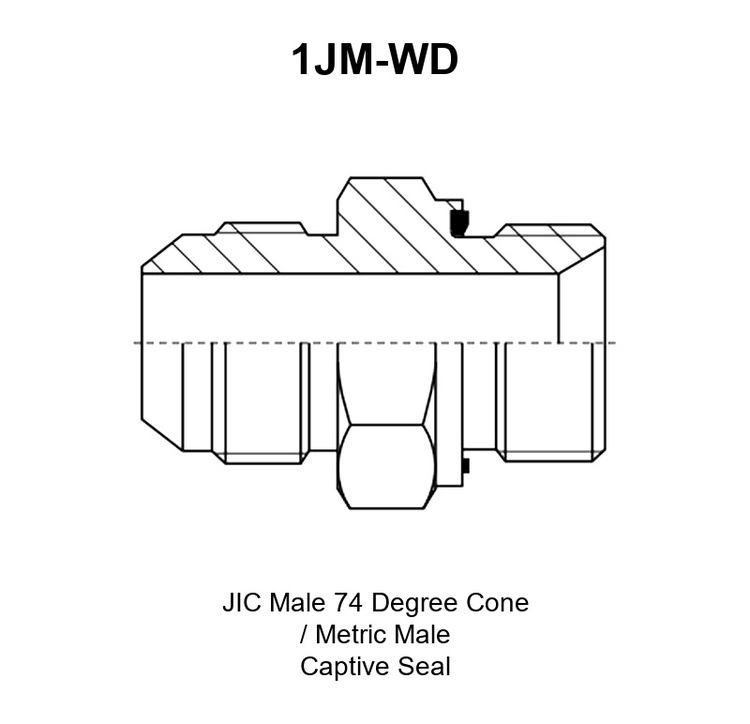
The 1JM-WD adapter is a straight cross standard adapter that joins a JIC 74° cone male end, made to SAE J514 with an inch thread, to a metric male end fitted with a captive seal. It is the hydraulic conversion adapter used where an SAE inch tube line has to meet a metric port that is sealed by an elastomer washer on a flat face rather than by a machined cone.
Both ends must match their mating port exactly, because that match is the precondition for eliminating leakage at the conversion point. The two ends of this male adapter do not even seal the same way: one is a metal cone joint and the other is a flat face joint closed by an elastomer captive seal, so the buyer has to read both the thread and the sealing method before ordering.
Sealing principle of this series: connection 1 is a 74° external cone that seats metal-to-metal on the mating 74° internal cone, and connection 2 is a metric male end with a captive seal that is compressed against the flat face of the mating port. The captive seal is a bonded seal: an elastomer element held in a metal carrier, seated in a groove on the stud so it cannot be lost and cannot walk out of position during tightening.
Core Advantages
- One piece carries an SAE J514 inch thread and a metric thread, so an inch line meets a flat-face metric port without an extra reducer.
- Captive seal held in its own groove, so the washer stays on the stud during handling, storage and assembly.
- Metal-to-metal 74° cone at the JIC end, with no elastomer in the cone sealing path.
- Full range from M10x1 up to M48x2 at the captive seal end, against JIC sizes from 7/16″x20 to 1.7/8″x12.
- Centre hex from 17 mm to 55 mm across flats, so standard wrenches fit without special tooling.
- Carbon steel with trivalent chromium zinc plating; 304 or 316 stainless steel available for corrosive service.
1. What a 1JM-WD Adapter Does
A 1JM-WD adapter is a straight stud with a JIC 74° cone male end on one side and a metric male captive seal end on the other. It connects a tube assembly terminated with a JIC 74° cone nut and sleeve to a port whose sealing surface is a flat face.
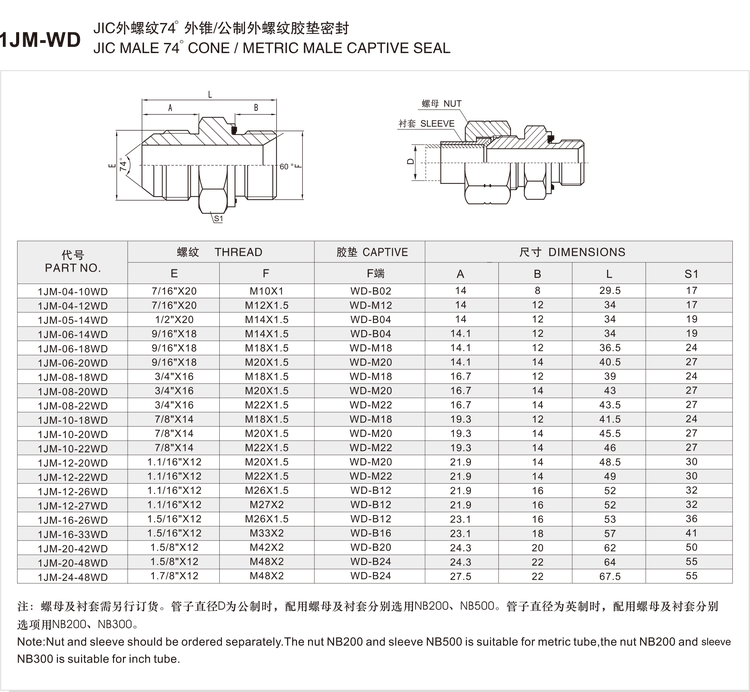
This JIC adapter does one job: it moves fluid between an SAE inch port and a metric port without changing direction, while changing the sealing method at the same time. The E column is the SAE J514 JIC 74° cone end, printed in the inch style such as 9/16"X18, and the F column is the metric captive seal end, such as M18X1.5. The F END column prints the captive seal reference for that thread, such as WD-M18.
The difference between this series and a metric 60° seat series is the second sealing surface, not the thread. Both use a metric thread at that end, but the 60° seat version seats on a machined internal cone while this version seats an elastomer washer against a flat face. Threading the two parts into the same port will not produce the same joint; section 6 sets out how to tell them apart.
The two ends are maintained differently: a nicked 74° cone leaks no matter how much torque is applied later, while a perished captive seal leaks even behind a perfect cone, so both halves are checked at every service interval.
2. 1JM-WD Specifications
2.1 Connection 1 – JIC 74° cone male end (E)
- Thread standard and family: SAE J514, JIC 74° cone seat family, inch thread.
- Thread size range available: 7/16″x20 to 1.7/8″x12, in the steps printed in table 2.5.
- Gender: male adapter stud end.
- Sealing method: 74° external cone seating metal-to-metal on the mating 74° internal cone.
- Mating port standard: SAE J514 74° cone seat, made up with the matching nut and sleeve for the tube.
2.2 Connection 2 – Metric male captive seal end (F)
- Thread standard and family: metric thread with a captive bonded seal, in the gasket-sealed stud end family that pairs with a flat-face metric port.
- Thread size range available: M10x1 to M48x2, in the steps printed in table 2.5.
- Gender: male stud end.
- Sealing method: a captive bonded seal compressed against the flat face of the mating port, with the thread running up free of the sealing path.
- Mating port standard: a metric port with a flat sealing face and a spotface wide enough to accept the captive seal washer.
Read the E column as the JIC adapter end in the SAE J514 inch thread standard and the F column as the metric captive seal end, with the F END column giving the seal reference. The two mirrored blocks above let a buyer map one end to the tube side and the other to the flat-face port without translating between thread systems.
2.3 Construction and Materials
The body is machined from bar stock on CNC lathes. The inch thread, the metric thread, the 74° cone and the seal groove are turned in one setup so the cone and the groove stay square to their threads.
- Body material: carbon steel as standard; 304 stainless steel or 316 stainless steel on request; brass for selected sizes.
- Plating and finish: trivalent chromium zinc plating (Cr3+) for carbon steel as standard; zinc-nickel plating available. Plating thickness and corrosion performance are confirmed per order rather than published as a series figure.
- Seal material options: NBR, FKM (Viton-type) and EPDM for the captive seal. The 74° cone at the JIC end is metal-to-metal and carries no elastomer.
- The captive seal sits in a groove on the stud, so it is supplied with the part and stays in place in transit.
- Machining process: bar-stock turning, each thread form produced to its own port standard, cone and seal face checked against the drawing.
- Hex feature: a single centre hex (S1) on the body, from 17 mm to 55 mm across flats depending on size. There is no bulkhead feature in this series.
2.4 Pressure and Temperature
Working pressure for a 1JM-WD adapter is not set by the series code. It is governed by the thread size, the wall thickness of the stud and the tube, the sealing method and the material selected. Working pressure for these sizes is confirmed per order by HENGHUA engineering.
Temperature is a material question and is stated here as a material fact rather than a performance claim. For NBR seals, the working range is approximately -30°C to +100°C. For FKM (Viton-type) seals, it is approximately -20°C to +200°C. For EPDM seals, it is approximately -40°C to +120°C. In this series these figures govern the captive seal at the metric end, because the 74° cone end has no elastomer in its sealing path.
Carbon steel with zinc plating suits general hydraulic service; specify 304 or 316 stainless steel for corrosive or offshore service.
2.5 Part Number and Dimension Table
The table below is the complete printed size range of the 1JM-WD series; lengths and hex dimensions are in millimetres.
| PART NO. | E | F | F END | A | B | L | S1 |
|---|---|---|---|---|---|---|---|
| 1JM-04-10WD | 7/16″X20 | M10X1 | WD-B02 | 14 | 8 | 29.5 | 17 |
| 1JM-04-12WD | 7/16″X20 | M12X1.5 | WD-M12 | 14 | 12 | 34 | 17 |
| 1JM-05-14WD | 1/2″X20 | M14X1.5 | WD-B04 | 14 | 12 | 34 | 19 |
| 1JM-06-14WD | 9/16″X18 | M14X1.5 | WD-B04 | 14.1 | 12 | 34 | 19 |
| 1JM-06-18WD | 9/16″X18 | M18X1.5 | WD-M18 | 14.1 | 12 | 36.5 | 24 |
| 1JM-06-20WD | 9/16″X18 | M20X1.5 | WD-M20 | 14.1 | 14 | 40.5 | 27 |
| 1JM-08-18WD | 3/4″X16 | M18X1.5 | WD-M18 | 16.7 | 12 | 39 | 24 |
| 1JM-08-20WD | 3/4″X16 | M20X1.5 | WD-M20 | 16.7 | 14 | 43 | 27 |
| 1JM-08-22WD | 3/4″X16 | M22X1.5 | WD-M22 | 16.7 | 14 | 43.5 | 27 |
| 1JM-10-18WD | 7/8″X14 | M18X1.5 | WD-M18 | 19.3 | 12 | 41.5 | 24 |
| 1JM-10-20WD | 7/8″X14 | M20X1.5 | WD-M20 | 19.3 | 14 | 45.5 | 27 |
| 1JM-10-22WD | 7/8″X14 | M22X1.5 | WD-M22 | 19.3 | 14 | 46 | 27 |
| 1JM-12-20WD | 1.1/16″X12 | M20X1.5 | WD-M20 | 21.9 | 14 | 48.5 | 30 |
| 1JM-12-22WD | 1.1/16″X12 | M22X1.5 | WD-M22 | 21.9 | 14 | 49 | 30 |
| 1JM-12-26WD | 1.1/16″X12 | M26X1.5 | WD-B12 | 21.9 | 16 | 52 | 32 |
| 1JM-12-27WD | 1.1/16″X12 | M27X2 | WD-B12 | 21.9 | 16 | 52 | 32 |
| 1JM-16-26WD | 1.5/16″X12 | M26X1.5 | WD-B12 | 23.1 | 16 | 53 | 36 |
| 1JM-16-33WD | 1.5/16″X12 | M33X2 | WD-B16 | 23.1 | 18 | 57 | 41 |
| 1JM-20-42WD | 1.5/8″X12 | M42X2 | WD-B20 | 24.3 | 20 | 62 | 50 |
| 1JM-20-48WD | 1.5/8″X12 | M48X2 | WD-B24 | 24.3 | 22 | 64 | 55 |
| 1JM-24-48WD | 1.7/8″X12 | M48X2 | WD-B24 | 27.5 | 22 | 67.5 | 55 |
What each column means
- PART NO. – the HENGHUA part number: the prefix
1JM, two size codes and theWDsuffix that marks the captive seal end. - E – the thread of connection 1, the JIC 74° cone end, printed as diameter x threads per inch in the SAE style, for example
3/4"X16. - F – the thread of connection 2, the metric captive seal end, printed as a metric thread, for example
M20X1.5. - F END – the captive seal reference for the metric end, for example
WD-B08, identifying the seal that belongs to that thread size. - A – the length from the end of connection 1 (the JIC cone end) to the hex face on that side, in millimetres, as marked on the series drawing.
- B – the same measurement at connection 2 (the metric captive seal end), in millimetres.
- L – the overall length of the part from end to end, in millimetres.
- S1 – the hex across flats, in millimetres, used to hold the body with a wrench during assembly.
Thread size and dash chart
The JIC size code follows the SAE convention based on the nominal tube outside diameter in sixteenths of an inch. The metric thread and the captive seal reference are printed directly.
| JIC size code | JIC thread | Metric threads at the F end |
|---|---|---|
| 04 | 7/16″x20 | M10x1, M12x1.5 |
| 05 | 1/2″x20 | M14x1,5 |
| 06 | 9/16″x18 | M14x1.5, M18x1.5, M20x1.5 |
| 08 | 3/4″x16 | M18x1.5, M20x1.5, M22x1.5 |
| 10 | 7/8″x14 | M18x1.5, M20x1.5, M22x1.5 |
| 12 | 1.1/16″x12 | M20x1.5, M22x1.5, M26x1.5, M27x2 |
| 16 | 1.5/16″x12 | M26x1.5, M33x2 |
| 20 | 1.5/8″x12 | M42x2, M48x2 |
| 24 | 1.7/8″x12 | M48x2 |
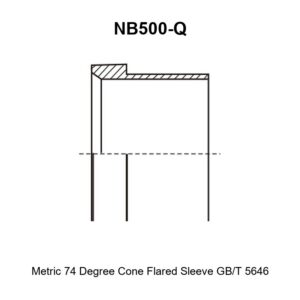
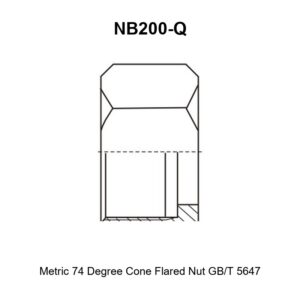
Nut and sleeve are ordered separately. The 1JM-WD stud does not include them, and the two ends need different nuts because the threads belong to two standards. Use nut NB200 with sleeve NB500 for metric tube and with sleeve NB300 for inch tube.
3. How to Read a 1JM-WD Part Number
A 1JM-WD part number has three elements: the series prefix, the two size codes, and the WD suffix that marks the captive seal end.
The prefix 1JM identifies the geometry: a straight stud with a JIC 74° cone male end and a metric male end. The WD suffix changes the sealing method, because the metric end now seals through a captive elastomer washer instead of a machined 60° seat. Other prefixes cover the metric 60° seat version, an NPT male end and a BSP male end.
The first size code is the JIC end, taken from the SAE dash convention, and the second size code is the metric end, taken from the metric thread designation. The two codes follow different numbering systems, the most common source of ordering error on a cross standard adapter.
Worked example: 1JM-08-20WD.
1JM– straight stud, JIC 74° cone male to metric captive seal male.08– connection 1 is the SAE J514 size with a 3/4″x16 thread.20– connection 2 is the metric captive seal end with an M20x1.5 thread.WD– the metric end seals through a captive bonded seal on a flat face.- From the table: the seal reference is WD-M20, A is 16.7 mm, B is 14 mm, L is 43 mm and S1 is 27 mm.
A buyer ordering 1JM-08-20WD therefore receives a male adapter whose JIC end takes a 3/4″x16 tube assembly and whose metric end screws into an M20x1.5 flat-face port. Check that the port face is flat and wide enough for the seal washer, because a 60° seat port gives this end no sealing surface.
4. Installation and Fitment
The two ends of a 1JM-WD adapter are tightened by different rules. The JIC end is a cone joint and is tightened until the cone seats metal-to-metal. The metric end is a flat-face joint and is tightened only until the captive seal is compressed against the port face. HENGHUA does not print a single torque figure for this hydraulic adapter, because the correct tightening depends on the mating port, the tube material and the wall thickness.
Cone seat handling: keep the 74° cone and the mating JIC seat clean and free of nicks. Wipe the cone with a lint-free cloth and inspect it under good light. An overtightened cone is deformed and must be replaced.
Captive seal handling: check that the washer sits squarely in its groove before starting the thread, and replace the seal if it is cut, swollen or hardened. A bonded seal that has taken a compression set will not seal again.
Thread preparation: neither thread is the sealing element in this series, so do not wrap either thread with thread tape and do not use sealant as a leak cure. Sealant on the flat face can push the washer off centre.
Contamination control: cap open ends before storage and before the line returns to service, because debris on the flat face stops the seal from bedding.
Alignment: bring the tube squarely to the cone end and the body squarely to the flat-face port before tightening, because a body pulled sideways loads the captive seal unevenly.
Reuse policy: the stud body with an undamaged cone and groove can be reused; the nut, the sleeve and the captive seal are the wear items, replaced at every rebuild.
Common fitment errors and their symptoms:
- Fitting a captive seal part into a 60° seat port. Symptom: the end bottoms without compressing the seal and weeps from first pressure.
- Fitting a 60° seat part into a flat-face port. Symptom: the cone never touches a seat, so the joint leaks and the seal face is marked.
- Overtightening the flat-face end to stop a seep. Symptom: a crushed captive seal, a distorted washer and a leak that returns immediately.
Six-step assembly
- Confirm the part number against the line list, and check that the E end is the JIC 74° cone and the metric end matches the port thread and seal reference.
- Inspect the cone, the seal groove and the port face for nicks, corrosion and previous overtightening marks.
- Check the captive seal for cuts and set, and confirm it sits squarely in its groove.
- Fit the nut and sleeve to the JIC tube, then bring the tube square to the cone end by hand.
- Run the JIC nut up by hand and tighten in stages until the cone seats; run the metric end in until the seal is compressed.
- Pressurise the circuit, check both ends for weeping, and re-check tightness after the first thermal cycle.
5. Applications and Industries
Application tags for this series: hydraulic systems, water jetting, oil and gas, industrial equipment, construction machinery, agriculture, marine, material handling.
Cross-standard equipment integration. Imported machinery frequently arrives with a metric port face on the manifold and an SAE inch tube line on the machine. This hydraulic conversion adapter provides the interface the two sides need, and rows such as 1JM-08-20WD let one part step between a smaller JIC line and a larger metric port without a second reducer. A flat-face metric port that has no internal cone can only be served by this sealing method, because a 60° seat part would have nothing to seat against.
Repair and replacement. Maintenance crews fit this series when a damaged inch tube end or a leaking metric port stud has to be replaced on site, and the part arrives complete because the captive seal is supplied on the stud.
High-pressure test benches and OEM lines. Test rigs need interfaces that can be broken and remade during a test programme, and the captive seal end makes that cycle predictable. For production lines, the 1JM-WD adapter is supplied to a drawing-based specification with material, plating and seal fixed per programme.
6. Replacement and Cross-Reference Guide
Cross-reference for this series is organised by standard and sealing method, never by brand: two fittings interchange only if the standard, thread size, seat angle and seal type all match.
A 1JM-WD adapter is a JIC adapter with an SAE J514 74° cone stud at one end and a metric captive seal stud at the other. It is not interchangeable with a JIC 37° flare fitting, which seals on a 37° conical flare face, and it is not interchangeable with an ORFS fitting, which seals a flat face against an O-ring held in a groove in the fitting face under SAE J1453. The closest lookalike is the metric 60° seat version of the same series: same metric thread, same hex, different seat, and the two will not seal in each other’s port.
To identify the correct replacement, measure three things.
- Thread at both ends. Measure the outside diameter and the pitch of each thread and record them separately. A 3/4″ end measures about 19.1 mm outside diameter with 16 threads per inch, while an M20x1.5 end measures about 20 mm with a 1.5 mm pitch: similar diameters, no interchange.
- Sealing surface at the metric end. Look for the captive seal groove and washer. A machined cone instead of a groove means a 60° seat part, not this series.
- Port face. Check the port the part came out of: a flat face with a spotface wide enough for the washer confirms a captive seal joint, while an internal cone confirms a 60° seat joint.
Where one of the ports is a pipe thread, a cross standard hydraulic conversion adapter is the correct part rather than a forced thread. Record the measurements with the part number and HENGHUA can match the replacement, including the seal reference.
7. Ordering, Packaging and Delivery
To order, give the following information:
- Series code:
1JM-WD. - Full part number, for example 1JM-10-20WD, taken from table 2.5.
- Thread sizes for the JIC end and the metric end, plus the seal reference from the F END column.
- Nut and sleeve requirement for the inch tube (nut NB200 with sleeve NB300), ordered separately from the stud.
- Seal compound for the captive seal (NBR, FKM or EPDM), plus body material and plating: carbon steel with trivalent chromium zinc plating, zinc-nickel plating, or 304 or 316 stainless steel.
- Quantity, and the destination and packing format required.
Packaging formats: bulk cartons for line-side consumption, small boxes for distributor shelves and labelled bags for service kits, each labelled with the part number and seal reference.
Sample orders: validation and first-article parts are available for OEM programmes, including specials outside the printed table.
Lead time is confirmed per order, because it depends on the size, the material, the plating, the seal compound and the quantity. As a hydraulic adapter manufacturer and hydraulic adapter supplier, HENGHUA can quote the stud, the nut and the sleeve as one matched kit.
8. FAQ
What is the difference between JIC 37° flare and ORFS, and which should I use?
A JIC 37° flare joint seals metal-to-metal on a 37° conical flare face under SAE J514. An ORFS joint seals a flat face against an elastomeric O-ring under SAE J1453. Choose the family that matches the port already on the equipment, because the two are not interchangeable. The 1JM-WD series is on the JIC 74° cone side of SAE J514, with a captive seal at the metric end.
Can NPT and BSPT be interchanged?
No. NPT is a 60° taper pipe thread under ANSI/ASME B1.20.1, and BSPT is a 55° taper pipe thread under ISO 7-1. The thread form, the angle and the pitch differ, so the two will not seal even though some sizes start by hand. Neither end of this series is a pipe thread, so a pipe port on the machine always needs a dedicated cross standard adapter rather than a forced thread.
How do I identify the correct 1JM-WD size?
Measure the thread outside diameter and the pitch at each port, then read across the E, F and F END columns of table 2.5. When the JIC thread, the metric thread and the seal reference all match a printed row, that row is the correct part number, so do not order a washer by thread size alone.
What seal material should I select for my fluid and temperature?
For general mineral hydraulic oil within -30°C to +100°C, NBR is the usual choice. For higher temperatures up to approximately +200°C, or where the fluid attacks NBR, choose FKM (Viton-type). For water-based fluids, EPDM is the option, with a working range of approximately -40°C to +120°C. In this series the choice applies to the captive seal rather than the metal cone end.
How is the working pressure of this adapter determined?
Working pressure is not fixed by the series code. It is governed by the thread size, the wall thickness of the stud and the tube, the sealing method and the material selected, and is confirmed per order by HENGHUA engineering.
What is the minimum order quantity and can I get samples?
Minimum order quantity depends on the size code, the material, the plating and the seal compound, so it is confirmed with the quotation. Samples are available for OEM evaluation.
Is the captive seal supplied with the 1JM-WD adapter?
Yes. The captive seal sits in a groove on the stud and is supplied with the part, which is why the F END column prints a seal reference for every row. On a rebuild the seal is replaced rather than reused.
Can I use this series in a port that has a 60° internal seat?
No. A port with a 60° internal seat needs a 60° seat stud, which is the standard version of this series without the WD suffix. In a captive seal joint the elastomer washer closes against a flat face, while in a 60° seat joint the metal cone closes against the seat, so the two ends are not interchangeable even when the threads match.
Send your requirement to HENGHUA
Send the part number, the JIC thread, the metric thread and seal reference, the material and plating, and the quantity. HENGHUA confirms the match to the printed table, the seal options and the delivery schedule, and quotes the 1JM-WD adapter that fits your circuit.
Related series in the same family: the 1JM adapter (straight) and the 1J adapter (straight). Browse the full Hydraulic Adapters range for the complete SAE J514 JIC, NPT, ORFS and ISO 6162 flange families.


 English
  Spanish
  Portuguese
  French
  German
  Arabic
  Russian