
Why This Metric Male 24° Cone Plug Adapter 4C / 4D Is a Reliable Port Blank
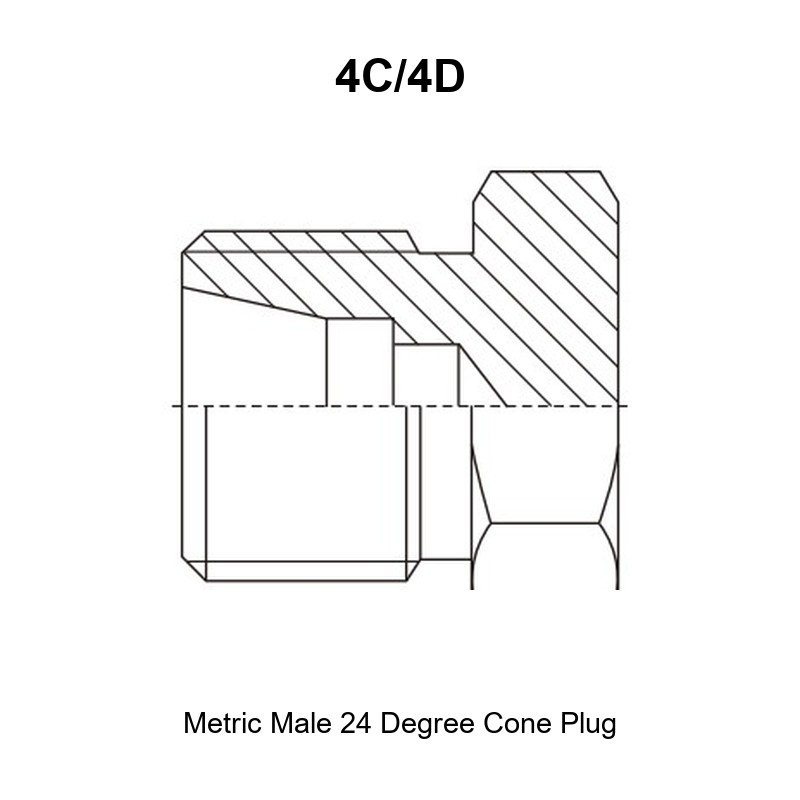
The metric male 24° cone plug adapter 4C / 4D is a machined steel plug with a metric male thread and a 24° cone, used to close a port that carries a metric female 24° cone seat. The cone does the sealing. When the plug is torqued into the port, the 24° cone is pressed into the female seat and the two steel surfaces deform into contact, so the blank holds pressure with no O-ring, no washer, no thread tape and no sealant.
That matters in two situations. First, in a manifold or valve block where a circuit branch has been deleted, threaded tape residue or a missing elastomer ring is a common source of weeping ports after a rebuild. Second, on equipment that spends its life outdoors or at high temperature, an elastomeric seal is the part that ages first; a cone plug has nothing to age.
Two series are listed under this drawing. 4C is the light L series and 4D is the heavy S series. Both are the same product in two wall thicknesses, matched to light series and heavy series ports respectively. Choosing between them is a question of which port you are blanking, not of which plug is stronger in the abstract.
Core Advantages
- Seals on the cone, not on the thread — the metric male 24° cone plug adapter 4C / 4D closes a port with a metal-to-metal cone joint, so leak paths do not depend on thread engagement, tape quality or sealant cure time.
- No elastomer to age out — with no O-ring in the joint, the blank does not go hard, swell or take a compression set, which suits high-temperature and long-dormant circuits.
- Fully removable and reusable — the plug can be backed out, inspected and refitted with the same result, which is what makes it useful for test ports and future expansion points.
- Wrench flats sized for the port — the hex is proportioned so the plug can be tightened with a standard open-end or ring wrench without damaging the cone.
- Light L and heavy S series in one family — 4C and 4D cover both port standards, so a mixed-standard machine needs only one spare-parts line per size.
- Free cross-reference and 24-hour quotation — send the port drawing, the old part number or a photograph and we will confirm the series, the thread and the quantity break.
Technical Specifications
What Is a 24° Cone Port Plug?
A 24° cone port plug is a solid, wrenchable fitting whose only purpose is to close a threaded port that is prepared with a metric 24° cone seat. It is not a cap, not a blind plug with a flat washer and not a tapered-thread pipe plug. The sealing surface is the 24° cone at the end of the plug, and it mates with the cone seat machined into the port.
This is the same sealing principle used by the male 24° cone stud ends in the DIN 3861 / ISO 8434-1 tube system, applied to a blanking function. That is the main practical benefit for a maintenance planner: the plug belongs to the same interface family as the tube fittings already on the machine, so one port preparation and one wrench set covers both tube joints and blanks.
A correctly specified metric male 24° cone plug adapter 4C / 4D is therefore a systems part rather than a miscellaneous hardware item. It closes the port without changing what the port is prepared for, and it can be removed later without repairing the port face, because nothing was cut, glued or taped.
Connection — Metric Male 24° Cone
| Article | Detail |
|---|---|
| Interface type | Metric male plug with 24° cone |
| Sealing method | Metal-to-metal 24° cone contact in the metric female cone seat |
| Thread form | Metric fine pitch, size-specific (for example M12X1.5, M16X1.5, M22X1.5) |
| Reference form | Metric 24° cone (DIN 3861 / ISO 8434-1 family) |
| Head style | Hex head with wrench flats, plain end opposite the cone |
| Série | Light L (4C) and heavy S (4D) |
| Sealing element | None — no O-ring, no washer, no sealant |
Dimensional Data
| Symbol | Signification | Unit |
|---|---|---|
| PART NO. | Catalogue order code for the size | – |
| E | Metric male thread at the plug end | mm pitch notation |
| D1 | Tube outside diameter the plug row is matched to | mm |
| l1 | Plug dimension as marked on the drawing | mm |
| L1 | Overall length of the plug | mm |
| S1 | Hex across flats at the plug head | mm |
| S2 | Second hex across flats shown on the drawing | mm |
Full Part Number Matrix
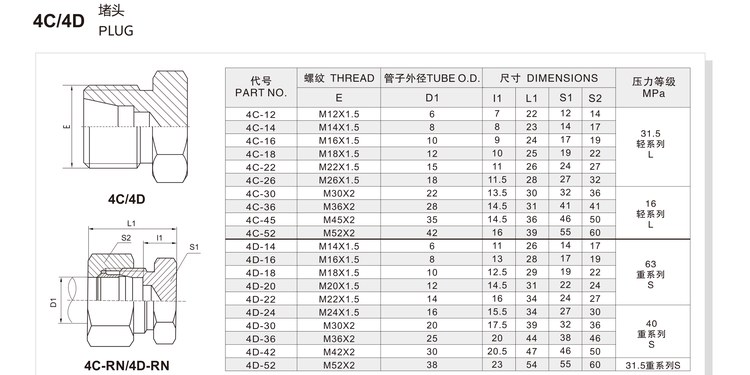
| PART NO. | E THREAD | TUBE O.D. D1 | l1 | L1 | S1 | S2 | Pressure Group |
|---|---|---|---|---|---|---|---|
| 4C-12 | M12X1.5 | 6 | 7 | 22 | 12 | 14 | 31.5 MPa, light series L |
| 4C-14 | M14X1.5 | 8 | 8 | 23 | 14 | 17 | 31.5 MPa, light series L |
| 4C-16 | M16X1.5 | 10 | 9 | 24 | 17 | 19 | 31.5 MPa, light series L |
| 4C-18 | M18X1.5 | 12 | 10 | 25 | 19 | 22 | 31.5 MPa, light series L |
| 4C-22 | M22X1.5 | 15 | 11 | 26 | 24 | 27 | 31.5 MPa, light series L |
| 4C-26 | M26X1.5 | 18 | 11.5 | 28 | 27 | 32 | 31.5 MPa, light series L |
| 4C-30 | M30X2 | 22 | 13.5 | 30 | 32 | 36 | 16 MPa, light series L |
| 4C-36 | M36X2 | 28 | 14.5 | 31 | 41 | 41 | 16 MPa, light series L |
| 4C-45 | M45X2 | 35 | 14.5 | 36 | 46 | 50 | 16 MPa, light series L |
| 4C-52 | M52X2 | 42 | 16 | 39 | 55 | 60 | 16 MPa, light series L |
| 4D-14 | M14X1.5 | 6 | 11 | 26 | 14 | 17 | 63 MPa, heavy series S |
| 4D-16 | M16X1.5 | 8 | 13 | 28 | 17 | 19 | 63 MPa, heavy series S |
| 4D-18 | M18X1.5 | 10 | 12.5 | 29 | 19 | 22 | 63 MPa, heavy series S |
| 4D-20 | M20X1.5 | 12 | 14.5 | 31 | 22 | 24 | 63 MPa, heavy series S |
| 4D-22 | M22X1.5 | 14 | 16 | 34 | 24 | 27 | 63 MPa, heavy series S |
| 4D-24 | M24X1.5 | 16 | 15.5 | 34 | 27 | 30 | 40 MPa, heavy series S |
| 4D-30 | M30X2 | 20 | 17.5 | 39 | 32 | 36 | 40 MPa, heavy series S |
| 4D-36 | M36X2 | 25 | 20 | 44 | 38 | 46 | 40 MPa, heavy series S |
| 4D-42 | M42X2 | 30 | 20.5 | 47 | 46 | 50 | 40 MPa, heavy series S |
| 4D-52 | M52X2 | 38 | 23 | 54 | 55 | 60 | 31.5 MPa, heavy series S |
The table above is transcribed in full from the 4C / 4D plug drawing: 10 light series L rows and 10 heavy series S rows, each with the plug thread E, the tube outside diameter D1, the dimensions l1 and L1, the hexes S1 and S2, and the pressure grade printed against that row. The drawing also shows the 4C-RN / 4D-RN variant, which is the same plug supplied as a complete set with cutting ring and nut.
Materials and Finish
| Component | Standard material |
|---|---|
| Plug body (4C / 4D) | Carbon steel, machined from bar stock |
| Surface protection | Plated finish as standard practice for hydraulic adapters |
| Sealing element | None |
| Alternative on request | Stainless steel body where the port sees washdown, brine or aggressive media |
Working Pressure and Operating Envelope
A metric male 24° cone plug adapter 4C / 4D is normally the strongest element in the joint, because the plug has no bore, no internal passage and no second thread. The pressure limit therefore comes from the port: the thread size, the wall thickness and material of the block, the cone seat preparation and the operating temperature all set the ceiling. Light L series plugs match light series ports and heavy S series plugs match heavy series ports, and the two must not be interchanged even where the thread happens to start.
Because the seal is metal-to-metal and the plug is solid, service temperature is limited by the port and the fluid rather than by an elastomer. Request the size-specific pressure table with your enquiry and we will return the rating for the exact thread, series and block material.
When to Blank a Port with a Cone Plug
Cone plugs are specified in four recurring situations:
- Decommissioned branches — a circuit has been removed but the port remains open in the block, and leaving it open is not acceptable for cleanliness or safety.
- Test and gauge ports — a port is used for commissioning checks, then has to be closed and reopened repeatedly without damaging the seat.
- Future expansion points — a manifold is delivered with spare ports blanked, so that adding a function later does not require stripping the block face.
- Shipping and storage — open ports are closed so that the internal surfaces of the machine arrive clean and free of debris.
In all four cases the argument for this plug is the same: it closes the port without adding a sealing element that can be lost, and it can be removed without cleaning tape or sealant out of the thread.
Installation Notes for the 4C / 4D Plug
- Inspect the cone seat first. Look for scratches, burrs, dirt or a previous thread sealant left in the port. A metal-to-metal cone will not seal across damage.
- Clean and dry the thread. Do not apply tape or paste. A cone joint is designed to seal on the cone, and sealant on the thread only changes the torque reading.
- Start the plug by hand until the cone contacts the seat. Cross-threading a solid plug is expensive; the first two turns by hand will tell you if the alignment is right.
- Torque to the value for the thread size and the block material. Over-torquing damages the cone seat in the block, which is a far more costly repair than the plug.
- Pressure-test the port before the machine returns to service, particularly on a block where several branches were blanked at the same time.
- Reuse is normal. Back the plug out, wipe it, inspect the cone, and refit it with the same torque value. No new sealing element is required.
Applications
The metric male 24° cone plug adapter 4C / 4D is used wherever a metric 24° cone port has to be closed durably:
- Hydraulic manifolds and valve blocks with spare or decommissioned ports
- Machine tools, presses and injection moulding machines on maintenance shutdowns
- Mobile and agricultural equipment during temporary or seasonal circuit changes
- Test stands and commissioning rigs with gauge ports that are opened and closed repeatedly
- Spare-part kits held by service providers for emergency port blanking
In each case the objective is a closed port that will open again cleanly.
Quality, Testing and Traceability
Plugs are machined from controlled steel stock, and thread form, cone angle, head squareness and hardness are checked as part of the normal production flow. Batch labels allow a supplied plug to be traced back to the material lot, and assemblies are pressure tested where the plug is supplied as part of a manifold kit. Material test reports, dimensional inspection records and third-party inspection arrangements are available on request, and OEM laser marking of part numbers or customer references can be applied where the quantity supports it.
Ordering Information
To order, specify four things:
- Série — light L (4C) or heavy S (4D)
- Thread size — the metric male thread that matches the port
- Head style — hex head as standard, or a specific head form from your drawing
- Quantity and marking — including any customer reference that has to be laser marked
Standard catalogue sizes ship from stock; non-standard threads are machined to order.
FAQ
Is the metric male 24° cone plug adapter 4C / 4D the same as a BSP or NPT pipe plug? No. A pipe plug seals on a tapered thread, usually with tape or paste. A 24° cone plug seals on a machined cone against a machined seat. The two are not interchangeable, and forcing a tapered plug into a cone port damages the seat.
Do I need an O-ring or a washer with this plug? No. The cone is the sealing surface. Adding a washer moves the cone off its seat and creates a leak path instead of closing one.
How much torque should be used? Use the value specified for the thread size and the block material. As a rule the cone only needs to be brought into firm contact; the seat is damaged by excess torque, not saved by it.
Can the plug be reused after it has been in service? Yes. Inspect the cone for dents or scoring, clean the thread, refit and torque. There is no sealing element to replace.
Can you supply plugs for a port that is not in your catalogue? Yes. Send the thread size, the cone form and the wrench clearance available around the port, and we will machine a plug that fits.
Request a Quote for the Metric Male 24° Cone Plug Adapter 4C / 4D
Send us the port drawing, the thread size and the old part number or a photograph of the plug being replaced, and we will confirm the series, the thread, the head form and the lead time within 24 hours. Please state the working pressure, the fluid and the operating temperature so that we can quote the correct material rather than a nominal equivalent. Stainless steel versions, non-standard threads and complete spare-part kits are available on the same order.
Browse the full Hydraulic Adapters range for the complete family, or contact us to request a quote, mill test reports, and samples.


 English
  Spanish
  Portuguese
  French
  German