
Why the Metric Lock Nut 8C Belongs in Every Service Kit
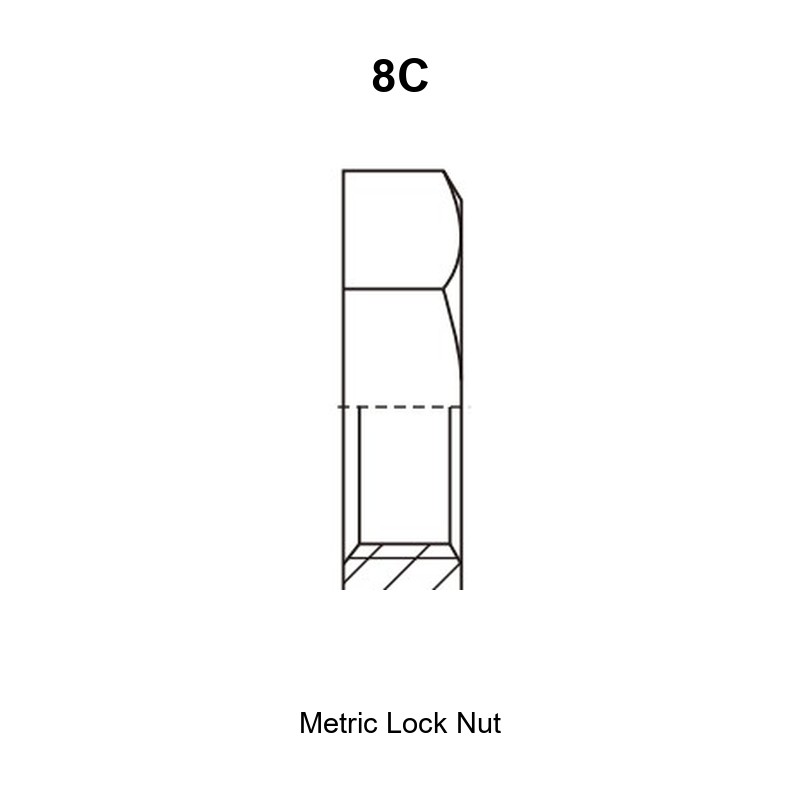
The metric lock nut 8C is a machined steel hex nut used to lock a bulkhead fitting, a panel mounted adapter or a stud end onto the structure it passes through. It is the small part that decides whether the joint stays put. When the nut is tightened against the fitting shoulder it clamps the panel or the manifold wall between itself and the shoulder, which both anchors the fitting mechanically and compresses the sealing element at the wall face.
Lock nuts get replaced far more often than the fittings they hold. They are removed and refitted each time a panel is opened, they are the part that gets dropped into a machine frame, and they are the part that is over-torqued and stripped by a fitter working with the wrong wrench. Keeping the correct metric lock nut 8C in stock is what turns a two-hour shutdown into a ten-minute job.
The 8C series is a straightforward, single-purpose range: metric fine pitch threads from M10X1 up to M33X2, one hex across flats per size, and a face that is machined square so that it bears evenly on the panel. A small number of sizes exist as separate catalogue entries under a suffixed part number, and those must be ordered by part number rather than by thread size alone.
Core Advantages
- Machined and square-faced — the bearing face is machined to sit flat against the panel or the fitting shoulder, so the clamp load is distributed instead of being carried on an edge.
- Metric fine pitch across the range — the whole metric lock nut 8C series uses metric fine threads, matching the metric adapter families used on the same machines.
- Hex sized for standard wrenches — each size takes an open-end or ring wrench from the normal range, so no special tool is needed on site.
- Available as a stock service item — lock nuts are consumables; the series is offered so that a spare is always on the shelf next to the fitting it belongs to.
- Traceable material — nuts are machined from controlled steel stock with batch labels, and material test reports are available on request.
- Free cross-reference — send the fitting part number or a photograph of the nut you are replacing and we will confirm the size within 24 hours.
Technical Specifications
What Is a Metric Lock Nut?
A metric lock nut is a hex nut with a metric fine pitch thread, used to lock a threaded component in position rather than to fasten two parts together with a bolt. In hydraulic practice the nut is threaded onto the mounting section of a bulkhead fitting or a panel mounted adapter, and it is tightened until the panel is clamped between the nut and the machined shoulder of the fitting. The same type of nut is used to lock stud ends and adapters that pass through a bracket.
Two properties matter more than the thread itself. The first is the bearing face: it must be flat and square to the axis, because the nut carries the clamp load and any rock in the face reduces the sealing force at the wall. The second is the hex across flats: it has to suit the wrench that can actually reach the position, which is why the standard hex matters as much as the thread in service.
Thread and Dimensions
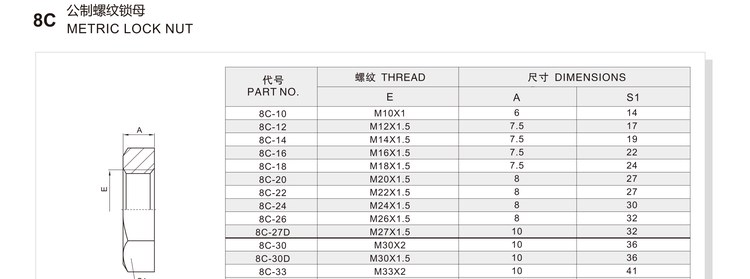
| Symbol | Signification | Unit |
|---|---|---|
| PART NO. | Catalogue order code for the nut | – |
| THREAD E | Metric fine pitch thread of the nut | mm pitch notation |
| A | Nut height, the overall axial thickness | mm |
| S1 | Hex across flats, the wrench size | mm |
Full Size Table
| PART NO. | THREAD E | A (mm) | S1 (mm) |
|---|---|---|---|
| 8C-10 | M10X1 | 6 | 14 |
| 8C-12 | M12X1.5 | 7.5 | 17 |
| 8C-14 | M14X1.5 | 7.5 | 19 |
| 8C-16 | M16X1.5 | 7.5 | 22 |
| 8C-18 | M18X1.5 | 7.5 | 24 |
| 8C-20 | M20X1.5 | 8 | 27 |
| 8C-22 | M22X1.5 | 8 | 27 |
| 8C-24 | M24X1.5 | 8 | 30 |
| 8C-26 | M26X1.5 | 8 | 32 |
| 8C-27D | M27X1.5 | 10 | 32 |
| 8C-30 | M30X2 | 10 | 36 |
| 8C-30D | M30X1.5 | 10 | 36 |
| 8C-33 | M33X2 | 10 | 41 |
The table above is transcribed from the metric lock nut specification table. Note that 8C-27D and 8C-30D are separate catalogue entries in a thread size that also appears elsewhere in the range — choose by PART NO., not by thread size alone, because the nut height and the thread pitch differ between the entries. Metric lock nut 8C sizes outside this table are machined to order. Confirm the thread, nut height and wrench size against your fitting drawing before release.
Materials and Finish
| Component | Standard material |
|---|---|
| Nut body (8C) | Carbon steel, machined from bar stock |
| Surface protection | Plated finish as standard practice for hydraulic adapters |
| Alternative on request | Stainless steel nuts for washdown, brine or aggressive environments |
Working Pressure and Operating Envelope
A lock nut does not seal; it clamps. Its requirement is therefore mechanical rather than hydraulic: it must develop enough clamp load to hold the fitting against the panel through the full range of vibration, pressure cycling and thermal expansion that the machine sees. The pressure ceiling of the joint is set by the fitting and the panel, not by the nut, but a nut of the wrong material, the wrong height or a stripped thread will remove the clamp load and the joint will leak at the wall face.
Two service points follow. First, always match the nut to the fitting rather than to a thread gauge: the same thread pitch appears in more than one catalogue entry with different nut heights. Second, on machines that run hot, re-check the clamp after the first thermal cycle, because the panel and the fitting expand at different rates and the clamp load can relax.
Where Lock Nuts Are Used
The metric lock nut 8C is used wherever a hydraulic component is anchored by a threaded mounting section:
- Straight bulkhead fittings passing through machine frames, guards and reservoir walls
- Panel mounted adapters on skids, test stands and control cabinets
- Stud ends locked into a bracket or a plate
- Cylinder mounted adapters with a threaded mounting section
- Field repair kits, where a stripped or lost nut has to be replaced without replacing the fitting
In each case the function is the same: hold the component in position and keep the clamp load on the joint.
Installation Notes for the 8C Lock Nut
- Check the thread pitch before fitting. Metric fine threads in the same nominal size are not interchangeable. Confirm against the fitting part number.
- Clean the mounting thread and remove any previous thread sealant, tape or debris.
- Run the nut on by hand to the point where it contacts the panel or the sealing washer. If it binds before that point, stop and check the thread rather than forcing it with a wrench.
- Tighten to the specified clamp torque while holding the fitting flats so that the line connections are not disturbed.
- Check the seal at the panel face, not just the nut, after the first pressure test.
- Replace rather than reuse a nut whose hex is rounded or whose thread has been damaged; the low cost of the nut does not justify the risk to the joint.
Quality, Testing and Traceability
Every metric lock nut 8C is machined from controlled steel stock, and thread form, nut height, hex across flats and bearing face squareness are checked as part of the normal production flow. Batch labels allow a supplied nut to be traced back to the material lot, and material test reports, dimensional inspection records and third-party inspection arrangements are available on request. OEM laser marking of part numbers or customer references can be applied where the quantity supports it.
Ordering Information
To order, specify three things:
- PART NO. — from the size table above, so that the correct nut height and pitch are supplied
- Thread confirmation — the fitting or adapter part number the nut is intended for
- Quantity and marking — including any customer reference that has to be laser marked
Standard sizes ship from stock; non-standard threads and stainless steel nuts are machined to order. Lock nuts are also supplied as part of complete bulkhead fitting kits where the customer prefers a single order line.
FAQ
Is a lock nut the same as a standard hex nut? Functionally it is a hex nut with a metric fine pitch thread, but it is selected by height, hex and bearing face rather than by thread alone. In a hydraulic joint it carries clamp load, so the bearing face and height matter.
Why are there two entries with the same thread size? Some thread sizes appear in more than one catalogue entry with a different nut height and a slightly different pitch — 8C-27D and 8C-30D are examples. Order by PART NO. and confirm against the fitting.
Can I substitute a hardware store nut? Not safely. A nut of the wrong height, pitch class or material will not hold the clamp load, and an undersized hex face can damage the panel.
Do I need a washer under the lock nut? Follow the fitting installation drawing. Where a sealing washer is specified at the panel face it goes between the shoulder and the panel, not under the nut.
Do you supply the fittings that these nuts lock? Yes. Bulkhead fittings, panel mounted adapters and the matching lock nuts can be supplied on one order, pre-matched by part number.
Request a Quote for the Metric Lock Nut 8C
Send us the fitting part number, the thread size or a photograph of the nut being replaced, and we will confirm the correct PART NO., the nut height and the wrench size within 24 hours. Please state the quantity, the material you require and whether the nuts are to be supplied as a kit with the fittings they belong to. Standard sizes ship from stock, and stainless steel or non-standard threads are machined to order.
Browse the full Hydraulic Adapters range for the complete family, or contact us to request a quote, mill test reports, and samples.

 English
  Spanish
  Portuguese
  French
  German