
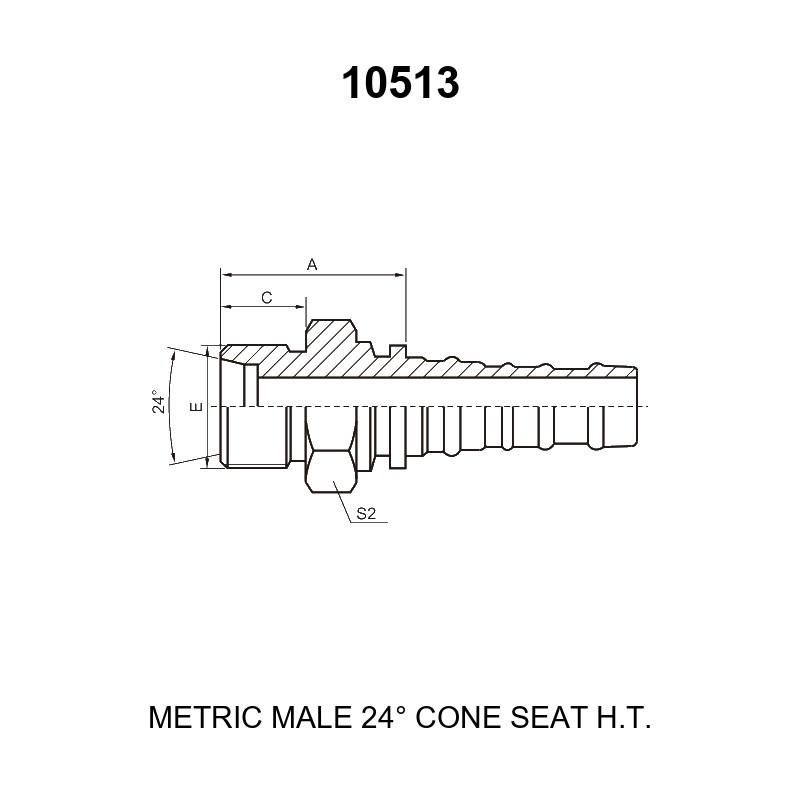
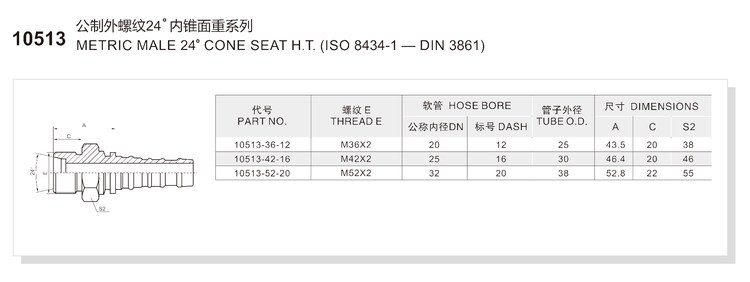
Interlock 24-degree cone hydraulic hose fittings are the large-bore answer when a plain barb tail is not enough. The 10513 heavy-series (H.T.) male ends keep the ISO 8434-1 / DIN 3861 24-degree cone on the port side and add an interlock tail on the hose side: a ribbed gripping zone plus a locking groove that works with a matched interlock ferrule to resist hose blow-off under pressure impulses. Three part numbers cover the biggest sizes in the heavy-series family: M36x2 (DN20), M42x2 (DN25) and M52x2 (DN32). If your assemblies carry large-bore hoses in circuits where a pulled-out hose end is not an option, this page explains how interlock construction changes the joint.
Why Choose These Interlock Hydraulic Hose Fittings
- Interlock tail against blow-off. The ribbed tail and locking groove engage with the matched interlock ferrule, giving the hose end a mechanical lock that plain barbs do not provide under severe pressure impulses.
- The heavy-series 24-degree cone. Port side stays in the ISO 8434-1 / DIN 3861 heavy-series (H.T.) system, so it connects into the same heavy-series machine ports as the 10511 range.
- The large-bore sizes that matter. M36x2, M42x2 and M52x2 cover DN20, DN25 and DN32 – the big hoses where retention force matters most.
- Supplied as a complete system. The fitting is designed to work with its matched interlock ferrule, and we supply both, so the tail and the crimp profile are always compatible.
Standards and traceability. Threads are ISO 724 metric threads. The sealing geometry follows the 24-degree cone heavy series per ISO 8434-1 / DIN 3861, the successor system to the well-known DIN 2353 heavy series. Dimensional inspection reports and material test certificates are available for OEM gate checks.
What Does “Interlock” Mean for Your Assembly?
A standard hose tail holds the hose with barbs that bite into the rubber and wire reinforcement. That works across most of the size range, but on large-bore hoses under high pressure, pressure impulses can work the hose end loose over time. The interlock design answers that in two ways:
- A longer, ribbed gripping zone on the tail gives the ferrule more surface to compress.
- A locking groove near the hex works with the matched interlock ferrule, whose crimp profile interlocks into that groove. Once crimped, the ferrule and the tail are mechanically locked together, so the hose cannot be pulled out of the fitting – even if the cover and wire are stressed by repeated impulse cycles.
The practical result: an interlock joint resists blow-off far better than a plain barb joint of the same size, which is why this construction is chosen for large-bore circuits in mining, offshore, heavy equipment and other impulse-heavy duty.
What does the interlock system include?
Each 10513 part number is designed for a specific matched interlock ferrule. Order the fitting and the ferrule together, or order pre-made hose assemblies from us, so the tail profile, the ferrule profile and the crimp specification always come from the same engineering data. Mixing an interlock tail with a plain ferrule removes the locking benefit, and mixing a plain tail with an interlock ferrule will not crimp correctly.
How is the 10513 different from the 10511 heavy series?
Both are heavy-series (H.T.) 24-degree cone male fittings to the same standard. The 10511 series covers the full heavy-series range with a plain barb tail; the 10513 series covers the three largest sizes (M36x2, M42x2, M52x2) with the interlock tail and matched ferrule. Where your drawing specifies an interlock construction – or where field experience says plain barbs are not holding – the 10513 is the fitting to use.
Cone and series checks
- The cone angle must be 24 degrees to match this series. 60-degree (10611 family) and 90-degree (10811L family) ports take their own fittings.
- Heavy series (H.T.) and light series (L) thread schedules are not interchangeable. These part numbers are heavy-series; check the thread callout on the port.
10513 Series Technical Specifications
Materials and processing
- Body material options: high-strength carbon steel (20#/35#/45# grades, cold-formed or machined) as standard; stainless steel 304 or 316L available for corrosive or wash-down environments.
- Surface treatment: zinc plating as standard; yellow, white or black zinc, zinc-nickel and Dacromet coating available for higher salt-spray requirements.
- Heat treatment: hardness and case depth are controlled per drawing to keep the thread, the cone zone and the interlock groove fatigue-resistant; typical surface hardness range HRC 20-28 (confirm the exact code on your drawing or PO).
- Matched ferrule: interlock ferrule supplied with the fitting or as a set, plated to match.
Full dimension and part number table
All linear dimensions are in millimeters. E = thread, DN = hose bore, Tube O.D. = the DIN heavy-series tube size sharing this thread and cone geometry, A and C = lengths per the supplier drawing, hex = across flats (labeled S2 on the sheet).
| Part Number | Fil de discussion E | Hose bore DN (mm) | Taille des tirets | Diamètre extérieur du tube (mm) | A (mm) | C (mm) | Hex (mm) |
|---|---|---|---|---|---|---|---|
| 10513-36-12 | M36x2 | 20 | -12 | 25 | 43.5 | 20 | 38 |
| 10513-42-16 | M42x2 | 25 | -16 | 30 | 46.4 | 20 | 46 |
| 10513-52-20 | M52x2 | 32 | -20 | 38 | 52.8 | 22 | 55 |
Full dimensioned CAD drawings and the matched ferrule drawing are available on request so your engineers can verify the tail profile, the locking groove and the crimp envelope before you commit a batch.
Which hose and what pressure?
This specification sheet lists the three part numbers without a hose-type or pressure note, so we will not guess for you. The interlock construction is built for high-retention duty on large-bore wire-reinforced hoses, and the correct working pressure always depends on the hose you pair with it and the crimp quality. Send us your hose specification and we will confirm the working pressure, burst margin and the exact interlock ferrule for your hose brand – the check is free and takes one message. For derating at elevated temperature, follow the hose manufacturer’s pressure-temperature curve.
Ordering the Complete Interlock System
Interlock fittings are a system, not a single part. For every 10513 part number you have three ordering options:
- Fitting only – if you already hold the matched interlock ferrule and crimp data.
- Fitting + matched interlock ferrule – the recommended option for hose assembly shops, so the tail and ferrule profiles always come from the same engineering data.
- Complete hose assembly – we cut, crimp and pressure-test assemblies to your hose spec and length, ready to install.
Tell us which option you need when you send the inquiry, and include your hose brand and type so we can confirm the crimp specification from the hose manufacturer’s data.
Part Number Decoder and How to Order
The 10513 part number carries the whole specification, so purchasing can copy it straight into a PO:
10513 – 42 – 16
- 10513 = heavy-series 24-degree cone interlock fitting
- 42 = thread nominal size (here M42x2, DIN heavy-series class for 30 mm tube)
- 16 = hose dash size (here DN25, 1-inch class bore)
If you are replacing an existing fitting, send us a photo of the thread end, the tail and the hose side, plus the hex size, and we will confirm the matching part number and ferrule the same day. This service is the fastest way to convert an unreadable old part number into a confirmed 10513 order – and it also tells you whether your old tail was an interlock or a plain barb design.
Assembly Guide: Four Steps for the Interlock Tail
Assembly follows the standard crimp routine, with one extra check on the ferrule.
Étape 1 – Coupez le tuyau à angle droit. Use a sharp hose cutter or cutoff saw. A square, clean cut is essential because the interlock ferrule must grip the full hose end evenly.
Step 2 – Prepare the insert depth. The hose must reach the full insertion depth on the ribbed tail, so the locking groove zone is covered correctly by the ferrule. Measure once against the fitting and use that depth on every assembly of the same size.
Étape 3 – Lubrifiez et insérez. Apply a thin film of assembly lubricant to the hose bore and the tail. Push the hose in with a steady twisting motion until it bottoms out, then wipe away excess lubricant. Do not use grease on the cone face.
Step 4 – Crimp the matched ferrule and verify. Use the interlock ferrule supplied for this part number and the hose manufacturer’s crimp specification. After crimping, always measure the crimp outside diameter with a caliper and compare it with the crimp table. If it is out of tolerance, do not put the assembly into service – cut it off and re-crimp with a corrected setting.
Warnings: three mistakes that defeat the interlock
- Never pair an interlock tail with a plain ferrule, or a plain tail with an interlock ferrule. The locking groove only works with the matched ferrule profile.
- Never mix cone-angle families or heavy/light thread schedules. A 24-degree heavy-series fitting goes into a 24-degree heavy-series port, nothing else.
- Never put PTFE tape or sealant on the straight metric thread, and never re-use a crimped fitting or ferrule. The cone and the interlock are made for one assembly cycle each.
Typical Applications
The interlock construction earns its place on large-bore circuits where a blow-off means downtime, fluid loss or worse. Typical duty includes:
- Mining and tunneling hydraulic systems
- Offshore and marine auxiliary circuits
- Heavy construction and earthmoving equipment
- Large hydraulic power units and presses
- High-impulse industrial circuits with big return and pressure lines
Wherever the port carries a 24-degree heavy-series cone seat and the hose is large-bore wire-reinforced, the 10513 interlock series is the high-retention choice.
OEM Customization and Quality Traceability
For equipment builders and large maintenance programs, the 10513 series can be adapted to your exact drawing and your traceability rules.
Customization options
- Thread and geometry: special threads, modified lengths and non-standard tail configurations machined to your drawing or to a sample.
- Surface treatment: zinc-nickel, Dacromet or other coatings for higher salt-spray grades; we confirm the achieved test hours for the coating you choose instead of quoting a generic number.
- Laser marking: your logo, part number and batch or date code laser-marked on the hex for full field traceability.
- Material: stainless steel 304/316L versions for corrosive media or wash-down duty.
- Assembly service: complete hose assemblies cut, crimped and tested to your hose spec.
- Packaging and kitting: fitting + ferrule sets kitted per assembly, custom labels and barcodes.
Quality documentation
- Batch number traceability: every order carries a batch code that links back to the production records.
- Material test reports (MTR) available for carbon steel and stainless batches.
- Dimensional inspection reports for OEM gate checks.
- Third-party inspection (BV, SGS or similar) can be arranged before shipment.
Samples and MOQ. Samples for stock sizes ship fast. Because interlock is a system, we recommend ordering the fitting and matched ferrule together for the first trial, so the crimp test runs on the correct pair.
Emballage et logistique
Standard export packing: fittings and ferrules are individually poly-bagged or boxed to protect threads, cone faces and interlock profiles, then packed in export cartons labeled with part number, quantity and batch code. Custom labeling, kitting and barcode requirements are available. Exact carton quantity, gross weight and CBM are confirmed on the packing list for every order.
FAQ
Q: What is an interlock hydraulic hose fitting? A: An interlock fitting has a ribbed hose tail with a locking groove that works with a matched interlock ferrule. Once crimped, the ferrule interlocks into the groove, giving the joint a mechanical lock that resists hose blow-off under pressure impulses.
Q: What is the difference between 10513 and 10511? A: Both are heavy-series (H.T.) 24-degree cone fittings. The 10511 series covers the full heavy-series range with a plain barb tail; the 10513 covers the three largest sizes (M36x2, M42x2, M52x2) with the interlock tail and matched ferrule.
Q: Do I need a special ferrule for the 10513? A: Yes. The interlock tail is designed for its matched interlock ferrule. We supply the fitting and ferrule together so the profiles always match.
Q: What cone angle does the 10513 use? A: 24 degrees, per ISO 8434-1 / DIN 3861 heavy series. It is not interchangeable with 60-degree or 90-degree cone ports.
Q: Is the 10513 heavy series or light series? A: Heavy series (H.T.). The thread schedule is the heavy-series schedule for each size, for example M42x2 for the 30 mm tube class. Light-series ports are not compatible.
Q: Which hose can I use with a 10513 fitting? A: This sheet lists the three part numbers without a hose-type note. The interlock construction suits large-bore wire-reinforced hoses; send us your hose specification and we will confirm the fit, the ferrule and the crimp data.
Q: Can you supply complete hose assemblies? A: Yes. We can cut, crimp and pressure-test assemblies to your hose spec and length, with the interlock fitting and ferrule matched.
Q: Can you make custom part numbers with my logo? A: Yes. We offer laser marking, custom plating, stainless versions and special dimensions, with MTR and batch traceability for OEM programs.
Order Today: Interlock 24-Degree Cone Hydraulic Hose Fittings with Matched Ferrule
Every 10513 interlock 24-degree cone hydraulic hose fitting is made to controlled dimensions, inspected before packing and backed by batch traceability. Send us your hose type, thread size and a photo of the port or the old fitting, and you will get a confirmed part number, the matched interlock ferrule, a delivery date and a quote within one working day. Request samples first and run them through your own crimper with the matched ferrule – the pull test will show you what interlock retention means on large-bore hose. We make sure the fitting, ferrule and hose work as one blow-off-resistant assembly.


 English
  Spanish
  Portuguese
  French
  German