


Why This BSP Female 60° Cone Double Hexagon Fitting Passes the Compliance Gate
A BSP female 60° cone double hexagon fitting joins a braided hydraulic hose to a BSPP 60° cone connection: a swivel nut with an internal parallel G thread draws the fitting’s 60° cone face onto the cone seat of the mating stud, and the two metal faces seal without an O-ring. The 22618D series from HENGHUA is built to ISO 12151-6 for hose fittings with ISO 8434-6 60° cone ends, covering 8 part numbers from -04 to -20 with G-series parallel threads from G1/4″ to G1.1/4″. Every unit is cold-forged from carbon steel, heat-treated, plated, and 100% pressure tested before shipment. For OEM buyers this fitting is a compliance gate; for maintenance teams it is a double hexagon termination with two wrenching positions and a swivel nut that never twists the hose.
- ISO 12151-6 / ISO 8434-6 60° cone geometry: the fitting body ends in a machined 60° cone that seats metal-to-metal against the mating 60° cone seat. The G thread is parallel (ISO 228-1) and only holds the connection; the cone does the sealing. No O-ring and no thread sealant are needed at the joint in the standard version.
- Double hexagon body: the drawing shows a hexagon on the main body (S1) and a second hexagon on the swivel nut collar (S2). S2 is the larger hex and is sized to the G thread; S1 is the body hex. Two hexagons mean two wrenching positions, which matters when one side of the joint is buried in a confined space.
- Captured swivel nut: the nut with the internal G thread rotates freely on the body (retained by a thrust wire on the W execution), so you can orient the hose before final torque without twisting the hose assembly.
- Eight sizes, one family: -04 to -20 with G1/4″ to G1.1/4″ threads covers the working range of small and medium BSP circuits, including the -06-05 combination for an 8 mm hose bore on a G3/8″ port.
- OEM gate check: full dimensional and material conformance per ISO 12151-6 and ISO 8434-6, with material test reports (MTR) available for every batch.
Core Advantages
- Two hexagons, two wrenching positions: the S1 body hex and the S2 nut hex give you a place to hold the fitting from either side of the joint, which turns confined-space installations into a routine job.
- Swivel nut, no hose twist: the nut turns independently on the body, so the hose keeps its natural lay and the assembly is not wound up when you tighten the connection.
- ISO 8434-6 pressure class: the 60° cone end is manufactured and tested per the standard (test practice ISO 19879), with heavy (S) class stud ends of this cone geometry rated up to 63 MPa (630 bar) in the small sizes; the rating for your part number is confirmed on the datasheet.
- -40°C to +120°C operating range: the steel cone seal holds across cold-start and hot-running circuits without elastomer ageing at the joint.
- 96 to 1000 h salt spray options: trivalent zinc (96 h), zinc-nickel (720 h), or Dacromet (1000 h), matched to your environment.
Technical Specifications
What Is This BSP Female 60° Cone Double Hexagon Fitting?
This fitting terminates a braided hose with the BSP 60° cone connection defined by ISO 8434-6 and used widely across European and Commonwealth hydraulic equipment. The port end is a swivel nut carrying a BSPP parallel thread (G series, thread form per ISO 228-1); inside the nut, the fitting body ends in a machined 60° cone. When the nut is tightened onto a male G-threaded stud, the 60° cone is drawn into the mating 60° cone seat and the two cone faces meet metal-to-metal. The joint seals by cone contact alone, so no O-ring or thread sealant is used in the standard version. The G thread is parallel and does not seal by interference; it only pulls and holds the connection. This is why a 60° cone seat must never be interchanged with a BSPT taper thread, which seals by thread interference instead.
On this BSP female 60° cone double hexagon fitting, two hexagons are machined: S1 on the main body, behind the stem, and S2 on the swivel nut at the port end. S2 is always the larger hex because it must clear the G thread it carries. In a confined installation you can hold S1 with a wrench while you tighten the mating stud, or wrench the nut hex S2 directly when the body side is not accessible. Two hexagons also let a technician hold the body firmly while the hose end is being connected, which protects the stem and the crimp zone from torsional load.
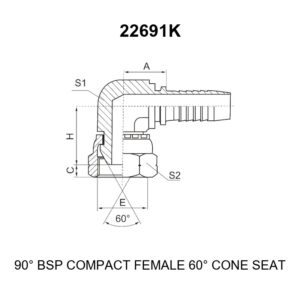
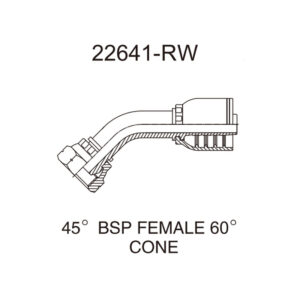
The 22618D series is the double hexagon straight execution of the BSPP 60° cone family from HENGHUA, in the -04 to -20 size band. The part numbers carry the R5 program suffix on the factory sheet; the -20-20 execution is drawn with the W variant, whose swivel nut is retained by a thrust wire. Use this straight fitting when the hose approaches the port in line with the port axis; it complements the 22641 (45°) and 22691 (90°) elbows on the same cone geometry. Confirm your exact hose construction with our engineers and the matching crimp data sheet is supplied with the order.
Dimensional Data and Threads
| Symbol | Description |
|---|---|
| E | BSPP female thread inside the swivel nut (G series, ISO 228-1), G1/4″ to G1.1/4″ |
| A | Overall length of the fitting, from the shoulder of the main body to the end of the hose stem |
| C | Depth of the internal G thread engagement in the swivel nut |
| S1 | Hex across flats of the main body |
| S2 | Hex across flats of the swivel nut collar |
| Dash | Hose inside diameter in 1/16″ increments (-04 to -20); per ISO 4397, -04 to -20 correspond to DN 6 to DN 32 hose bores |
Full dimension drawings with A, C, S1, and S2 callouts are supplied as PDF and CAD (STEP/DWG) files. Because this is a crimp fitting, the two process-critical parameters are the hose insert depth and the crimp outside diameter; both are hose-series specific and are listed in the crimp data sheet that accompanies every order.
Full Dimension Table (Part Number Matrix) {#by-thread-size}
Read the table with your BSPP thread (E) and your hose size (dash). The part number is the order code; copy it directly into your inquiry or purchase order. The pattern is 22618D-[thread dash]-hose dash: for example, 22618D-12-12(R5) has a G3/4″ thread and suits a -12 (20 mm) hose.
| Référence. | Thread E (BSPP) | Dash | A (mm) | C (mm) | S1 (mm) | S2 (mm) |
|---|---|---|---|---|---|---|
| 22618D-04-04(R5) | G1/4″x19 | 04 | 26 | 5.5 | 14 | 19 |
| 22618D-06-05(R5) | G3/8″x19 | 05 | 29.1 | 6.3 | 17 | 22 |
| 22618D-06-06(R5) | G3/8″x19 | 06 | 30 | 6.3 | 17 | 22 |
| 22618D-08-08(R5) | G1/2″x14 | 08 | 35 | 7.5 | 19 | 27 |
| 22618D-10-10(R5) | G5/8″x14 | 10 | 35.5 | 9.5 | 22 | 30 |
| 22618D-12-12(R5) | G3/4″x14 | 12 | 38.5 | 10.9 | 27 | 32 |
| 22618D-16-16(R5) | G1″x11 | 16 | 37 | 11.7 | 32 | 41 |
| 22618D-20-20(R5)W | G1.1/4″x11 | 20 | 41.5 | 11 | 41 | 50 |
The part numbers shown are the R5 executions on the factory sheet. If your hose construction needs a different stem profile, a custom BSP female 60° cone fitting is machined on request.
Select by Hose Dash Size {#by-hose-size}
Match your hose bore first, then confirm the thread for that bore (dash sizes follow ISO 4397: -04 = DN 6, -05 = DN 8, -06 = DN 10, -08 = DN 12, -10 = DN 16, -12 = DN 20, -16 = DN 25, -20 = DN 32):
| Hose Dash | Part Number |
|---|---|
| -04 | 22618D-04-04(R5) (G1/4″) |
| -05 | 22618D-06-05(R5) (G3/8″) |
| -06 | 22618D-06-06(R5) (G3/8″) |
| -08 | 22618D-08-08(R5) (G1/2″) |
| -10 | 22618D-10-10(R5) (G5/8″) |
| -12 | 22618D-12-12(R5) (G3/4″) |
| -16 | 22618D-16-16(R5) (G1″) |
| -20 | 22618D-20-20(R5)W (G1.1/4″) |
Matériaux et traitements thermiques
| Article | Standard Option | Premium Option |
|---|---|---|
| Material | High-strength cold-forged carbon steel (20#/35#/45#) | Stainless steel 304 or 316L |
| Heat treatment | Carburizing and quenching, core hardness HRC 20-28 | Solution treatment, stable corrosion resistance |
| Surface | Trivalent zinc plating (96 h salt spray) | Zinc-nickel (720 h), Dacromet (1000 h), or passivated |
| Thread class | G-series gauge-checked | Same, with 100% thread gauge inspection |
Cold forging preserves the grain flow of the steel, which raises fatigue resistance under pressure pulsation. Each heat-treatment batch is hardness-tested and recorded, so the hardness number on the MTR matches the parts you receive.
Working Pressure
| Article | Rating |
|---|---|
| 60° cone end (ISO 8434-6) | Pressure class per ISO 8434-6, size-dependent; heavy (S) class stud ends with this cone sealing geometry are rated up to 63 MPa (630 bar) in the small sizes |
| Crimped assembly | Governed by the hose and confirmed per ISO 12151-6 test practice; braided hose at these sizes typically carries about 10-40 MPa depending on construction and size |
| Factory test | Every fitting is 100% pressure tested before shipment |
The exact rating for your part number and hose combination is confirmed on the datasheet and by our engineers before shipment.
Pressure-Temperature Operating Envelope
| Temperature | Pressure Retention |
|---|---|
| -40°C | 100% of rated pressure |
| -20°C | 100% |
| 0°C | 100% |
| +20°C | 100% |
| +40°C | 100% |
| +60°C | 100% |
| +80°C | 100% |
| +100°C | 100% |
| +120°C | 100% (system derating governed by hose and elastomer seals, not by the fitting) |
The steel cone seal and body hold full rated pressure across the whole temperature window. In a crimped assembly the working pressure is governed by the weakest component, normally the hose; use the hose derating curve for the system, and the fitting will not be the limiting part.
Selection and Ordering
The 22618D BSP female 60° cone double hexagon fitting series covers the double hexagon segment of BSP hydraulic hose fittings from -04 to -20, so most orders can be placed directly from the table above.
How to Read the Part Number Matrix
Find your BSPP thread in the E column, then the hose dash size you use. The intersecting row gives the order code, for example a G1/2″ thread with a -08 hose gives 22618D-08-08(R5). If your combination is not listed, send us both sizes; a custom BSP 60° cone fitting is machined on request.
BSPP Thread Size Chart
Use this chart to identify the thread on your port. BSPP G threads are parallel; they are identified by measuring the thread outside diameter and counting the threads per inch.
| BSPP Thread (G) | TPI | Thread Dash | Typical Hose Dash |
|---|---|---|---|
| G1/4″ | 19 | -04 | -04 |
| G3/8″ | 19 | -06 | -05, -06 |
| G1/2″ | 14 | -08 | -08 |
| G5/8″ | 14 | -10 | -10 |
| G3/4″ | 14 | -12 | -12 |
| G1″ | 11 | -16 | -16 |
| G1.1/4″ | 11 | -20 | -20 |
Cross Reference Service {#by-oem-part-number}
Most maintenance teams buy against a legacy part number printed on the old drawing. Send us the OEM or distributor part number you currently use, with a photo of the fitting if possible. Our engineers identify the thread, the cone geometry, the hose size, and the body configuration, then confirm the exact 22618D equivalent before you place the order. The service covers 60° cone fittings, BSP hydraulic hose fittings, and BSPP elbows in your inventory, and interchange confirmation is free. The cross reference sheet is returned in PDF for your records.
Emballage et logistique
| Article | Detail |
|---|---|
| Standard packing | 10 pcs per box (typical), 100 pcs per carton for small sizes |
| Gross weight | Calculated per size and confirmed on the proforma invoice |
| Marking | Carton label with part number, quantity, and batch number for incoming inspection |
| Origine | Made in China, HENGHUA factory |
| Export documents | Commercial invoice, packing list, MTR, certificate of conformity |
Assembly and Use Guide
Four-Step Crimping Procedure
- Cut the hose square: use a hose cutter, never a hacksaw or an angle grinder. A square, clean end is the precondition for a uniform ferrule grip.
- Mark the insert depth: read the insert depth for your hose series from the crimp data sheet and mark the line on the hose cover.
- Lubricate and insert: apply a thin film of assembly lubricant to the stem and the hose bore, then push the fitting into the hose until the mark meets the ferrule.
- Crimp and verify: select the die per the crimp table, crimp in one continuous stroke, then measure the crimp outside diameter with a caliper and compare with the tolerance.
Connecting the 60° Cone End
On the BSP female 60° cone double hexagon fitting, clean the 60° cone face and the cone seat of the mating stud with a lint-free cloth. Screw the swivel nut onto the male G-threaded stud by hand until the cone face touches the seat, then tighten to the torque listed for the thread size. Hold the S1 body hex with a second wrench while you torque the nut, or wrench the S2 nut hex directly when the body side is accessible. The 60° cone contact does the sealing, so no sealant is applied to the cone faces. The nut swivels on the body, so position the hose routing first and tighten last; the hose will not be twisted by the connection.
Installation Warnings
- ❌ Never mix fittings and ferrules from different suppliers, even when the thread and hose sizes look identical. Stem geometry, ferrule hardness, and crimp parameters differ, and a mixed joint will leak or blow off under pressure.
- ❌ Never confuse G (BSPP parallel) threads with R (BSPT taper) threads. A G thread with a 60° cone seal seals by cone contact; a taper thread seals by thread interference and needs sealant. The two are not interchangeable.
- ❌ Never crimp without the matching crimp data sheet. An under-crimped joint weeps, and an over-crimped joint damages the hose reinforcement.
- ❌ Never recrimp a fitting after a failed attempt, and never reuse a fitting removed from a hose.
- ❌ Never apply sealant to the 60° cone faces. It hardens, blocks metal-to-metal contact, and contaminates the circuit.
- ✔ After assembly, pressure-test the circuit at 1.5x working pressure and inspect all joints for weepage.
OEM Customization and Quality Traceability
Customization Options
- Size and thread customization: non-standard G thread and hose combinations and special stem lengths machined to your drawing.
- Surface treatment customization: trivalent zinc (96 h), zinc-nickel (720 h), or Dacromet (1000 h) salt spray grades, selected by your environment and corrosion specification.
- Laser marking: your logo, part number, and batch code laser-marked on the hex for full field traceability.
- Material options: 304/316L stainless for chemical, marine, and food-contact circuits, with passivation certificates.
Quality and Traceability System
Every batch follows a documented flow: incoming steel with mill certificate → cold forging → CNC machining → heat treatment → plating → 100% thread gauge and dimension inspection → pressure test → laser marking → packing. The batch number on the carton links back to the raw material lot, the heat-treatment record, and the inspection report. Material test reports (MTR) are provided with every order on request, and third-party inspection reports (BV/SGS) can be arranged before shipment.
FAQ
Q: What is a BSP female 60° cone double hexagon fitting? A: It is a crimp-on fitting for hose whose port end is a swivel nut with a BSPP internal G thread (ISO 228-1) plus a body-end 60° cone that seals metal-to-metal against the mating cone seat, per ISO 8434-6 geometry. The body carries two hexagons, S1 and S2, which gives two wrenching positions.
Q: What does the double hexagon give me? A: The fitting has two hexagons: S1 on the main body and S2 on the swivel nut. You can hold S1 while torquing the nut, or wrench whichever hex is accessible when one side of the joint is buried in a confined installation. S2 is the larger hex and is sized to the G thread; S1 is the body hex behind the stem.
Q: Does the nut swivel, and why does that matter? A: Yes. The nut with the internal G thread is captured on the body and rotates freely. You can orient the hose to its natural routing before final torque, and tightening the connection will not twist or wind up the hose assembly.
Q: How does the 60° cone seal? A: When the nut is tightened onto a male G-threaded stud, the fitting’s 60° cone is drawn into the mating 60° cone seat and the two metal faces meet. The G thread is parallel and only holds the connection; the cone does the sealing, so no O-ring or sealant is used in the standard version.
Q: What is the difference between the 22618D and the 22611D series? A: Both are straight BSPP 60° cone double hexagon fittings from HENGHUA. The 22618D carries the R5 execution with its own stem geometry and dimension set, includes the -06-05 combination (G3/8″ thread on an 8 mm hose), and runs -04 to -20; the 22611D is the SM execution in the same size band. Send us your legacy part number and our engineers will confirm the correct execution.
Q: What is the difference between the 22618D and the 22641/22691 elbows? A: The 22618D is a straight termination: the hose approaches the port in line with the port axis. The 22641 (45°) and 22691 (90°) are elbows that turn the hose when the port axis and the hose run are not in line. All use the same BSPP 60° cone geometry.
Q: Can you provide crimp data for my hose? A: Yes. Every order includes the crimp data sheet for your hose construction, with insert depth, crimp outside diameter, and die selection. Send us your hose series and brand, and our engineers will confirm the crimp parameters before shipment.
Demander un devis
Tell us the BSPP thread, the hose dash size, the hose construction, and the annual quantity. Whether you need stock BSP hydraulic hose fittings for distribution or a custom 60° cone fitting for an OEM program, the quoting process is the same. For replacement orders, send the legacy part number and a photo, and our engineers will confirm the interchange before quoting. Every BSP female 60° cone double hexagon fitting leaves the HENGHUA factory pressure-tested, batch-coded, and backed by a written warranty. Request your quote, crimp data sheet, or drawing pack today, and we will respond within 24 hours.


 English
  Spanish
  Portuguese
  French
  German