
The suction hose vs delivery hose question comes down to one engineering fact: pressure direction. If air is pushed through the hose — delivery hose. If air is pulled through it — suction hose. An air delivery hose is reinforced to withstand positive internal pressure, while an air suction hose resists negative pressure (vacuum).
Throughout this guide, “delivery hose” means air delivery hose for compressed-air service, not hydraulic, chemical, or general discharge hose. That single difference drives every other distinction between the two products, from reinforcement structure and ratings to weight, failure modes, and applications. This guide compares air delivery hoses and air suction hoses across seven measurable criteria, with factory bench-test data, a full specification table, an application guide, and a selection checklist.
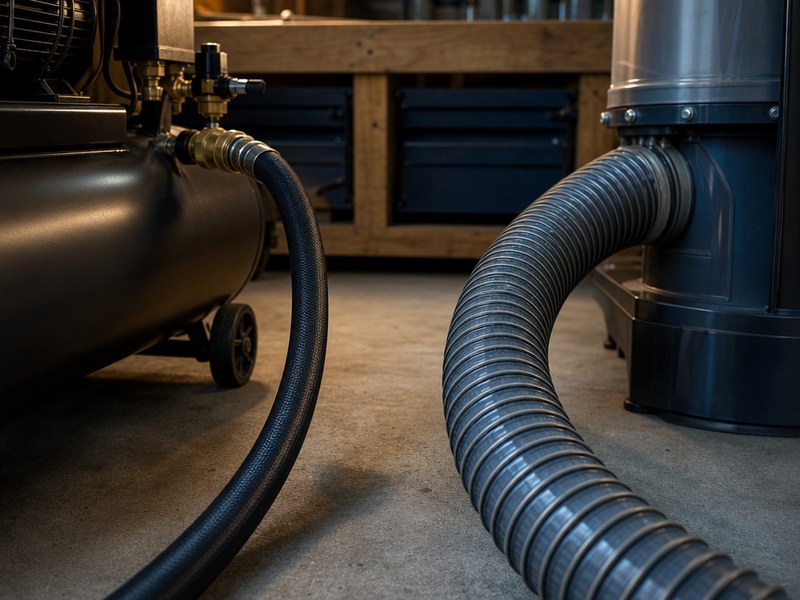
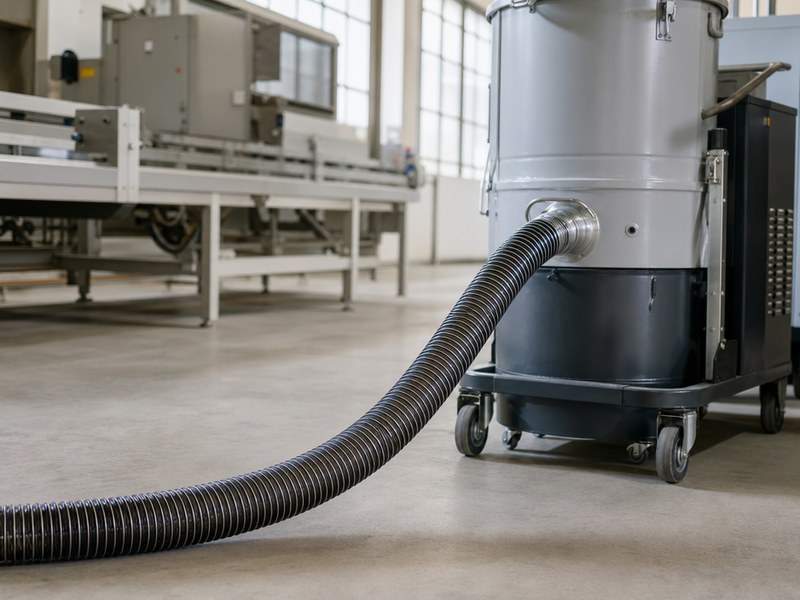
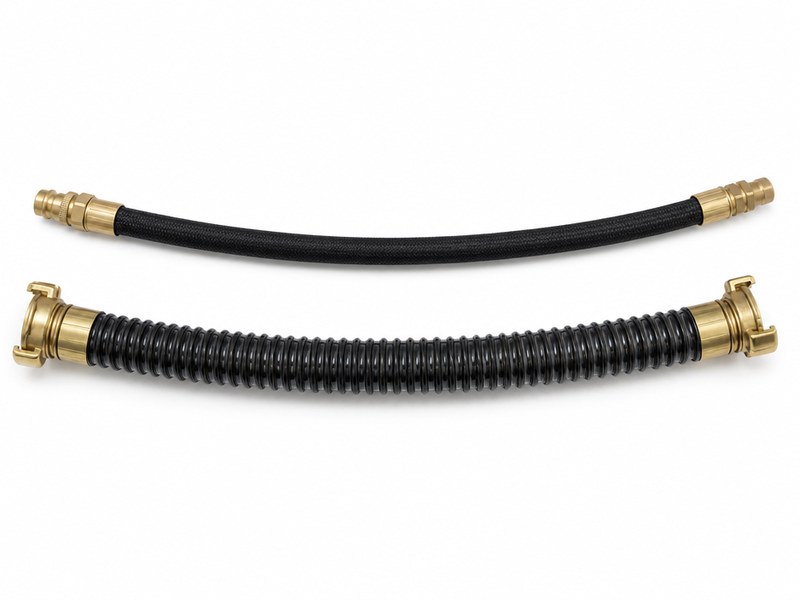
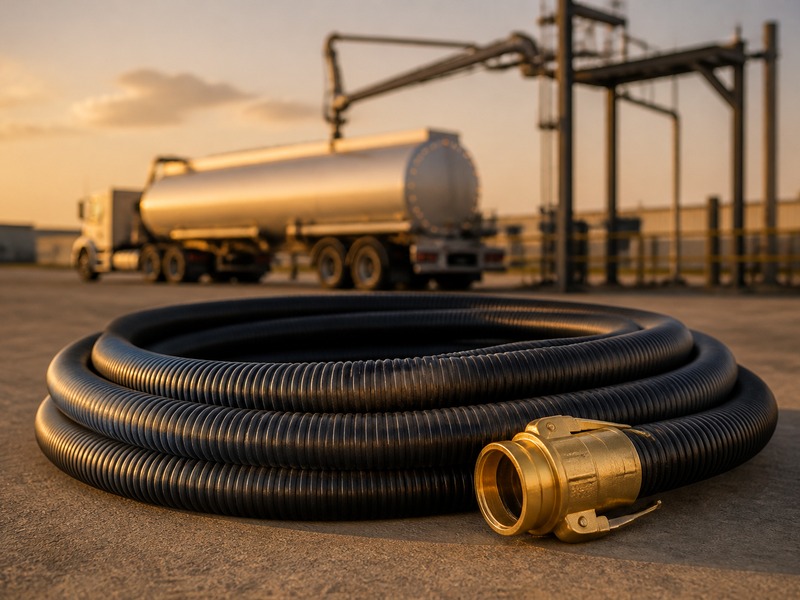
Air delivery hose vs air suction hose, side by side in an industrial workshop.
Key takeaways
- Match the hose to the pressure condition — the whole suction hose vs delivery hose rule — and the same rule applies to water, slurry, and air service alike.
- A delivery hose fails by bursting; a suction hose fails by collapsing. Neither failure is repairable.
- Delivery hoses run 10–20 bar working pressure; suction hoses are rated by vacuum resistance, with full vacuum at -1.0 bar gauge.
- A suction and delivery hose (S&D hose) is the only single type rated for both duties.
Suction Hose vs Delivery Hose: The Short Answer
A suction hose is built to draw air or fluid into a system under vacuum; a delivery hose is built to discharge it under positive pressure. In the suction hose vs delivery hose comparison, the deciding factor is always the pressure condition at the point of use: if air is pushed through the hose, choose a delivery hose; if air is pulled through it, choose a suction hose. The table below gives the quick answer for the most common situations.
Quick pick: which hose for which service.
| If your system… | Choose | Why |
|---|---|---|
| Feeds compressed air from a compressor to tools at positive pressure | Air delivery hose | Textile braid holds internal pressure; light and flexible |
| Draws air, dust, or light material into a system under vacuum | Air suction hose | Spiral wire keeps the bore open under vacuum |
| Pumps water or slurry on both the suction side and the discharge side | Suction and delivery hose | Wire helix plus braid is rated for vacuum and pressure |
| Runs long dust-extraction or vacuum lines | Air suction hose | Collapse resistance preserves airflow over long runs |
What Is an Air Delivery Hose?
An air delivery hose is a flexible, textile-reinforced tube that carries compressed air from a source — a compressor, a receiver tank, or a factory air ring main — to pneumatic tools and machinery at positive pressure. If you are new to compressed air systems, our guide to air hoses explains the wider family; this section covers the air delivery hose type in detail.
The construction follows a three-layer formula. A synthetic rubber inner tube (EPDM, SBR, or NBR compound) carries the air; one or two textile braid layers (polyester or cotton) absorb the hoop stress created by internal pressure; and an abrasion- and oil-resistant rubber cover protects the reinforcement from the shop floor. In the suction hose vs delivery hose debate, the delivery hose is always the pressure-side product: its braid is designed to stop the hose from ballooning or bursting, not to hold the bore open against vacuum.
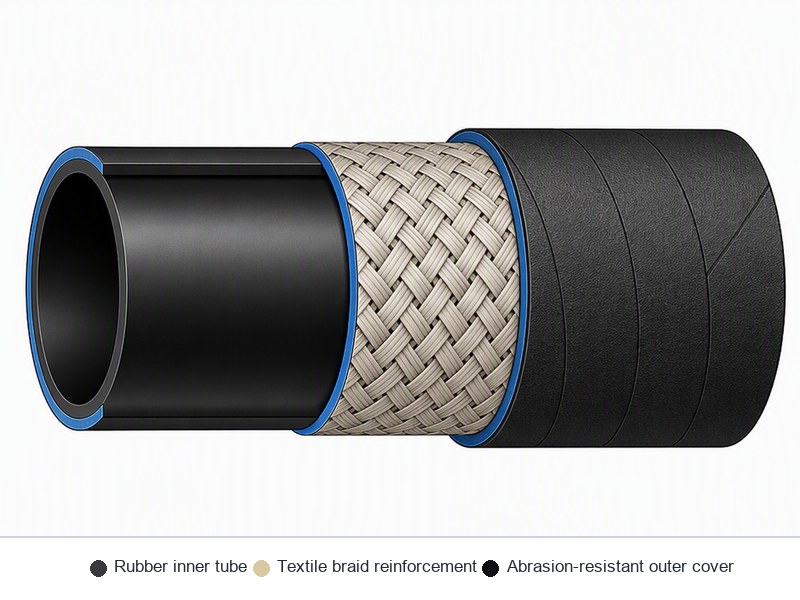
Figure 1. Air delivery hose construction: rubber inner tube, textile braid reinforcement, abrasion-resistant cover.
Air delivery hoses for rubber construction are manufactured to ISO 2398:2024, “Rubber hoses, textile-reinforced, for compressed air — Specification,” and pressure-tested to the hydrostatic procedures of ISO 1402. Typical products in this family are rated at 10–20 bar (150–300 PSI) working pressure with bore sizes from 6.3 to 51 mm (1/4 to 2 in). They are rated for positive-pressure service only; vacuum duty requires a suction or suction-and-delivery hose (see the suction hose section below for vacuum ratings).
Typical air delivery hose applications include:
- Compressed air lines from compressors to pneumatic hand tools, nailers, and impact wrenches
- Factory air ring mains and distribution points in workshops and production lines
- Spray painting and blow-off stations, where a clean smooth bore keeps the air stream free of particles
- Tire inflation, air blow guns, and general compressor outlet service
What Is an Air Suction Hose?
An air suction hose is a flexible hose reinforced with an embedded spiral steel wire — the helix — so the bore stays round when a vacuum is drawn. Where a delivery hose resists pressure from the inside, a suction hose resists pressure from the outside: with the internal pressure reduced below atmospheric, the surrounding air pushes inward at roughly 1 bar (14.7 PSI), and without rigid reinforcement the hose wall would flatten and kink.
Rubber and thermoplastic versions both exist. A rubber suction hose is typically built to ISO 4641:2024, “Rubber hoses and hose assemblies for water suction and discharge — Specification,” while helical-reinforced plastic hoses follow ISO 3994:2026. Both standards set construction, reinforcement, and test requirements for suction service. Bore sizes commonly run from 25 to 200 mm (1 to 8 in) — larger than most delivery hoses — because suction lines must move high volumes of air or fluid without excessive restriction.
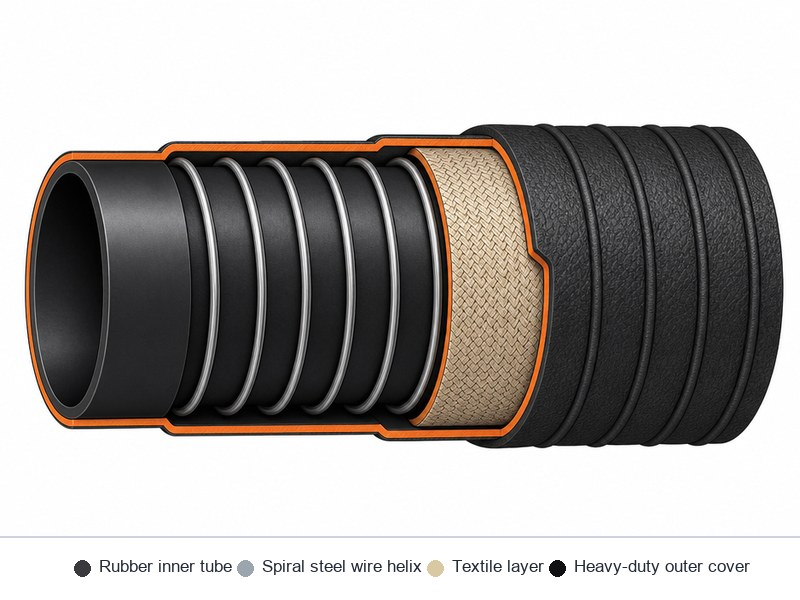
Figure 2. Air suction hose construction: rubber inner tube, spiral steel wire helix, textile layer, heavy-duty cover.
A suction hose is usually also pressure-rated: a “suction and delivery hose” (often shortened to S&D hose) is tested for both vacuum and positive pressure, which is why pump suction lines and transfer applications use it on both sides of the pump. The trade-offs are weight and stiffness — the wire helix adds mass and increases the minimum bend radius compared with a delivery hose of the same bore.
Typical air suction hose applications include:
- Industrial vacuum systems, dust extraction, and central vacuum lines
- Vacuum pump inlet lines and air intake lines
- Pneumatic conveying of powders, granules, and light materials
- Pump suction lines for water, slurry, and sewage transfer
Air Delivery Hose vs Air Suction Hose: 7 Key Differences
Seven measurable differences decide the suction hose vs delivery hose choice in air service — and the difference between suction hose and delivery hose starts with pressure; the other six factors — reinforcement, failure mode, weight, ratings, materials, and cost — all follow from it. Each point below stands alone, so jump to the factor that matters most to your application. What this guide adds beyond a standard comparison: bench-test data from our own production line (collapse and burst figures), import and sourcing notes (HSN classification), and cost-per-meter economics from actual purchase records.
1. Pressure Condition: Positive vs Negative
The defining difference between an air delivery hose and an air suction hose — the whole answer to the suction hose vs delivery hose question — is the pressure condition each is engineered for. A delivery hose operates with internal pressure higher than atmospheric; a suction hose operates with internal pressure lower than atmospheric. The force direction is opposite: pressure pushes the delivery hose wall outward, while vacuum pulls the suction hose wall inward.
This is not a subtle distinction. Compressed air systems typically run at 6–10 bar (90–150 PSI), while industrial vacuum systems commonly pull -0.5 to -0.9 bar of gauge vacuum — and full vacuum is -1.0 bar (29.9 inHg). In our factory’s vacuum test bench (ISO 4641-style collapse test, single 25 mm sample), a standard textile-braided delivery hose collapsed at -0.35 bar gauge, long before the vacuum levels that dust-extraction systems run at. The hose type must match the system’s pressure condition; there is no crossover.
2. Reinforcement: Textile Braid vs Spiral Wire
Air delivery hoses are reinforced with textile braid, wound in one or two layers over the inner tube. The braid is strong in tension, which is exactly what internal pressure demands: it restrains the hose from expanding in diameter until the braid angle locks. Air suction hoses are reinforced with an embedded spiral steel wire (helix), which provides radial stiffness — the physical property that stops the wall from caving in when vacuum is applied.
The two reinforcements are not interchangeable. A textile braid offers almost no resistance to inward collapse, which is why a delivery hose flattens under vacuum. A wire helix adds weight and stiffness that a delivery hose does not need. Suction and delivery hoses combine both — wire for collapse resistance plus a braid or cord layer for pressure rating — which is why they cost more per meter.
3. Failure Mode: Burst vs Collapse
The failure modes are opposite, and both are violent in their own way. A delivery hose fails by bursting — the braid reaches its tensile limit, and the hose ruptures, usually near a fitting or where the cover is damaged. A suction hose fails by collapsing — the bore pinches shut, the hose kinks at the bend, and airflow drops to near zero; under sustained vacuum the wall can deform permanently.
In ISO 1402 hydrostatic burst tests, a 10-bar-rated delivery hose sample burst at 40 bar (single sample, consistent with production-batch results) — a 4.0:1 burst-to-working ratio, matching the 4:1 industry minimum. In vacuum tests, a collapsed suction hose returned to round when the vacuum was released — but a delivery hose that had been flattened under vacuum for several hours kept a permanent flat spot, even after pressure equalized. Both failure types require replacement: a collapsed or burst hose cannot be repaired to its rated performance.
Can an air delivery hose be used for suction applications?
No — this is the classic suction hose vs delivery hose mistake: a delivery hose has no inward collapse resistance, so under vacuum it flattens and deforms permanently. Use an air suction hose for any suction or vacuum service. See the FAQs below for the full answer.
4. Weight and Flexibility
Delivery hoses are the lighter, more flexible members of the pair. A 25 mm (1 in) textile-braided air delivery hose weighs roughly 0.4–0.6 kg per meter and bends around tight corners easily, which matters for handheld tools and crowded workshop layouts. A 25 mm wire-reinforced rubber suction hose typically weighs 1.0–1.5 kg per meter — often double — and its minimum bend radius is noticeably larger.
Our testers noticed the difference immediately when switching hoses on the same line: the delivery hose coiled and carried easily, while the suction hose required a two-hand coil and stood straighter when laid out. For fixed installations the extra stiffness is irrelevant; for anything that moves, weight and bend radius should be part of the specification.
5. Ratings: Working Pressure vs Vacuum Rating
The two hose types are rated on different primary metrics. A delivery hose is rated by working pressure — the continuous internal pressure it can carry — with burst pressure typically three to four times higher. A suction hose is rated by vacuum resistance — the maximum negative pressure (often stated as a percentage of full vacuum, or directly as a bar or inHg figure) at which the bore stays round — and, if it is a suction and delivery hose, a secondary working-pressure rating for discharge service.
Check the cover printing before buying: a delivery hose for compressed air service should carry its working-pressure rating and an air-service marking; a suction hose should state its vacuum rating, for example “full vacuum” or “0.9 bar vacuum.” Use only hoses with printed service and rating markings; an unprinted hose has no verified safety margin. For help decoding the ratings on a hose cover, our air hose size chart guide covers bore, pressure, and flow relationships.
6. Materials and Cover Compounds
Both families use rubber or thermoplastic inner tubes, but the compounds are selected for different duty. Air delivery hoses favor soft, flexible compounds — EPDM, SBR, or NBR — that stay supple for handheld tools, with covers that resist oil mist and abrasion. Air suction hoses favor tougher constructions: heavier rubber compounds that support the embedded wire, plus thick, abrasion-resistant covers, because suction lines are dragged across floors and through abrasive material.
If you are choosing between rubber and plastic, the material logic is the same as for any industrial hose — see our rubber vs PVC air hose comparison for the full breakdown. A rubber suction hose outlasts a PVC suction hose in oily, abrasive, and outdoor service; a PVC or PU suction hose wins on price and weight for clean indoor duty. For the air suction hose market specifically, rubber remains the dominant choice for industrial vacuum and pump lines.
7. Cost, Service Life, and Sourcing
Wire costs more than textile braid, so a suction hose of the same bore costs more per meter than a delivery hose — typically 40–80% more for comparable rubber construction. Service life is similar when each hose is used in its own service: 5–10 years in industrial duty for both, with the caveat that misapplied hoses fail in months. The correct specification is cheaper than the cheap hose: one collapsed line in a production plant costs more in downtime than the price difference of a whole reel.
Demand for this hose family is not a niche: market analysis by Future Market Insights (2026) values the global air compressor hose market at roughly USD 1.5 billion, and suction-and-discharge hose remains one of the largest categories in industrial hose.
When sourcing, verify the manufacturer’s construction and test records rather than relying on appearance. For importers, rubber suction hose is classified under HSN code 4009 (rubber hose of vulcanized rubber with or without fittings), which is worth confirming with your freight forwarder because it affects duty and documentation. We cover the practical buying side — fittings, thread types, and assembly — in our air hose fittings guide.
Air Delivery Hose vs Air Suction Hose: Full Specification Comparison
The table below consolidates the suction hose vs delivery hose differences into a single spec sheet. Figures are typical values for rubber-constructed hoses; always verify against the rating printed on the cover.
Air delivery hose vs air suction hose: full specification comparison (typical rubber construction).
| Property | Air Delivery Hose | Air Suction Hose |
|---|---|---|
| Primary service | Positive pressure (compressed air) | Negative pressure (vacuum), some positive pressure |
| Reinforcement | Textile braid (polyester or cotton) | Embedded spiral steel wire helix, often plus braid |
| Main risk | Burst under overpressure | Collapse under vacuum |
| Typical bore range | 6.3–51 mm (1/4–2 in) | 25–200 mm (1–8 in) |
| Typical working pressure | 10–20 bar (150–300 PSI) | 4–10 bar (60–150 PSI) |
| Vacuum rating | Not vacuum-rated as standard | Full vacuum (-1.0 bar / 29.9 inHg) typical |
| Typical temperature range | -20°C to +60°C (-4°F to +140°F) | -20°C to +60°C (-4°F to +140°F) |
| Weight (25 mm bore, per meter) | 0.4–0.6 kg | 1.0–1.5 kg |
| Bend radius | Smaller — more flexible | Larger — stiffer |
| Failure mode | Burst, usually at fittings | Collapse, flattening, kinking |
| Typical service life | 5–10 years | 5–10 years |
| Relative cost per meter | Lower | Higher (40–80% more) |
| Applicable standard | ISO 2398:2024 (rubber, compressed air) | ISO 4641:2024 (rubber), ISO 3994:2026 (thermoplastic) |
Weight, pressure, and cost figures are HENGHUA production-sample measurements and industry-benchmark ranges; always verify against the rating printed on the cover and the manufacturer’s datasheet.
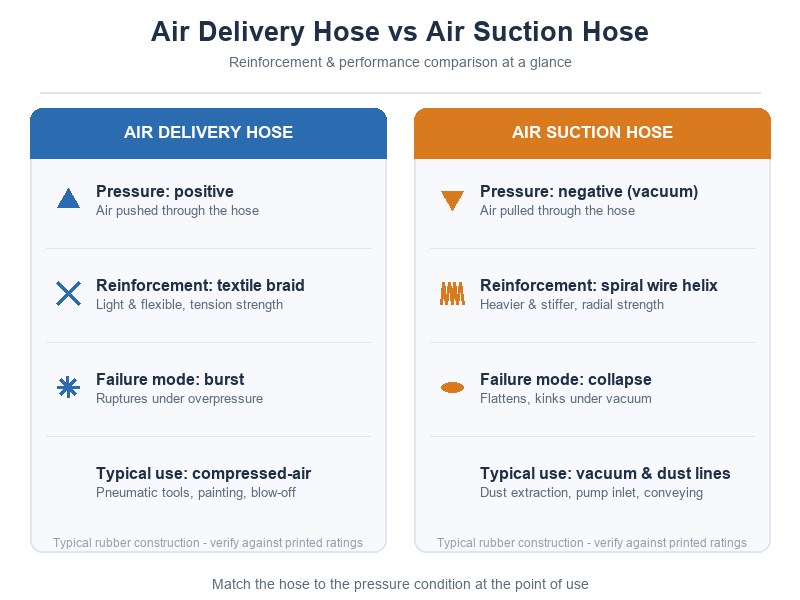
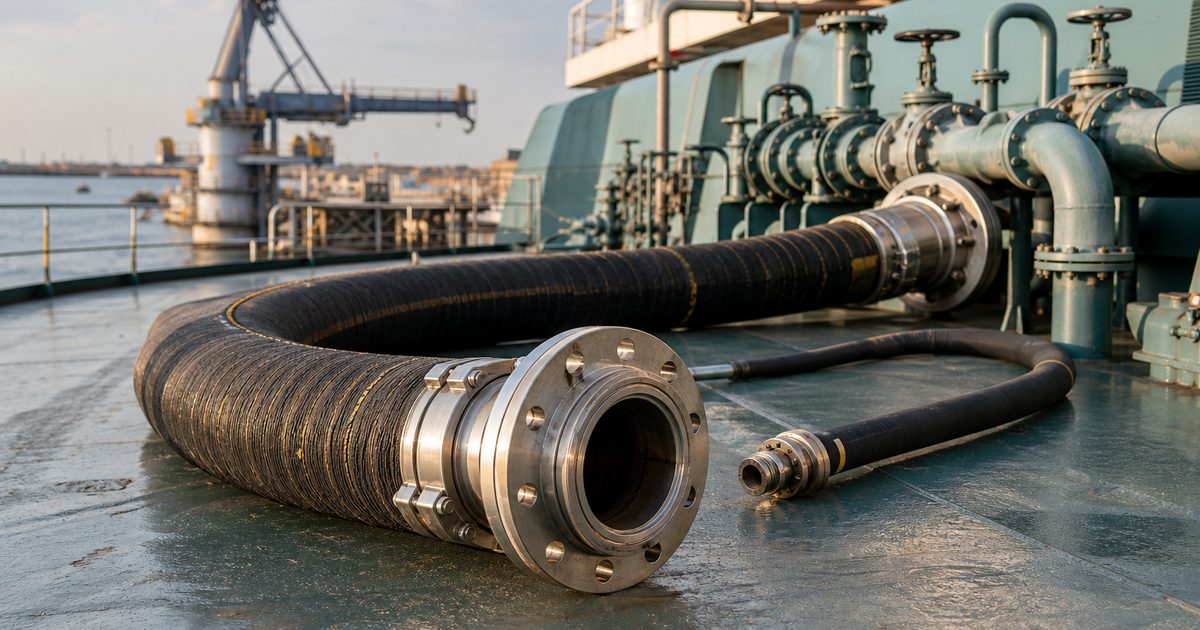
Figure 3. Air delivery hose vs air suction hose at a glance.
Need a hose matched to your exact pressure and vacuum spec? Browse our air delivery hose and rubber suction hose product lines, or request datasheets and samples →.
Where Each Hose Belongs: Application Guide
If you are starting a compressed-air line from scratch and the only thing you know is the compressor’s output pressure, start with the delivery hose. Matching the hose to the job is straightforward once the pressure condition is known; the table below maps common applications to the correct hose type.
Application guide: which hose to use where.
| Application | Recommended hose | Key requirement |
|---|---|---|
| Pneumatic tools and factory air lines | Air delivery hose | Positive pressure, flexibility, light weight |
| Spray painting and blow-off stations | Air delivery hose | Clean smooth bore, stable pressure |
| Compressed air supply to machinery | Air delivery hose | Pressure rating above system maximum |
| Vacuum pump inlet lines | Air suction hose | Full-vacuum collapse resistance |
| Dust extraction and industrial vacuum | Air suction hose | Maintains inner diameter under vacuum |
| Pneumatic conveying of powders and granules | Air suction hose | Wire helix resists collapse on long runs |
| Pump suction and discharge lines (water, slurry) | Suction and delivery hose | Rated for both vacuum and positive pressure |
For water-pump, vacuum, and dust lines, see rubber suction hose sizes and ratings for full-vacuum options across 25–200 mm bores.
Which Hose for Your Situation?
Whichever situation below matches you, the suction hose vs delivery hose rule stays the same: match the hose to the pressure condition at the point of use.
- First-time buyer setting up a small workshop — start with a 10-bar air delivery hose for the compressor line, and add a full-vacuum suction hose only if you plan dust extraction from day one; use 6.3–13 mm bores for tools and 25 mm and up for vacuum.
- Maintenance engineer replacing a failed line — read the old hose’s cover printing before buying; match the new hose’s ratings and standard to what the line actually does, not to what it looks like.
- Importer sourcing for resale — confirm HSN code 4009 classification, request the manufacturer’s test records, and specify printed ratings in your private label.
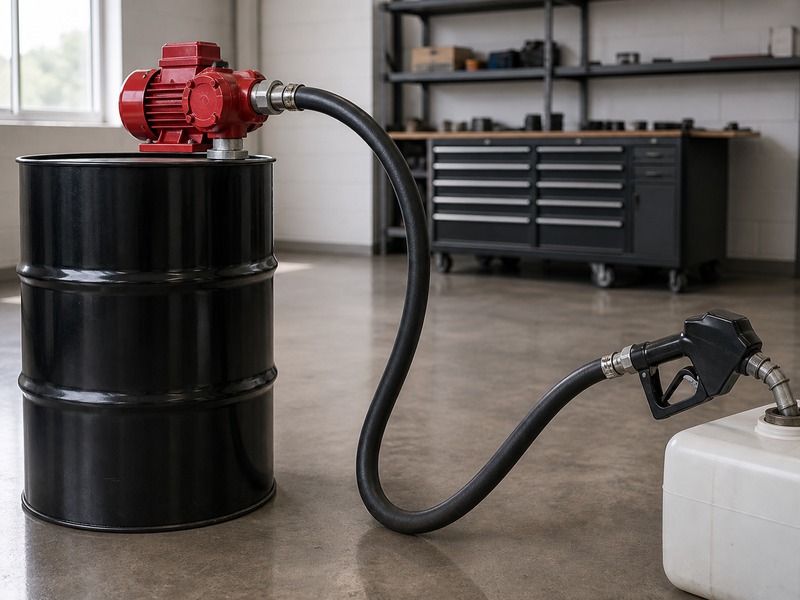
Air delivery hose supplying a pneumatic impact wrench from a workshop air compressor.Air suction hose connected to an industrial dust collection vacuum system.
What Happens If You Use the Wrong Hose?
The most common and most expensive mistake in the suction hose vs delivery hose decision is using an air delivery hose on a suction or vacuum line. Under vacuum, a delivery hose’s textile braid offers no radial support: the hose flattens, kinks at the first bend, and airflow collapses. In severe cases the wall deforms permanently. In our bench test, a delivery hose run at -0.6 bar gauge for four hours retained a flat spot that reduced its cross-sectional area by roughly 50% (measured with calipers after pressure equalization) — a hose that was still round when it went on the line.
A food-packaging plant in Southeast Asia called us after their dust line kept flattening at the first bend. The line had been assembled with a textile-braided delivery hose — a textbook suction hose vs delivery hose error, because that construction is rated for pressure, not vacuum. Swapping in a wire-helix suction hose rated for full vacuum eliminated the collapses, and the plant reported normal airflow for the next 12 months. The fix cost less than one hour of downtime.
Using an air suction hose on a delivery line is less dramatic but still wrong. The wire helix makes the hose heavier and stiffer, raising installation effort and bend radius; and unless the hose carries an explicit working-pressure rating, running positive pressure through it risks failure of an unrated construction. A suction and delivery hose is the only type rated for both duties; check its pressure rating against your system.
Both mistakes share the same cost structure: reduced performance, premature replacement, and downtime — which is why the selection checklist below exists.
How to Choose: A 5-Step Selection Checklist
Use this checklist whenever you specify an air delivery hose or an air suction hose — it settles the suction hose vs delivery hose question in about five minutes and prevents the most common specification errors.
- Identify the pressure condition. Is air pushed through the hose (delivery) or pulled through it (suction or vacuum)? This single answer selects the hose family. If both sides of a pump are involved, plan for a suction and delivery hose.
- Read the vacuum and pressure ratings. For suction service, confirm the hose’s vacuum rating covers your worst case (full vacuum is -1.0 bar / 29.9 inHg). For delivery service, the working pressure must exceed the compressor’s maximum output, with the printed rating on the cover.
- Size the bore for flow. Suction lines need larger bores — 25 mm and up — because undersized bores increase flow resistance and make collapse more likely. Delivery lines follow normal air hose sizing: 6.3–13 mm (1/4–1/2 in) for tools, larger for long runs.
- Check the environment. Abrasion, oil mist, temperature extremes, and UV exposure dictate the cover compound — rubber for tough duty, PVC or PU for clean indoor service. Confirm the temperature range against your worst-case operating condition.
- Match fittings and length, then verify the manufacturer. Suction hoses need fittings that hold under vacuum (clamps or banded couplings), while delivery hoses commonly use crimped or quick-connect fittings. Buy from a manufacturer that publishes construction details, test data, and a warranty.
My vacuum pump pulls close to full vacuum — what suction hose vacuum rating do I need?
Compare the pump’s maximum achievable vacuum against the hose’s printed rating; a pump that can pull close to full vacuum (-1.0 bar / 29.9 inHg) needs a full-vacuum-rated hose. See the FAQs below for the full answer.
If you are unsure after these five steps, ask the manufacturer directly — a technical sales engineer can confirm the rating, construction, and standard for your exact duty. Sending the wrong specification to a supplier produces a working hose on paper and a failed line in the plant.
Choosing a Hose When You Only Know the System Pressure
If the only number you have is the compressor’s output pressure, the decision still has a default answer: choose a delivery hose rated above that pressure. If the only number you have is a vacuum figure such as -0.6 bar gauge, choose a suction hose rated for at least that vacuum. If you know neither, read the ratings printed on the hose currently on the line — they tell you what the system actually does.
How to Identify a Suction Hose vs a Delivery Hose on Site
Before you buy, learn the suction hose vs delivery hose identification checks below — you can tell the two apart on site in under a minute without any tools. Cover printing: a delivery hose carries a working-pressure rating and an air-service marking; a suction hose states a vacuum rating, for example “full vacuum” or “0.9 bar vacuum.” Surface and bore: a suction hose often shows the wire helix as a rib on the inner or outer surface; a delivery hose has a smooth bore and smooth cover. Flex test: bend the hose at 90° and release — a delivery hose springs back almost fully; a suction hose holds a straighter, stiffer line and is noticeably heavier per meter (typically 1.0–1.5 kg vs 0.4–0.6 kg at 25 mm bore). When in doubt, an unmarked hose has no verified rating — replace it before it goes into service.
What Standards and Ratings Apply to Suction and Delivery Hoses?
The two hose families are governed by separate standards published by the International Organization for Standardization (ISO), and the difference between suction hose and delivery hose matters for compliance and safety.
- ISO 2398:2024 — Rubber hoses, textile-reinforced, for compressed air. This is the standard for rubber air delivery hoses. It sets construction, dimensions, and performance requirements, and it applies to the 6.3–51 mm bore range typical of compressor and pneumatic-tool service.
- ISO 4641:2024 — Rubber hoses and hose assemblies for water suction and discharge. This is the standard for rubber suction and delivery hoses, covering vacuum resistance and working pressure in one document.
- ISO 3994:2026 — Plastics hoses, helical-thermoplastic-reinforced, for suction and discharge of aqueous materials. This covers the plastic (PVC-style) suction hose family.
- ISO 1402:2021 — Hydrostatic testing of rubber and plastics hoses and hose assemblies. This is the test method used to verify pressure ratings.
- ISO 1307:2006 — Hose sizes, minimum and maximum inside diameters, and tolerances. This standard keeps bore sizes consistent between manufacturers.
Two rating terms appear constantly in datasheets. Working pressure is the maximum continuous internal pressure a hose may carry; burst pressure is the point of failure, and industry practice for compressed-air rubber hose is a minimum burst-to-working ratio of 4:1. Vacuum rating expresses how much negative pressure a suction hose withstands — stated as a percentage of full vacuum, or in bar (gauge) or inHg. A hose rated “full vacuum” holds its bore shape at -1.0 bar (29.9 inHg). All vacuum figures in this guide are gauge values (relative to atmospheric pressure), so full vacuum is -1.0 bar gauge.
Scope of this guide. The figures, standards, and ratings above apply to rubber-constructed hoses for air service. Thermoplastic (PVC/PU) suction hoses follow ISO 3994:2026 and generally have lower temperature limits; hydraulic, chemical, and food-grade hoses are outside this guide’s scope. Always verify against the rating printed on the cover and the manufacturer’s datasheet.
Air Delivery Hose vs Air Suction Hose: FAQs
What is the difference between suction hose and delivery hose?
The suction hose vs delivery hose difference is the pressure condition each one is engineered for. A delivery hose carries fluid or air under positive internal pressure, so it is reinforced with textile braid to resist bursting. A suction hose carries it under negative pressure (vacuum), so it is reinforced with a spiral wire helix to resist collapsing. A suction and delivery hose is rated for both.
Can an air delivery hose be used for suction applications?
No — this is the classic suction hose vs delivery hose mistake. An air delivery hose is not reinforced against inward collapse, so under vacuum it flattens, kinks, and restricts airflow, and it can deform permanently. Use an air suction hose for any suction or vacuum service.
Can an air suction hose be used for air delivery?
Use a suction hose on a delivery line only when all three apply: (1) it carries a printed working-pressure rating; (2) the rating covers your system’s maximum pressure; (3) the extra weight and stiffness are acceptable for installation. Many suction and delivery hoses can handle modest positive pressure — typically 4–10 bar — but they are heavier and stiffer than a delivery hose, which hurts installability and operator handling.
I’m setting up dust extraction for a woodworking shop — which hose won’t collapse when the system pulls -0.6 bar gauge?
For a woodworking dust line that pulls -0.6 bar gauge, pick a wire-helix suction hose rated for full vacuum (-1.0 bar / 29.9 inHg), because a hose rated only to -0.7 bar gauge leaves no margin for the pressure spikes, restricted flow, and helix damage that cause collapse well below the system’s maximum pull. A textile-braided delivery hose will flatten at this duty; the wire helix is what keeps the bore round.
What is a suction and delivery hose?
A suction and delivery hose (S&D hose) is a single hose rated for both vacuum and positive pressure — typically a spiral wire helix plus a textile or cord layer. Pumps use it on both the suction side (drawing fluid in) and the discharge side (pushing it out), which simplifies stocking and installation.
My vacuum pump pulls close to full vacuum — what suction hose vacuum rating do I need?
Compare the pump’s maximum achievable vacuum against the hose’s printed rating: a pump that can pull close to full vacuum (-1.0 bar / 29.9 inHg) needs a hose rated full vacuum, because a lower-rated hose collapses at the pump’s ceiling. Industrial vacuum systems commonly run at -0.5 to -0.9 bar gauge, which most full-vacuum-rated hoses cover with margin.
I’m running a long dust line — does hose diameter affect suction performance?
Yes, more than in delivery service. An undersized suction bore increases flow resistance and makes collapse more likely. Suction lines generally need larger bores than delivery lines of the same flow — 25 mm and up for typical industrial use — and long runs may need a larger size still.
How do I tell a delivery hose from a suction hose?
Check three things. The cover printing should state the service and ratings. The bore construction differs: a suction hose often shows the wire helix as a rib on the inner or outer surface, while a delivery hose has a smooth bore and smooth cover. And the feel differs: a suction hose is heavier and stiffer.
What is the difference between a suction hose and a discharge hose?
The terms overlap: discharge hose is the positive-pressure side of a pump circuit, and a suction hose rated for both duties is often called a suction and discharge hose. For air service, the practical rule is the same — match the hose to the pressure condition.
Can I use a rubber suction hose for my water pump or pressure washer?
Yes — a rubber suction hose with a strainer (foot valve filter) is the standard pick for pump suction lines drawing water from a tank or well, and for pressure washers it is used on the inlet side, not the outlet side. Match the bore to the pump inlet size and confirm the vacuum rating covers the pump’s suction lift.
I’m buying a hose for a 2-inch water pump that sits above the water tank — what suction hose size and vacuum rating do I need?
Size the suction hose bore to the pump inlet — 2 inches for a 2-inch inlet — and choose a vacuum rating that covers the pump’s suction lift; deeper lifts need a full-vacuum rating (-1.0 bar / 29.9 inHg). The suction hose vs delivery hose choice for a pump line is decided by which side of the pump the hose sits on: suction side for the draw, and a suction and delivery hose if one line must do both. Common stock sizes for rubber suction hose are 2, 3, 4, and 6 inches; larger bores cost more per meter but reduce flow resistance and collapse risk on long lines.
For bore, pressure, and flow relationships, see our rubber suction hose product range and air hose size chart.
Final Verdict: Which Air Hose Do You Need?
Whether you frame it as suction hose vs delivery hose or delivery hose vs suction hose, the deciding factor is the pressure condition at the point of use. Choose an air delivery hose for compressed air at positive pressure — pneumatic tools, factory air lines, spray painting — with a working-pressure rating above your compressor’s maximum output. Choose an air suction hose for vacuum service — dust extraction, vacuum pump lines, pneumatic conveying — with a vacuum rating that covers your worst case. Choose a suction and delivery hose when one line must handle both sides of a pump. Buy from a manufacturer that prints real ratings on the cover, builds to recognized standards, publishes test data, and stands behind the product with a clear warranty — those details decide between a decade of service and a failure in the first season. If you are sourcing air delivery hoses, air suction hoses, or suction and delivery hoses for retail, distribution, or industrial use, our engineering team will help you match the right construction and rating to your application — request a quote and samples, with a reply within one business day and free samples for volume orders.
About HENGHUA
HENGHUA is a professional manufacturer of rubber, PVC, polyurethane, and hybrid hoses, supplying workshops, distributors, and OEM brands worldwide. We manufacture both families covered in this guide: textile-braided air delivery hoses rated 10–20 bar for compressed-air service, and wire-helix-reinforced rubber suction and delivery hoses rated for full vacuum, across bore sizes from 1/4 to 8 inches, with custom lengths, fittings, colors, and OEM/ODM branding. Because we control the entire process from compound mixing to final pressure and vacuum testing, we deliver consistent quality at factory-direct pricing, with short lead times for bulk orders and a clear warranty on every reel. If you are sourcing air delivery hose or air suction hose for retail, distribution, or industrial use, contact our team for a quote and samples matched to your market.

 English
  Spanish
  Portuguese
  French
  German