
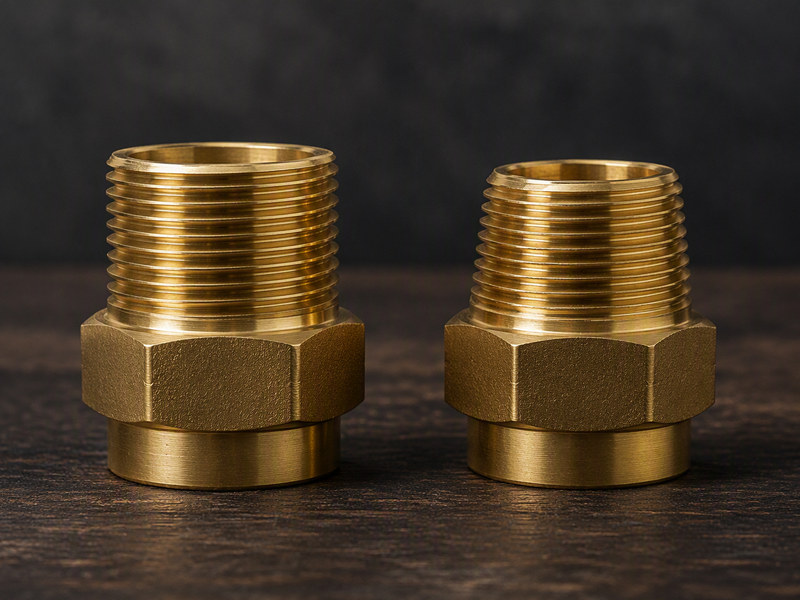
NPSM and NPT are both American pipe threads with the same pitch and major diameter, but they are not interchangeable: NPT is tapered and seals through thread interference, while NPSM is straight and relies on a separate mechanical seat. This NPSM vs NPT guide explains the six differences that decide which thread you actually need, answers whether an NPT fitting can thread into an NPSM port (and why that usually leaks), provides a full NPSM vs NPT thread size chart, shows how to identify either thread with a caliper and pitch gauge, and covers when an NPSM to NPT adapter is the correct fix.
What Is an NPSM Thread?
NPSM stands for National Pipe Straight Mechanical, a straight pipe thread defined in the ANSI/ASME B1.20.1 standard. The threads run parallel to the axis with no taper, using the same 60-degree thread angle, pitch, and major diameter as an NPT of the same nominal size.
The word “mechanical” is the part most people miss. An NPSM fitting is designed to hold two parts together, not to seal by itself. The seal comes from a separate mechanical seat: a 30-degree or 60-degree cone inside a swivel nut, a flat face pressed against a washer or gasket, or an O-ring captured between the two parts. If that seat is missing, damaged, or mismatched, no amount of tightening will stop a leak.
In our fitting shop, we see NPSM threads in four places most often:
- Female swivel ends on hydraulic hose assemblies — the swivel nut turns independently so the hose is not twisted during installation.
- Pump ports — gear pumps, centrifugal pumps, and compressor discharge ports are frequently machined with NPSM threads.
- Filter housings, valve bodies, and instrument ports — anywhere the fitting must stop at a specific rotational position.
- Low-pressure fluid transfer lines where a gasket or washer face seal is already part of the design.
The practical advantage of NPSM is assembly freedom: the fitting can be clocked to any orientation before the locknut or seat is tightened, and the straight thread is far less likely to gall on disassembly than a wedged taper.
What Is an NPT Thread?
NPT stands for National Pipe Taper, the most widely used pipe thread in North America. It is also defined by ANSI/ASME B1.20.1 and carries the same 60-degree thread angle as NPSM, but the thread form tapers at a rate of 1:16 — 0.75 inch of diameter change per foot of thread length (62.5 mm per meter).
That taper is the sealing mechanism. As the male NPT is torqued into a female port, the thread flanks wedge against each other until the crests and roots deform and lock. The joint normally needs thread sealant — PTFE tape or pipe dope — to fill the tiny spiral leak path that remains between the flanks. A correctly assembled NPT joint is pressure-tight on its own, which is why NPT dominates general plumbing, compressed air lines, and industrial piping.
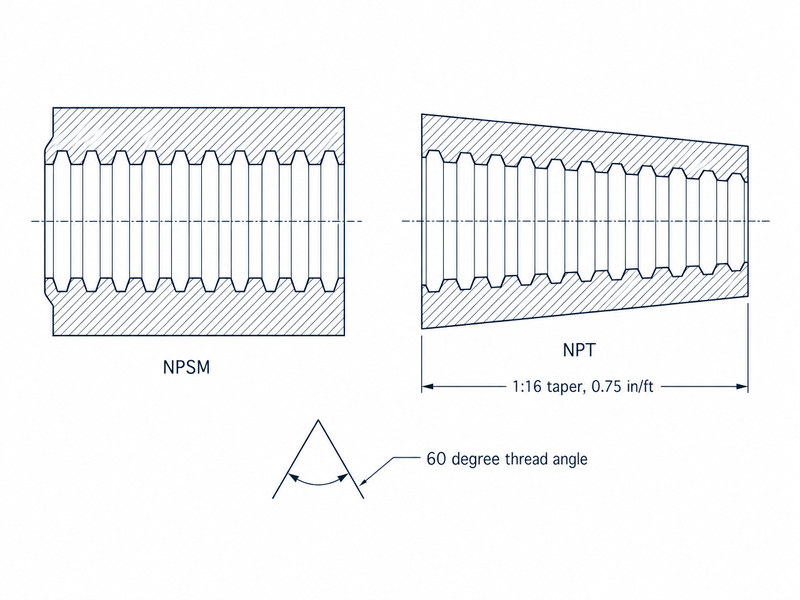
Figure 1. NPSM threads stay parallel along their full length; NPT threads taper 1:16 (0.75 inch per foot of diameter).
There is also NPTF, the dryseal variant. NPTF threads have adjusted crest and root heights so the interference fit closes the spiral path without sealant. For most buyers the practical difference is small: NPTF is preferred for fuel and high-integrity connections, NPT is the everyday standard. NPSM vs NPTF comparisons appear constantly in hydraulic catalogs, because both thread families show up on hose ends and pump ports.
NPSM vs NPT: The 6 Differences That Matter
If you only remember one thing from this article, remember the table below. Whether you search NPSM vs NPT or NPT vs NPSM, the answer is the same: one thread is straight, the other tapers, and that geometry decides everything.
| Difference | NPSM (Straight Mechanical) | NPT (Taper Pipe) |
|---|---|---|
| Thread geometry | Straight and parallel, no taper | Tapered, 1:16 (0.75 in per ft of diameter) |
| Sealing method | Mechanical seat — cone, washer/gasket, or O-ring | Thread flank interference — metal wedging on the taper |
| Thread sealant | Optional; never the primary seal | Normally required (PTFE tape or pipe dope) |
| Assembly position | Any rotational position; swivel friendly | Fixed by taper engagement; stop after 2–3 wrench turns past hand-tight |
| Disassembly | Low galling risk, easy to break down | Can seize, especially in steel or stainless |
| Typical use | Swivel hose ends, pump ports, housings | Plumbing, air lines, hydraulic piping, general service |
The six differences produce one clear rule: NPSM threads hold, seats seal. NPT threads both hold and seal. Design a joint around the wrong one and you will chase leaks that no amount of tape can fix.
Are NPSM and NPT Threads Compatible?
The short answer: they will thread together, but they will not seal reliably — with one practical exception covered below. Because NPSM and NPT share the same pitch and size, a male of one type starts into a female of the other type easily. That easy start is exactly why so many leaky connections exist.
Will NPSM thread into NPT?
A male NPSM thread into a female NPT port will start, then bind partway. The straight male thread cannot follow the taper of the female port, so only the first few threads make contact. The result is a loose, partial engagement that leaks at any useful pressure, and overtightening risks cracking the female port in aluminum or cast iron. This combination should be avoided, not “fixed” with extra sealant.
Can NPT fit into NPSM?
A male NPT into a female NPSM port engages further because the taper allows the male to wedge against the straight female threads near the port mouth. At low pressure, with generous sealant, this joint sometimes holds — which is why the practice survives in the field. But the contact area is small and inconsistent, the joint is not repeatable, and under vibration or thermal cycling it will weep. Standards-based design does not recognize this as a proper connection.
The one combination that works in practice
NPSM female swivel fittings with a 60-degree cone are commonly mated with male ends that carry a matching 60-degree cone nose (often NPTF or NPT male with a machined cone). In this configuration the cone is the seal and the threads only provide clamping force. We assemble and pressure-test this exact combination daily for hydraulic customers — the joint seals at the cone, never on the thread flanks, which is precisely how the NPSM design is meant to work.
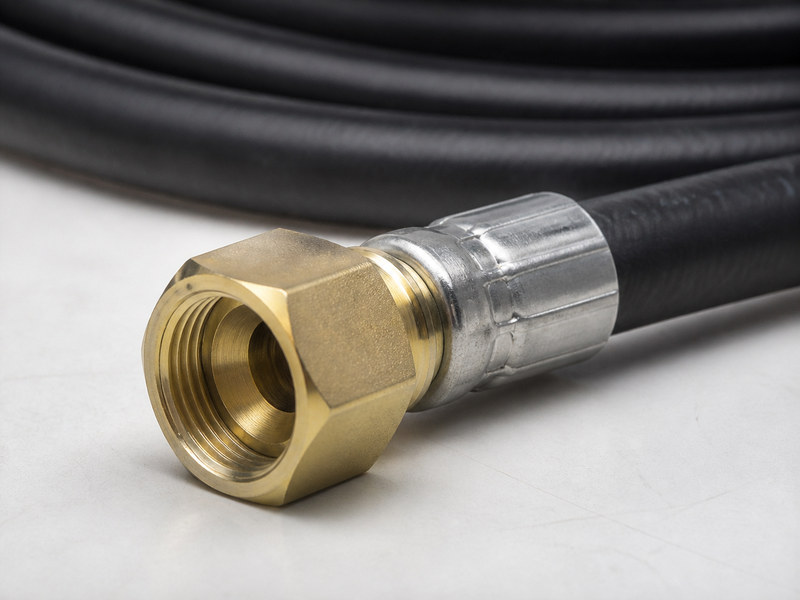
Figure 2. An NPSM female swivel: the nut turns freely to avoid hose twist, and the 60-degree cone carries the seal.
| Combination | Threads engage? | Reliable seal? | Verdict |
|---|---|---|---|
| Male NPSM → Female NPT | Yes, partially | No | Avoid; leaks and port damage risk |
| Male NPT → Female NPSM | Yes | Rarely (low pressure only) | Not a proper joint |
| Male NPT/NPTF with 60° cone → NPSM swivel with 60° cone | Yes | Yes, at the cone | Accepted practice in hydraulics |
| Both sides NPSM with matching seat | Yes | Yes, at the seat | Correct NPSM joint |
| Both sides NPT with sealant | Yes | Yes, on the taper | Correct NPT joint |
The rule that prevents most field failures: thread engagement proves only that the pitch matches — it proves nothing about sealing compatibility.
NPSM vs NPT Thread Size Chart
Because the two threads share identical dimensions for a given nominal size, one chart covers both. Nominal pipe size refers to the nominal bore of the pipe, not the thread diameter — a 1/2-inch NPSM or NPT measures 0.840 inch across the thread OD.
| Nominal Pipe Size | Threads per Inch (TPI) | Thread Pitch (inch) | Major Diameter (inch) | Major Diameter (mm) |
|---|---|---|---|---|
| 1/8 | 27 | 0.0370 | 0.405 | 10.29 |
| 1/4 | 18 | 0.0556 | 0.540 | 13.72 |
| 3/8 | 18 | 0.0556 | 0.675 | 17.15 |
| 1/2 | 14 | 0.0714 | 0.840 | 21.34 |
| 3/4 | 14 | 0.0714 | 1.050 | 26.67 |
| 1 | 11.5 | 0.0870 | 1.315 | 33.40 |
| 1-1/4 | 11.5 | 0.0870 | 1.660 | 42.16 |
| 1-1/2 | 11.5 | 0.0870 | 1.900 | 48.26 |
| 2 | 11.5 | 0.0870 | 2.375 | 60.33 |
Two practical notes from our inspection bench. First, pitch and outside diameter are identical between NPSM and NPT, so dimensional measurement alone can never tell you which thread you hold — you must check the taper. Second, the chart applies to both male and female threads; a female NPSM port uses the same nominal size and TPI as its male counterpart.
How to Identify an NPSM or NPT Thread
Identification takes about two minutes with a caliper and a thread pitch gauge. We use this five-step sequence in our workshop whenever a customer sends in an unmarked fitting or a pump port photo.
- Measure the outside diameter twice. Take the OD at the first full thread, then again one inch back toward the shoulder. A male NPT will read roughly 0.0625 inch (1.6 mm) smaller at the second point because of the 1:16 taper. An NPSM reads the same at both points.
- Count the threads per inch. Use a thread pitch gauge or count crests over one inch. Match the result to the chart: 27, 18, 14, or 11.5 TPI.
- Look for a swivel nut. A female fitting with a hex nut that spins freely around the hose end is almost certainly NPSM.
- Inspect the sealing end. A 30- or 60-degree cone, a flat sealing face, or an O-ring groove points to a mechanical-seal NPSM design; a plain threaded bore with no seat points to an NPT-style interference joint.
- Confirm against the mating part. If possible, check what the fitting actually connects to. The mating seat is the final authority, not the thread.
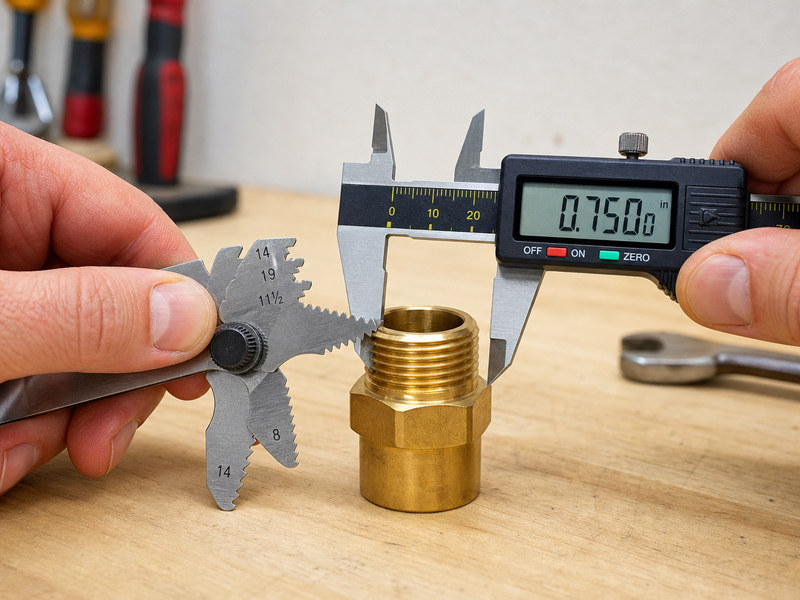
Figure 3. Pitch gauge and caliper readings identify the thread size; only the double OD measurement reveals the taper.
| Check point | NPSM indicates | NPT indicates |
|---|---|---|
| OD at two points | Identical readings | Second reading ~1/16 in smaller per inch |
| Thread pitch | Same values as NPT | Same values as NPSM |
| Swivel nut | Common on female ends | Rare |
| Sealing seat | Cone, flat face, or O-ring groove | None — thread interference only |
| Typical marking | “NPSM” stamped on hex | “NPT” or nothing (assume NPT in US) |
If the part is still ambiguous after these checks, treat it as NPT and verify with the mating equipment before ordering fittings. A wrong guess costs more than a careful measurement.
NPSM to NPT Adapter: When and How to Convert
An NPSM to NPT adapter is the right answer whenever a pump, compressor, or valve port is machined NPSM but the rest of the system is NPT — or the reverse. Adapters exist for every size in the chart above and are machined from brass, steel, or stainless steel.
We recommend an adapter in three situations:
- The port is stamped NPSM and you must connect an NPT hose or pipe line.
- The equipment is NPT and you are installing an NPSM swivel hose assembly.
- You are unsure of the seat condition and do not want to risk a marginal direct connection.
Common adapter styles:
| Adapter style | Typical use | Sealing detail |
|---|---|---|
| Hex nipple NPSM × NPT | Straight male-to-male conversion between a port and a line | NPT side seals on its taper; NPSM side needs the mating seat or sealant as designed |
| Bushing NPSM × NPT | Reducing or adapting a female port | Check both seats before assembly |
| Female swivel adapter with cone seat | Converting a pump NPSM port to accept a male cone-end hose fitting | The cone carries the seal; the swivel prevents hose twist |
| Adapter with O-ring face | Vibration and high-cycle applications | O-ring provides the primary seal, threads only clamp |
Three things to verify before ordering any adapter: the exact nominal size and TPI on both ends, the working pressure rating of the adapter (it should match or exceed the hose rating), and the material for the media — brass for water and general fluids, steel or stainless for high pressure and corrosive service.

Figure 4. A hex nipple adapter converts an NPSM port to NPT — each side keeps its own sealing method.
An adapter is inexpensive compared with the alternative: a cracked port, a contaminated system, or a production line stopped by a weeping joint. When in doubt, convert properly.
NPSM or NPT: How to Choose for Your Application
Choose by how the joint must behave in service, not by what happens to be in stock. The decision matrix below reflects what we recommend after reviewing hundreds of customer applications.
| Application | Recommended thread | Reason |
|---|---|---|
| Hydraulic hose assembly with swivel end | NPSM female swivel | Prevents hose twist; cone seat seals reliably |
| Pump or compressor port stamped NPSM | NPSM fitting or NPSM to NPT adapter | Never force a male NPT into an NPSM port |
| General plumbing and air lines | NPT | Pressure-tight interference seal; industry standard |
| Repeated disconnect under vibration | NPSM with cone seat or O-ring face | Orientation freedom; no taper seizure; serviceable |
| High-pressure static piping | NPT | Thread interference seal holds high pressure without extra parts |
| Metric or export equipment outside North America | BSPP or BSPT | Different standard; verify before assuming compatibility |
A useful summary: if the joint must be taken apart often or must align to a fixed position, NPSM earns its keep. If the line is permanent, high-pressure, or part of a standard plumbing system, NPT is the conventional and cheaper choice. Neither thread is “better” in general — each is correct in the system it was designed for.
NPSM vs NPTF vs NPS: Related Threads at a Glance
The NPSM vs NPT confusion often widens into NPS, NPTF, and NPSL, which appear on the same drawings. Of the six types, NPSM vs NPTF is the pairing buyers mix up most often after NPSM vs NPT, because both show up on hydraulic hose ends. Here is the whole family in one view:
| Thread | Form | How it seals | Where it appears |
|---|---|---|---|
| NPT | Tapered | Thread interference + sealant | General piping, air, hydraulics |
| NPTF | Tapered (dryseal) | Interference fit, no sealant needed | Fuel and high-integrity joints |
| NPSM | Straight | Mechanical seat (cone, washer, O-ring) | Swivel hose ends, pump ports |
| NPS | Straight | Depends on design; not thread wedging | Mechanical joints where taper is not needed |
| NPSL | Straight | Locknut or loose mechanical joint | Lamps, fixtures, loose-fit joints |
| NPSH | Straight | Hose-coupling-specific | Hose couplings |
The most common mix-up after NPSM vs NPT is NPS vs NPT: NPS is a straight pipe thread and, like NPSM, it does not seal on the threads. If a drawing simply says “NPS,” confirm the sealing method with the equipment manufacturer before ordering.
Common NPSM and NPT Mistakes That Cause Leaks
Almost every leak we troubleshoot traces back to one of these five errors. The table doubles as a pre-installation checklist.
| Mistake | Result | Correct approach |
|---|---|---|
| Threading male NPSM into a female NPT port | Partial engagement, immediate leak | Use the correct adapter or fitting |
| Assuming straight threads seal on the threads | Persistent weep at the seat | Confirm the cone, washer, or O-ring seat is present and clean |
| Reusing a fitting with a scratched or dented seat | Leak that gets worse with torque | Inspect seats under good light; replace damaged parts |
| Overtightening NPSM swivels | Seat damage and galling | Tighten to the seat, not to the maximum torque |
| Mixing NPSM with NPS or generic straight thread | Wrong part ordered; leak after pressure test | Identify taper + pitch + seat before ordering |
Sealant placement matters too. On an NPT side, apply tape or dope to the male threads and leave the first thread clean so no material enters the line. On an NPSM side, treat sealant as a helper, never as the seal — if the seat is wrong, tape will only hide the problem until the warranty period ends.
NPSM vs NPT FAQs
Is NPSM the same as NPT?
No. NPSM is a straight thread that seals at a mechanical seat; NPT is a tapered thread that seals by flank interference. They share the same pitch and diameter, which is why they are so often confused.
Will NPSM thread into an NPT port?
Physically, yes — the pitch matches, so it starts. But a straight male NPSM binds partway into a tapered female NPT port, leaving a partial engagement that leaks and can crack the port if forced.
Can I use PTFE tape on NPSM fittings?
You can, but it is not the primary seal. An NPSM joint seals at its cone, washer, or O-ring seat. If the seat is damaged or mismatched, tape will not fix it. Fix the seat first.
How do I know if my pump port is NPSM or NPT?
Measure the thread OD at two points one inch apart. Identical readings indicate a straight NPSM thread; a reading about 1/16 inch smaller at the second point indicates NPT. Most pump manufacturers also stamp the port type on the housing.
What is the difference between NPSM and NPS threads?
Both are straight pipe threads. NPSM is the mechanical-joint variant commonly used with swivel hose ends and cone seats; NPS is the general straight pipe thread used where a taper is not required. Sealing method, not thread form, is the deciding factor for compatibility.
Do I need a special NPSM to NPT adapter?
Yes. A purpose-made adapter converts between the two standards correctly. Directly threading one type into the other is not a recognized connection and will leak under load.
Conclusion: Choose the Thread That Matches Your Seat
The NPSM vs NPT decision comes down to one question: where does the seal happen? NPT seals on its taper and needs sealant; NPSM seals at a mechanical seat and needs a seat that actually matches. Measure the taper, count the threads, inspect the seat, and convert with a proper adapter when the standards differ. Do that, and the joint will hold pressure, survive vibration, and come apart again when you need it to.
About HENGHUA: Threads We Gauge, Hoses We Build
HENGHUA is a manufacturer of reinforced rubber hose assemblies and threaded fittings for hydraulic and industrial fluid transfer. Every NPSM and NPT connection described in this guide is part of our standard production: swivel hose ends, cone-seat adapters, and NPSM to NPT conversion fittings in brass, steel, and stainless steel.
Thread accuracy is the difference between a joint that seals and one that weeps, so we gauge every batch to the ANSI/ASME B1.20.1 dimensions in the chart above — checking taper, pitch, and major diameter before assembly. Our test bench pressure-cycles swivel assemblies and inspects cone seats for exactly the failure modes listed in this article’s troubleshooting table.
- Factory-direct supply — consistent pricing and lead times for distributors, OEMs, and brands.
- Full thread coverage — NPSM, NPT, NPTF, BSPP, and BSPT fittings and adapters across 1/8-inch to 2-inch sizes.
- Material options — brass, carbon steel, and stainless steel matched to your pressure rating and media.
- OEM / ODM service — custom hose lengths, end configurations, and private-label packaging for your brand.
- Engineering support — thread identification from photos, compatibility confirmation, and sample testing before bulk orders.
Not sure whether your pump port is NPSM or NPT? Send a photo of the port and the mating end to our engineering team, and we will identify the thread and recommend the correct fitting or adapter — usually within one business day.
Contact the HENGHUA engineering team for a quotation or request free samples to verify thread fit on your own equipment.


 English
  Spanish
  Portuguese
  French
  German