
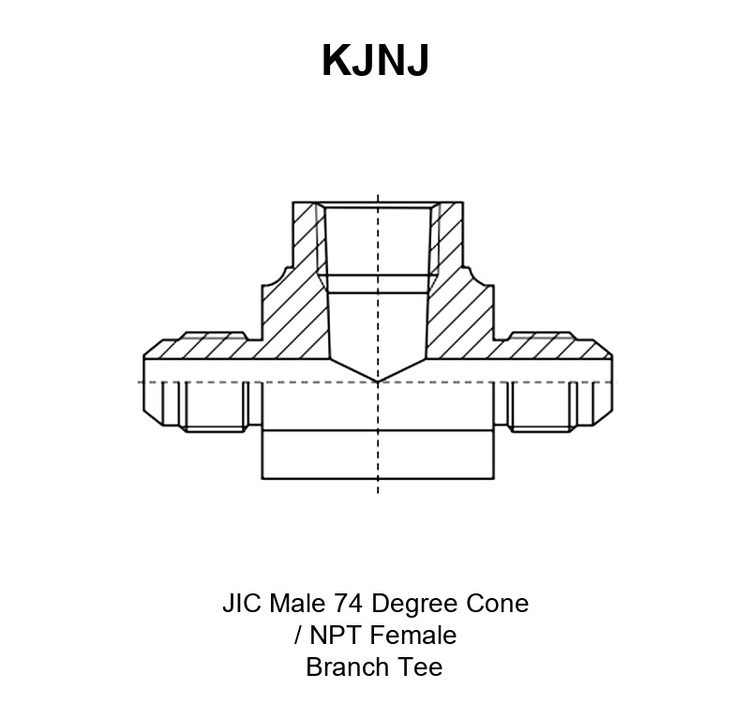
The KJNJ adapter is a branch tee hydraulic adapter that carries two JIC male 74° cone ends, marked E and G on the run, and one NPT female port marked F on the branch, so a JIC cone line can be split into a pipe-threaded take-off at a tee junction. The run presents an external 74° cone at each end and seals metal-to-metal on that cone face under SAE J514, while the branch presents an internal NPT taper thread that seals on the thread flanks under ANSI/ASME B1.20.1 and needs a sealant applied to the mating male thread.
Each port must match its mating connection exactly in thread form, thread size and cone angle or pitch, because that match is the precondition for eliminating leakage at the conversion point. A KJNJ adapter that starts on the mating thread but carries the wrong cone angle on the run, or the wrong taper on the branch, will seat on the wrong line of contact and weep under pressure.
Sealing principle of this series: the run ends seal metal-to-metal on a 74° cone face under SAE J514, and the branch seals on the thread flanks of the mating male NPT thread, with a sealant or an NPTF dryseal thread pair per SAE J476. This series does not use a 37° flare, an O-ring face, an elastomeric seat or a four-bolt flange at any port.
Core Advantages
- Branch tee body that adds a pipe-threaded take-off to a JIC 74° cone line in one part.
- Two JIC male 74° cone ends on the run and one NPT female tapped port on the branch, so two sealing methods meet in one body.
- Twelve printed rows from KJNJ-04 to KJNJ-20, including unequal rows where the branch thread differs from the run thread.
- Carbon steel with trivalent chromium zinc plating, or 304 / 316 stainless steel for corrosive and offshore service.
1. What a KJNJ Adapter Does
A KJNJ adapter joins three connections in one body: the E and G ports at the two ends of the horizontal run, and the F port on the vertical branch. The run ports are JIC male 74° cone stud ends, and the branch port is a female NPT taper thread. Flow entering the run divides between the opposite run port and the branch port, and flow entering the branch divides between the two run ports, without a preferred flow path.
The geometry matters as much as the thread. A branch tee carries its main flow path straight through the body along one axis, and the branch leaves that axis at 90°. The through ports are the run ports, E and G, and they are always the JIC cone side on this series. The perpendicular port is the branch port, F, and it is always the NPT female side, even in the unequal rows where its thread size differs from the run.
The conversion is the reason this series exists. A circuit that runs on JIC 74° cone tube ends often has to feed a component ported with a male pipe thread, such as a gauge, a filter head or a valve. Instead of stacking a cone-to-pipe adapter on a separate tee, one branch tee body does both jobs, which removes a joint and shortens the assembly.
The two sealing methods behave differently and must be treated differently. At the run ports the seal is metal-to-metal between the external 74° cone and the internal 74° seat of the mating part, with the nut drawing the cone in. At the branch the seal is made on the thread flanks of the mating male pipe thread as it is drawn into the tapped taper, and it needs a sealant on that male thread.
2. KJNJ Specifications
The three ports are presented below as two mirrored blocks: one for the run ends E and G, one for the branch end F. The two blocks use different thread standards and different sealing methods.
2.1 Connection 1 – JIC male 74° cone, E and G ports on the run
- Thread standard and family: SAE J514 hydraulic tube fitting, SAE 74° seat / flareless cone family.
- Thread size range available at E and G: 7/16″X20 through 1.5/8″X12, in the steps printed in table 2.5.
- Gender: male, with an external 74° cone at each run end.
- Sealing method: metal-to-metal contact between the external 74° cone and the internal 74° seat of the mating port or hose end.
- Mating connection standard: a JIC female 74° seat port or hose end of the same thread size, per SAE J514.
2.2 Connection 2 – NPT female taper thread, F port on the branch
- Thread standard and family: American tapered pipe thread NPT to ANSI/ASME B1.20.1, with NPTF dryseal threads to SAE J476 as the pressure-tight option.
- Thread size range available at F: Z1/8″X27 through Z1.1/4″X11.5, in the steps printed in table 2.5.
- Gender: female, an internal tapped thread on the vertical branch.
- Sealing method: metal-to-metal contact on the thread flanks of the mating male thread, with a sealant applied by the installer.
- Mating connection standard: a male NPT or NPTF pipe thread of the same nominal size and pitch.
The branch thread is not tied to the run thread. KJNJ-08 and KJNJ-08-06-08 both carry a 3/4″X16 cone run, but the first has a Z1/2″X14 branch and the second a Z3/8″X18 branch, so the pipe size at F is chosen with the equipment.
2.3 Construction and Materials
The body is machined from bar stock on CNC lathes as a tee, then drilled on the run and branch axes, coned at both run ends, tapped with the NPT taper at the branch and given one hex.
- Body material: carbon steel as standard; 304 stainless steel, 316 stainless steel or brass on request.
- Plating: trivalent chromium zinc plating (Cr3+) for carbon steel as standard; zinc-nickel plating available. Plating thickness and corrosion performance are confirmed per order rather than published as a series figure.
- Seal material: neither the JIC adapter run nor the NPT adapter branch carries an elastomer. Where the same circuit uses O-ring sealed components, NBR, FKM (Viton-type) and EPDM are the available seal material options, matched to the fluid and temperature of the system.
- Machining process: bar-stock turning, two-axis drilling, 74° cone machining on the run, NPT taper tapping at the branch, gauging at all three ports and deburring.
- Hex feature: one hex printed as S2 in table 2.5, from 16 mm to 48 mm across flats depending on size, used to hold the body while the joints are made up.
2.4 Pressure and Temperature
Working pressure for a KJNJ adapter is not set by the series code. It is governed by the thread size, the wall thickness of the tee body, the sealing method and the material selected, and it is limited by the mating cone joints at the run and the mating pipe thread at the branch. Working pressure for these sizes is confirmed per order by HENGHUA engineering, based on the thread size, sealing method and material selected.
Temperature follows the body material rather than an elastomer at either end. Published material ranges of the elastomers used elsewhere in the same hydraulic circuit are approximately -30°C to +100°C for NBR, -20°C to +200°C for FKM (Viton-type) and -40°C to +120°C for EPDM.
2.5 Part Number and Dimension Table
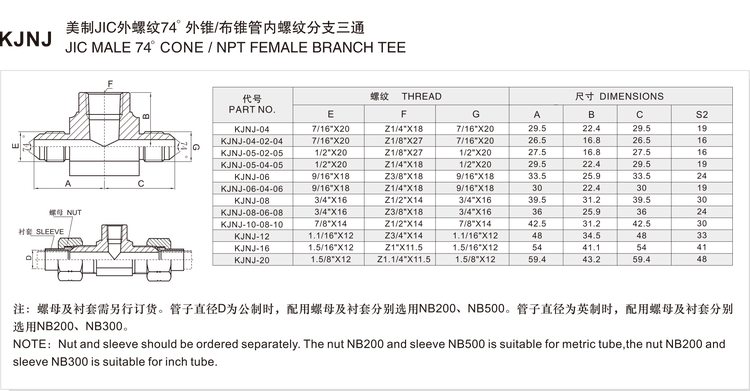
The table below is the complete printed size range of the KJNJ series. All dimensions are in millimetres. Columns E, F and G are threads; columns A, B, C and S2 are dimensions.
| PART NO. | E | F | G | A | B | C | S2 |
|---|---|---|---|---|---|---|---|
| KJNJ-04 | 7/16″X20 | Z1/4″X18 | 7/16″X20 | 29.5 | 22.4 | 29.5 | 19 |
| KJNJ-04-02-04 | 7/16″X20 | Z1/8″X27 | 7/16″X20 | 26.5 | 16.8 | 26.5 | 16 |
| KJNJ-05-02-05 | 1/2″X20 | Z1/8″X27 | 1/2″X20 | 27.5 | 16.8 | 27.5 | 16 |
| KJNJ-05-04-05 | 1/2″X20 | Z1/4″X18 | 1/2″X20 | 29.5 | 22.4 | 29.5 | 19 |
| KJNJ-06 | 9/16″X18 | Z3/8″X18 | 9/16″X18 | 33.5 | 25.9 | 33.5 | 24 |
| KJNJ-06-04-06 | 9/16″X18 | Z1/4″X18 | 9/16″X18 | 30 | 22.4 | 30 | 19 |
| KJNJ-08 | 3/4″X16 | Z1/2″X14 | 3/4″X16 | 39.5 | 31.2 | 39.5 | 30 |
| KJNJ-08-06-08 | 3/4″X16 | Z3/8″X18 | 3/4″X16 | 36 | 25.9 | 36 | 24 |
| KJNJ-10-08-10 | 7/8″X14 | Z1/2″X14 | 7/8″X14 | 42.5 | 31.2 | 42.5 | 30 |
| KJNJ-12 | 1.1/16″X12 | Z3/4″X14 | 1.1/16″X12 | 48 | 34.5 | 48 | 33 |
| KJNJ-16 | 1.5/16″X12 | Z1″X11.5 | 1.5/16″X12 | 54 | 41.1 | 54 | 41 |
| KJNJ-20 | 1.5/8″X12 | Z1.1/4″X11.5 | 1.5/8″X12 | 59.4 | 43.2 | 59.4 | 48 |
Ordering note printed with this table: nut and sleeve should be ordered separately. The nut NB200 and sleeve NB500 is suitable for metric tube, the nut NB200 and sleeve NB300 is suitable for inch tube.
What each column means
- PART NO. – the HENGHUA part number. The prefix KJNJ marks the branch tee adapter body that joins a JIC male 74° cone run to an NPT female branch. One size code after the prefix marks an equal row; three codes separated by dashes mark an unequal row, read in the order run E, branch F, run G.
- E – the thread at the first run port, a JIC male 74° cone stud end.
7/16"X20means a 7/16″ nominal JIC thread at 20 threads per inch per SAE J514. - F – the thread at the branch port, a tapped NPT female thread.
Zmarks the American tapered pipe thread, the fraction is the nominal pipe size and the number afterXis the pitch in threads per inch, soZ1/4"X18is a 1/4″ NPT internal thread at 18 threads per inch. - G – the thread at the second run port, the opposite end of the run from E, in the JIC notation and the same nominal size as E in every printed row.
- A – the run-end dimension at the E port in millimetres, as marked on the series drawing.
- B – the branch dimension at the NPT female port F in millimetres, measured on the branch as marked on the series drawing.
- C – the run-end dimension at the G port in millimetres. A and C are equal in every printed row, because the two run ends are the same size.
- S2 – the hex across flats in millimetres, the wrench size used to hold the body while the joints are made up.
Thread size and dash chart
The dash codes pair the JIC adapter run size with the NPT adapter branch size. The printed rows are:
| Run size code | Run cone thread (E, G) | Branch pipe thread (F) | Part number | Hex S2 (mm) |
|---|---|---|---|---|
| 04 | 7/16″X20 | Z1/4″X18 | KJNJ-04 | 19 |
| 04 | 7/16″X20 | Z1/8″X27 | KJNJ-04-02-04 | 16 |
| 05 | 1/2″X20 | Z1/8″X27 | KJNJ-05-02-05 | 16 |
| 05 | 1/2″X20 | Z1/4″X18 | KJNJ-05-04-05 | 19 |
| 06 | 9/16″X18 | Z3/8″X18 | KJNJ-06 | 24 |
| 06 | 9/16″X18 | Z1/4″X18 | KJNJ-06-04-06 | 19 |
| 08 | 3/4″X16 | Z1/2″X14 | KJNJ-08 | 30 |
| 08 | 3/4″X16 | Z3/8″X18 | KJNJ-08-06-08 | 24 |
| 10 | 7/8″X14 | Z1/2″X14 | KJNJ-10-08-10 | 30 |
| 12 | 1.1/16″X12 | Z3/4″X14 | KJNJ-12 | 33 |
| 16 | 1.5/16″X12 | Z1″X11.5 | KJNJ-16 | 41 |
| 20 | 1.5/8″X12 | Z1.1/4″X11.5 | KJNJ-20 | 48 |
3. How to Read a KJNJ Part Number
The prefix KJNJ identifies the body: a branch tee that joins a JIC male 74° cone run to an NPT female branch. The letter sequence marks the body type and thread combination within the American Adapters range.
The size codes follow the prefix. In an equal row one code is printed: KJNJ-04 carries a 7/16″ cone run with a Z1/4″ branch. In an unequal row three codes are printed, read in the order E, F, G: KJNJ-04-02-04 carries a 7/16″ run at both ends with a Z1/8″ branch.
A JIC adapter size code is the nominal tube outside diameter in sixteenths of an inch, so 04 is 4/16″ or 1/4″ and 08 is 8/16″ or 1/2″. A pipe size code is the nominal pipe size in eighths of an inch, so 02 is 2/8″ or 1/8″ and 08 is 8/8″ or 1″. The two code systems are not the same scale, so read the printed thread columns.
Worked example: KJNJ-08-06-08.
KJNJ– branch tee body with a JIC male 74° cone run and an NPT female branch.08– the E run port is the 3/4″X16 JIC cone thread.06– the F branch port is the Z3/8″X18 NPT tapped thread.08– the G run port is the 3/4″X16 JIC cone thread.- From the table: A and C are 36 mm, B is 25.9 mm and the hex S2 is 24 mm.
4. Installation and Fitment
HENGHUA does not publish a single torque figure for the series. Follow the equipment maker’s recommendation, or confirm the figure with HENGHUA per order.
Check the cone and the thread separately. On the run, the seal is the cone face itself, so a nick or a ring of debris on a cone or in a seat will leak however well the nut is tightened. On the branch, the seal is the thread flanks, so both threads must be clean and undamaged.
Sealant belongs on the male pipe thread, not on the cone. Apply the selected sealant to the mating male NPT thread, starting one thread back from the end, and keep it away from the run cone faces and seats.
Start the run joints first. Bring the two run ends in hand-tight, because they set the position of the whole tee. Clock the branch to the direction the line needs, hold the hex S2 and snug both run joints, then make up the branch pipe joint.
Tube ends need the correct nut and sleeve. The nut and sleeve are separate items ordered against the printed references: NB200 nut with NB500 sleeve for metric tube, NB200 nut with NB300 sleeve for inch tube.
Contamination and reuse. Cap all three ports in storage, because the cone faces, seats and tapped thread are sealing surfaces and debris scores them. The body can be reused while those surfaces are undamaged.
Common fitment errors and their symptoms:
- Forcing an NPT male thread into a BSPT tapped port, or a BSPT male into the branch. Symptom: the threads bind after two or three turns and then weep.
- Mixing a 37° flare with the 74° cone run. Symptom: the nut bottoms on the thread before the faces touch, and the joint weeps at low pressure.
- Applying sealant to the run cone instead of the pipe thread. Symptom: the cone no longer seats squarely and the run joint weeps.
Six-step assembly
- Confirm that the two run connections are JIC 74° cone ports of the same thread size as columns E and G, and that the branch connection is a male NPT thread matching column F.
- Inspect the run cones and seats for nicks and debris, and the branch tapped thread for damage, checking threads with a gauge where available.
- Clean the run cones and seats, and clean the branch tapped thread and its mating male thread of all old sealant.
- Apply the selected sealant to the mating male pipe thread, then fit the two run joints hand-tight and set the branch direction.
- Hold the hex S2 and snug both run ports, then make up the branch pipe joint without forcing it.
- Leak-check all three ports at system pressure, then re-check after the first thermal cycle and re-torque only where a weep appears.
5. Applications and Industries
Application tags for this series: hydraulic systems, water jetting, oil and gas, industrial equipment, construction machinery, agriculture, marine, material handling.
A pipe-threaded take-off on a cone line. The most common use of this series is to add a gauge, a filter or a valve ported with a male pipe thread to a circuit that runs on JIC 74° cone tube ends. The run continues the cone line, the branch provides the pipe thread, and no separate tee and adapter stack is needed.
Cross-standard equipment integration. Where a machine mixes a cone circuit with pipe-threaded accessories, this branch tee adapter is the single conversion point. The run mates with cone ports or hose ends, and the branch mates with a male pipe thread of the size printed in column F.
Repair and replacement. Maintenance crews keep the common rows on the shelf as junction stock, because a damaged pipe port can be recovered by replacing the tee body rather than reworking the line, and the exact thread combination can be re-ordered from the printed table.
6. Replacement and Cross-Reference Guide
Cross-reference for this series is organised by standard and sealing method, never by brand. Two tee adapters interchange only if the thread form and size at every port, the sealing method at every port and the run or branch geometry all match.
A KJNJ adapter is a branch tee adapter that joins a JIC adapter run to an NPT female branch under SAE J514 and ANSI/ASME B1.20.1. It is not interchangeable with a JIC tee, which is a cone joint at all three ports. The run tee of the same family, in which the branch is a JIC female seat rather than a pipe thread, is a different body.
To identify the correct replacement, measure three things.
- Run thread and seat angle. Measure the outside diameter and pitch of each male cone end and confirm that the cone angle is 74° and not 37° or 60°.
- Branch thread. Measure the inside diameter and pitch of the tapped port and confirm the taper. Confirm that it is a 60° NPT thread and not a 55° BSPT thread, because the two are not interchangeable.
- Run and branch geometry. Confirm which ports form the straight run and which port leaves at 90°, and record A, B, C and S2 so the replacement fits the same envelope. The branch size is independent of the run size in this series.
Where the mating port is not a JIC cone or an NPT thread, a cross standard adapter of the same size is the correct part
7. Ordering, Packaging and Delivery
To order, give the following information:
- Series code:
KJNJ. - Full part number, for example KJNJ-08-06-08, taken from table 2.5.
- The run cone thread size, read from the E and G columns.
- The branch pipe thread size, read from the F column.
- The branch direction, so the tee is clocked correctly at assembly.
- Sealant or dryseal thread requirement for the branch, if the joint is specified as NPTF.
- Nut and sleeve requirement for the run tube ends, against the NB200, NB300 and NB500 references.
- Body material and plating: carbon steel with trivalent chromium zinc plating, zinc-nickel plating, or 304 or 316 stainless steel.
- Quantity, destination and the packing format required.
Packaging formats: bulk cartons for line-side consumption, small boxes for distributor shelves and labelled bags for service kits, each labelled with the part number, the thread sizes and the quantity. Sample orders and first-article parts are available for OEM programmes, including drawing-based manufacture of specials.
Lead time is confirmed per order and depends on size, material, plating and quantity. As a hydraulic adapter manufacturer and supplier, HENGHUA can quote this cross standard adapter, the matching sealant recommendation and the packing format as one supply.
8. FAQ
What is a KJNJ adapter used for?
A KJNJ adapter is a branch tee that joins a JIC 74° cone run to an NPT female branch under SAE J514 and ANSI/ASME B1.20.1.
What is the difference between JIC 37° flare and ORFS, and which should I use?
A JIC 37° flare joint seals metal-to-metal on a 37° conical flare face under SAE J514. An ORFS joint seals a flat face against an elastomeric O-ring under SAE J1453. Choose the family that matches the port already on the equipment, because the two are not interchangeable. The run of this series is a 74° cone joint of the same SAE J514 standard, sealing on the wide cone face.
Can NPT and BSPT be interchanged?
No. NPT is a 60° taper pipe thread under ANSI/ASME B1.20.1, and BSPT is a 55° taper pipe thread under ISO 7-1. The form, angle and pitch differ, so the two will not seal even when a few threads start by hand. The branch of this series is NPT, so a BSPT male thread must not be forced into it.
How do I identify the correct KJNJ adapter size?
Measure the outside diameter and pitch of the mating male cone ends for the run and of the mating male pipe thread for the branch, then read across the E, F and G columns of table 2.5. Both the run size and the branch size have to match a printed row. Confirm the cone angle and the pipe taper as well.
Does the NPT female branch need a sealant?
Yes. The NPT adapter branch seals on the thread flanks of the mating male thread, not on a seat or an O-ring, so the joint needs a sealant applied to the mating male thread, or an NPTF dryseal thread pair per SAE J476. Keep the sealant away from the run cone faces and seats.
What seal material should I select for my fluid and temperature?
The run cone joints and the branch pipe thread both carry no elastomer, so the material decision at the branch is the sealant rather than an O-ring. Where the same circuit uses O-ring sealed components, the published material ranges are approximately -30°C to +100°C for NBR, -20°C to +200°C for FKM (Viton-type) and -40°C to +120°C for EPDM.
How is the working pressure of this adapter determined?
Working pressure is not fixed by the series code. It is governed by the thread size, the wall thickness of the tee body, the sealing method and the material selected, and it is limited by the run cone joints and the branch pipe thread. Working pressure for these sizes is confirmed per order by HENGHUA engineering, based on the thread size, sealing method and material selected.
What is the minimum order quantity and can I get samples?
Minimum order quantity depends on the size code, the material and the plating, so it is confirmed with the quotation rather than published as one series figure. Samples and validation parts are available for OEM and distributor evaluation, including specials made to a drawing.
Send your requirement to HENGHUA
Send the part number, the run cone thread sizes, the branch pipe thread size, the branch direction, the nut and sleeve requirement, the material and plating, and the quantity. HENGHUA confirms the match to the printed table, the seal options at both ends and the delivery schedule, and quotes the KJNJ adapter that fits your circuit.
Related series in the same family: the 5JN adapter (straight) and the 1JN adapter (straight). Browse the full Hydraulic Adapters range for the complete SAE J514 JIC, NPT, ORFS and ISO 6162 flange families.



 English
  Spanish
  Portuguese
  French
  German
  Arabic