
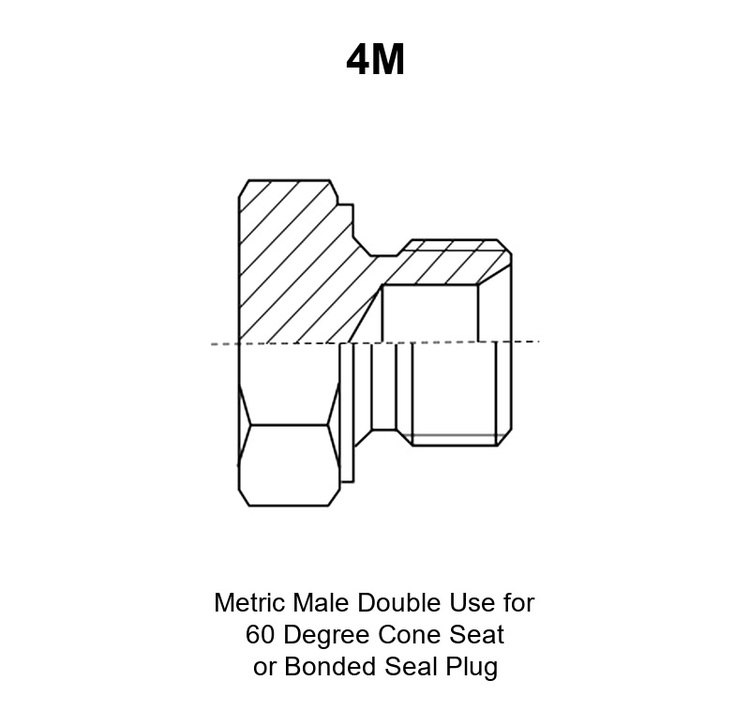
The 4M plug is a blanking plug with one metric male stud end and one hex, and no second port. The stud end seals either on a 60° metal cone seat or on a bonded seal washer pressed against a flat machined face. The 4M plug therefore closes a metric port by the same two sealing methods that the 1M two-port adapter uses, with the body terminated behind the hex.
Core Advantages
- One stud end covers two sealing methods: a 60° metal cone seat and a bonded seal washer on a flat face.
- Twelve part numbers from M10X1 through M30X2, including the fine pitch M27X1.5 and M30X1.5 variants.
- Cone geometry follows DIN 3861; the bonded seal form follows DIN 3852-2 with a DIN 7603 washer.
- A closed end behind the hex, so the port is terminated rather than joined to a second line.
- Machined from bar stock on CNC lathes, with thread gauges and dimensional checks applied batch by batch.
- Body options of carbon steel with trivalent chromium zinc plating, or 304 / 316 stainless steel.
1. What a 4M Plug Does
A 4M fitting is a hydraulic plug that terminates a single metric port. Its body carries a threaded stud end at the nose and a hex behind it, and it has no second connection: the metal closes behind the hex. The 4M plug is used where a port must be sealed off, either permanently or while a line is removed for service.
The sealing end must match its mating port exactly, because that match is the precondition for eliminating leakage at the joint. A stud end designed for a 60° cone will not seal correctly in a port that expects an elastomer seal in a machined recess, and a bonded seal washer will not seal in a port whose face is recessed for an O-ring. This plug is built for the two port styles that present either a cone seat or a plain flat face.
The sealing principle has two branches. On a cone-seated port the 60° nose seats metal-to-metal on the matching 60° cone of the port, following the cone geometry described in DIN 3861 for metric compression couplings with a cutting ring. On a flat-faced port a bonded seal washer, a metal washer with an elastomer insert as described in DIN 7603, is trapped between the hex face and the flat port face, with the elastomer insert providing the seal and the metal washer carrying the load. DIN 3852-2 describes metric stud ends that seal with or without an elastomer seal, which is the stud end form used here. Because the thread is parallel, it does not create the seal; it only clamps the faces together.
2. 4M Specifications
2.1 Connection 1 – Metric male stud end for 60° cone seat or bonded seal
- Thread standard and family: metric parallel thread to the metric stud end practice described in DIN 3852-2.
- Thread size range: M10X1 through M30X2, including the fine pitch M27X1.5 and M30X1.5 variants.
- Gender: male.
- Sealing method: 60° metal cone seat at the nose, or a bonded seal washer to DIN 7603 on the flat face under the hex.
- Mating port standard: a port machined with a 60° cone seat per DIN 3861, or a flat-faced metric port that accepts a bonded seal washer per DIN 3852-2.
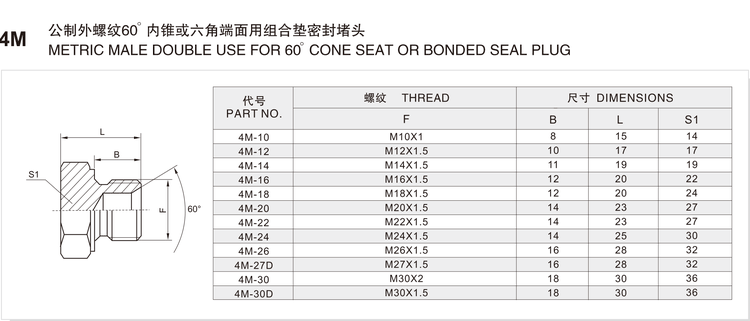
This stud end is the F end in the dimension table. Its thread is the size code in the part number and its threaded length is dimension B.
2.2 Connection 2 – Closed end, no second port
This blanking plug has no second connection. The body terminates behind the hex, and the drawing shows a solid section at that point rather than a bore, a thread or a port face. There is nothing on this end to seal against and nothing to connect to.
That is the whole point of the part. This port plug closes one port: the single stud end is the only live connection, and once it is tightened the port is terminated. The pressure boundary is the cone contact or the washer at the nose, plus the solid body wall behind it.
Because the closed end carries no thread and no seal, you cannot stack a second fitting onto this port plug, and you cannot use it as a coupling. If a port has to feed two lines, or if a line has to continue through the port, the correct part is a metric adapter with a stud end at each side, such as the 1M adapter, rather than this hydraulic plug. The 4M plug exists for the case where a port has to be sealed off and nothing else.
2.3 Construction and Materials
The blanking duty of this part and its drive feature both sit in the body. The body is machined from bar stock on CNC lathes in one piece, so no brazed or welded joint sits in the pressure path, and the closed end is solid metal rather than a plugged or capped opening. The hex is produced in the same operation that turns the thread and the 60° cone, which keeps the cones concentric with the thread axis and the hex flats square to it. The hex is an external hex, so the plug is driven from outside with a standard open-end or ring wrench across the S1 dimension.
The thread is a parallel metric thread, so the flanks do not wedge and do not deform the port. The flat face under the hex is machined to give the bonded seal washer a full, uninterrupted bearing surface, because that face and the cone are the only two sealing surfaces the part has.
Body material options are carbon steel, 304 stainless steel, 316 stainless steel and brass. Carbon steel bodies are supplied with trivalent chromium zinc plating (Cr3+) for general hydraulic service, and zinc-nickel plating is available for more demanding conditions. Stainless steel bodies are supplied unplated, and plating specification is agreed per order. Seal material for the bonded seal washer is selected from NBR, FKM and EPDM to match the fluid and the temperature, with the metal shell of the washer matched to the port face and the fluid.
2.4 Pressure and Temperature
Working pressure for these plug sizes is confirmed per order by HENGHUA engineering, based on the thread size, sealing method and material selected. The printed dimension chart for this series carries no pressure column, so no per-size rating is published on this page. What the plug holds depends on the cone contact or washer compression actually achieved in the port and on the port material.
Temperature capability follows the seal material rather than the body. NBR suits approximately -30°C to +100°C, FKM approximately -20°C to +200°C and EPDM approximately -40°C to +120°C. Where the plug runs on a cone seat only and no elastomer is present, the limit is set by the fluid and by the mechanical properties of the body material, which HENGHUA confirms per order.
2.5 Part Number and Dimension Table
The table below is reproduced in full from the printed dimension chart for this hydraulic plug series. All dimensions are in millimetres.
| PART NO. | F | B | L | S1 |
|---|---|---|---|---|
| 4M-10 | M10X1 | 8 | 15 | 14 |
| 4M-12 | M12X1.5 | 10 | 17 | 17 |
| 4M-14 | M14X1.5 | 11 | 19 | 19 |
| 4M-16 | M16X1.5 | 12 | 20 | 22 |
| 4M-18 | M18X1.5 | 12 | 20 | 24 |
| 4M-20 | M20X1.5 | 14 | 23 | 27 |
| 4M-22 | M22X1.5 | 14 | 23 | 27 |
| 4M-24 | M24X1.5 | 14 | 25 | 30 |
| 4M-26 | M26X1.5 | 16 | 28 | 32 |
| 4M-27D | M27X1.5 | 16 | 28 | 32 |
| 4M-30 | M30X2 | 18 | 30 | 36 |
| 4M-30D | M30X1.5 | 18 | 30 | 36 |
What each column means
- PART NO. – the ordering code for the row. The digits after the series prefix are the nominal size of the threaded stud end.
- F – the thread of the stud end, given as nominal diameter by pitch, for example M10X1.
- B – the threaded length of the stud end in millimetres, measured from the nose.
- L – the overall length in millimetres, including the threaded end and the hex.
- S1 – the width across the hex flats in millimetres, which is the wrench size for the plug.
Thread size and dash chart
| Nominal size | Thread | Part number |
|---|---|---|
| 10 | M10X1 | 4M-10 |
| 12 | M12X1.5 | 4M-12 |
| 14 | M14X1.5 | 4M-14 |
| 16 | M16X1.5 | 4M-16 |
| 18 | M18X1.5 | 4M-18 |
| 20 | M20X1.5 | 4M-20 |
| 22 | M22X1.5 | 4M-22 |
| 24 | M24X1.5 | 4M-24 |
| 26 | M26X1.5 | 4M-26 |
| 27 | M27X1.5 | 4M-27D |
| 30 | M30X2, M30X1.5 | 4M-30, 4M-30D |
3. How to Read a 4M Part Number
A 4M part number has two or three elements, read from left to right.
- Series prefix
4M– a metric male stud end that seals on a 60° cone seat or on a bonded seal, made as a plug with a closed end. The prefix tells you the sealing method and the fact that this is a single-port part. - Size code – the nominal size of the stud end, which is the F end in the table.
10means M10X1,12means M12X1.5 and22means M22X1.5. - Suffix
D(optional) – the fine pitch variant. ADpart uses a 1.5 mm pitch where the plain part uses a 2 mm pitch, so 4M-30 is M30X2 while 4M-30D is M30X1.5.
Worked example: 4M-27D. The prefix 4M denotes a metric male plug with 60° cone or bonded seal sealing and no second port. The size code 27 sets the stud end at M27X1.5 with a threaded length B of 16 mm, and the D suffix confirms the 1.5 mm pitch. The row also gives an overall length L of 28 mm and a hex width S1 of 32 mm.
4. Installation and Fitment
This plug seals at the cone or at the washer, never at the thread, so installation practice concentrates on one seating face. Start the stud end by hand to confirm the threads engage without resistance, then bring the plug down until the nose or the hex face contacts its mating surface. Tighten until the cone makes firm metal-to-metal contact, or until the bonded seal washer is evenly compressed, without distorting the hex, the cone or the port face. HENGHUA confirms the recommended tightening torque for your thread size, body material and port material per order.
Prepare the thread and the seating face before assembly. Blow out the port, remove swarf and old sealant residue, and check the cone for nicks and the flat face for scoring. A burr on a cone or a scratch across a flat face creates a leak path that no amount of torque will close. If the port has a 60° cone seat, the cone on the stud end does the sealing and no washer is fitted; if the port has a plain flat face, a DIN 7603 washer of the correct inside and outside diameter is fitted under the hex. The washer must never be omitted, and a thread sealant must never be used to compensate for a missing or wrong washer, because a liquid sealant cannot reproduce the controlled compression of an elastomer insert. A bonded seal washer is single-use, and a cone that has been crushed or marked is replaced with the plug rather than dressed with a file.
Assembly steps
- Confirm the port type: 60° cone seat, or flat face for a bonded seal washer.
- Select the matching bonded seal washer for a flat-faced port and check its inside and outside diameter.
- Clean the port, the thread, the nose cone and the seating face, and confirm they are free of swarf and old sealant.
- Start the stud end by hand and turn it in until it seats, keeping the plug axis aligned with the port axis.
- Tighten with a wrench across S1 to the torque confirmed for the thread size, material and port material.
- Pressurise the circuit and check the port for weeping before returning the machine to service.
Common fitment errors and their symptoms
- Fitting a washer to a cone-seated port: the plug stops short, the cone never seats and the joint leaks at low pressure.
- Omitting the washer on a flat-faced port: a steady weep that increases with pressure and temperature.
- Over-torquing to stop a leak caused by a damaged cone: the hex distorts, the cone work-hardens and the leak continues.
- Using the plug where a two-port adapter is needed: the circuit stays blocked, because the closed end cannot pass flow.
5. Applications and Industries
Application tags for this series are hydraulic systems, water jetting, oil and gas, industrial equipment, construction machinery, agriculture, marine and material handling.
The most common use of a blanking plug is a port that must be closed while the machine keeps running. When a cylinder, a valve section or an auxiliary line is removed from a manifold, the open port has to be sealed so the rest of the circuit can be pressurised. This port plug is fitted with the same stud end as the line that came out, so the sealing method and the seat angle are already correct.
In machine building and equipment refurbishment, unused ports are blanked at the factory and again after reconfiguration. A blanking plug seals an unused port on a manifold block without leaving a spare line in place, which keeps the assembly compact and removes a potential leak point. Where the same machine also carries flat-faced metric ports, the double use stud end covers those ports with the same part.
In construction machinery, agriculture and material handling, a port plug is a service item. Field repairs often leave a port open overnight, and a plug with a bonded seal washer or a 60° cone keeps dirt out and fluid in. In water jetting, oil and gas and marine service, the stainless steel versions are chosen where wash-down, spray or salt exposure would attack a plated carbon steel part.
6. Replacement and Cross-Reference Guide
Cross-reference for this family is organised by standard, thread and sealing method, never by brand. To replace this plug, identify the port rather than the part that was removed.
Measure these three things
- Thread – measure the outside diameter over the thread and the pitch, and confirm the thread is parallel rather than tapered. M30X2 and M30X1.5 look alike but will not interchange, and the
Dsuffix separates them. - Seal type at the port – look for a 60° cone seat inside the port, a plain flat face for a bonded seal washer, or a machined recess that takes an O-ring. The seal type decides the family, not the thread alone.
- Seat angle and face depth – confirm the 60° angle with a protractor and check that the flat face is genuinely flat and not recessed.
Where the port carries an O-ring in a machined recess and the thread is metric, the correct family is the metric ISO 6149 plug, covered in this range by the 4H series. Where the port carries a G thread to ISO 228-1 with an elastomer seal in a recess to ISO 1179-1, the correct part is a BSPP plug such as the 4G series. Where the port has a flat face and takes a bonded seal washer on a metric thread, this bonded seal plug is the direct match.
Two variants of the same idea are worth knowing. Where the port must connect onward instead of being closed, the 1M adapter is the metric adapter counterpart of this plug and uses an identical stud end at both ends. Where the port is in a confined space and a wrench cannot reach across the plug, the 4MN-WD hollow hex plug replaces the external hex with an internal hex drive. The 4M series itself has no light and heavy duty split, because the sealing method is the cone or the washer rather than a recessed O-ring; the split that matters here is the pitch marked by the D suffix.
7. Ordering, Packaging and Delivery
To order this plug, give five pieces of information: the series code 4M, the full part number including the D suffix where it applies, the thread size of the stud end, the seal material for the bonded seal washer if one is required, and the body material and plating.
For example, 4M-16 is a M16X1.5 plug, and 4M-30D is the fine pitch M30X1.5 plug. If you are unsure whether your port uses a 2 mm or a 1.5 mm pitch, send the port drawing rather than the old part number. Bonded seal washers are ordered as separate items, so that the washer material and the metal shell can be matched to your fluid and spares can be stocked for planned maintenance.
Packaging follows two routes. Distributor orders go into labelled cartons with part number, thread size and quantity printed on the box, so parts go straight onto a shelf. OEM and direct-to-line orders are packed in bulk and labelled to the customer reference. Samples are available so that a new size can be validated against the port before a production quantity is released. Lead time is confirmable per order, because it depends on the size, material, plating and quantity. Every batch is checked against the drawing with thread gauges before packing.
8. FAQ
What is the difference between a straight-thread O-ring seal and a tapered pipe thread?
A tapered pipe thread seals by wedging the thread flanks against each other as the joint is tightened, so the thread itself is the seal. A straight-thread joint such as the metric stud end on this part seals on a separate element, either a 60° metal cone seat or a bonded seal washer, and the parallel thread only clamps the faces together.
Can BSP and NPT be interchanged?
No. BSP threads are Whitworth forms with a 55° thread angle, covered for the parallel family by ISO 228-1, while NPT is a tapered thread with a 60° thread angle. They differ in diameter and in threads per inch, and a G thread will not seat correctly in an NPT port. Forcing one into the other damages both threads, and any joint that appears to hold will not do so reliably under pressure.
How do I identify the correct 4M size?
Measure the thread outside diameter and pitch at the port, confirm that the face presents a 60° cone or a flat face for a bonded seal, then read the size code from the table in 2.5. The size code in the part number is the stud end thread. Take particular care with M30, where both a 2 mm and a 1.5 mm pitch exist in this range.
What seal material should I select for my fluid and temperature?
Select the bonded seal washer elastomer from NBR, FKM or EPDM. NBR suits mineral hydraulic oil over approximately -30°C to +100°C, FKM extends the range to approximately -20°C to +200°C and handles a wider spread of aggressive fluids, and EPDM covers approximately -40°C to +120°C and is the usual choice for water and many water-based fluids. EPDM is not compatible with mineral oil, so it is selected only when the fluid calls for it.
How is the working pressure of this fitting determined?
Working pressure for the 4M plug sizes is confirmed per order by HENGHUA engineering, based on the thread size, sealing method and material selected. The printed dimension chart carries no pressure column, so no per-size rating is published here. In practice the limit is set by the cone contact or washer compression actually achieved in the port and by the port material.
What is the minimum order quantity and can I get samples?
Minimum order quantity is confirmable per order and depends on the size, the body material and whether the part is a standard row or a drawing-based special. Samples are available so that a new size, material or sealing arrangement can be validated against the actual port before a production quantity is committed.
Can a 4M plug be used to join two hoses?
No. A 4M plug has one stud end and a closed body, so it terminates a port and cannot connect two lines. If two ports or two lines have to be joined, the part required is a metric adapter with a stud end at each side, which uses the same 60° cone or bonded seal stud end as this plug but carries a thread at both ends.
What is the difference between a 4M plug and a 4MN-WD hollow hex plug?
Both close a single metric port and both have a closed end, but they differ in the drive and the seal. The 4M plug has an external hex across S1 and seals on a 60° cone or a DIN 7603 bonded seal washer. The 4MN-WD hollow hex plug has an internal hex drive and seals on a captive seal at the rear of the thread. The choice usually follows the available wrench clearance and the port design.
HENGHUA machines the 4M plug in carbon steel, 304 stainless steel and 316 stainless steel, with NBR, FKM and EPDM bonded seal washers to match your fluid. Send your port drawing, thread size and required quantity, and HENGHUA will confirm the exact row, material and washer for your application.
Related series in the same family: the 1M adapter and the 4MN-WD hollow hex plug. Browse the full Hydraulic Adapters range for the complete ISO 1179 BSP, ISO 6149 metric, ISO 11926-3 SAE O-ring boss and SAE J513 cone families.



 English
  Spanish
  Portuguese
  French
  German
  Arabic
  Russian