
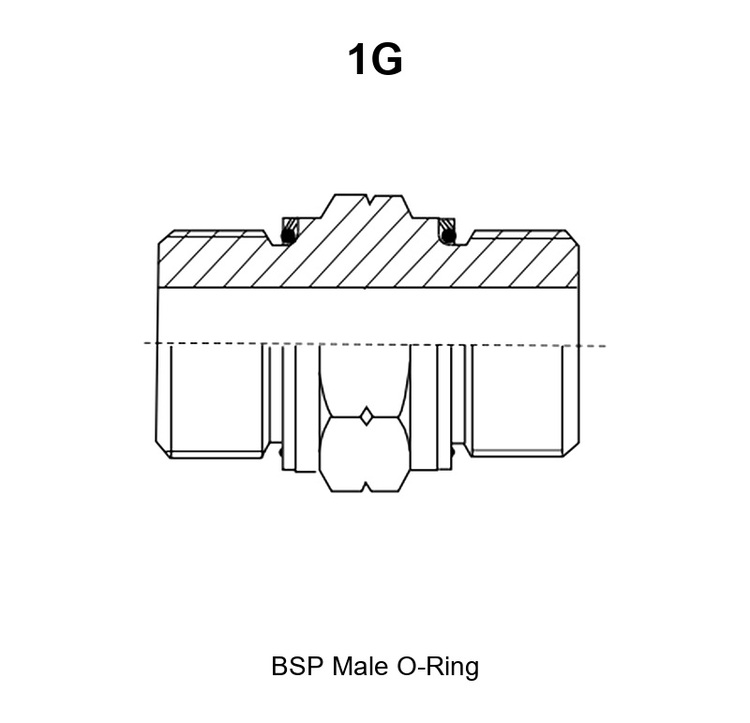
The 1G adapter is a straight male stud adapter with a BSPP G thread at both ends and an O-ring at each sealing face. Each stud end seals by compressing its O-ring into the machined recess of a port made to ISO 1179-1, so the thread only clamps and the elastomer does the sealing. The 1G adapter therefore joins two BSPP O-ring ports of the same size with one machined part.
Core Advantages
- Two identical G thread stud ends, each with its own O-ring, for straight-through port-to-port connection.
- G thread form to ISO 228-1; stud end sealing per ISO 1179-2.
- Eight sizes from G1/8″X28 through G1.1/2″X11, with the O-ring code printed for each end.
- O-rings are the seal, so the joint does not rely on thread deformation or on a thread sealant.
- Machined from bar stock on CNC lathes, with thread gauges and dimensional checks applied batch by batch.
- Body options of carbon steel with trivalent chromium zinc plating, or 304 / 316 stainless steel.
1. What a 1G Adapter Does
A 1G fitting is a hydraulic adapter that joins two BSPP ports through a male stud end at each side of the body. Each stud end carries a parallel G thread and an O-ring at the sealing face, and the body has one hex between the two ends. Because both ends are the same size in every row of this range, the 1G adapter is a straight connector rather than a reducer.
The sealing end must match its mating port exactly, because that match is the precondition for eliminating leakage at the joint. A G thread stud end designed to seal on an O-ring in a machined recess will not seal correctly in a port with a 60° cone seat or in a plain flat-faced port that expects a bonded seal washer. The 1G adapter is built for ports machined to ISO 1179-1, where the port face carries a recess dimensioned for the elastomer seal.
The sealing principle is a straight-thread O-ring seal. The O-ring sits at the base of the stud end and is compressed into the machined recess on the port face as the adapter is tightened, so the seal is radial and axial against a controlled metal recess, not against the thread. ISO 228-1 defines the G thread family as pipe threads where pressure-tight joints are not made on the threads, which is exactly the case here, and ISO 1179-2 defines stud ends with G thread and elastomer seal in heavy duty type S and light duty type L forms. The thread is a clamp, the O-ring is the seal, and the two jobs are separate.
2. 1G Specifications
2.1 Connection 1 – BSPP male G thread stud end with O-ring
- Thread standard and family: BSPP parallel pipe thread to ISO 228-1, with elastomer seal stud end practice to ISO 1179-2.
- Thread size range: G1/8″X28 through G1.1/2″X11, as listed in the dimension table.
- Gender: male.
- Sealing method: elastomer O-ring compressed into the machined recess of the port face.
- Mating port standard: a port with G thread and an elastomer seal recess per ISO 1179-1.
This first stud end is the E end in the dimension table. Its thread is the first thread column and its O-ring is listed under O-RING E, with the threaded length as dimension A.
2.2 Connection 2 – BSPP male G thread stud end with O-ring
- Thread standard and family: BSPP parallel pipe thread to ISO 228-1, with elastomer seal stud end practice to ISO 1179-2.
- Thread size range: the same G sizes as the first end, as printed for each row.
- Gender: male.
- Sealing method: elastomer O-ring compressed into the machined recess of the port face.
- Mating port standard: a port with G thread and an elastomer seal recess per ISO 1179-1.
The second stud end is the F end and it is identical to the first in every row of this range, with its own O-ring listed under O-RING F and its threaded length as dimension B. This is a genuine two-port part: both ends are live connections and both must be sealed at installation. A 1G adapter connects two G ports of the same size end to end, which is the usual way to bring a hose end out of a manifold face or to pass a line through a bulkhead plate.
2.3 Construction and Materials
The body is machined from bar stock on CNC lathes in one piece, so no brazed or welded joint sits in the pressure path. The hex is produced in the same operation that turns the threads, which keeps the hex flats square to the thread axis and the two stud ends concentric with each other. The O-ring seat at the base of each stud end is turned so that the O-ring is held square to the thread and enters the port recess without rolling.
The thread is a parallel G thread to ISO 228-1, so the flanks do not wedge and do not deform the port. Because the thread is not the seal, the surface finish of the thread does not decide whether the joint holds; the O-ring, the recess and the face contact do. That is why a thread sealant has no role on this part and why an O-ring must never be omitted.
Body material options are carbon steel, 304 stainless steel, 316 stainless steel and brass. Carbon steel bodies are supplied with trivalent chromium zinc plating (Cr3+) for general hydraulic service, and zinc-nickel plating is available for more demanding conditions. Stainless steel bodies are supplied unplated, and plating specification is agreed per order. O-ring material options are NBR, FKM and EPDM, matched to the fluid and to the operating temperature. The O-ring is a consumable item and is normally renewed whenever the joint is opened.
2.4 Pressure and Temperature
Working pressure for these BSPP adapter sizes is confirmed per order by HENGHUA engineering, based on the thread size, sealing method and material selected. The printed dimension chart for this series carries no pressure column, so no per-size rating is published on this page. What the joint holds depends on the O-ring compression actually achieved in the port recess, on the port material, and on the body material and plating.
Temperature capability follows the O-ring material rather than the body. NBR suits approximately -30°C to +100°C, FKM approximately -20°C to +200°C and EPDM approximately -40°C to +120°C. These are material facts for the elastomer. For corrosive, offshore and wash-down duty, 304 or 316 stainless steel is the appropriate body choice, and the O-ring material is then matched to the fluid.
2.5 Part Number and Dimension Table
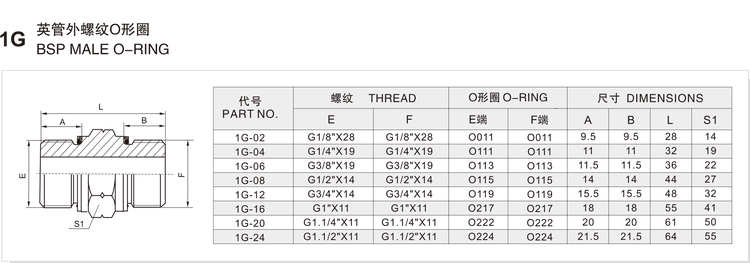
The table below is reproduced in full from the printed dimension chart for this BSPP O-ring adapter series. All dimensions are in millimetres.
| PART NO. | E | F | O-RING E | O-RING F | A | B | L | S1 |
|---|---|---|---|---|---|---|---|---|
| 1G-02 | G1/8″X28 | G1/8″X28 | O011 | O011 | 9.5 | 9.5 | 28 | 14 |
| 1G-04 | G1/4″X19 | G1/4″X19 | O111 | O111 | 11 | 11 | 32 | 19 |
| 1G-06 | G3/8″X19 | G3/8″X19 | O113 | O113 | 11.5 | 11.5 | 36 | 22 |
| 1G-08 | G1/2″X14 | G1/2″X14 | O115 | O115 | 14 | 14 | 44 | 27 |
| 1G-12 | G3/4″X14 | G3/4″X14 | O119 | O119 | 15.5 | 15.5 | 48 | 32 |
| 1G-16 | G1″X11 | G1″X11 | O217 | O217 | 18 | 18 | 55 | 41 |
| 1G-20 | G1.1/4″X11 | G1.1/4″X11 | O222 | O222 | 20 | 20 | 61 | 50 |
| 1G-24 | G1.1/2″X11 | G1.1/2″X11 | O224 | O224 | 21.5 | 21.5 | 64 | 55 |
What each column means
- PART NO. – the ordering code for the row. The two digits after the series prefix are the BSP nominal size code, following the nominal size in sixteenths of an inch.
- E – the thread of the first stud end, given in the standard form of nominal size by threads per inch, for example G1/4″X19.
- F – the thread of the second stud end, in the same notation as E.
- O-RING E – the O-ring code for the first stud end, which is the seal reference to quote when ordering spares.
- O-RING F – the O-ring code for the second stud end, in the same notation as O-RING E.
- A – the threaded length of the first stud end in millimetres, measured from the nose.
- B – the threaded length of the second stud end in millimetres, measured from the nose.
- L – the overall length in millimetres, including both threaded ends and the hex.
- S1 – the width across the hex flats in millimetres, which is the wrench size for the adapter.
Thread size and dash chart
| Dash code | Thread | O-ring | Part number |
|---|---|---|---|
| 02 | G1/8″X28 | O011 | 1G-02 |
| 04 | G1/4″X19 | O111 | 1G-04 |
| 06 | G3/8″X19 | O113 | 1G-06 |
| 08 | G1/2″X14 | O115 | 1G-08 |
| 12 | G3/4″X14 | O119 | 1G-12 |
| 16 | G1″X11 | O217 | 1G-16 |
| 20 | G1.1/4″X11 | O222 | 1G-20 |
| 24 | G1.1/2″X11 | O224 | 1G-24 |
3. How to Read a 1G Part Number
A 1G part number has two elements, read from left to right.
- Series prefix
1G– a BSP male stud end of the BSPP family, sealing with an O-ring per ISO 1179-2 on a G thread to ISO 228-1, made as a straight two-port connector. - Size code – the nominal BSP size code, which follows the nominal size in sixteenths of an inch.
02is 1/8,04is 1/4,06is 3/8,08is 1/2,12is 3/4,16is 1,20is 1-1/4 and24is 1-1/2.
Worked example: 1G-06. The prefix 1G denotes a BSPP male O-ring adapter, and the size code 06 sets both ends at G3/8″X19, with O-ring code O113 at each end. Reading across the row, the threaded lengths A and B are 11.5 mm each, the overall length L is 36 mm and the hex width S1 is 22 mm.
4. Installation and Fitment
The O-ring is the seal and the thread is only the clamp. That single rule governs everything about installing a BSPP O-ring stud end. Never omit the O-ring, never replace it with a thread sealant, and never assume that tightening further will stop a leak that the O-ring is not stopping.
Check the port before assembly. An ISO 1179-1 port has a machined recess on the face, and that recess has to be clean, undamaged and free of old sealant or paint. Blow out the port, wipe the face, and confirm that the recess will accept the O-ring without cutting it. Fit the O-ring on the stud end, lubricate it with clean system fluid where the application allows, and start the adapter by hand so that the threads engage without resistance. Tighten until the stud end seats against the port face and the O-ring is compressed in the recess, without over-torquing to the point where the hex or the port face deforms. HENGHUA confirms the recommended tightening torque for your thread size, body material and port material per order.
Two fitment errors cause most of the leaks on this family. The first is a missing or incorrect O-ring, which produces a steady weep that grows with pressure. The second is a mismatched port, such as a G thread port with a flat face and no recess, where the O-ring has nothing to compress into; that port needs a bonded seal washer to DIN 7603 instead, not this part. A third and subtler error is reusing a hardened O-ring that has taken a compression set, which seals on the bench and fails after a few thermal cycles.
Assembly steps
- Confirm both ports are ISO 1179-1 ports with a G thread and a machined elastomer seal recess.
- Check the recesses for damage and contamination, and select the O-ring code printed for the row.
- Fit the O-rings on both stud ends and lubricate them with clean system fluid if the application allows.
- Start the first stud end by hand and turn it in until it seats against the port face, keeping the body axis aligned with the port axis.
- Tighten to the torque confirmed for the thread size, material and port material, without over-compressing the O-ring.
- Repeat for the second end, then pressurise the circuit and check both joints for weeping before returning the machine to service.
Common fitment errors and their symptoms
- O-ring omitted or replaced by thread sealant: the joint weeps from the very first pressurisation.
- Adapter fitted to a flat-faced G port with no recess: the O-ring is crushed between two faces, extrudes and leaks.
- Over-tightening: the port face or the hex distorts, and the O-ring is flattened beyond recovery.
- Wrong O-ring code for the size: the O-ring rolls out of the recess during tightening and is cut.
5. Applications and Industries
Application tags for this series are hydraulic systems, water jetting, oil and gas, industrial equipment, construction machinery, agriculture, marine and material handling.
BSPP ports are common on European and Asian hydraulic equipment and on imported machine tools, and a straight G thread O-ring joint is preferred there because it can be opened and remade without replacing the fitting. In industrial equipment, this connection is used to bring a line out of a manifold face, to extend a port to a more accessible position, and to join two control blocks that were machined to the same G port standard.
In construction machinery, agriculture and material handling, the G thread O-ring joint is valued for its tolerance of repeated service. A hose end or a test point that is connected and disconnected during maintenance keeps its sealing performance because the O-ring, not the thread, is the sealing element. Where a line has to pass through a bulkhead or a panel, two identical stud ends make this hydraulic adapter a natural pass-through part.
In water jetting, oil and gas and marine service, the stainless steel versions are chosen where wash-down, spray or salt exposure would attack a plated carbon steel part, and the O-ring material is matched to the fluid, with FKM or EPDM selected where NBR is not suitable. In industrial equipment and machine tools, the same BSP adapter serves as a simple straight connector between two G ports of equal size, keeping the number of different fittings on a machine to a minimum.
6. Replacement and Cross-Reference Guide
Cross-reference for this family is organised by standard, thread and sealing method, never by brand. To replace this BSP adapter, identify the port rather than the part that was removed.
Measure these three things
- Thread – measure the outside diameter over the thread and the threads per inch, and confirm the thread is parallel rather than tapered. G1/4″X19 and G3/8″X19 are different threads with the same family name, and a tapered BSPT thread will not interchange with either.
- Seal type at the port – look for a machined recess for an elastomer seal. If the face is plain and flat, the port expects a bonded seal washer to DIN 7603 rather than an O-ring stud end.
- Recess dimensions and seal code – measure across the recess and compare it with the O-ring column in the table, and check whether the port is dimensioned as ISO 1179-2 type S or type L, because the two differ in stud end length.
Where the port carries an O-ring in a machined recess and the thread is metric, the correct family is the ISO 6149 O-ring stud end, covered in this range by the 1H series, with the heavy duty S series equivalent in 1H-H. Where the port has a 60° cone seat or a flat face that takes a DIN 7603 bonded seal washer, the correct part is a metric 60° cone or bonded seal adapter such as the 1M series. Where the port must be closed rather than connected, the same BSPP O-ring stud end is produced as the 4G plug.
The family distinction that matters most here is thread form and seal recess together, not thread form alone. ISO 228-1 describes the G thread used on this adapter and ISO 1179-1 describes the port it seals in; both have to be satisfied at once. A G thread port with a cone seat is not an ISO 1179-1 port, and a metric port with an O-ring recess is not a G port, even where the two threads happen to be close in diameter.
7. Ordering, Packaging and Delivery
To order this BSPP adapter, give five pieces of information: the series code 1G, the full part number, the G thread size of each end, the O-ring material, and the body material and plating. Also state the O-ring code from the table if you want the correct seal supplied with the fitting.
For example, 1G-08 is a G1/2″X14 adapter with O-ring O115 at both ends. Because both ends are the same size in every row of this range, a single size code fully describes the part. If you are replacing an existing hydraulic adapter and the marking is worn, measure the thread outside diameter and the threads per inch and send those figures with the port drawing, and the row will be confirmed for you.
O-rings are ordered as separate items as well as with the fittings, so that spare seals can be stocked for planned maintenance without buying complete adapters. State the O-ring code and the material when ordering spares, because the same size code is available in NBR, FKM and EPDM. Packaging follows two routes: distributor orders go into labelled cartons with part number, thread size and quantity printed on the box, and OEM and direct-to-line orders are packed in bulk and labelled to the customer reference. Samples are available so that a new size or seal material can be validated against the port before a production quantity is released. Lead time is confirmable per order, because it depends on the size, material, plating and quantity. Every batch is checked against the drawing with thread gauges before packing.
8. FAQ
What is the difference between a straight-thread O-ring seal and a tapered pipe thread?
A tapered pipe thread seals by wedging the thread flanks against each other as the joint is tightened, so the thread itself is the seal and it deforms slightly at every make-up. A straight-thread joint such as the G thread stud end on this part seals on a separate element, the O-ring compressed into the port recess, and the parallel thread only clamps the faces together. That is why the 1G adapter can be opened and remade repeatedly, and why a thread sealant is not used on it.
Can BSP and NPT be interchanged?
No. BSP threads are Whitworth forms with a 55° thread angle, covered for the parallel family by ISO 228-1, while NPT is a tapered thread with a 60° thread angle and a different threads-per-inch series. They differ in diameter and in form, and a G thread will not seat correctly in an NPT port. Forcing one into the other damages both threads, and any joint that appears to hold will not do so reliably under pressure. A G port needs a G stud end, and this BSP adapter is that part.
How do I identify the correct 1G size?
Measure the thread outside diameter and the threads per inch, and read the size code from the table in 2.5. The dash code follows the nominal size in sixteenths of an inch, so 02 is 1/8, 08 is 1/2 and 24 is 1-1/2. Also check that the port face has a machined recess for the elastomer seal, because the size alone does not prove the port is an ISO 1179-1 port.
What seal material should I select for my fluid and temperature?
Select the O-ring material from NBR, FKM or EPDM. NBR suits mineral hydraulic oil over approximately -30°C to +100°C, FKM extends the range to approximately -20°C to +200°C and handles a wider spread of aggressive fluids, and EPDM covers approximately -40°C to +120°C and is the usual choice for water and many water-based fluids. EPDM is not compatible with mineral oil, so it is selected only when the fluid calls for it.
How is the working pressure of this fitting determined?
Working pressure for the 1G adapter sizes is confirmed per order by HENGHUA engineering, based on the thread size, sealing method and material selected. The printed dimension chart carries no pressure column, so no per-size rating is published here. In practice the limit is set by the O-ring compression achieved in the port recess, by the port material, and by the body material and plating.
What is the minimum order quantity and can I get samples?
Minimum order quantity is confirmable per order and depends on the size, the body material and whether the part is a standard row or a drawing-based special. Samples are available so that a new size, material or O-ring compound can be validated against the actual port before a production quantity is committed.
Can a bonded seal washer be used instead of the O-ring on a 1G adapter?
No. A bonded seal washer to DIN 7603 seals on a plain flat face, while this BSPP adapter is dimensioned to seal with an O-ring compressed into a machined recess on the port face, following the G thread stud end practice of ISO 1179-2. Fitting a washer instead of the O-ring leaves the recess unfilled and produces a leak path. Where the port has a plain flat face, a metric 60° cone or bonded seal adapter from the 1M or 4M series is the correct family rather than this BSPP O-ring adapter.
What is the difference between a 1G adapter and a 4G plug?
Both use the same BSPP O-ring stud end to ISO 1179-2 and both are machined from bar stock. This adapter carries a stud end at each side and joins two G ports, while the 4G plug has one stud end and a closed body, and closes a single G port. Choose the 1G when a line has to pass through or between ports, and the 4G when a G port has to be terminated.
HENGHUA machines the 1G adapter in carbon steel, 304 stainless steel and 316 stainless steel, with NBR, FKM and EPDM O-rings to match your fluid. Send your port drawing, G thread size and required quantity, and HENGHUA will confirm the exact row, O-ring code and material for your application.
Related series in the same family: the 4G plug and the 1H adapter. Browse the full Hydraulic Adapters range for the complete ISO 1179 BSP, ISO 6149 metric, ISO 11926-3 SAE O-ring boss and SAE J513 cone families.


 English
  Spanish
  Portuguese
  French
  German
  Arabic