
Why This metric male O-ring tee adapter AE Passes the Compliance Gate
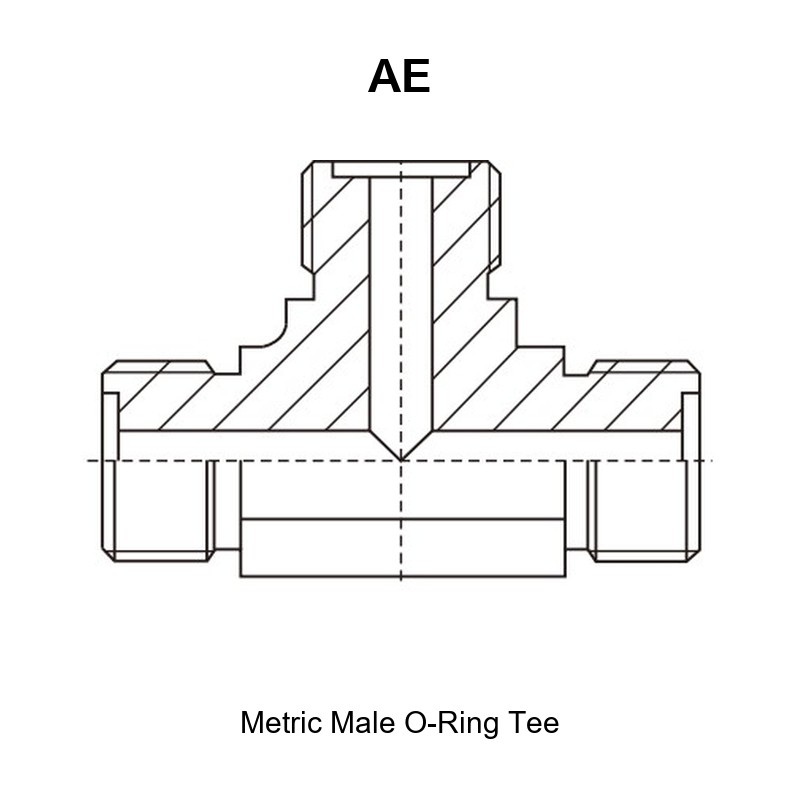
All three ports of the metric male O-ring tee adapter AE are metric male O-ring stud ends that seal with a captive O-ring on the flat face of an ISO 6149-1 port, from M14x1.5 to M52x2. Because ports E, F and G share one thread size in every row, the tee splits a pressure line into two equal branches with no reducer and no second joint. The branch run leaves the main line at 90 degrees, so a circuit can be tapped inside a manifold without adding a stack of fittings.
The tee is bought by manifold builders, hydraulic power unit assemblers and maintenance engineers who must take a second leg off a machined block. Each size row is a single part number that replaces three separate adapters and the leak paths between them.
Core Advantages
- Three matched ISO 6149-2 stud ends. Every port seals the same way, so the same port preparation, O-ring stock and torque value apply on the run and on the branch.
- Equal tee geometry. Ports E, F and G carry the same thread and the same L1, L2 and L3 values, which keeps flow balanced and keeps the drawing simple.
- Eleven tabulated sizes. M14x1.5 through M52x2, each row with its own O-ring size and hex across-flats.
- Fewer joints, fewer leak paths. One tee replaces a cross-drilled block or a two-adapter stack at every branch point.
- Documented, traceable supply. Batch traceability, dimensional records and material test reports support incoming inspection.
- OEM marking. Laser marking of your part number, logo and batch code is available on the body or the hex.
Technical Specifications
What Is a metric male O-ring tee adapter AE?
It is a one-piece three-way tee in which ports E, F and G are all ISO 6149-2 metric male O-ring stud ends. Each port seals with an elastomeric O-ring compressed on a flat machined port face, as defined for that stud end family.
It is not a DIN 2353 / ISO 8434-1 24 degree cone tee, and it is not a 74 degree cone tee from the SAE J514 family, because those seal on a cone inside the port. Check the port standard first, then the thread, then the branch load.
Connection 1, Connection 2 and Connection 3 – Metric male O-ring stud ends (E, F, G)
| Attribute | Specification |
|---|---|
| Seal principle | Captive O-ring, face seal in an ISO 6149-1 machined port, on all three ports |
| Thread standard | ISO 6149-2 metric stud end (inch equivalents sit in the ISO 11926 family, a different series) |
| Threads in this series | M14x1.5, M16x1.5, M18x1.5, M22x1.5, M27x1.5, M30x1.5, M36x2, M39x2, M42x2, M45x2, M52x2 |
| O-ring sizes in this series | 10×1.9, 11×1.9, 13×1.9, 16×2.4, 20×2.4, 24×2.4, 30×3.1, 32×3.1, 35×3.1, 38×3.1, 40×3.1 |
| Stud hex across-flats (S) | 14 mm to 50 mm, per row of the matrix |
| Configuration | Equal tee, fixed body, no swivel |
Dimensional Data
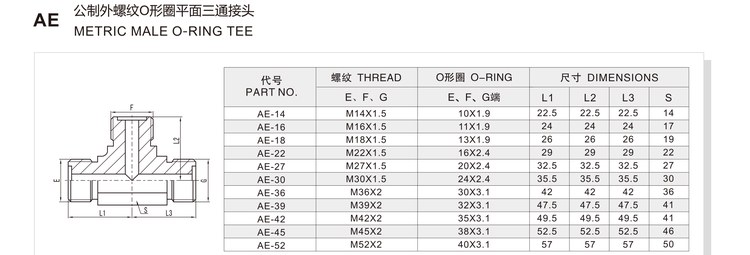
| Symbol | Meaning | Unit |
|---|---|---|
| E, F, G | Metric male stud threads at the three ports, identical in every row of this series | – |
| O-RING (E, F, G end) | O-ring size designation, written as inside diameter x cross-section | mm |
| L1 | Centre-to-face dimension at the first port, as defined on the data-sheet drawing | mm |
| L2 | Centre-to-face dimension at the second port | mm |
| L3 | Centre-to-face dimension at the third port | mm |
| S | Hex across-flats (wrench size) on the stud ends | mm |
Full Dimension Table (Part Number Matrix)
| PART NO. | THREAD E, F, G | O-RING (E, F, G end) | L1 | L2 | L3 | S |
|---|---|---|---|---|---|---|
| AE-14 | M14X1.5 | 10X1.9 | 22.5 | 22.5 | 22.5 | 14 |
| AE-16 | M16X1.5 | 11X1.9 | 24 | 24 | 24 | 17 |
| AE-18 | M18X1.5 | 13X1.9 | 26 | 26 | 26 | 19 |
| AE-22 | M22X1.5 | 16X2.4 | 29 | 29 | 29 | 22 |
| AE-27 | M27X1.5 | 20X2.4 | 32.5 | 32.5 | 32.5 | 27 |
| AE-30 | M30X1.5 | 24X2.4 | 35.5 | 35.5 | 35.5 | 30 |
| AE-36 | M36X2 | 30X3.1 | 42 | 42 | 42 | 36 |
| AE-39 | M39X2 | 32X3.1 | 47.5 | 47.5 | 47.5 | 41 |
| AE-42 | M42X2 | 35X3.1 | 49.5 | 49.5 | 49.5 | 41 |
| AE-45 | M45X2 | 38X3.1 | 52.5 | 52.5 | 52.5 | 46 |
| AE-52 | M52X2 | 40X3.1 | 57 | 57 | 57 | 50 |
All dimensions are in millimetres and are transcribed row by row from the product data sheet. Thread codes are reproduced as printed, so M14X1.5 reads as M14x1.5 metric fine thread, and O-ring codes such as 16X2.4 read as 16 mm inside diameter by 2.4 mm cross-section. Because the series is an equal tee, L1, L2 and L3 are identical within each row.
Thread Size and Dash Chart
| Metric stud thread (E, F, G) | Part number | O-ring at each port | Hex S (mm) |
|---|---|---|---|
| M14x1.5 | AE-14 | 10×1.9 | 14 |
| M16x1.5 | AE-16 | 11×1.9 | 17 |
| M18x1.5 | AE-18 | 13×1.9 | 19 |
| M22x1.5 | AE-22 | 16×2.4 | 22 |
| M27x1.5 | AE-27 | 20×2.4 | 27 |
| M30x1.5 | AE-30 | 24×2.4 | 30 |
| M36x2 | AE-36 | 30×3.1 | 36 |
| M39x2 | AE-39 | 32×3.1 | 41 |
| M42x2 | AE-42 | 35×3.1 | 41 |
| M45x2 | AE-45 | 38×3.1 | 46 |
| M52x2 | AE-52 | 40×3.1 | 50 |
Material and Heat Treatment
| Item | Standard supply (typical) | On request |
|---|---|---|
| Body material | Carbon steel | Austenitic stainless steel for corrosive and offshore duty |
| Heat treatment | Stress relief applied as required by the drawing for carbon steel bodies | Grade and condition agreed per drawing |
| Surface treatment | Zinc-based plating | Zinc-nickel, chrome-free passivation, stainless passivation |
| O-ring elastomer | NBR, service range about -40 °C to +120 °C | FKM for higher temperature and aggressive media |
| Dimensional inspection | Sample and batch dimensional records | Full-lot dimensional report |
| Pressure testing | Batch pressure test with recorded results | Third-party witnessed testing |
| Documentation | Batch certificate and traceability record | Material test report on request |
The values above describe normal commercial practice for this family and are confirmed on the order drawing, not replaced by it.
Working Pressure and Operating Envelope
Because the data sheet for this series carries no pressure column, working pressure is governed by the port standard (ISO 6149-2 together with the ISO 6149-1 port) and by the tube, hose or fitting grade selected, and the finished assembly is only as strong as its weakest member. A tee also carries two downstream branches, so the branch load and any side load on the run should be supported by clamps rather than by the tee body.
Ask for a rating table with your enquiry and we will state the figure and the test method for your thread size, material and downstream parts. Proof or burst testing of the finished assembly is written into the order when your specification calls for it.
Temperature Range
The typical service window is -40 °C to +120 °C with a standard NBR O-ring, and the limit is set by the elastomer rather than by the steel body. FKM raises the upper limit for hot oil and some aggressive media, so confirm the elastomer for your fluid before ordering.
How to Read the Part Number Matrix
The order code carries two pieces of information: the tee family prefix and the stud thread size, which applies to all three ports.
- Prefix – AE. The prefix states the configuration: an equal tee with metric male O-ring stud ends on ports E, F and G.
- Size group – thread size. In AE-22 the group 22 identifies the metric stud thread, M22x1.5, on all three ports.
Two examples make the pattern clear. AE-14 is the smallest row: M14x1.5 on all three ports, 10×1.9 O-rings, L1 = L2 = L3 = 22.5 mm, hex 14. AE-45 is a large manifold size: M45x2 on all three ports, 38×3.1 O-rings, 52.5 mm centre-to-face dimensions, hex 46.
If you need different sizes on the branch and the run, the equal tee is the wrong part: ask instead for a reducing tee, and send the three port callouts. If you know only the run thread, quote that single value and we will return the matching equal tee row.
Selection and Ordering
| Question | What to confirm before ordering |
|---|---|
| Are all three ports ISO 6149-1 flat-face O-ring ports? | The tee has three stud ends of one size, so all three mating ports must be the same thread and the same seal type. |
| What is the port thread? | Read the port callout, for example M22x1.5, and do not infer the thread from the port bore diameter. |
| Is an equal tee what the circuit needs? | An equal tee gives three identical ports; a reducing branch requires a different series. |
| Is the O-ring material correct for the fluid? | NBR is the default; specify FKM or another elastomer for hot or aggressive service. |
| Will the hex and the branch clear? | The S value is the wrench size; check spanner access on all three ports and on the branch. |
| Does the run need support? | A tee carries branch weight and side load, so plan a clamp either side of the tee. |
Cross Reference Service
Send an old part number, a photograph or a worn sample of the metric male O-ring tee adapter AE and we will cross it to the closest row of this matrix. The answer states thread, O-ring and hex explicitly so you can verify it against your own measurement, the service is free, and we never re-label another maker’s part as our own.
Packaging and Logistics
Tees ship in individual bags inside cartons, grouped by part number, with batch code and quantity on the outer label. Mixed cartons are routine for distributors and repair workshops. Material test reports travel with the goods when ordered, standard rows ship quickly from stock, and air freight covers urgent shutdown dates.
Installation and Fitment Guide
Step-by-Step Assembly
- Verify the port threads and the port standard on all three ports before starting work.
- Check each port face for burrs, paint or old sealant, because an O-ring face seal needs a clean flat landing.
- Fit new O-rings of the tabulated size to each stud end, lightly lubricated with a compatible fluid.
- Thread all three ports in by hand and confirm the body lines up before tightening any port, so the tee is not loaded by misalignment.
- Tighten each stud end to the torque value for the thread size and material from the applicable standard data table, in a sequence that keeps the body square.
- Pressure test the finished assembly and record the result.
Torque and Sealing Notes
Tighten metric O-ring stud ends to the torque values for the thread size, material and coating from the applicable standard data table, and treat those figures as a starting point to be confirmed against your own test. An O-ring face seal does not need thread sealant, and tape or paste on the stud thread can force the O-ring out of its groove. On a tee, tighten the run ports first and the branch last, because a tee tightened at one port loads the other two. Over-tightening does not improve the seal and can stretch the thread or distort the port face.
Installation Warnings
- ✔ Confirm all three ports are ISO 6149-1 flat-face O-ring type before fitting this tee.
- ✔ Fit new O-rings of the tabulated size whenever a joint is broken.
- ✔ Support the branch with a clamp so side load is not carried by the tee body.
- ✔ Use a spanner on the S hex, and hold the body steady when breaking a joint.
- ❌ Never fit this tee into 24 degree cone ports (DIN 2353 / ISO 8434-1), 60 degree cone ports, or 74 degree cone / SAE J514 style ports. The thread may start, but the seal geometry differs and the joint will not seal correctly.
- ❌ Never interchange this metric stud end with an inch O-ring stud end from the ISO 11926 family, even where thread diameters look close.
- ❌ Never use thread tape or sealant on the O-ring stud thread to stop a weep.
- ❌ Never use an equal tee as a reducing branch, and never plug one port of a tee to make an elbow.
Applications and Industries
The metric male O-ring tee adapter AE appears wherever a pressure line on a machined block must feed a second branch.
- Manifold and power unit assembly. A tee on the pressure or return line feeds a gauge, accumulator or second function without cross-drilling the block.
- Repair and replacement. A weeping or stripped branch port is repaired by replacing the tee rather than the block, with the cross reference service identifying the row.
- Test rigs and benches. Instrumentation taps, bleed points and pressure gauge connections are added to a live line with one part number.
- Industrial plant. Lubrication, cooling and clamp circuits use equal tees to split flow where a balanced split matters more than a specific ratio.
- Mobile and construction machinery. Tees feed attachment and steering functions from a main line, with the branch clamped against vibration.
Tags: hydraulic adapter, metric O-ring tee, ISO 6149 hydraulic fitting, equal tee hydraulic adapter, hydraulic manifold tee, metric male O-ring stud end, three way hydraulic fitting, tee to port adapter.
OEM Customization and Quality Traceability
We manufacture matching hydraulic adapters and hose assemblies alongside our hose range, so specials are quoted engineering work rather than a favour. Laser marking of your part number, logo, date code and batch code is available on the body or the hex, and custom finishes, non-standard threads, alternative O-ring elastomers and special body dimensions are quoted from your drawing or sample, normally within 24 hours.
Every batch is traceable from raw material to finished part. Batch records, dimensional results and material test reports are available with the goods, third-party inspection such as BV or SGS can be arranged, and finished assemblies are pressure tested with results recorded for the lot. Ordering the metric male O-ring tee adapter AE on a repeat schedule keeps one drawing, one O-ring size and one traceability record behind every branch point.
FAQ
Q: What is the difference between this equal tee and a reducing tee? A: An equal tee has the same thread and the same O-ring on all three ports, as every row of this matrix shows. A reducing tee carries one thread on the run and a different thread on the branch, and it is ordered as a different series.
Q: Is a metric male O-ring stud end the same as a DIN 2353 24 degree cone stud end? A: No. This stud end seals with an O-ring against a flat port face as defined by ISO 6149-2 in an ISO 6149-1 port, while a DIN 2353 / ISO 8434-1 24 degree cone stud seals on a cone machined inside the port. Thread sizes may look identical, but the sealing interface differs and the two must not be mixed.
Q: Can I use this tee in a 74 degree cone port such as an SAE J514 style port? A: No. A 74 degree cone joint seals on a cone, not on a flat face with an O-ring, so an AE tee will not seal there. Use a 74 degree cone adapter for that interface.
Q: What pressure can the metric male O-ring tee adapter AE take? A: The data sheet has no pressure column for this series, so the rating follows the port standard and the grade of the parts fitted downstream, and the finished assembly is only as strong as its weakest member. Request a rating table for your combination and we will state the figure and the test method.
Q: Why are L1, L2 and L3 the same in every row? A: The series is an equal tee, so all three ports stand the same distance from the body centre in each size. That symmetry keeps the drawing simple and lets the tee be installed in any orientation.
Q: Which O-ring material should I order? A: NBR is standard for general mineral-oil hydraulic service across roughly -40 °C to +120 °C. Choose FKM for higher temperatures or chemically aggressive media, and tell us the fluid and temperature so the elastomer can be confirmed.
Q: Can you supply a manifold block drilled for this tee pattern? A: Send the port layout and we will quote the tee with the matching port preparation work and any clamps or plugs needed. Made-to-drawing specials are normally quoted within 24 hours.
Q: What is the smallest order and the lead time? A: Small quantities are accepted for samples and trials, standard rows are held for fast dispatch, and made-to-drawing specials are normally quoted within 24 hours with a lead time stated on the quotation.
Request a Quote
Send the port thread, the port standard on all three connections, the material and surface treatment, the quantity you need, and the fluid and temperature of the circuit. To speed up a quotation on the metric male O-ring tee adapter AE, add the drawing, the branch load and a photograph of one port face. We reply with part number, confirmed dimensions, price and lead time within 24 hours, and trial samples can be arranged at the same time.
Browse the full Hydraulic Adapters range for the complete family, or contact us to request a quote, mill test reports, and samples.

 English
  Spanish
  Portuguese
  French
  German
  Arabic